Sunday, May 26, 2013

May 26, 2013

A rather miserable Memorial Day Weekend at Lake Wicwas.  Cold, windy, rainy - there was even a little snow in the air last night, as the temperature hovered only a few degrees above freezing.  It was a little better today with some sun, but still cold and windy;  let's hope for better tomorrow.  With all the rain the past few days, the lake level rose a full twelve inches, from two inches below full, to ten inches above!  Let's hope things settle down so the loons can find a safe nesting site.

There are several more wild flowers blooming around the lake now, including Bluebead Lilly, Star Flower, and Lady Slippers. 
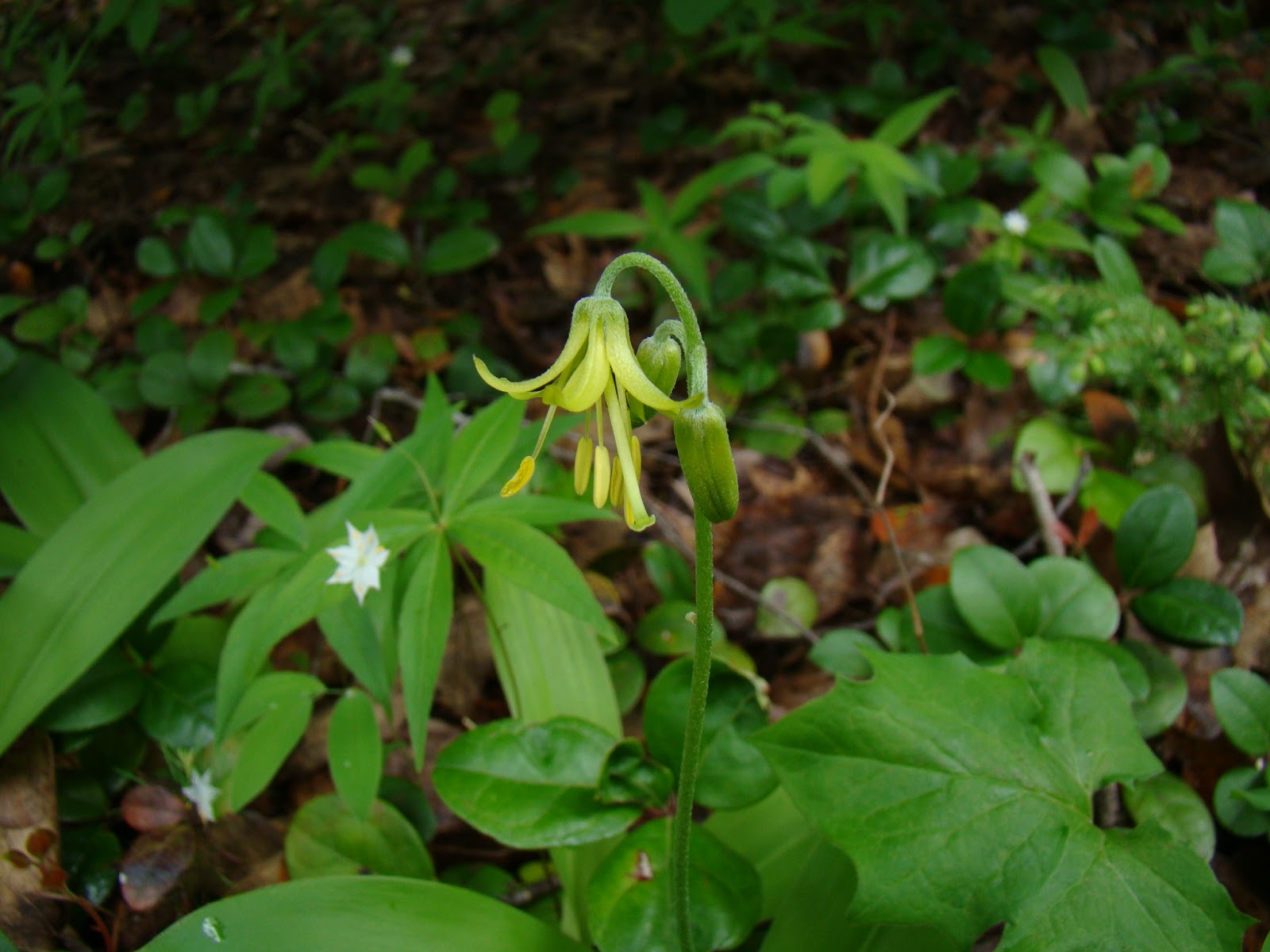
Bluebead Lilly
Eastern Starflower
Lady Slipper

I found some Striped Maple blooming also, up on the trail to Arbutus Hill Pond - a rather unusual flower on an interesting tree.

Striped Maple

The new animals for 2013 have started to arrive!  The first I've seen are the geese, which are as prolific as ever.  These two families were scouting around Oakland Cemetary on Saturday.


And young fox might be next.  I came across a pair of Red Fox in a meadow today.  When they saw me, one loped off slowly into the woods, but the other one sat motionless in the field.  Perhaps one was a decoy to lure me away from the den, while the other remained to protect the kits (which if there were any, I didn't see).  The sentry watched me for a long time, perfectly motionless.  After a while it started to rotate its ears like radar, with bits of black flashing from the back of its ears, but that was all that moved - maybe its tail twitched once or twice.  Keep an eye out for fox kits around the lake - they should have been born by now.  And maybe more fox will help keep the goose population in check - those little fluff-ball chicks would be easy prey for a fox!

We had another renowned fisherman come to pay tribute to Chuck Maul.  A cormorant perched on a fallen tree right in front of Chuck's house - a tree that Chuck had marked with a red buoy to warn others of the hazard.
Cormorant


We took another walk up to Meredith Center yesterday - the landscaping around the Grange looks good!  The door to the Grange was open, so we poked our noses in the door and met two of the people who have been putting in tremendous effort to restore the property.  They gave a us a great tour of the building and all the work they've done:  beautiful stone fireplace, freshly varnished original wood floor, office with the original ticket window, upgraded bathroom, and lots of historical items.  They even have the horse watering trough running with a fountain in it!
Fountain at Meredith Center

Who remembers weekly trips to Meredith Center to collect drinking water from the well years ago?

I put out my trail camera to see who is visiting these days, and found the usual characters:  Red and Gray Fox - plus Squirrels, Geese, etc, but no Deer.
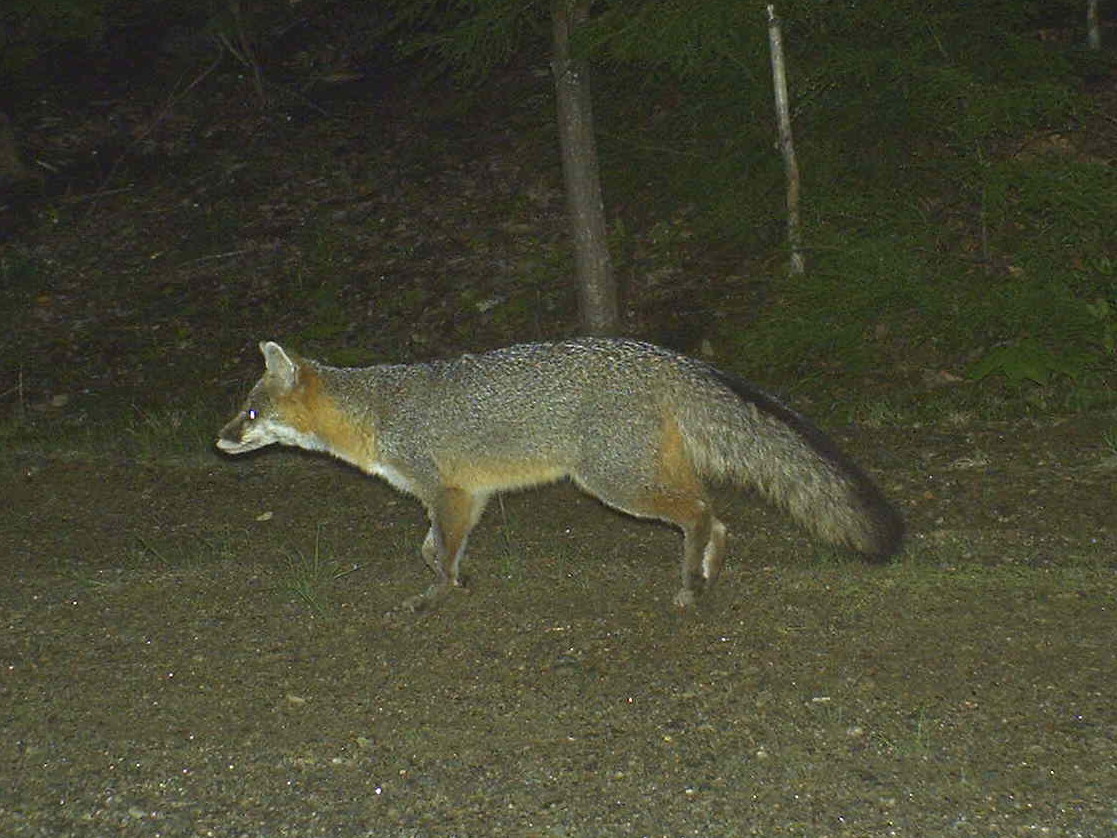
Gray Fox
The new laptop has a card reader in, so I looked at the pictures there rather than in my camera, and decided to go back through old pictures to clean out any useless images.  In the process, I found that my camera wasn't reading all of the pictures that had been taken - no obvious reason, but there were several the camera won't read, but the laptop will.  And going through them all, I discovered that, way back in 2010, I had captured a photograph of a Bobcat!  A picture I had never seen!
Bobcat - November 1, 2010

I have seen several tracks that I was nearly certain a bobcat had left in the snow, but never had 100 percent confidence until now, as the Bobcat is one the most secretive animals in the forest.  This is the first definite evidence I have had of bobcat at Lake Wicwas in 40 years!  And to think I almost missed it.  It is another example of the incredibly diverse ecosystem that surrounds our lake.  Those of you who have helped to protect this sanctuary should be proud of what you have realized.  It takes a lot of protected land to sustain animals such as Moose, River Otter, and Bobcat.

Sunday, May 19, 2013

May 19, 2013

Have you been sneezing this week?  Perhaps New Hampshire should endorse yet another season:  pollen season.  The crystal clear water we've enjoyed since the ice melted is now cloudy and thick with pollen.
Pollen on Lake Wicwas

If you look way up at the tops of the oak trees you will see long, dangling blossoms - hundreds of them - providing an idea of just how much pollen they release.  But all this pollen in Lake Wicwas probably serves as a food source for many small organism at the bottom of the food chain, in turn providing food for fish, amphibians, and birds of prey.

Yesterday, sitting on the deck on a calm evening, I heard a loud bird calling from the top of a tree, up where those oak blossoms are - a rather short, two-syllable, rising whistle that I didn't recognize.  I got the binoculars, but couldn't find it until it flew.  Then I could see it a bit, but it was way up in the tip top, and hard to get a good look, but it did look and behave like a flycatcher.  I got the laptop and went to my most trusted bird identification web site, the Cornell Lab of Ornithology.  Going to the section on flycatchers, I started playing their calls to see if I could identify it.  When I played the Great Crested Flycatcher call, I was pretty sure that was it.  But then I played some of its longer calls, and all of a sudden, the bird called back!  It sang the same calls playing on the computer!  I took that as a pretty good confirmation of its identity.  I played a couple more calls and each time it responded;  I then decided to leave it alone.  I never got a picture of it, but looking it up on line, I found that it eats a lot more than flies!
Great Crested Flycatcher (Credit Joe McDonald)

Did you see an article in the May 9th edition of the Meredith News about the Wicwas Grange?  It's getting a major renovation, and its membership has risen from seven to almost 100 over the past three years.  Today, walking up to the Center, we saw a bustle of activity as people and equipment were doing outside landscaping.  It's looking pretty nice!
Wicwas Grange

On the walk, we also saw a new spider:  A Nursery Web Spider. 
Nursery Web Spider (Pisaurina mira)


Like many spiders, the female carries it eggs in a sac, but when they are ready to hatch, she builds a nursery web for them.  The young hatch and grow through their fist molt in the safety of the web, while the mother stays close by to defend her nursery from attackers.  

We also enjoyed the Lilacs blooming all around Lake Wicwas this week. 
Lilacs near Meredith Center

There are some beautiful lilacs at the house on the corner of Dow Road and Meredith Center Rd, across from the Lakeland School.

I had one other new experience this week.  Walking along a path on a mostly calm day, I noticed a couple of puffs of smoke coming up from a juniper tree.  Stopping to watch, of course, I saw no more and wondered if it was my imagination.  So I blew a breath of air at the tip of a branch, and poof - a burst of smoke-like pollen dispersed flew into the air.
Common Juniper (Juniperus Communis) Releasing Pollen
It has been extremely dry again around the lake, with the pine needles and leaves stiff and brittle on the ground.  But as I write, it is raining, so the fire danger may recede, as will, hopefully, the agony of the allergy sufferers!


Saturday, May 11, 2013

May 11, 2013

Just in time for Mother's Day, mother nature is decorating Lake Wicwas with beautiful flowers of all sizes and colors.  In addition to the Painted Trillium I posted earlier, there are violets, both white (Canada Violet) and blue (Common Violet), Fringed Polygala, Goldthread, and Wild Strawberry.
Common Violet

Fringed Polygala

Goldthread

Wild Strawberry

Some trees are flowering, including the Hobblebush Viburnum and what appears to be a cherry tree , though it doesn't look like a native cherry tree.  It is right along the side of Chemung Road just north of the Wicwas boat ramp.
Hobblebush Viburnum

Cherry Tree?
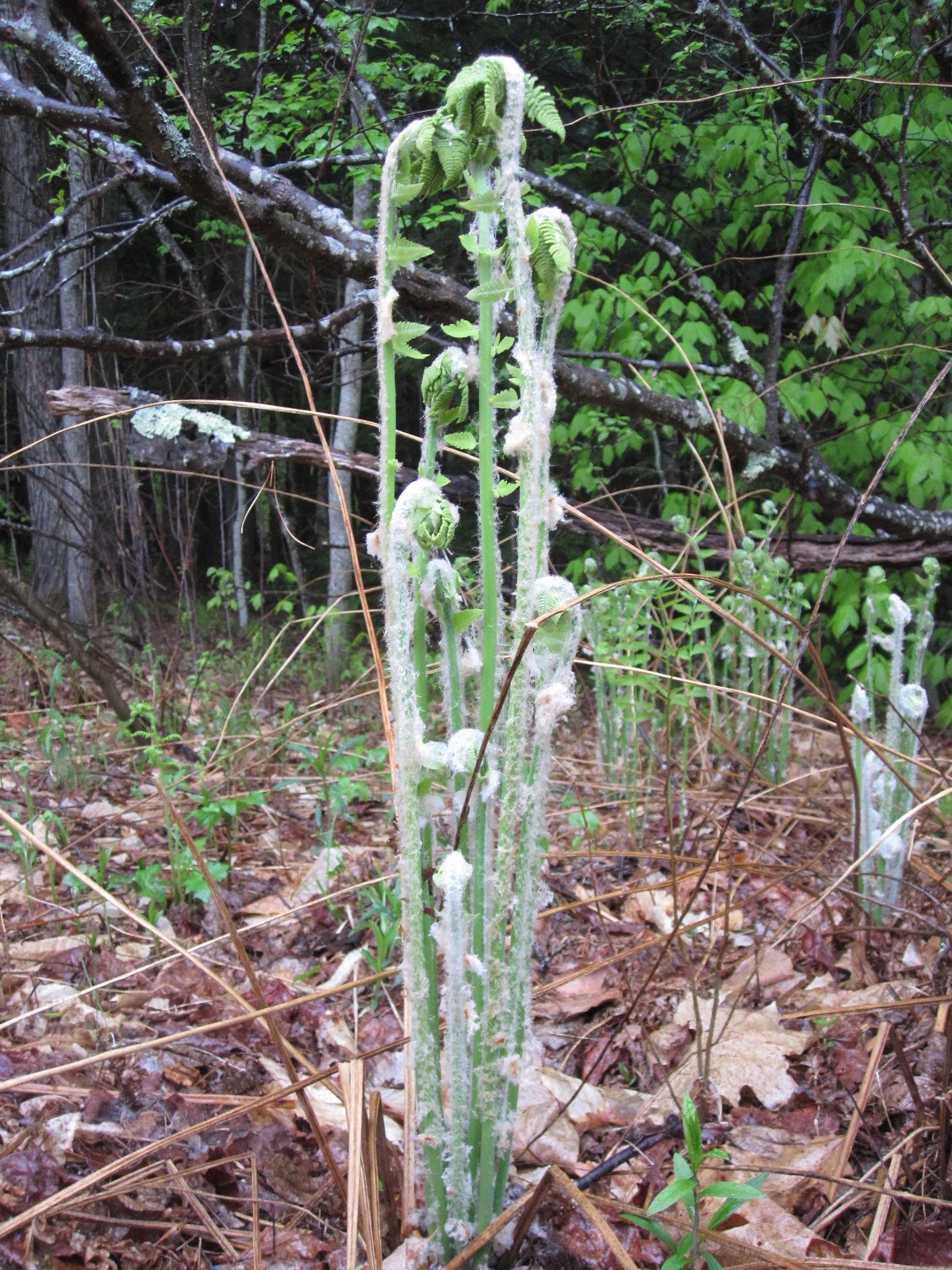
Various specious of ferns are unfurling all around the lake as well.


While I was in the Hamlin area, I found a dead Ringneck Snake right in the middle of the trail. 
Ringneck Snake


It is black on the top with a bright orange belly, and its markings show how it got its name.  It had no wounds or other signs of a battle, rather it appeared to be lying right where it would have been sunning itself.  It hadn't died very long before, as its body was still pliable and its eyes were clear.  Another mystery....

After a long stretch of beautiful weather, we finally had some needed rain on Saturday.  I was walking along in a light rain early in the morning and saw an animal swimming in the water.  It was immediately recognizable as not a beaver, as it didn't have the straight, bee-line path of the determined beaver.  Soon there was a second, and I watch two Otters playing in the lake for several minutes.  They were chasing each other, splashing and romping around, and generally enjoying themselves.  Eventually they disapeared along a shoreline, probably climbing up on the island.  It was too dark and they were too far a away to get any good pictures.
River Otters


And, just now, as I'm sitting here writing this at 8:10 pm, Linda said "look out the window"!  There, standing right in front of the house amid the blueberry bushes was a good size Moose!  Being a dark and rainy night, again, no hope for a decent picture, but here's the proof.
Moose


I hope it wasn't eating all those new blueberry blossoms!  It soon wandered off along the shoreline, sometimes moving very quickly, then just standing and watching - my guess is it detected our motion in the house.

Rainy days might not be much fun for us, but they seem to bring out the creatures.

Trillium

A quick post just in case anyone is at the lake this weekend and interested in seeing some Painted Trillium.  I found several blooming in near-proximity in the Hamlin area.  I have no concern with providing the location, knowing that people reading this blog would never pick such a unique flower.  You will find them on the yellow trail, a little more than half-way from the trail head to the junction where the yellow trail splits into the fork before Crockett's Ledge.  But, the insects are out, so bring your bug spray as well as your camera!  Happy hunting!

Painted Trillium

Sunday, May 5, 2013

May 5, 2013

Lake Wicwas has been enjoying a fabulous stretch of spring weather - days on end of warm, sunny days with crystal blue skies, followed by cold nights with very little humidity to keep the atmosphere warm.

Daily temperature swings of 40 degrees have been common, with lows in the 30s and highs well into the 70s.  There was someone out on a tube this afternoon, and I even saw someone swimming!

I didn't see as much bird activity this week, but the warm weather has encouraged the trees to push out their leaves.  The beech and maple are well on their way, with the oaks lagging behind as usual.

Beech
Maple

I love the interesting colors the leaves make when they first emerge. 

Scrub Oak (I think)


By next week the hills will have a pale-green tinge to them as the trees start to form chlorophyll.

There are now many Trailing Arbutus blooming;  I haven't seen any other wildflowers yet, though the Canada Mayflowers have sprouted.

Canada Mayflower (Wild Lilly of the Valley)
 And the blueberries have started their work in creating one of my favorite summer treats.
High Bush Blueberry
The lack of rain and the dam lowered in preparation of spring flooding has let the water level in the lake get very low.  With a board restored to the dam last week, it is rising again.

I don't know how long this weather can last, but it sure is nice while we have it.
Tubing on May 5th!

Sunday, April 28, 2013

April 28, 2013

This is what we need - the first spring wildflower at Lake Wicwas!
Trailing Arbutus (Mayflower)


I saw the first one, a Trailing Arbutus, on April 26 - right on its usual schedule even with the cold spring.

The lake is still seeing some cold mornings with frost forming,

April Frost

but even with the cold nights the lake is warming up - the temperature is nearing 50 degrees in shallow water near shore.  The water was extremely clear for my first kayak trip, though I didn't see much activity in the water, only a few fish and painted turtle.  I did see a single Sandpiper on a rocky shoreline;  perhaps it is a Spotted Sandpiper.

Sandpiper
This bird has some amazing camouflage.

We took a long walk up through the Hamlin/Eames/Smyth conservation area on Saturday, as I wanted to get one more hike in when one can walk slowly and enjoy the world before the attack of the insects.  Plus, this time of year, with the leaves off the trees, the visibility into the forest is so much better.  We saw deer and a red fox on our trip, and even found some ice left in the pools below the white mountain ledge.  It was a peaceful, serene walk, accompanied only by nature without a single human encounter.  The wealth and diversity of nature and beauty in this protected forest is truly a gift to be treasured.
The last Ice - on the Lower Ridge Red Trail

Around the lake, the birds are very active in their mating and territorial behavior.  The geese are the most noticeable, aggressively protecting "their" property.
Protecting its Property


The loons are much more proper and composed, but no less effective or determined in their mission, as this pair was firmly escorting an interloper out of a cove it had claimed as its own.
Loons Escorting an Interluder from their Cove
Today there was a solitary loon floating all afternoon and evening in our cove.  Perhaps it was the same one, looking for a mate to come along and find Lake Wicwas.  Could it be our new loon that hatched on the lake last summer?

There was a pair of pileated Woodpeckers performing a mating dance around an oak tree.
Pileated Woodpeckers
 

Last year there were two males portraying similar behavior, but this time it is one male and one female - the female indicated the lack of a red "mustache".

One calm, sunny morning just after sunrise there were several Song Sparrows out serenading their mates from the branches hanging over the lake.
Song Sparrow Singing in the Morning Sun


So as the last vestiges of winter dissipate from Lake Wicwas, new life is evident everywhere, bringing with it renewal and hope, even as we grieve what we have lost. I wasn't quite up to putting it in words last week, but when I saw the Osprey - also knows as a Fishhawk because it is one of nature's most proficient fishers - soaring over Bev and Chuck's house, presenting a fish in its talons, I couldn't help but think it was showing its respect to Lake Wicwas' greatest fisherman.