Showing posts with label Fringed Polygala. Show all posts

Sunday, May 18, 2025

May 18, 2025: One Big Loon

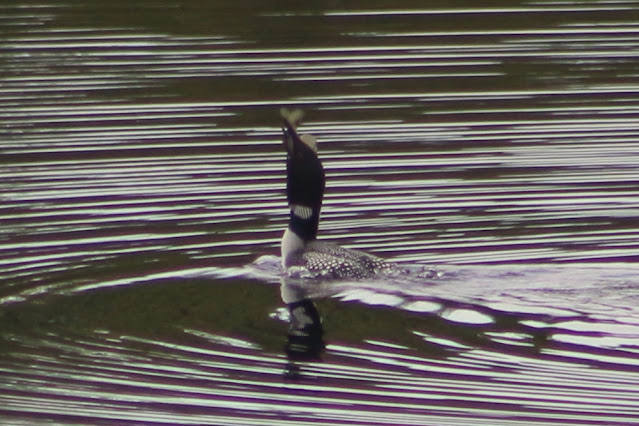
This week the banded male in the northern territory gave us a lesson on how it manages to stay strong enough to defend what is clearly a highly desirable breeding territory.  

Yup, he's going to swallow that whole.

We watched him catch and devour not one, but two huge fish.  Someone may be able to estimate the weight of these fish, but I expect each one accounted for a significant portion of his daily two-pound diet.  Here's the process he went through to get it down its throat after taking a good five minutes playing with it to weaken it enough to swallow.


At this point something wasn't going right and he coughed the fish back and started over again.

Getting farther down this time.

Swimming hard seemed to be part of the final swallowing process.

A big lump in that throat.

Almost down.

Always a big shake to get that neck bulge sent all the way down.

So that was a pretty good meal.  Two days later it was back in the same spot like any fisherman that returns to a spot where he once caught a big one.


This fish is also sliver with dark spots.  Are they Black Crappies?

I'll short cut the process this time, but it took just as long as before to accomplish the whole thing.


With plenty of fish in his belly he's got the energy he needs to keep up his weight and fight off the endless challenges on his territory.


In case you didn't catch the update to last week's journal, Lake Wicwas eventually crested over two feet above normal level, lapping over the edge of the dam.  Not the highest it's ever been, but close, and it's still about a foot higher than normal.  With three boards removed from the dam it's dropping at a rate of about 2" per day so without any more rain it will take another week before it's back to normal level.
Aren't fish supposed to swim under the dock?


We must be pretty close to a full complement of summer birds now.  Arriving this week were the Eastern Kingbird, Scarlet Tanager, and Great Crested Flycatcher.  The latter has a sharp call that's easy to recognize once you've learned it.  Wildflowers came on strong this week with the warm sunny days, and that green Lady's Slipper I found last week did in fact bloom.  
Pink Lady's Slipper

A few other flowers popped out as well including the Eastern Starflower and the Fringed Polygala.
Eastern Starflower

Fringed Polygala


We know "poly" means many, and this week I learned that "gala" means milk.  I also learned that's where the word "galaxy" comes from, originating as the "Milkyway Galaxy".  Though it looks like an orchid, this fringed polygala is a member of the Milkwork Family.  [Ref:  US Forest Service]  

Keep an eye for more flowers appearing on the forest floor in the next couple of weeks.


Friday, May 19, 2023

May 19, 2023: Woodland Wildflowers

I'm publishing early this week in case anyone wants to go out this weekend to look for woodland wildflowers.   Most of the deep-woods flowers are blooming now, and by next weekend they may be going by, depending on the weather.  One exception is the Lady's Slipper which usually doesn't bloom until late May, but you might get lucky and see an early bloomer this weekend.  Last week I noted I found a couple of trilliums blooming, but this week there were many to be found.

Painted Trillium

Several of the tiny white woodland flowers are also blooming, including the starflower and the goldthread.  

Starflower
Goldthread

There are still a few trailing arbutus around, but these, the earliest of the wildflowers, are mostly gone.  All of these deep-wood flowers take advantage of a narrow window of opportunity after the ground warms up, but before all the trees leaf out.  The bare branches of deciduous trees allow sufficient sun to reach the forest floor for these plants to collect enough energy to grow and flower before they are relegated to the dark shade of the forest.  They will continue to photosynthesize throughout the summer with what little light does reach them, but that short window is what really keeps them going.  

If your travels take you by more open sunny areas you're likely to see several other pretty blooms growing down at your feet.  Two violets, the sweet white and the common blue are in bloom now.
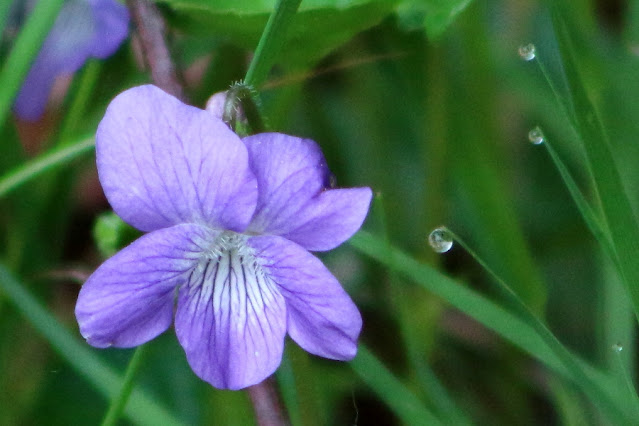
I love the perfect spheres of dew on the blades of grass,

Also down at ground level, wild strawberry are flowering, hoping to attract an early pollinator to let them set fruit for the birds later in the summer.

A future strawberry in the making.

Another fruit-bearer is blooming as well, and judging by the quantity of blossoms, it appears another good blueberry season might be in store for us.

Lots of blossoms have been set on the blueberry bushes.

Of course, this depends on sufficient rain coming during June and July, something we haven't seen in two weeks now.  

Bridging the borders between sun and shade is one of my favorite flowers, the fringed polygala, which can spread into large patches.

Fringed Polygala

I think it's the unusual color, somewhere between magenta and violet, that I find intriguing.  You might also see bluets and lily-of-the-valley blooming right now.

Lily-of-the-valley

The last flower I'll mention is a new one for me, and I had to work to determine what it is.  Though I found it on the forest floor, it's not one that blooms down low, but rather up high in the forest canopy.


I expected it was a flower from a tree, but which tree?  I found many of these flowers under hemlocks, but I knew that wasn't its host.  Eventually, by looking up flowers of the various trees that grow in our forests, I determined it's the flower of the American Beech; it perfectly fits the description of the male beech flower in the Audubon guide "Eastern Forests".  [Alfred A. Knopf, Inc, publisher, 1985]  The flowers are very light, and with the strong winds this week, they could have blown a long way.

The tiny flower of the mighty beech tree.

The variation in relative size between plant and flower that different species have developed is remarkable.  A trillium flower is about one third the height of a mature plant, while the flower of the American Beech is less than one one-thousandth of the height of a mature tree.

Moving on to the animals, I saw a couple of new bird arrivals this week, the American Redstart the Baltimore Oriole and the Chestnut-sided Warbler.
Chestnut-sided warbler.

These birds tell me that we're nearing the end of the migration, as these birds, based on my observations, are among the last to arrive.  I heard the oriole on the Wetland Loop Trail at Page Pond, high up in a tree with no chance to see it.  Chestnut-sided warblers flit around in the thickets of young successional forests, but its song is so loud you can easily track it, and if you watch long enough you can usually get a glimpse of him (it's always him that sings).  You're likely to see one along the Page Pond Field Trail at the Barnard Ridge Road trailhead.  Listen for its distinctive "Pleased, pleased, pleased to MEET you" song.

It can be hard to get past the bugs, but if you can, the sights and sounds of the forest are now reaching their spring climax.
Singing loudly to defend his territory.


Sunday, June 6, 2021

June 6, 2021: Loon Nesting Begins

June could be called flower appreciation month because of the magnificent diversity of wildflowers that can be found as we make the subtle transition from late spring to early summer.  In deep, cool forests with a full canopy as well as up at higher elevations, spring bloomers such as bluebead lily, trillium, lady's slippers, and fringed polygala are still hanging on.

Fringed Polygala

Bluebead Lily


In less shrouded areas that receive more sunlight, larger, more conspicuous blossoms such as lupine, lilac, and columbine are now adding their intense colors of red, violet, and blue to the forest palette.

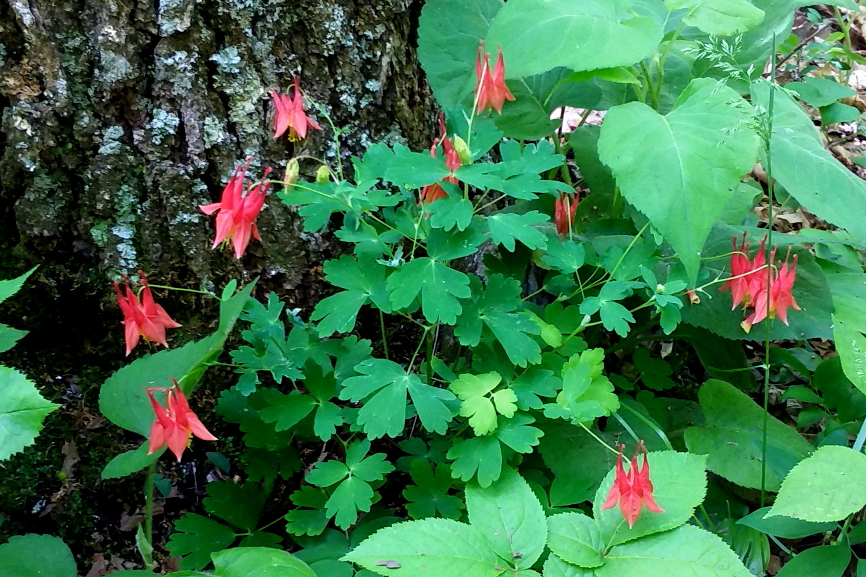
Columbine along the Mt. Roberts Trail in the Ossipee Mountains.

Lupine in a sunny spot.


And in intermediate areas - forested but with sunlight penetrating for part of the day - low-lying mid-summer flowers such as bunchberry and bluets are starting to perform.


Now on to the big stuff - as in big birds.  We've had regular sightings of eagles around the lake, both mature and immature (much to the distress of the loons) including this immature eagle that glared down on me one morning as I paddled around Bryant Island on Lake Wicwas.  

"I've got my eye on you."

But the eagles haven't stopped the loons from doing their thing.  On that same morning paddle I saw five loons including one group of three that were not pleased with each other.

The distrusting loon-dance.

A bunch of agitated birds.


The big hump on their head indicates stress, and these three circled each other round and round, none willing to take their eye off the others in fear of an attack from one of those 4" long sharp pointy beaks.  It's possible that one of the three was half of a mating pair, making sure the others stayed away from its nest, because later that day I got word of loon on a nest.

One pair of loons has gotten down to business.

Felix Puetsch discovered it.  He reported seeing loons that didn't dive or swim away as he was kayaking, but rather went ashore which is of course, unusual.  That's when he saw the nest with two eggs in it.  He commented on how close it was to the edge of the water, correctly noting that loons don't like to be on land because their legs are so far back on their body that they can barely walk.  

The nest is in a good location to be shielded from boat wakes which is important since a boat's wake can easily wash over a loon nest right on the edge of the lake.  But the nest is also very exposed, so signs have been placed near the nest to alert nearby boaters.  I'll leave it as an exercise for the reader to find the nest - just please stay well beyond the signs and move away quickly, especially if either loon shows signs of stress: the loon on the nest putting its head down low to hide, or the loon on the lake calling or making a display of itself.  If the loon leaves the nest for even a few minutes the eggs can become unviable, particularly if the weather is sunny or warm, as the eggs can overheat quickly.

If you'd like to learn more about how to enjoy the lakes without disturbing wildlife you may be interested in a webinar that NH Lakes is offering called "Enjoying Lakes while Protecting Wildlife".  More information can be found here.

It's not clear if this is the only nesting pair on the lake or not.  Two loons had been building a nest in another location on Wicwas but we don't know yet whether it's the same pair and they just changed their mind or whether it's a different pair.

A nicely built, then abandoned loon nest.

Maybe it's just a decoy!  If we get a look at a leg band we may be able to figure it out.

At any rate, nesting season has begun, and both we and the eagles will be watching eagerly to see what transpires.

Sunday, May 26, 2019

May 26, 2019: Pick your Season

It's that time of year where you can find whatever season you want in New Hampshire.  You can go to the beach on a warm May day, search for spring wildflowers in the forest, or head to the mountains for a bit of winter.
Snow pack at 4000' on Mt. Tripyramid

There are still two feet of snow even at the lower peaks in the White Mountains just 20 miles north of Meredith. 
Tree wells show the snow depth

As I hiked the loop trail over the tripyramids I found dozens of purple trillium in bloom around 1500 feet elevation, while higher up they were still developing.
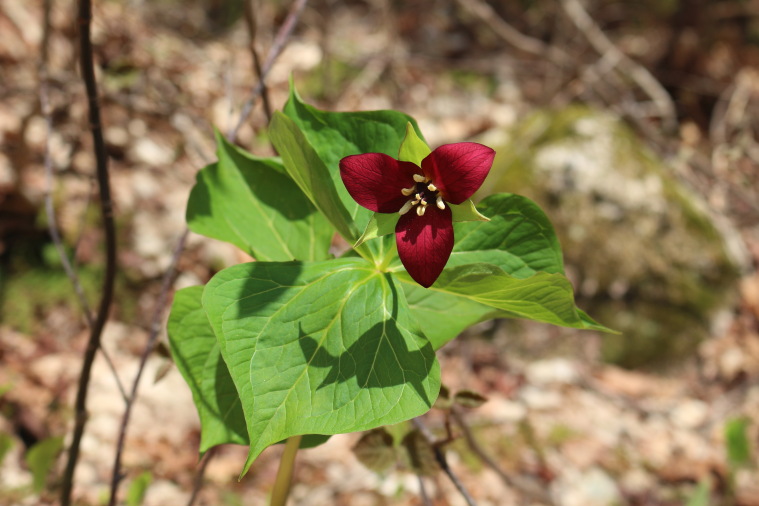
Purple Trillium

Around Lake Wicwas I see mostly painted trillium which are also blooming now, though I have seen some purple trillium on Meredith Neck.
Painted Trillium

There are also goldthread, fringed polygala, and many others booming now, as we are in peak spring wildflower season. 
The pretty and delicate Goldthread

Fringed Polygala

The polygala seem to be having a good year with large patches of them in many places - perhaps they enjoy the cool weather we've had.  With all the new vegetation available in the forest I haven't seen deer lately.  The does are probably eating well and staying hidden as they are getting close to birthing their young.  But many signs can be found so we know they're present.  Footprints of course are a definitive sign.
Deer footprints in sand along Chemung Rd.

But browse is also evident.
Black cherry browse at chest height

Deer don't leave a clean cut when they browse, as unlike rabbits which make a clean cut just like a knife, deer tear off the branches with their teeth.

Deer scat this time of year is often different from the small hard pellets one usually sees because the lush diet available now provides much more moisture than winter food.
Spring scat shows their changing diet

And finally, you might still find areas of dry leaves where the deer rustle around looking for acorns. 

I followed this path for a little bit looking for confirmation that it was deer (turkey and bear will also search for acorns among the leaves) which I found shortly.
Typical deer scat

This has a fall appearance to it, so I guess that closes the loop and means that you can find all four seasons right now!

Lastly, a reminder there will be a guided bird walk this coming Saturday, June 1st at Page Pond in Meredith.  Click here for details.  I'm hoping to see some new birds, maybe even a woodcock or a grouse!

And, I just heard that our eagle eye loon spotters have determined that the loons have nested!  I haven't seen the area yet, but our great team just put signs up this morning since it's in a high traffic area.  Please keep your distance - at least 150 feet away, and we'll hope for loon chicks in late June!