Showing posts with label Bluebead Lilly. Show all posts

Sunday, May 10, 2026

May 10, 2026: Spring Multimedia Show

In addition to the spring warbler invasion that's serenading us with the joyous sounds of nature, we're now being treating to an influx of visual beauty as spring flowers erupt everywhere.  It's nature's live, multimedia show in full 360 degree non-virtual reality!  Last week the tiny Trailing Arbutus provided the trailer with the first blooms in the forest, and this week, the main event is on, starting with a large and showy shrub on display throughout the Lakes Region.

Serviceberry (aka Shadbush)

Serviceberry is widely spread around lake shores as well road sides, especially in damp damp soils.  The tree above is in Chemung State Forest along Chemung Road.  

In sunny spots, violets are blooming, both the Common Blue and the Sweet White.

Common Blue Violet

Sweet White Violet

A walk through the field at Page Pond Town Forest revealed Wild Strawberry joining the cast as well.

Wild Strawberry

High up on the summit of Belknap Mountain, a lone elderberry bush was just starting to come on stage to display its purple flowers.

Red Elderberry

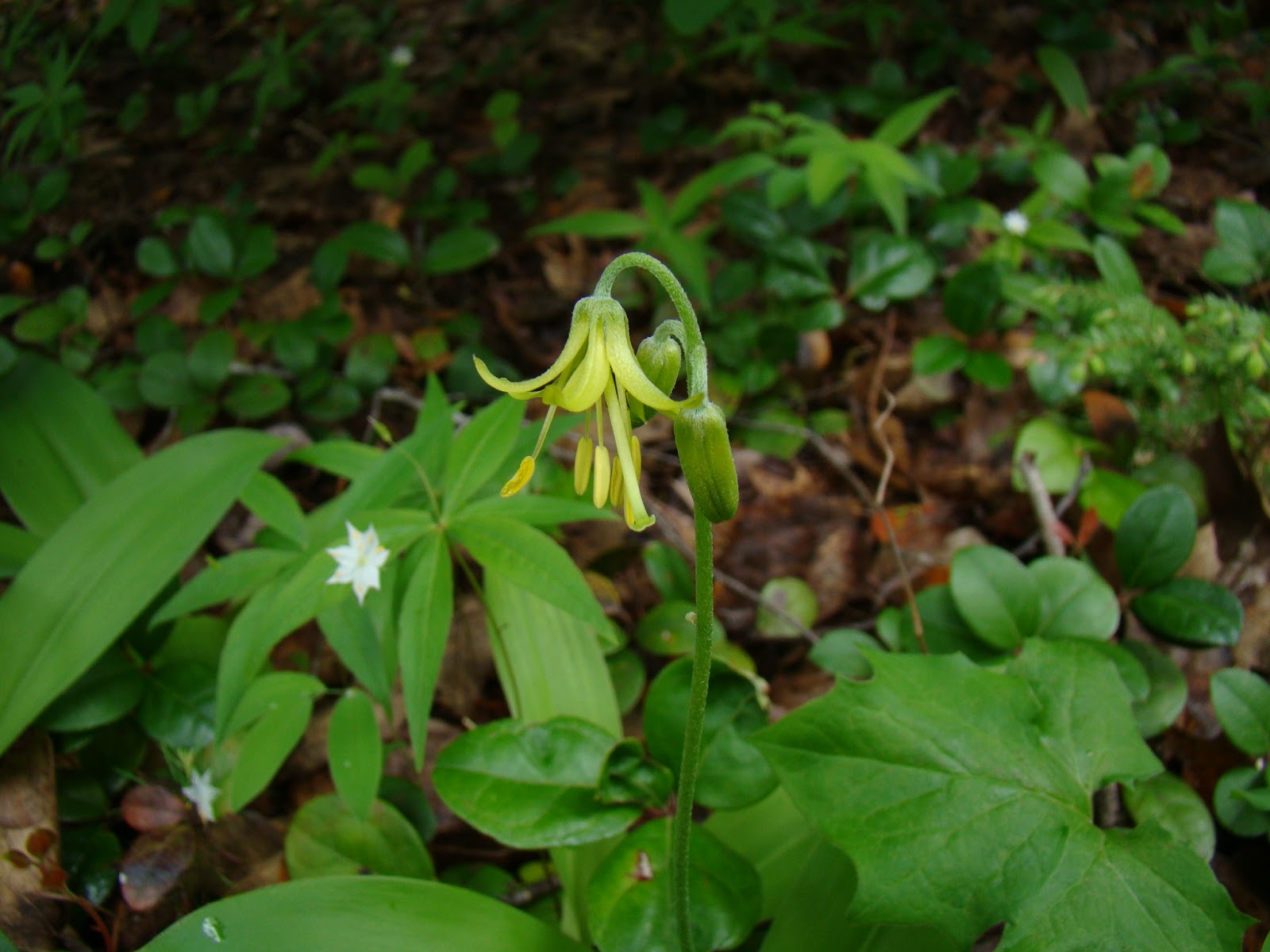
I've had reports of Bluebead Lily flowering, but in the Belknap Range, they weren't quite far enough along, at least as of Thursday.

Bluebead Lily about to bloom.

They are probably in bloom by now, because this is a magical time in the New Hampshire forest.  The days are long - over 14 hours between sunrise and sunset - but leaves aren't yet on the trees, so for a very short period, direct sunlight shines down onto the forest floor.  The woodland flowers thus have a brief window after snowmelt to sprout, photosynthesize, and put out flowers, before the curtain closes and they are immersed in deep shade for the next five months.  

There was a surprising guest appearance on my hike in the Belknap Range:

Red Eft

I didn't expect to see an eft this early in the year, especially on a cool and partly cloudy morning at elevation.  It was resting on an exposed piece of granite which was being warmed when the sun shone down around the clouds.


The sound track to accompany this week's multimedia presentation was provided by Black and White Warblers, Ovenbirds, Black-throated Green Warblers, Bluebirds, Common Yellowthroat, and many more.  I heard nine species in the Belknap Range, and I participated in a bird walk sponsored by the Meredith Conservation Commission at Page Pond Town Forest yesterday, where, under the expert guidance of Dan Mullarkey and Kelly Hanson, we observed 20 different species.  My favorite was the Yellow-bellied Sapsucker which we heard several times.

A Yellow-bellied Sapsucker seen on yesterday's bird walk at Page Pond.

Back on Wicwas we had a huge flock of Yellow-rumped Warblers at the lake for several days, feeding on caterpillars on the trees.  

Yellow-rumped Warbler on a broken maple branch at Lake Wicwas

There are also dozens of Tree Swallows zooming all around the water picking off insects on the wing.  They are too fast for me to capture their acrobatics, but our pair of Eastern Phoebes gave me nice show right at the house. 


Spring is in full swing now, and there will be many more birds and blooms to look for in the coming weeks!

                                                     
  Happy Mother's Day!  


Sunday, June 11, 2023

June 11, 2023: Fern Weather

A stretch of cool, damp weather is just what ferns and other wetland-dwelling plants love, so they were in their element this week.

Cinnamon Fern (Osmundastrum cinnamomeum)

The cinnamon fern is identifiable by its distinctive cinnamon-colored central fronds that grow straight up, surrounded by large green fronds, both of which can grow up to five feet high in fertile wetlands.  When these ferns emerge in spring as fiddleheads they resemble the edible ostrich fern, but cinnamon fiddleheads have a white, fuzzy covering over them.

Don't eat fiddleheads that have this white, fuzzy covering.

In comparison, ostrich ferns have a thin, brown, papery covering.  Even the edible ostrich fern can contain toxins, but not enough to cause problems.  The cinnamon fern has sufficient toxins that if eaten can cause nausea and other symptoms.  

The Jack-in-the-Pulpit is often found in cultivated gardens, but it also grows wild in the Lakes Region.  I found this one at the edge of a drainage ditch along a dirt road.  It took me a minute to figure out why it didn't look quite right:  its leaves had been chomped off by a deer.

Jack-in-the-pulpit (Arisaema triphyllum)
Note the bare stalks where the leaves have been eaten off the top.

Another plant that favors cool and damp is the false Soloman's seal.

False Soloman's Seal (Maianthemum racemosum)

Later in the summer the pretty white flowers will produce deep-red berries which are edible, but with a large pit and little flesh, they're not worth much more than a sample of one or two as you pass them by.


One more spring flower blooming now is the bluebead lily.


These will have large, blue berries in mid-summer, but they are not edible.

Thanks to Amy Wilson's good eye, we finally confirmed that the female of the loon pair that nests in Harris Cove has returned.  Reports are that the pair continues to poke around the islands looking for a safe place to build a nest but still hasn't settled on a site.  The Loon Preservation Committee biologist visited Wicwas again this week and confirmed that all is well on the northern nest.  

One of the Harris Cove loons caught itself a really nice meal one morning.

A fish this size might be a whole meal.

It had to spend several minutes beating it up enough to dare to swallow it.

A loon doesn't want a fish this large flailing around in its gullet.

It looks to me like the fish was a black crappie.


That's a favorite pan fish for humans too!


Sunday, June 12, 2022

June 12, 2022: Lupine Time

We did get up to Sugar Hill this week and the lupines are putting on a fine show this year.

Lupine (Lupinus perennis)

So fine in fact that a painting class was taking place in the upper field where Cannon Mountain and the Lafayette Range set the background for the artists.


I think the lower field was the most spectacular I've ever seen it, awash in deep blue and purple with the occasional burst of pink or white sprinkled here and there.


It's always worth the drive up through Franconia Notch in Lupine season, but I also found mountain color closer to home.  On a hike to Mt. Shaw in the Ossipee Range I found several flowers in bloom including lady's slippers around 2000' elevation.  But the most interesting find was a plant that grows in dry, acidic soils as found in rocky granite outcroppings at high elevations.
Cinquefoil
I think this is three-toothed cinqufoil growing in the cracks and crevises in the granite which helps to break down the rock over time.


Granite ledges in the Ossipee Range with Lake Winnipesaukee and the Belknap Mountains in the background.

  Other flowers seen along the trail included bunchberry and bluebead lily.

Bluebead lily (Clintonia borealis)

Bunchberry (Cornus canadensis)

Later this summer bunchberry will have many small red berries while bluebead lily will have large - you guessed it - blue berries.

I also came across a towering birch tree right beside the High Range Trail which New Hampshire forester Dan Stepanauskas identified for me as yellow birch and estimated it at over 250 years old. 

An ancient yellow birch in the Ossipee Mountains

The mountains aren't claiming all the beauty though, as there is plenty to be found down at lake level.
Larger blue flag (Iris versicolor)
These wild irises grow in marshes and wet shorelines all around lake.  

One more lake flower I'll share is this wild cranberry viburnum I found growing on Sheep Island:
Cranberry Viburnum (Viburnum trilobum) also called highbush cranberry

I'll end with an update on the loon picture which remains fluid.  As far as I can tell the banded pair is still tending to a nest though I often see both loons together far away from the nest.  Band sightings indicate it is the nesting pair.  But I also believe a second pair of loons is working on a nest in another part of the lake.  I've seen two loons near the island where a pair successfully raised a chick ("Justin Time") in 2018.  One loon observer has seen them bringing nesting materials from the bottom of the lake to the island, and one day when I was near the island a loon popped up right next to my kayak, acting as a decoy to draw me away from the island, which I immediately did, but still managed to get perhaps the closest look at a loon I've ever had.


There have been reports of a possible fifth loon on the lake.  It could be an interesting summer.


Sunday, June 6, 2021

June 6, 2021: Loon Nesting Begins

June could be called flower appreciation month because of the magnificent diversity of wildflowers that can be found as we make the subtle transition from late spring to early summer.  In deep, cool forests with a full canopy as well as up at higher elevations, spring bloomers such as bluebead lily, trillium, lady's slippers, and fringed polygala are still hanging on.

Fringed Polygala

Bluebead Lily


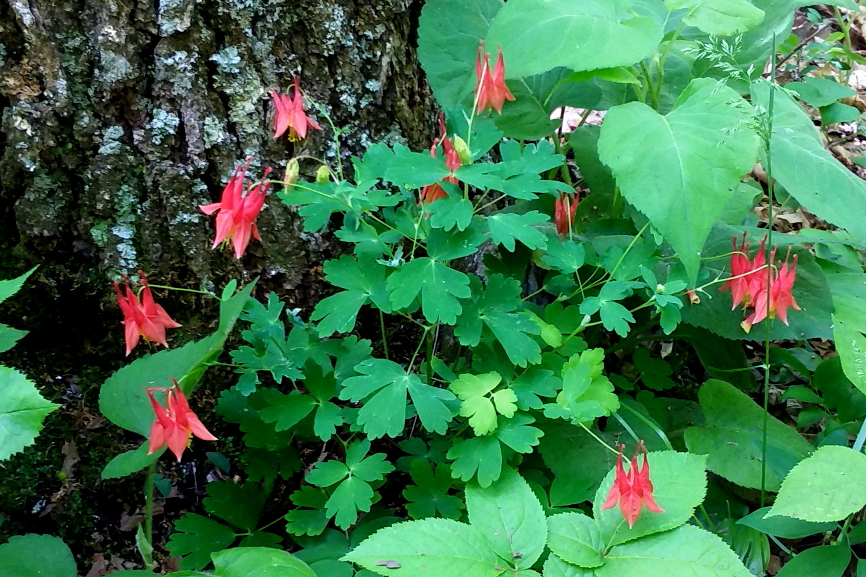
In less shrouded areas that receive more sunlight, larger, more conspicuous blossoms such as lupine, lilac, and columbine are now adding their intense colors of red, violet, and blue to the forest palette.

Columbine along the Mt. Roberts Trail in the Ossipee Mountains.

Lupine in a sunny spot.


And in intermediate areas - forested but with sunlight penetrating for part of the day - low-lying mid-summer flowers such as bunchberry and bluets are starting to perform.


Now on to the big stuff - as in big birds.  We've had regular sightings of eagles around the lake, both mature and immature (much to the distress of the loons) including this immature eagle that glared down on me one morning as I paddled around Bryant Island on Lake Wicwas.  

"I've got my eye on you."

But the eagles haven't stopped the loons from doing their thing.  On that same morning paddle I saw five loons including one group of three that were not pleased with each other.

The distrusting loon-dance.

A bunch of agitated birds.


The big hump on their head indicates stress, and these three circled each other round and round, none willing to take their eye off the others in fear of an attack from one of those 4" long sharp pointy beaks.  It's possible that one of the three was half of a mating pair, making sure the others stayed away from its nest, because later that day I got word of loon on a nest.

One pair of loons has gotten down to business.

Felix Puetsch discovered it.  He reported seeing loons that didn't dive or swim away as he was kayaking, but rather went ashore which is of course, unusual.  That's when he saw the nest with two eggs in it.  He commented on how close it was to the edge of the water, correctly noting that loons don't like to be on land because their legs are so far back on their body that they can barely walk.  

The nest is in a good location to be shielded from boat wakes which is important since a boat's wake can easily wash over a loon nest right on the edge of the lake.  But the nest is also very exposed, so signs have been placed near the nest to alert nearby boaters.  I'll leave it as an exercise for the reader to find the nest - just please stay well beyond the signs and move away quickly, especially if either loon shows signs of stress: the loon on the nest putting its head down low to hide, or the loon on the lake calling or making a display of itself.  If the loon leaves the nest for even a few minutes the eggs can become unviable, particularly if the weather is sunny or warm, as the eggs can overheat quickly.

If you'd like to learn more about how to enjoy the lakes without disturbing wildlife you may be interested in a webinar that NH Lakes is offering called "Enjoying Lakes while Protecting Wildlife".  More information can be found here.

It's not clear if this is the only nesting pair on the lake or not.  Two loons had been building a nest in another location on Wicwas but we don't know yet whether it's the same pair and they just changed their mind or whether it's a different pair.

A nicely built, then abandoned loon nest.

Maybe it's just a decoy!  If we get a look at a leg band we may be able to figure it out.

At any rate, nesting season has begun, and both we and the eagles will be watching eagerly to see what transpires.

Sunday, May 26, 2013

May 26, 2013

A rather miserable Memorial Day Weekend at Lake Wicwas.  Cold, windy, rainy - there was even a little snow in the air last night, as the temperature hovered only a few degrees above freezing.  It was a little better today with some sun, but still cold and windy;  let's hope for better tomorrow.  With all the rain the past few days, the lake level rose a full twelve inches, from two inches below full, to ten inches above!  Let's hope things settle down so the loons can find a safe nesting site.

There are several more wild flowers blooming around the lake now, including Bluebead Lilly, Star Flower, and Lady Slippers. 
Bluebead Lilly
Eastern Starflower
Lady Slipper

I found some Striped Maple blooming also, up on the trail to Arbutus Hill Pond - a rather unusual flower on an interesting tree.

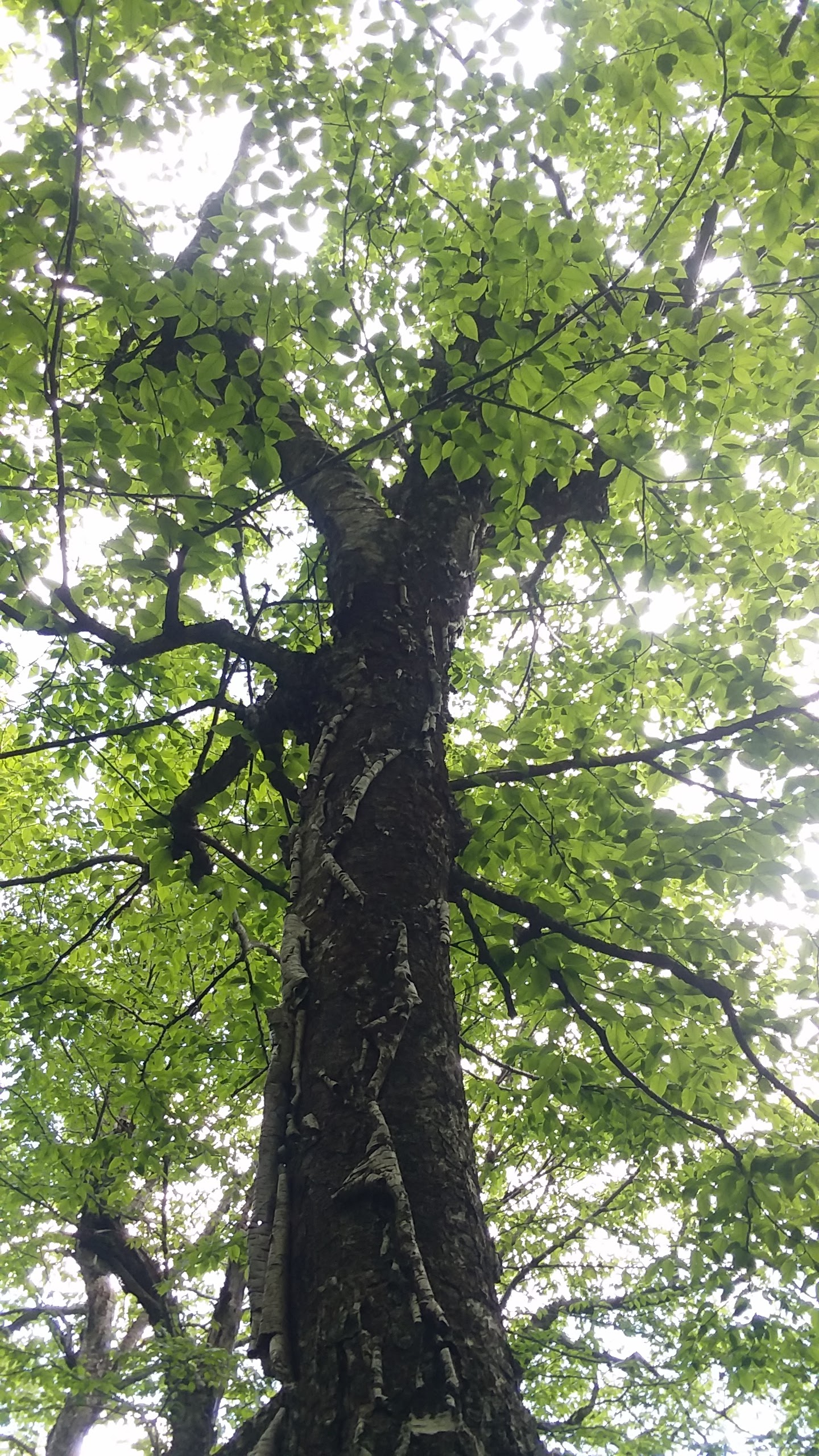
Striped Maple

The new animals for 2013 have started to arrive!  The first I've seen are the geese, which are as prolific as ever.  These two families were scouting around Oakland Cemetary on Saturday.


And young fox might be next.  I came across a pair of Red Fox in a meadow today.  When they saw me, one loped off slowly into the woods, but the other one sat motionless in the field.  Perhaps one was a decoy to lure me away from the den, while the other remained to protect the kits (which if there were any, I didn't see).  The sentry watched me for a long time, perfectly motionless.  After a while it started to rotate its ears like radar, with bits of black flashing from the back of its ears, but that was all that moved - maybe its tail twitched once or twice.  Keep an eye out for fox kits around the lake - they should have been born by now.  And maybe more fox will help keep the goose population in check - those little fluff-ball chicks would be easy prey for a fox!

We had another renowned fisherman come to pay tribute to Chuck Maul.  A cormorant perched on a fallen tree right in front of Chuck's house - a tree that Chuck had marked with a red buoy to warn others of the hazard.
Cormorant


We took another walk up to Meredith Center yesterday - the landscaping around the Grange looks good!  The door to the Grange was open, so we poked our noses in the door and met two of the people who have been putting in tremendous effort to restore the property.  They gave a us a great tour of the building and all the work they've done:  beautiful stone fireplace, freshly varnished original wood floor, office with the original ticket window, upgraded bathroom, and lots of historical items.  They even have the horse watering trough running with a fountain in it!
Fountain at Meredith Center

Who remembers weekly trips to Meredith Center to collect drinking water from the well years ago?

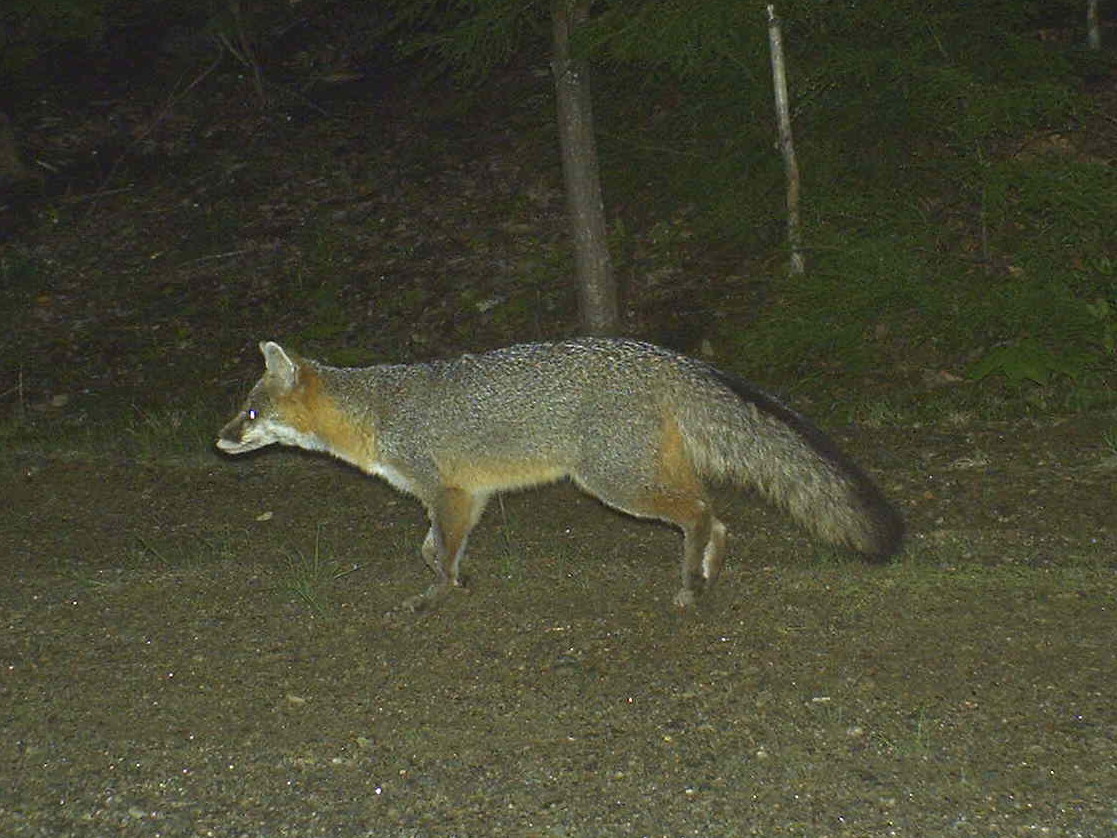
I put out my trail camera to see who is visiting these days, and found the usual characters:  Red and Gray Fox - plus Squirrels, Geese, etc, but no Deer.

Gray Fox
The new laptop has a card reader in, so I looked at the pictures there rather than in my camera, and decided to go back through old pictures to clean out any useless images.  In the process, I found that my camera wasn't reading all of the pictures that had been taken - no obvious reason, but there were several the camera won't read, but the laptop will.  And going through them all, I discovered that, way back in 2010, I had captured a photograph of a Bobcat!  A picture I had never seen!
Bobcat - November 1, 2010

I have seen several tracks that I was nearly certain a bobcat had left in the snow, but never had 100 percent confidence until now, as the Bobcat is one the most secretive animals in the forest.  This is the first definite evidence I have had of bobcat at Lake Wicwas in 40 years!  And to think I almost missed it.  It is another example of the incredibly diverse ecosystem that surrounds our lake.  Those of you who have helped to protect this sanctuary should be proud of what you have realized.  It takes a lot of protected land to sustain animals such as Moose, River Otter, and Bobcat.