Showing posts with label Gray Fox. Show all posts

Sunday, September 13, 2026

September 13, 2026: Beech Leaf Disease

Before we look at Beech Leaf Disease let's get an update on our loon chick, Pip.

Pip looks large when alone, but seen next to an adult, still has more growing to do.

Pip spends a lot of time alone these days, though at least one parent - probably the female - is still on the lake.  At this point, the tides have turned:  instead of Pip floating on the surface while mom fishes, it's now Pip that spends most of the time diving while mom soaks up the warm September rays.  I have to assume that Pip is successful with many dives, but still petitions mom for food when they're together.

I learned from the Loon Preservation Committee's most recent newsletter that juvenile loons are considered fledged when their primary (flight) feathers have grown to the point they can fly, which occurs at 11 to 13 weeks of age.  Thus our northern pair has now successfully fledged another loon, though I haven't observed Pip flying yet.


Pip will most likely remain on the lake into November or even December.

Now to beech leaf disease.  On a visit to the Hamlin-Eames-Smyth town forest last week, I came upon a large infestation of the nematode that causes beech leaf disease (BLD). 

Leaves affected by the BLD nematoad.

BLD is an invasive species believed to have its origin in Asia.  It was first detected in North America in Ohio in 2012 and made its way to New Hampshire by 2022.  It has now progressed as far north as Woodstock.  The nematodes enter leaf buds in the summer and fall, and the damage appears the following year when in the leaves exhibit dark bands between the veins.  It's most obvious when viewed from below with a bright sky above. 

Infested trees often die in 3-5 years, with larger trees surviving longer.  If New Hampshire loses its beech trees as currently expected, it will be a huge loss to the forest and the wildlife, especially having already lost the American Chestnut in the 1950s, which used to be the primary food source in eastern forests.  Today, beech is an important mast crop for many animals; it also provides excellent nest cavities in their sturdy trunks which can stand in the forest for years.  You can read more about BLD in this article by the UNH Extension Service.

Now let's move on to more pleasant sights seen this week, including fall wildflowers.

New England Asters


Asters, goldenrod, woodland sunflowers, and many other fall plants are important food for pollinators for their winter survival.
Woodland sunflower with a honeybee, which is not a native insect.

Nodding Ladies Tresses

Bumblebee on Goldenrod

And how about this great photo of a Gray Fox a friend and colleague from my working days at BAE Systems sent me:


He captured this photo with a trail camera, and it looks like a couple of this adult's offspring came back at night to romp around the area.

Thank you JH for sharing these!

I'll close with another video, this one of a bumblebee working the goldenrod.

The animals are starting to build up their reserves for the coming winter!


Sunday, April 2, 2023

April 2, 2023: Caught the Otter

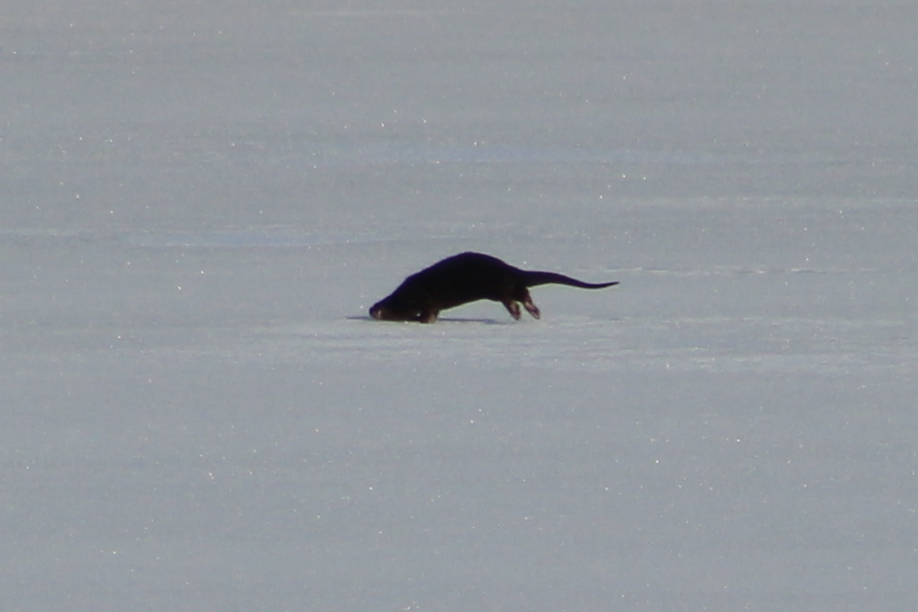
This week I caught a river otter on Lake Wicwas.  Not in the literal sense, but caught on film - well, silicon.  Earlier in the week I saw a bobcat bounding across the lake after being startled by a human.  It was way too fast to be able to catch.  But the otter was just lazily hopping and sliding across the ice, so I had time to pick up a camera and click some photos.  It was having great fun out there on the ice - it would take a couple of hops to get up some speed, 


then put its nose down on the ice, 


give a push with its strong hind legs and slide along on its belly for a few feet.


Then jump up, hop, and repeat. 

All told it took less than a minute before it slid up to an island where it disappeared down through a hole and under the ice.  And speaking of ice, there is still a lot of it.  I saw that Lake Winnisquam has much open water, but Meredith Bay is just starting to open up, and Waukewan and Wicwas still have only small gaps along sunny edges - of which the otters take advantage.

The few open spots freeze back over on cold nights.

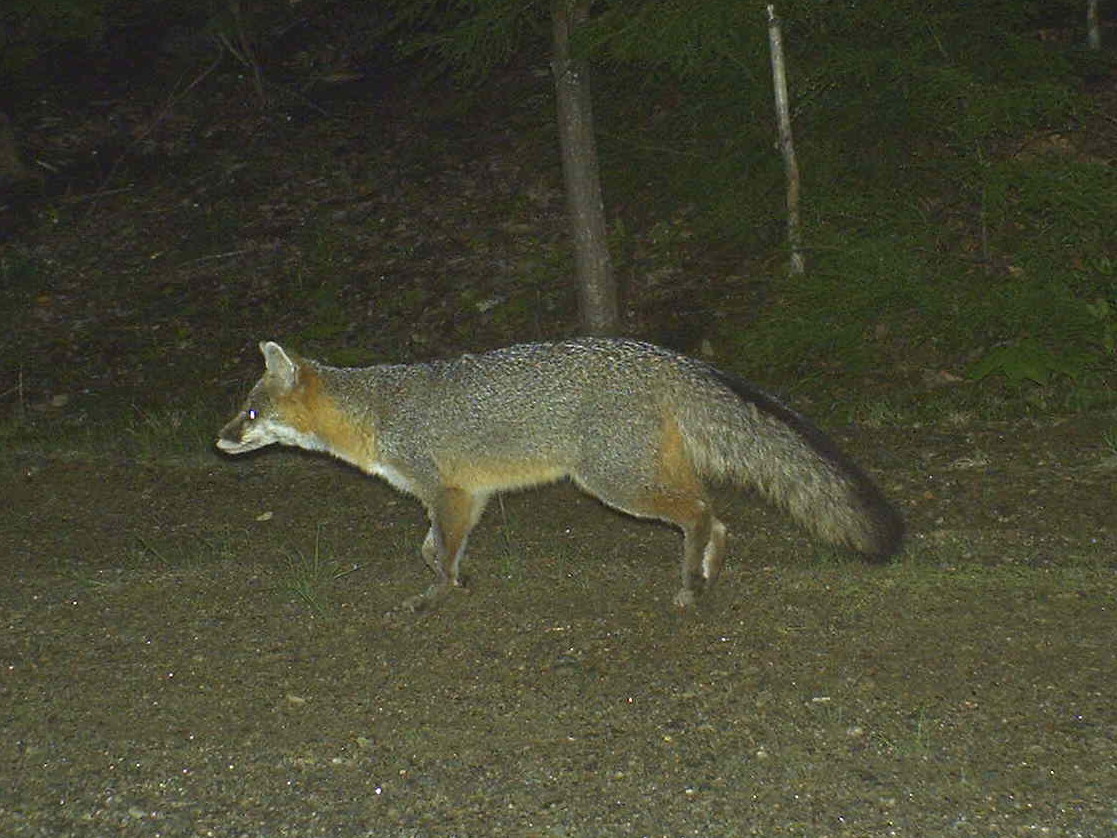
There is plenty of ice for all the animals to travel on, including this pretty gray fox that walked by my trail camera one night.

It just simply skirted around that open hole to continue its path along the shoreline looking for a midnight meal (this was 2:12am).  At night it's probably looking for mice.  During the day there are lots of squirrels around both red and gray, and those are probably what the bobcat is hunting.

There is lots of snow and ice, but signs of spring are becoming abundant.  This week I saw a pair of buffleheads at the dam, three black ducks in a bit of open water along Chemung Road, and lots of turkey vultures soaring all around the Lakes Region.  A flock of dark-eyed juncos (aka snowbirds) arrived with yesterday's snow, just as their nickname warrants.  

Dark-eyed junco

Coming up from digging in the new snow with a bill full of seed.

Yes, more snow yesterday,
Saturday morning.

while three days earlier it was spring even up in the mountains.  

Mt. Lincoln from Little Haystack.

Though it might not appear that way, it was beautiful warm spring day.

Rime ice coats stunted spruce at the tree line.

Winter-spring-winter-spring - on rages the battle even as we move into April.
The Presidential Range all dressed in white.


Sunday, December 18, 2016

December 18, 2016

If you live pretty much anywhere north of Florida you know that winter hit hard this week.  Temperatures here in the Lakes Region were below zero and we had a couple of storms come through, bestowing fabulous light powder upon us. 

But then today it all was spoiled by a dose of rain and freezing rain last night. 

In New England, one has to take advantage of good weather when one can, so after the first snow I got right out for a quick ski on gentle terrain to enjoy the conditions.
First XC ski of the season

The very next day, I saw that a gray fox had already found my tracks and took advantage of them for ease in his winter travel.

He also blazed a prominent spot to mark his territory (that's why I assume it's a male).

A fox marks its spot
I only say it's the gray fox because I've seen one in that area many times. 

My friend the mink from a couple of weeks ago was back out running around, but this time on top of the lake rather than in it.
Mink tracks tracing the shoreline for the better part of a mile
 Here it snuffled around a hole in the bank, following the scent of something to eat:


A short squall had left the thinnest layer of dry snow on the ice which made a great substrate for prints.
A near perfect set of mink tracks

I've only ventured out a few feet on the ice in coves where it froze up quite a while ago - in those locations it is already 4" thick - but I'm giving the wider lake more time before I'll consider it safe. 

Well after those protected coves froze over, a strange hole opened up and was bubbling away like a hot spring at Yellowstone. 

Watch the short video clip:

I don't know the cause of this - perhaps a warm spring in the bottom of the lake?

Lake Wicwas is frozen over but Winnipesauke has a long way to go, and the northwest wind blows the mist coming off the water down Meredith Bay on cold mornings.

These are pretty times here, when the cold and snow arrives in New Hampshire.

Sunday, January 19, 2014

January 19, 2014

The most tantalizing aspect of using my trail camera is the mystery of what I might find when I retrieve it and down-load a set of new images.  Most of the time I haven't capture anything extraordinary, but I usually get a least one or two interesting pictures - and I always learn something about the animal life, even if it's just that they aren't active, at least in my chosen location. 

Knowing we would have warm weather and a full moon, I set my camera out for a few days last week to see who was in the neighborhood. As is often the case, the Gray Fox came by a couple of times, once on the 13th and once on the 15th, both times traveling in the same direction. 
13 January at 4:51am

 I'm always excited to see this magnificent animal in the area, with its thick winter coat and beautiful colors. 
15 January at 5:57am

But then I moved onto the next image and beheld one of the greatest shots I've ever gotten:


Breakfast!

A good-size Fisher Cat carrying a large Gray Squirrel home for breakfast!  A few weeks ago (see December 22 post) I followed Fisher tracks around Lake Wicwas, and I knew one was in the local area because I had seen its scat.  But I have never got a picture of one, probably because they take such varied paths from tree to tree in their search for food.  My guess is that after getting such a large meal, this one was happy to take the shortest route back to its den to either eat or store its bounty for later. 

The picture was taken at 6:45 am, before sunrise when it is still quite dark;  I don't see squirrels out this early, so the fisher had probably found the squirrel's nest in one of its trips up an oak tree.  (This time of year it is pretty easy to see the ball of leaves that form a gray squirrel's nest high up in an oak tree.)  At any rate, there will be one less squirrel under the bird feeder this week.

We had a beautiful, light snowfall on Saturday night, which greatly enhanced the scenery around Lake Wicwas - it was getting a little drab after the recent thaw.

And this morning, the squirrels were back searching for food under the new snow.  (Though I only saw one gray squirrel!)  With a layer of crusty snow and ice on the bird feeder baffle, one clever red squirrel found a way to climb up and mount an attack on the feeders. 

Linda enjoyed the ensuing display of creativity and acrobatic ability.


You have to appreciate their drive for sustenance! 

I hope all the animals managed to get a good supply of fat and protein to store up, as the weather is now forecast to return to a prolonged stretch of deep freeze!  We'll see if it will surpass the last one....

Sunday, May 26, 2013

May 26, 2013

A rather miserable Memorial Day Weekend at Lake Wicwas.  Cold, windy, rainy - there was even a little snow in the air last night, as the temperature hovered only a few degrees above freezing.  It was a little better today with some sun, but still cold and windy;  let's hope for better tomorrow.  With all the rain the past few days, the lake level rose a full twelve inches, from two inches below full, to ten inches above!  Let's hope things settle down so the loons can find a safe nesting site.

There are several more wild flowers blooming around the lake now, including Bluebead Lilly, Star Flower, and Lady Slippers. 
Bluebead Lilly
Eastern Starflower
Lady Slipper

I found some Striped Maple blooming also, up on the trail to Arbutus Hill Pond - a rather unusual flower on an interesting tree.

Striped Maple

The new animals for 2013 have started to arrive!  The first I've seen are the geese, which are as prolific as ever.  These two families were scouting around Oakland Cemetary on Saturday.


And young fox might be next.  I came across a pair of Red Fox in a meadow today.  When they saw me, one loped off slowly into the woods, but the other one sat motionless in the field.  Perhaps one was a decoy to lure me away from the den, while the other remained to protect the kits (which if there were any, I didn't see).  The sentry watched me for a long time, perfectly motionless.  After a while it started to rotate its ears like radar, with bits of black flashing from the back of its ears, but that was all that moved - maybe its tail twitched once or twice.  Keep an eye out for fox kits around the lake - they should have been born by now.  And maybe more fox will help keep the goose population in check - those little fluff-ball chicks would be easy prey for a fox!

We had another renowned fisherman come to pay tribute to Chuck Maul.  A cormorant perched on a fallen tree right in front of Chuck's house - a tree that Chuck had marked with a red buoy to warn others of the hazard.
Cormorant


We took another walk up to Meredith Center yesterday - the landscaping around the Grange looks good!  The door to the Grange was open, so we poked our noses in the door and met two of the people who have been putting in tremendous effort to restore the property.  They gave a us a great tour of the building and all the work they've done:  beautiful stone fireplace, freshly varnished original wood floor, office with the original ticket window, upgraded bathroom, and lots of historical items.  They even have the horse watering trough running with a fountain in it!
Fountain at Meredith Center

Who remembers weekly trips to Meredith Center to collect drinking water from the well years ago?

I put out my trail camera to see who is visiting these days, and found the usual characters:  Red and Gray Fox - plus Squirrels, Geese, etc, but no Deer.

Gray Fox
The new laptop has a card reader in, so I looked at the pictures there rather than in my camera, and decided to go back through old pictures to clean out any useless images.  In the process, I found that my camera wasn't reading all of the pictures that had been taken - no obvious reason, but there were several the camera won't read, but the laptop will.  And going through them all, I discovered that, way back in 2010, I had captured a photograph of a Bobcat!  A picture I had never seen!
Bobcat - November 1, 2010

I have seen several tracks that I was nearly certain a bobcat had left in the snow, but never had 100 percent confidence until now, as the Bobcat is one the most secretive animals in the forest.  This is the first definite evidence I have had of bobcat at Lake Wicwas in 40 years!  And to think I almost missed it.  It is another example of the incredibly diverse ecosystem that surrounds our lake.  Those of you who have helped to protect this sanctuary should be proud of what you have realized.  It takes a lot of protected land to sustain animals such as Moose, River Otter, and Bobcat.