Showing posts with label Great Crested Flycatcher. Show all posts

Sunday, June 8, 2025

June 8, 2025: Great Crested Flycatcher

The dragon flies came out in full force with the warm temperatures this week which means it's feast time for the birds - no more need to go after tiny mosquitoes and black flies when there's much larger game available.  I mentioned recently the distinctive call of the Great Crested Flycatcher and on a paddle this week there was one calling loudly near me which I was able to locate perched on its branch waiting to attack whatever flew by its outpost.
Great Crested Flycatcher


In addition to the Phoebes which have been here for weeks, the Eastern Kingbirds now have a large presence around water as well.
Eastern Kingbird

All three of these flycatchers are quite noisy birds.  I also saw a couple of Belted Kingfishers this week.  

On the loon front, it appears the southern pair has decided to build a nest on a tiny hummock deep in Harris Cove.  It's well protected from boat traffic but won't have any protection from the sun which could be a problem for them.  At last check they weren't on the nest, so there probably wasn't an egg yet, but by today there might be.  If all goes well, mark your calendar for a chick just after the fourth of July.

One morning this week a pair of float planes landed on Wicwas.  

The two are the same model of pusher-plane with different paints schemes.
Note they have wheels as well as floats for water.
The loons were not pleased with these large noisy birds flying over them.

There are so many birds in the trees now feeding happily on flying insects as well as the crawling ones:  caterpillars.  One native caterpillar that has developed an excellent defense mechanism is the Tent Caterpillar.  
Tent caterpillars create a defense shield against predators.
Tent caterpillar are not a species at risk and since they can defoliate small trees there's generally no harm in removing them if you wish.

The bunchberry is booming now; I saw these up by Arbutus Hill Pond in the Hamlin-Eames property behind Lake Wicwas.
Bunchberry

More white flowers are adorning the False Soloman's Seal plants.
False Soloman's Seal

Later in the summer these will have large bunches of red and white speckled berries which are consumer by birds and rodents.  The Canada Mayflowers didn't quite live up their name this year, but they only missed it by a few days as they are blooming now in early June.
Canada Mayflower

And thank you Canada for giving us some gorgeous red sunsets this week.
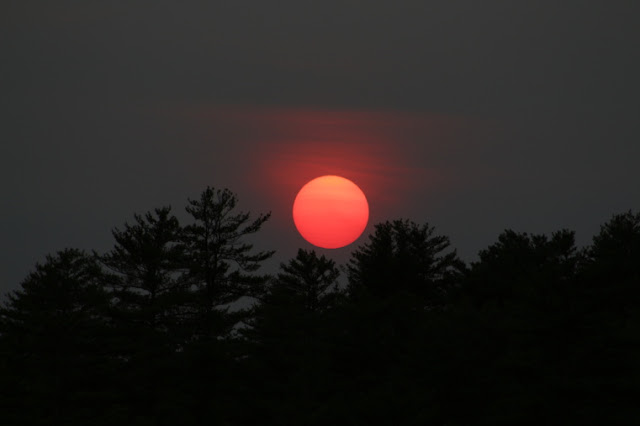
That's about the only good that comes from those wildfires, but we might as well appreciate whatever we can!

Sunday, May 18, 2025

May 18, 2025: One Big Loon

This week the banded male in the northern territory gave us a lesson on how it manages to stay strong enough to defend what is clearly a highly desirable breeding territory.  

Yup, he's going to swallow that whole.

We watched him catch and devour not one, but two huge fish.  Someone may be able to estimate the weight of these fish, but I expect each one accounted for a significant portion of his daily two-pound diet.  Here's the process he went through to get it down its throat after taking a good five minutes playing with it to weaken it enough to swallow.


At this point something wasn't going right and he coughed the fish back and started over again.

Getting farther down this time.

Swimming hard seemed to be part of the final swallowing process.

A big lump in that throat.

Almost down.

Always a big shake to get that neck bulge sent all the way down.

So that was a pretty good meal.  Two days later it was back in the same spot like any fisherman that returns to a spot where he once caught a big one.


This fish is also sliver with dark spots.  Are they Black Crappies?

I'll short cut the process this time, but it took just as long as before to accomplish the whole thing.


With plenty of fish in his belly he's got the energy he needs to keep up his weight and fight off the endless challenges on his territory.


In case you didn't catch the update to last week's journal, Lake Wicwas eventually crested over two feet above normal level, lapping over the edge of the dam.  Not the highest it's ever been, but close, and it's still about a foot higher than normal.  With three boards removed from the dam it's dropping at a rate of about 2" per day so without any more rain it will take another week before it's back to normal level.
Aren't fish supposed to swim under the dock?


We must be pretty close to a full complement of summer birds now.  Arriving this week were the Eastern Kingbird, Scarlet Tanager, and Great Crested Flycatcher.  The latter has a sharp call that's easy to recognize once you've learned it.  Wildflowers came on strong this week with the warm sunny days, and that green Lady's Slipper I found last week did in fact bloom.  
Pink Lady's Slipper

A few other flowers popped out as well including the Eastern Starflower and the Fringed Polygala.
Eastern Starflower

Fringed Polygala


We know "poly" means many, and this week I learned that "gala" means milk.  I also learned that's where the word "galaxy" comes from, originating as the "Milkyway Galaxy".  Though it looks like an orchid, this fringed polygala is a member of the Milkwork Family.  [Ref:  US Forest Service]  

Keep an eye for more flowers appearing on the forest floor in the next couple of weeks.


Sunday, April 24, 2022

April 24, 2022: Peculiar Pelicans

This week we took a diversion from spring in New Hampshire down to the Low Country of South Carolina and enjoyed experiencing some very different birds, the most peculiar of which has to be the brown pelican.

Brown Pelican (Pelecanus Occidentalis)

We often watch formations of pelicans gliding over the water as they search for fish where they appear to be such graceful birds.


But up close they are really quite ungainly.


One observer aptly describes the pelican as "comically elegant".  Of course their most dramatic feature is their huge bill with attached pouch.  One evening at low tide I watched a pelican catch a rather large fish which might have been a skate - it was certainly something with wide, thin appendages that hung out both sides of the bird's bill.

I really had to study this scene to figureout what I was looking at. The thin point is the top of the beak, with the fish below it, spilling out of the pouch. 


The pelican managed to toss it around enough to capture the fish mostly within its bill.

What's the reason for the strange wing position?

While it was tangling with it, other pelicans crowded in close hoping for a chance to steal the fish with any false move.

A competitor rushes in, hoping for a steal.

After it got things organized I almost wondered if it was going to split its pouch open.


But the bird managed to point its beak to the sky and somehow slide that sea monster down its throat.


Pelicans most often catch fish by plunge diving where they let their bodies fall from high above the water, crashing down with an impact great enough to stun the fish which they scoop up with their bill.  Pelicans are the only birds that use this technique.  They are truly a uniquely evolved creature of earth.

I saw and heard many other birds including some we'll see shortly up in New Hampshire as they follow the insect migration north.

Laughing Gulls will soon come to New Hampshire and Maine coasts to breed.

House Finches range from South Carolina to northern New Hampshire throughout the year.

Great Crested Flycatchers will be in New Hampshire soon.

We might see a Snowy Egret blown inland by a storm along the Laverak Trail in Meredith.  This one was fishing in Shem Creek at low tide.

One last bird we got an excellent look at is a great egret.


This particular bird has become accustomed to humans and hangs out along the Shem Creek pier with the fishermen, begging for handouts of extra bait.  It's not very healthy for it but it's fun to be able to see one so close.

The South Carolina coast was a great place to spend Earth Day 2022.


Sunday, June 14, 2020

June 14, 2020: Great Crested Flycatcher

Ever since the spring birds started arriving I've been hearing a loud, sharp, rising bird call coming from somewhere high in the trees.  I couldn't find the artisan producing this distinct sound, nor could I figure out from the guide books who it was.  Eventually I was so frustrated by it that I went to the Merlin bird app (from Cornell Ornithology Lab) and worked my through all the bird calls, starting with the most likely birds in our area, and finally I found it.  There was no doubt when I heard the recording of the Great Crested Flycatcher that this was my bird. 

I never would have guessed it was in the flycatcher family since the other common flycatchers I know - the eastern phoebe and the eastern wood-peewee don't make such a sharp call.  The great-crested does have a song similar to the other flycatchers, and I have likely many times attributed its song to one of these other flycatchers.  The great crested flycatcher spends its days high in the trees searching out insects and worms, which is why it's not commonly seen.  This is from the identification information from the Ornithology Lab:

"When the male sings, it's to be heard, not to see or be seen. He picks a singing perch within the canopy, well away from branch ends. In contrast, hunting perches require an unobstructed view of potential prey and unobstructed flight paths to them, whether the prey are in the air or on leaves or twigs. Both sexes favor hunting from dead branches with a backdrop of foliage for cover."

Several days later, when I heard it calling close by in the morning I went looking once again, and this time I caught the elusive rascal - it was hunting from the top of a dead branch just as the book instructed him to.

Great Crested Flycatcher (Myiarchus crinitus)


It's a pretty bird, with a lemon-yellow belly and a small (not very great!) crest on its head.  Here are two interesting facts about the great crested:  One, they like to use shed snake skins in their nests; and two, although they are flycatchers they also eat fruit, consuming them whole and then regurgitating the pits.  (Most birds peck at fruit and eat just the flesh.)  These are common birds in our area; once you know their call you'll probably notice them frequently, even if you never see one.

Waiting for the next unsuspecting insect to fly by.


Two weeks ago I shared a picture of a ground nest, guessing it was the nest of a hermit thrush or a veery.  This week those three blue eggs were replaced with three hungry mouths waiting for mom or dad to return with an insect or three.

Two mouths closed up when they realized I wasn't bring food.

So cute to see these little birds with giant mouths.  Hopefully they will soon be flying off to the trees where they will be safer.

All of New Hampshire - except the very northern tip - is in an "abnormally dry" state  [Ref:  NOAA] and the ground is already is already quite parched.  We did get one short downpour on Thursday afternoon, but it blew over quickly a left a nice evening on the lake.  There's been a single loon hanging around in Marion Cove on Lake Wicwas quite a bit lately, and I assumed it was the rogue loon that has been spending time here the past several years.  In the late afternoon following that brief shower the loon was here again; since the evening had calmed down nicely I went out for a paddle to enjoy the sights.
Rain drops bead up on the lily pads.

Larger Blue Flag (Iris versicolor), native to New England, is blooming widely around the lakes.

When I returned the single loon was still in the cove, preening.  I stopped and watched for a few minutes, taking some pictures in the soft post-storm light, and only after I looked at the pictures did I realize this bird had a band - a white band with what appeared to be a black dot - it was the male from the Bryant Island nest!
I wouldn't have been sure that was really a band if it hadn't appeared in several pictures.

I guess he was out for a long evening fishing trip - the loon equivalent of getting out of the house for a few hours?