Showing posts with label Hobblebush Viburnum. Show all posts

Sunday, September 14, 2025

September 14, 2025: Spider Webs in the Morning Dew

We had a series of cool nights this week with each night falling well into the 40s.  One cool morning, with everything drenched in condensed water, I found an extraordinary array of spider webs adorned by the dew that formed overnight.  These webs are probably there every morning, they just aren't so visible.  I enjoyed examining the different form and structure and site of each spider's web.  The variety of approaches each species takes to catch food is its own lesson in evolution.  First off, the classic spiderweb of an orb weaver:

The well-planned geometric web of an orb weaver.

This orb weaver built its nest in a small tree at the edge of a field filled with much different spider webs.
A recently mowed field full of spider webs.

These were nothing like the carefully planned and constructed web of the orb weaver, but rather a seemingly random, dense network of threads designed to capture the smallest of insects in the grass.
Thick webs built low down in grass.
This one has a tall spire attached.
Does the tall web perform a particular function in relation to the thick web below?  

This next similar web was also in the grassy field, but built on a tall flower stalk, giving it yet different properties.
This could be the same species with a different idea on how to catch breakfast, or a completely different species.

In yet another location, deep in a mature forest, were more dense webs, but these were built high up in tree branches.


Spider silk is made primarily of protein, and spiders create unique types of silk for different uses with each type formed by a different gland in their body.  The strong silk that forms the frame of a web is called dragline silk.  This silk, which isn't sticky so the spider can walk on it, is stronger by weight than nylon and even Kevlar.  [REF:  Römer L, Scheibel T. The elaborate structure of spider silk: structure and function of a natural high performance fiber. ]  A spider fills in the web structure with a sticky silk called capture silk.  There are yet other silks that are used for preserving captured prey, wrapping eggs, and even a light silk used as a balloon to travel long distances on the wind.  

The spider's ability to create such useful material made me think that we humans have evolved with the ability to create incredible things with our brains and hands, but there's really nothing useful we create using just our bodies like a spider does.  There's a whole world of science that studies spiders and their silk.  See the above reference for a glimpse into that world.

The colder nights makes me think about how the next couple of months are critical times for animals bulking up on food stores, either to get through winter hibernation or for a long migration to the south; for some animals this continues through November.  As noted last week, many food sources are ripening now, just in time for this feeding frenzy, including berries, mushrooms, and seeds from plants large (oak and beech trees) and small (milkweed and asters).  Hobblebush viburnum are highly visible with their red and black berries growing in large clumps on chest-high shrubs.

Hobblebush Viburnum

Old neglected apple trees are ripening their fruit for animals like deer, bear, fox and coyote, all of which will eat them right from the tree or after they've fallen on the ground.  Black cherry trees likewise are maturing their fruit as our young robin from last week knows.
Black Cherry

Black cherries are mostly pit with little flesh; the flesh is edible by humans, though the pits, which produce a cyanogenic glycoside, are not. [REF: https://plants.usda.gov/DocumentLibrary/plantguide/pdf/pg_prse2.pdf]  Birds consume the flesh but not the seeds, which they distribute widely after they pass through their digestive systems.  Rodents on the other hand will eat the flesh, but they also can crack open the pits to eat, or store the pits in their winter caches.  Bears and foxes are like the birds in that they eat cherries only for the flesh, and then plant the pits wherever they leave their scat.  

Other fall berries I seen now are Winterberry, False Solomon's Seal, and Bunchberry.
False Soloman's Seal
Bunchberry

I'm told the Summer mechanic team at a particular ski area has their own name for bunchberries: "Oh Shoot berries" (or something similar to that ;-)  The name derives from the fact that when these berries turn red, it means, oh shoot, we only have a couple of weeks left to finish all our summer maintenance before the snow flies!

I've seen a few garter snakes around lately.  In preparation of their winter hibernation, they're probably feasting on the many small frogs that have been hopping all over the place this summer. 
Common Garter Snake

It's amazing how large a frog a small snake can swallow whole.


We were in mid-coast Maine for most of this week so I wasn't able to check on the loons.  I spent a lot of time along marshes and estuaries where I saw the usual shorebirds including pipers, plovers, eagles, and osprey, but only one new bird, a Killdeer.  I first heard it at night as they were calling while hunting beneath a bright full moon illuminating the estuary all week.  It was unusual to hear something other than loons or owls at night.  For those who love Maine as much as we do, here are a few familiar sights from the Wiscasset Area.
Chewonki Estuary on Montsweag Brook.

Marshall Point Lighthouse in Port Clyde

Burnt Island Light in Southport


Saturday, May 3, 2025

May 4, 2025: Fiddleheads Erupt

A few sunny days in late April really get things moving - the sun is as strong now as it is at the end of July.  In warm, damp, sunny spots ferns are shooting out of the ground, their fiddle heads mimicking the top of a violin.  


While on shaded forest floors, the Trailing Arbutus are now in full bloom.

They are so small you may have to look carefully to find them.  Trailing Arbutus, along with Partridge Berry are some of our forests' more common ground covers, helping to maintain moisture in the soil as well as providing food and cover for the smallest of animals.  I saw my first bee of the year buzzing among the Trailing Arbutus - it was a bumble bee, the primary pollinator of this plant.  These large bees with a hairy coat can stand colder temperatures, and are the first  bees to emerge after winter.  If you find Trailing Arbutus flowers, pinch one of their flowers and smell the strong, sweet perfume that attracts the bees. 


More birds arrive daily now - this week there's been a flock of Yellow-rumped Warblers here every day.  
Yellow-rumped Warbler.

They flit erratically among the bare branches picking off insects and caterpillars. 
Caught this one in action.

Yellow-rumpeds spend the winter farther north than most warblers so they arrive early, allowing us to see them rather than just hear them since the bare tree branches give them no cover.  
How they got their name.

Bare tree branches let me watch a Tufted Titmouse forage around in a young successional forest picking off insects and spiders.  

We'll lose those bare branches in just a few more days so the birds will be well hidden up in the treetops.  The trees are now starting to put out leaves; the view down on treetops from Crockett's Ledge shows tinges of pale yellow-green aspen and dark red maple buds.
Just a smattering of color against brown branches.


Other new arrivals this week include Oven Bird, Common Yellowthroat, and Veery.  But my bird of the week was this Broad-winged Hawk which spent time hanging out amidst the warblers.
Broad-winged Hawk

I was surprised that while it was here the warblers will still flying around in the trees.  The hawk wasn't trying to be secretive because it twice flew from one tree to another. 
It also walked up and down a branch, showing off its talons.

So the warblers were certainly aware of its presence.  Are warblers smart enough to tell a broad-winged hawk apart from the smaller Merlin and Kestrel, and know that broad-wings mostly go after small animals on the ground?  They should keep in mind that these hawks do occasionally take a bird on the wing.


One quiet morning as I was listening to the birds' sunrise serenade beside the lake, I jumped a foot in the air when a beaver gave a loud slap just a few yards away from me. I hadn't seen it coming and it really is startling when you're not expecting it. I watched it swim back and forth, and it presented me with a couple more tail slaps.
There was another noisy event on the lake this week:  The loons are back to fighting over either territory or mates.  Two days after I took a nice trip around the lake and was pleased at seeing two pairs of loons peacefully enjoying their separate territories, I witnessed the most intense loon battle I've ever seen.  I heard a ruckus and looked out and saw two loons in a wing-rowing chase winding back and forth across the lake at breakneck speed - they looked like waterskiers carving up the cove.  When they reached the end of the cove they went back and forth multiple times, chasing, diving to make sharp stops and turns, barely losing a beat.  I had watched for a long time not wanting to look away, but eventually I got my camera.
They went out of my sight, but then came back and I took more video until they went far down the lake.  I checked my watch only after they'd been at it for at least a few minutes - I have no idea how long it was going on before they caught my attention, but it was ten minutes that I watched before they went back out of sight, still in active combat.  
I'm amazed at their endurance; that video was only two and a quarter minutes of a fight that went on well over ten minutes and they never once stopped going full tilt.  I can only assume one of the contestants is the north territory male.  It seems it would be one doing the chasing to drive another away, but it could be the other way around.  It could also be two females fighting over who gets to pair with the male.  Hopefully someone will give up rather than fight to the death.  But what will happen if the weaker bird gets so exhausted it can't escape?  I was happy to see a pair together fishing peacefully in the northern territory the next morning.


Some of the trees and shrubs I like to watch progress in spring are Service Berry, Black Cherry, and Hobblebush Viburnmum, all of which are pushing out small leaves now.  The viburnum is the furthest along, already forming flower buds.  
Hobblebush Viburnum early buds.


All three of these shrubs/trees might have blossoms by next week - stay tuned!


Sunday, March 30, 2025

March 30, 2025: The Spring Sprung Backwards

Spring sprung back to winter this week.

Oops - winter's back.

Snow fell on the snowdrops, but it was a nice soft snow with a beautiful warm day following that gave us another opportunity to get out on the skis and snowshoes.

Note that long line of animal tracks.

While skiing I followed a set of tracks almost the whole time, tracks that took me a while to decipher.  They were too small for a bobcat, and too undisciplined for a fox.  There wasn't any tail drag which ruled out porcupine, plus they covered far greater territory than a porcupine would travel.  A process of elimination brought me to a member of the weasel family.  Another sign is the 2-2 track pattern characteristic of the weasel family as seen at the bottom of the photo above, though it's not very clear due to the soft snow.  Being too far away from water to be a mink, and too small to be a fisher, I concluded it was either a Long-tailed Weasel or an Ermine, both of which call New Hampshire home.  Rezendes' tracking book reports that the two animals' tracks are similar in size, but the long-tailed weasel is more erratic. 

An erratic, winding trail is characteristic of the Long-tailed Weasel.

Rezendes describes the animal as "distracted by everything in its environment", so my best guess is a long-tailed weasel.  


The snow also provided proof that our otters were out, enjoying the snow as much as I was.

An otter slide on a downhill section of trail.

You can easily determine the direction of travel on land:  they hop uphill and slide downhill.  They'd been on land, on the ice, and they even seem to revel in splashing around in the slush.


It's amazing to me that they can keep warm.

Did I mention bears last week?  Yes, they are out.  A pretty big one has been using a long stretch of the Arbutus Hill (White) Trail up in Hamlin/Eames.  

That's a big bear print.

It found some reason to meander around here a bit.

I also came across coyote tracks and lots of turkey tracks.

A turkey walked long sections of the trail too.

Arbutus Hill Pond is still almost entirely ice-covered.


So, Spring has taken a little set back; even more snow and ice fell yesterday.  But if one can get past the travel difficulties and power outages, we can be grateful for winter's beauty.

And yes, there are signs of spring if you look for them!

Hobblebush Viburnum pushing out new leaves and flower buds.

One late picture taken at 8:00 this morning (Sunday):


Sunday, October 22, 2023

October 22, 2023: Fog in the Woods and Woodies in the Fog

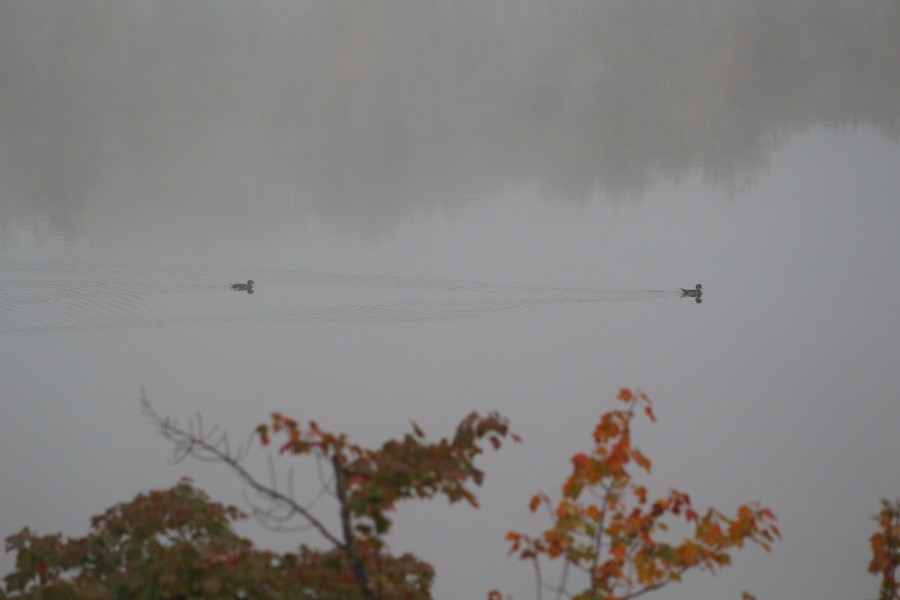
October days often emerge with fog in the valleys and over the lakes that sometimes doesn't burn off until mid-morning.  It's interesting to see what emerges from the fog as it lifts.  This week it has been wood ducks.

A pair of wood ducks in the morning fog.

As the day brightens more and more of them materialize.  


Each day this week I've seen at least half a dozen on the lake.

The loons paddle around in the fog as well, both the two juveniles as well as adults.  This adult was probably stopping by Wicwas for a visit or a rest stop on its way to the ocean.

A mature loon part way through its molt.

I have to look carefully to tell adults and juveniles apart now.  It's possible both of our nesting adults have left the lake as I haven't seen LuLu and Checkers with either parent this week, though it doesn't mean they won't return for visit to check on the kids.  The young ones are very quiet now - no whining and nagging for food when they're on their own.

I found the hobble bush viburnum to be especially interesting this foliage season, transitioning through a sequence of colors from green to red to a deep burgundy.

Hobblebush viburnum on October 13th.

And six days later.

They do this even as they are putting out new growth from the end of their stems.

New growth just emerging.

I'm afraid today's wind is going to bring an end to the best of the foliage for this year.  The oaks will hang on to their leaves for another couple of weeks, but the red, yellow, and orange maples will probably sacrifice most of their leaves to the forest.

A calm morning after the fog.

Damp mornings bring out the bright colors of the leaves that have left their homes and found their way to their final resting place, ready to start the process of giving themselves back to the forest floor to sustain new life as they decompose.


I hope you're able to take in the fall beauty that nature has left to give us before it fades into a much different personality, known as "November".
Two different beings pursue their piscium prey below the rising fog.