Showing posts with label Sweet White Violet. Show all posts

Sunday, May 10, 2026

May 10, 2026: Spring Multimedia Show

In addition to the spring warbler invasion that's serenading us with the joyous sounds of nature, we're now being treating to an influx of visual beauty as spring flowers erupt everywhere.  It's nature's live, multimedia show in full 360 degree non-virtual reality!  Last week the tiny Trailing Arbutus provided the trailer with the first blooms in the forest, and this week, the main event is on, starting with a large and showy shrub on display throughout the Lakes Region.

Serviceberry (aka Shadbush)

Serviceberry is widely spread around lake shores as well road sides, especially in damp damp soils.  The tree above is in Chemung State Forest along Chemung Road.  

In sunny spots, violets are blooming, both the Common Blue and the Sweet White.

Common Blue Violet

Sweet White Violet

A walk through the field at Page Pond Town Forest revealed Wild Strawberry joining the cast as well.

Wild Strawberry

High up on the summit of Belknap Mountain, a lone elderberry bush was just starting to come on stage to display its purple flowers.

Red Elderberry

I've had reports of Bluebead Lily flowering, but in the Belknap Range, they weren't quite far enough along, at least as of Thursday.

Bluebead Lily about to bloom.

They are probably in bloom by now, because this is a magical time in the New Hampshire forest.  The days are long - over 14 hours between sunrise and sunset - but leaves aren't yet on the trees, so for a very short period, direct sunlight shines down onto the forest floor.  The woodland flowers thus have a brief window after snowmelt to sprout, photosynthesize, and put out flowers, before the curtain closes and they are immersed in deep shade for the next five months.  

There was a surprising guest appearance on my hike in the Belknap Range:

Red Eft

I didn't expect to see an eft this early in the year, especially on a cool and partly cloudy morning at elevation.  It was resting on an exposed piece of granite which was being warmed when the sun shone down around the clouds.


The sound track to accompany this week's multimedia presentation was provided by Black and White Warblers, Ovenbirds, Black-throated Green Warblers, Bluebirds, Common Yellowthroat, and many more.  I heard nine species in the Belknap Range, and I participated in a bird walk sponsored by the Meredith Conservation Commission at Page Pond Town Forest yesterday, where, under the expert guidance of Dan Mullarkey and Kelly Hanson, we observed 20 different species.  My favorite was the Yellow-bellied Sapsucker which we heard several times.

A Yellow-bellied Sapsucker seen on yesterday's bird walk at Page Pond.

Back on Wicwas we had a huge flock of Yellow-rumped Warblers at the lake for several days, feeding on caterpillars on the trees.  

Yellow-rumped Warbler on a broken maple branch at Lake Wicwas

There are also dozens of Tree Swallows zooming all around the water picking off insects on the wing.  They are too fast for me to capture their acrobatics, but our pair of Eastern Phoebes gave me nice show right at the house. 


Spring is in full swing now, and there will be many more birds and blooms to look for in the coming weeks!

                                                     
  Happy Mother's Day!  


Sunday, May 11, 2014

May 11, 2014

Happy Mother's Day!  Mother nature gave her best today, providing all mothers with a fabulous day at Lake Wicwas - warm and sunny with a deep blue sky reflecting off the water.

The warmer weather has brought along the trees, as more buds are swelling and starting to pop.  The Red Maples are the first to have pushed out early, tiny leaves.
May 9th


And then just two days later, they are already exhibiting the familiar structure of the maple leaf.
May 11th
The Sweet White Violet is blooming in the sunniest locations and the Canada Mayflower and some ferns have sprouted, adding some green to the otherwise brown and drab forest floor.  .

The lake is still high, and the outlet flowing rapidly;  the streams emptying into the lake are full and wide.  The high sun and open canopy allows more light to penetrate than during any other season, which aids in warming the ground, fostering the growth of the new plants.

And my now good-friend, the garter snake was out enjoying the sun again as well.

Watching the surface of lake I noticed little wakes being made by small animals, thinking at first it was a snake, but soon realizing there too many of them and their travel pattern wasn't consistent with a Water Snake.  So I took my first kayak trip of the year to investigate.  They were made by an insect about half an inch long, which I think is the Water Boatmen.  I couldn't get a picture but here's a photograph of a Water Boatmen from the North Carolina State University web site.
http://www.cals.ncsu.edu/course/ent525/water/aquatic/images/09.jpg
Water Boatmen (NCSU photo)

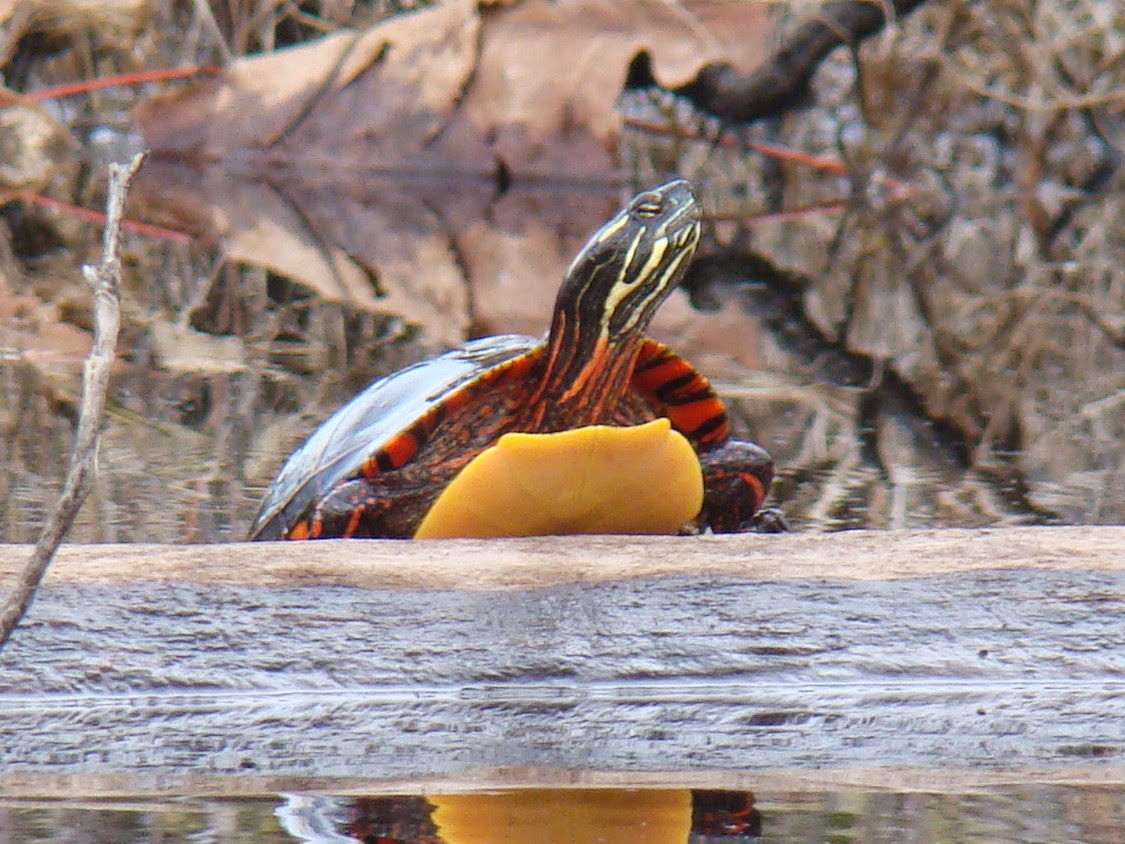
Continuing along the shore of the lake, taking advantage of the high water and lack of pond weeds, I saw many turtles sunning themselves wherever a spot providing good exposure.  This log had six or eight turtles all lined up it, which I didn't notice until I heard them splooch, splooch, splooch, one after another into the lake.

Soon their scout came back up to see if the coast was clear.
Painted Turtle

I identified a new shoreline plant that is blooming around Lake Wicwas.  This is known as bothLeatherleaf and Cassandra, and is an evergreen member of the Heath family.  It is responsible for much of the deep red and maroon color that appears all along the shore of the lake in the late fall when its foliage turns.
Leatherleaf or Cassandra (Chamaedaphne calyclata)
Meanwhile, at the bottom of the lake, plant growth is starting as well;  in the shallows I could see the pond lilies putting out leaves that will soon rise to the surface.

Pond Lilies Sprouting from the Lake Bottom


The flycatchers and song birds are arriving in large numbers now;  I watched a group of them doing acrobatics as they feasted on bugs over the water, and the raspy call of the Phoebe is heard frequently.

Last night I captured a picture of a fox;  it still had its bushy winter coat on.
Gray Fox

I suppose it is still cold in their den, and with nighttime hunting, a warm coat is in order for a little bit longer. 

Back up at lake level I came upon the male Wood Duck in the cove near its nesting site.  No sign of mom - she's at home working at the nest.  I'm sure dad is out finding her something special to bring her for a mother's day treat!
Wood Duck

Saturday, May 11, 2013

May 11, 2013

Just in time for Mother's Day, mother nature is decorating Lake Wicwas with beautiful flowers of all sizes and colors.  In addition to the Painted Trillium I posted earlier, there are violets, both white (Canada Violet) and blue (Common Violet), Fringed Polygala, Goldthread, and Wild Strawberry.
Common Violet

Fringed Polygala

Goldthread

Wild Strawberry

Some trees are flowering, including the Hobblebush Viburnum and what appears to be a cherry tree , though it doesn't look like a native cherry tree.  It is right along the side of Chemung Road just north of the Wicwas boat ramp.
Hobblebush Viburnum

Cherry Tree?
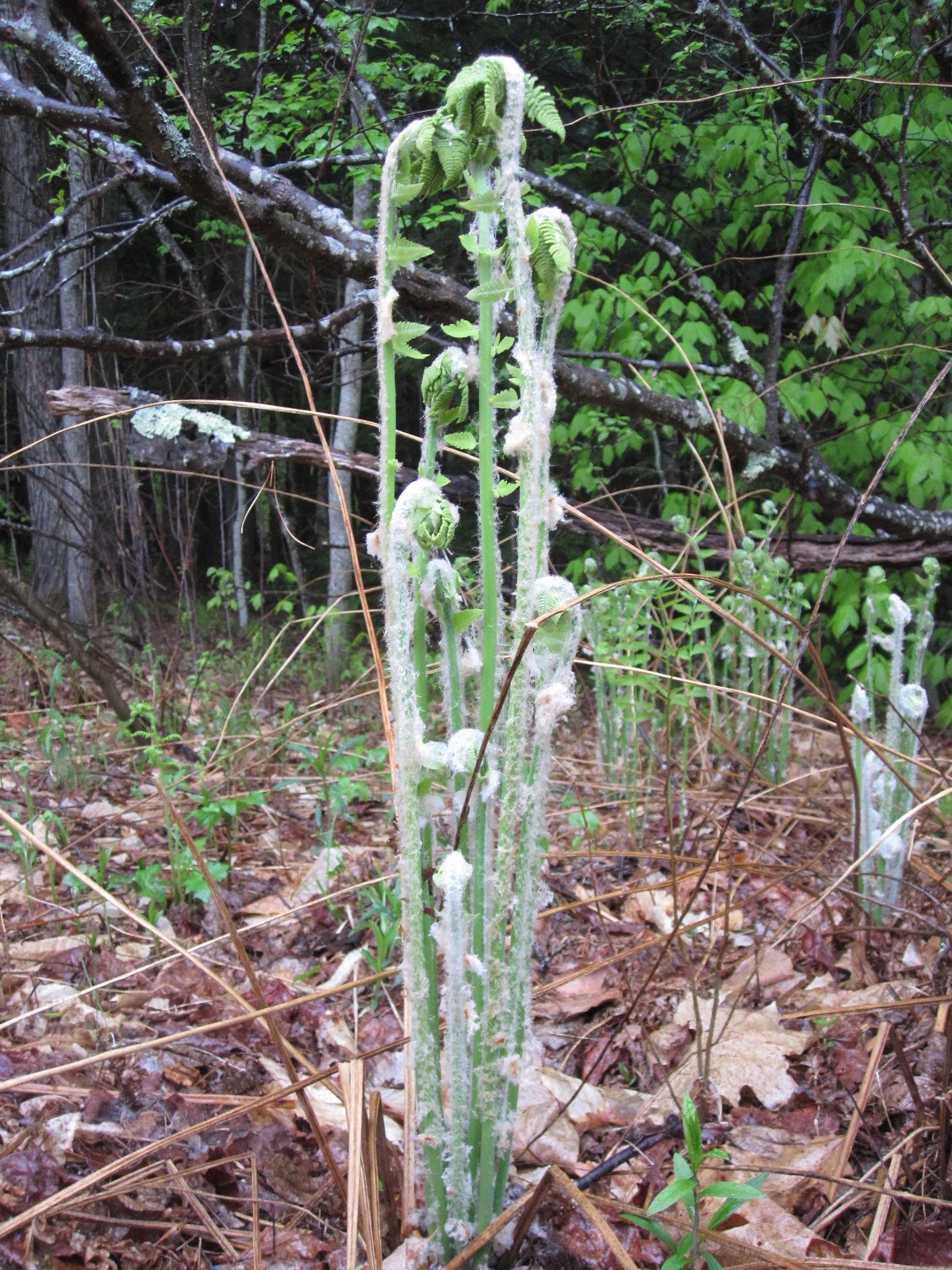
Various specious of ferns are unfurling all around the lake as well.


While I was in the Hamlin area, I found a dead Ringneck Snake right in the middle of the trail. 
Ringneck Snake


It is black on the top with a bright orange belly, and its markings show how it got its name.  It had no wounds or other signs of a battle, rather it appeared to be lying right where it would have been sunning itself.  It hadn't died very long before, as its body was still pliable and its eyes were clear.  Another mystery....

After a long stretch of beautiful weather, we finally had some needed rain on Saturday.  I was walking along in a light rain early in the morning and saw an animal swimming in the water.  It was immediately recognizable as not a beaver, as it didn't have the straight, bee-line path of the determined beaver.  Soon there was a second, and I watch two Otters playing in the lake for several minutes.  They were chasing each other, splashing and romping around, and generally enjoying themselves.  Eventually they disapeared along a shoreline, probably climbing up on the island.  It was too dark and they were too far a away to get any good pictures.
River Otters


And, just now, as I'm sitting here writing this at 8:10 pm, Linda said "look out the window"!  There, standing right in front of the house amid the blueberry bushes was a good size Moose!  Being a dark and rainy night, again, no hope for a decent picture, but here's the proof.
Moose


I hope it wasn't eating all those new blueberry blossoms!  It soon wandered off along the shoreline, sometimes moving very quickly, then just standing and watching - my guess is it detected our motion in the house.

Rainy days might not be much fun for us, but they seem to bring out the creatures.

Sunday, April 29, 2012

April 29, 2012


More evidence that Lake Wicwas will soon be green again is emerging from the earth and water. More and more leaves are rupturing their buds and starting to paint the hills with the faintest hint of summer color.

Beech Tree Bud and Emerging Leaf


Joining the tiny wildflowers now in bloom are the sweet white violets.


They might look big, but they aren't!


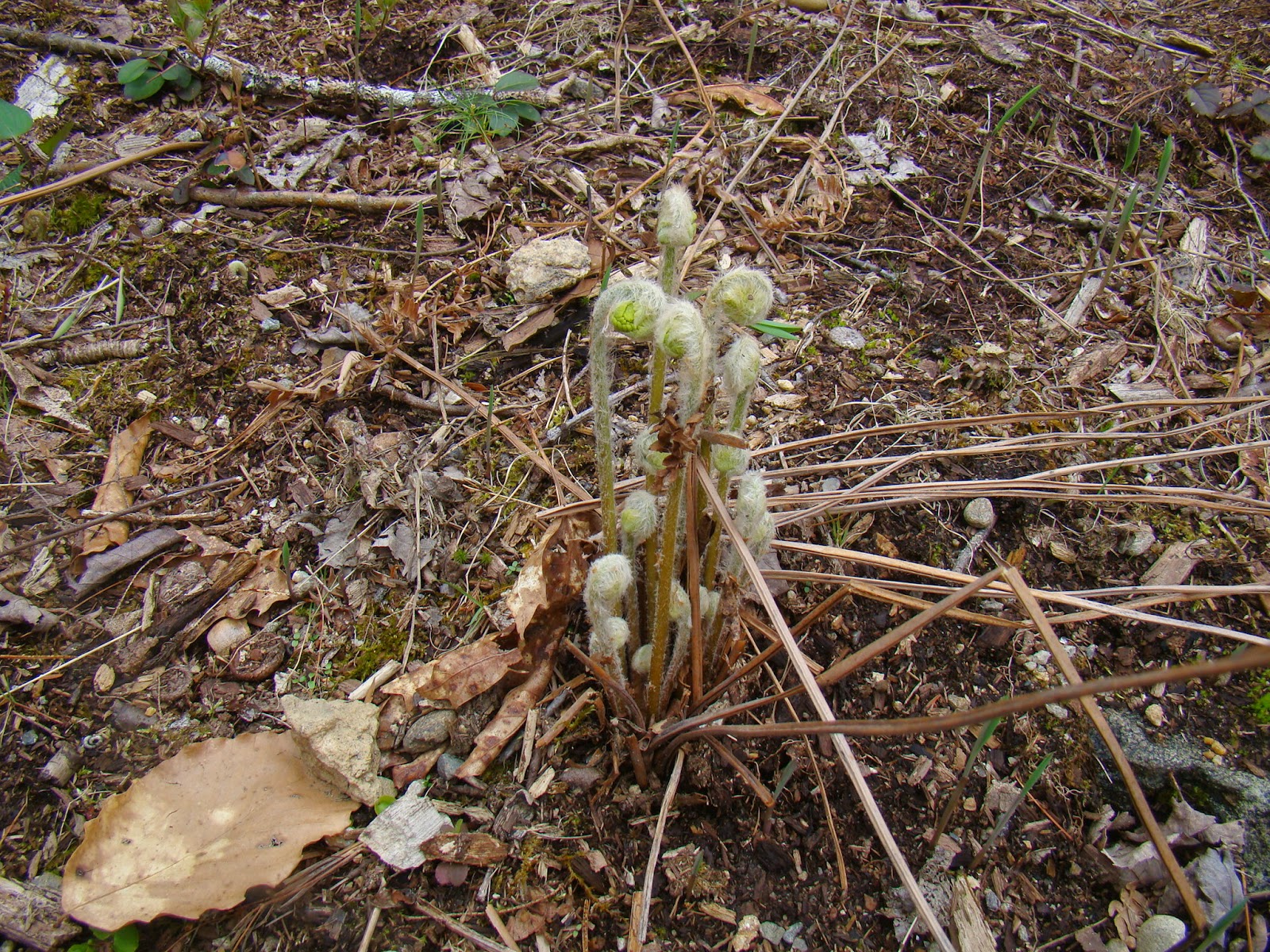
The ferns are in various states of growth as well, providing the signal that fiddleheads should be available.  Sure enough, Moultan Farm had them this weekend - locally harvested - a couple of weeks earlier than usual.  They are a once-a-year treat as they’re in the proper state for such a short time.  The ferns I’ve seen around Lake Wicwas aren’t the eating type....  Here are some just pushing up amidst the dried up stems from last summer's plants.


The past three days have given us very strong winds, strong and steady, with gusts over 30 mph.  The wind direction on Friday gave a long fetch down the north edge of the lake, with good size waves crashing against the dam.


Perhaps the winds have kept the loons in sheltered areas, as we only saw them a couple of times.  We seem to have three loons on the lake at the moment – a pair, and a single loon keeping its distance from the others.  Hopefully the pair is searching for a safe nesting site, and will be as successful as last year.


We’ve also had a lone turkey visiting the yard lately.  This is mating season, approaching nesting time, and I wonder if it is a young, one-year old male (a jake) that has been kept from mating by older, dominant males who collect and protect their harem.

Since I’m constrained close to home with extra time on my hands during my foot surgery, I decided to read Henry David Thoreau’s “Walden” about his two years spent living on Walden Pond in Concord Mass.  Needless to say, I’m getting much more out of his writing than the last time I “read” it as a junior in Ms. Nicoson’s Concord Authors class at CCHS.  Anyone who loves spending time around Lake Wicwas will surely appreciate his account, as the parallels - natural, social, and political - between Lake Wicwas and the time and place of his experience are truly remarkable.