Showing posts with label Blueberry. Show all posts

Sunday, July 14, 2024

July 14, 2024: A Week of Extremes

It was a week of extremes on lake Wicwas, from great beauty to true tragedy.  We'll start with the beauty from a paddle in one morning as the lake was just waking up.  Dragonflies and damselflies start their days drying off the prior night's dew along the reeds and ferns near shore before starting their hunting excursions for the day. 

Pondhawk


There were quite a few young damselflies that apparently had just hatched out from their larval stage.  

This is a spreadwing damselfly, perhaps an Emerald Spreadwing.

I found their exoskeletons on reeds where they had metamorphized into their flying forms.  

Exoskeletons left on the reed where they climbed up out of the lake.


I also saw that blueberry season has begun. 
They're still mostly green but some have turned a powdery-blue.

The first fruit was just starting to ripen but later in the week I was able to find enough for our first batch of Lake Wicwas summer blueberry treats.  They'll probably hit their peak this coming week so if you're around now is the time to take advantage of this opportunity to taste summer in New Hampshire.


On the gloomy end of the enjoyment spectrum is more sad news for the loons.  Jayden from the Loon Preservation Committee came out on Wednesday for a routine check on our loon nests, and as we approached the north nest everything seemed fine with the male loon at his sentry post, but as we got near the nest we saw a terrible sight.  The female loon was dead on the ground about four feet from the nest. 
The female loon with the nest in the foreground.


Not expecting this event we had to return to shore to get proper protective gear to bag the loon to bring it to the Loon Center for study and hopefully determine the cause of death.  This gets a little grisly now, so you may want to skip over the next two pictures.  There were no visible injuries on the bird such as a spear hole through the sternum which would indicate attack from another loon.  

A scavenger or two had found the carcass but most of the bird was intact.


Possible causes of death include a fight with another loon, perhaps a female trying to evict this female from its mated pair so it could take its place.  (This is in fact what this female did in 2021 when she killed or drove off the prior banded female - she hasn't been seen since.)  Another possibility is of course lead poisoning.  Either of these could have weakened the loon causing it to return to its nesting site where it expired.  There's also a possibility of attack by a predator but it seems unlikely since the bird was not taken away or consumed.  We know it took place at most 48 hours earlier, because two days prior the female was sitting happily on her nest. 
July 8th, 2024


The Loon Center is very busy right now so a necropsy (an animal autopsy) will probably not happen until this fall but hopefully blood tests and examination of injuries and will give us some indication as to what happened.   If we get a report later in the year I'll be sure to pass on what was discerned.  Both of the destroyed eggs were outside of the nest and were collected for study as well.  Before and after this event there has been a lot of loon trauma on the lake, perhaps all caused by a rogue loon that's been here much of the summer.  It's been dubbed "Bad Loon" by someone who's seen it even harassing the ducks!
"Bad Loon"     Photo by Amy Wilson.


We also went to the site of the southern pair where Jaden was able to find some shell fragments from that nest which were also collected to be analyzed.  It's unlikely the southern pair will nest again, but the pair is still staying close together in their nesting territory so it could happen.  At any rate it's been a very difficult year for the Wicwas loons and it may be the first year since 2017 without at least one chick fledged.  It's a painful year to be a loon watcher on Wicwas.


The ducks have done much better.  I've seen a couple families of little ducklings zipping rapidly into the weeds when they hear my kayak approaching, and this week I must have caught them off guard when I rounded a corner because once we saw each other, Mrs. Wood Duck put on quite a show scooting and splashing dramatically along the surface to draw my attention in the opposite direction from where she had sent her little ducklings down around the corner. 

Once she was far enough away she went airborne and circled up and around to make sure she was seen.  But looking back at the ducklings I saw what I'm pretty sure was another adult hen herding the ducklings along.

Mrs. Woodie #2 herding four visible ducklings plus an unknown number around the bend.

I know some waterfowl as well as some land birds (turkeys for example) will merge their broods together and I wonder if that's what happened with these two merganser females. 


OK, we'll end the week back at the beautiful end of the spectrum with some summer flowers blooming right now.
Shinleaf

Swamp Milkweed

Steeplebush

Pickerel Weed
Page Pond
Swamp Rose.  (Those last two pictures were taken at the Page Pond Town Forest on Meredith Neck.)

Bring a pair of binoculars on your travels around the lake to enjoy these heart-warming summer sights.


Sunday, May 22, 2022

May 22, 2022: It's Mating Season

First it's the prey.  Lots of small ripples on the surface of the water raised our curiosity when it continued for an hour or more.  Linda was the first to investigate and found a very large fish - a largemouth bass - swimming casually around in shallow water very close to shore.

Papa Largemouth.
(A polarizing filter helps to reduce reflections from the water.)

There are lots of bugs on the water, so the ripples were probably the fish rising to catch them.  

Lots food for birds and fish right now.
(No polarizer has surface reflection.)

This continued for a second day, and now there was a school of mixed species swimming around the area together, perch, bass, and sunfish, all not seeming to bother each other.

A mixed school of fish is waiting for lunch to arrive.
Yellow Perch
Sunfish (Pumpkin Seed)

And now there were two largemouth bass.

Note the distended belly on the lower fish.

They were swimming and circling close together over an areas swept clear of silt - all the clues of a largemouth bass nesting area.  Bass nesting starts in the spring when the water temperature rises to about 65 degrees, at which point the male bass will select a site and clear it out by fanning the bottom with its fins.  When the water has been warm for a few days the females will arrive near nesting sites and the male will go in search of an egg-bearing female, herding her to the nest site.  At the nest the male will strive to keep her there, swimming alongside and circling the female, sometimes bumping her abdomen to encourage the release of her eggs.  When she does release eggs, she will only release a portion of them, saving the remainder to deposit in another male's nest, increasing the odds of her offspring's survival.  

After spawning the male will remain at the nest to defend the eggs from predators - that's probably why all the other small fish are hanging around the nesting site, hoping for an easy meal of fresh fish eggs.  After the eggs hatch in about a week the male will continue to defend the small fry for up to two more weeks when they will disperse from the nest.  During this time the male will not eat - until it's so hungry that it just can't resist all the young fish it has been protecting, and will often eat much of its own young.  The strongest and fastest will escape and survive, keeping the gene pool strong.  Still, males may die from the exhaustion and lack of food from defending the nest.  By Saturday only one bass was to be seen, and it was busy chasing away any smaller fish that dared enter its lair.


The second mating scene this week is a predator of the first:  Our loon pair, which has been spending lots of time poking around various islands in search of the perfect nesting site:  one close to the water (because they can't walk on land) but not too close to the water level (so a heavy rain won't flood the nest) and on a lee shore (so waves won't flood the nest).  It's not clear to me whether they have learned the boat patterns on the lake to know where they're safe from boat wakes, but they seem to do a pretty good job with that.  I only recall one year when a nest was located where it received a lot of boat wake.  

There have been a few territorial fights where one loon - presumably the mating male - chases an intruding loon.  These chases of high-speed wing-rowing along the water can go on for a quarter of a mile across the lake.

Wing-rowing to drive off an intruder (photo taken a few years ago).

After one of these events, successful in driving off the unwanted loon, the victor swam slowly back to a tiny island it has been scouting with its partner.

Returning home.

Arriving at the island, a second loon magically appeared.

There she is.

She was probably hiding safely out of site so as not to reveal a possible nesting site to the intruding loon.  They once again perused the real estate as a potential place to live for the next four or five weeks.


"It seems rather small to me."

They seem confident they'll be able to nest in peace somewhere on the lake, because on Thursday, they were actively mating.

I'll try to keep this R rated.

Eggs are usually laid a few days after successful fertilization which may require several copulation attempts.  With any luck they will be on a nest by next weekend.  And a few weeks after that, they'll be in search of those tiny bass minnows to feed to their chicks.  The timing of nature sure has things figured out.  


And the blueberries!  

A bumper crop of blueberries has started.
Hot weather interspersed with plenty of rain has the 2022 crop looking fantastic.

Maybe they'll be some left for us after the birds and chipmunks have their fill.

Next weekend is Memorial Day - Hello Summer!


Sunday, May 2, 2021

May 2, 2021: Yellow-rumped Warblers

The procession of song bird migration to New England is running at full speed right now as an explosion of insects bursts out all around us.  I've already had the pleasure of the first swarm of black flies dive-bombing my eyes and buzzing like chainsaws as they probe my ear canals.  As much as I may despise these annoying creatures, they are what allow so many of our animals to survive, from song birds to trout, and this week a large flock of yellow-rumped warblers arrived at the lake to gorge on the plentiful feast, hungry from their long travel up from the south.  We counted about 15 of them, but there were certainly many more on either side of our field of view.  They would perch momentarily on a tree branch, a railing, or a dock post before flitting off to snag a tiny, tasty morsel.

Yellow-rumped warbler (Setophaga coronata)

These warblers have a distinctively different attack method than the eastern phoebe.  The phoebes seem to jet out on a direct path to their target, snatch it immediately at full speed, then circle right back to their observation post where they wait for their next victim.  They will occasionally make a minor flight adjustment right at the point of attack and sometimes have a little twitch of their wings, but in general they are very efficient.  In contrast, these warblers spent a lot time suspended in the air with their wings fluttering madly as they maneuvered to grasp their prey.  Their flight path is still fast and unpredictable enough that I was unable to catch any action pictures at all.

I considered whether the difference in the two birds' behavior is due to going after different insects but what from what I could find, they have the same target food.  Furthermore, both species were feeding together in the same location at the same time (and tolerating each other just fine) so perhaps it's just that the phoebe has much better flight planning and targeting skills.

An Eastern phoebe stalks its prey amongst the maple blossoms.

At least some of the warbler flock made its way over to the western side of the lake as Marge Thorpe observed them reducing the bug population over there.  She took some great pictures, then she and Dave did some research, and noting there are two subspecies of yellow-rumped warblers, determined these are the "Myrtle" subspecies, identified by the white throat.

A good look at the white throat of the Myrtle subspecies.
Photo by Marge Thorpe


These populate the east coast, while the "Audubon" subspecies, which has a yellow throat, live on the west coast.  In areas where the two subspecies overlap such as in the Canadian Rockies, intermediate forms of the bird occur. [Ref:  Cornell Ornithology Lab.]

"Who you lookin' at?"
Photo by Marge Thorpe

We also had a visit from mother deer and junior recently, but it was bittersweet because there was only one of the two siblings we watched all last summer.  

Momma deer (does she look pregnant again?)
And last year's fawn.

I'm afraid the other sibling met its demise this past winter, and was in fact the source of the remains I found on the lake back in early March (see March 7, 2021).  The remaining yearling looks pretty small and weak; I assumed the coyotes took advantage of its sibling's weakened winter condition, but it's also possible the deer died of its own accord and the coyotes just cleaned up the remains.  

Then, just this morning, in the early light of day, I came upon the two of them munching away on my favorite hobblebush shrub, which being out in the middle of the woods, they are welcome to enjoy, and enjoy they did, decimating all the fresh, tasty blossoms below chest level.

There won't be any berries for the birds from this viburnum bush.

Once they saw me they were off into the thick woods with five quick bounds, but they didn't go far, stopping to look back at me to watch where I was going.

"Can I please finish my breakfast?"

I expect they'll be back shortly to finish off the higher branches.
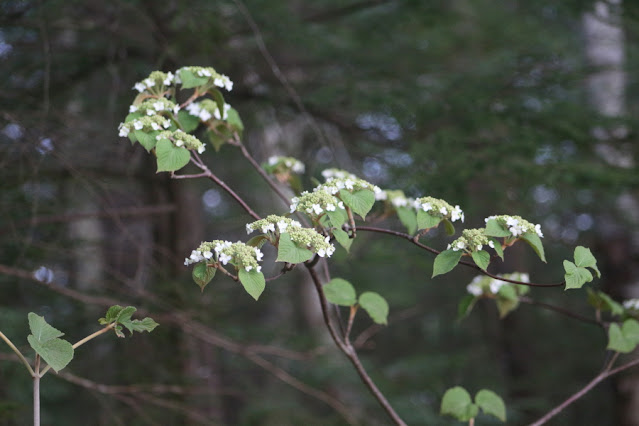
Deer dessert.

At least the flowers are going to a good cause, fueling the new fawns growing in momma's belly.

On another happy note, wildflower season is ramping up;  now is the time to be on the lookout for trillium - I had a report from Canterbury (thanks GP!) that painted trillium are blooming there, just a bit south of the Lakes Region, so they should be out here soon.

Painted trillium blooming in Canterbury.
Photo by Glen Powell

The spring wildflowers compete with the trees for our attention during the spring foliage season which is highlighted by red maple blossoms in the upper story and blueberry buds down by the waters edge.

Red maples shine up high

While blueberry bushes gleam down below.

Both are not only pretty but also welcome hints of what's to come.

Note that in addition to the black flies and other flying pests, crawling ticks are also on the prowl;  I've found both black legged (deer) ticks and wood ticks creeping up my legs even after following anti-tick measures, so do a good tick-check after your outdoor adventures.  

And thank those yellow-rumped warblers for doing their part in the battle of the bugs!