Showing posts with label Canada Mayflower. Show all posts

Sunday, June 8, 2025

June 8, 2025: Great Crested Flycatcher

The dragon flies came out in full force with the warm temperatures this week which means it's feast time for the birds - no more need to go after tiny mosquitoes and black flies when there's much larger game available.  I mentioned recently the distinctive call of the Great Crested Flycatcher and on a paddle this week there was one calling loudly near me which I was able to locate perched on its branch waiting to attack whatever flew by its outpost.
Great Crested Flycatcher


In addition to the Phoebes which have been here for weeks, the Eastern Kingbirds now have a large presence around water as well.
Eastern Kingbird

All three of these flycatchers are quite noisy birds.  I also saw a couple of Belted Kingfishers this week.  

On the loon front, it appears the southern pair has decided to build a nest on a tiny hummock deep in Harris Cove.  It's well protected from boat traffic but won't have any protection from the sun which could be a problem for them.  At last check they weren't on the nest, so there probably wasn't an egg yet, but by today there might be.  If all goes well, mark your calendar for a chick just after the fourth of July.

One morning this week a pair of float planes landed on Wicwas.  

The two are the same model of pusher-plane with different paints schemes.
Note they have wheels as well as floats for water.
The loons were not pleased with these large noisy birds flying over them.

There are so many birds in the trees now feeding happily on flying insects as well as the crawling ones:  caterpillars.  One native caterpillar that has developed an excellent defense mechanism is the Tent Caterpillar.  
Tent caterpillars create a defense shield against predators.
Tent caterpillar are not a species at risk and since they can defoliate small trees there's generally no harm in removing them if you wish.

The bunchberry is booming now; I saw these up by Arbutus Hill Pond in the Hamlin-Eames property behind Lake Wicwas.
Bunchberry

More white flowers are adorning the False Soloman's Seal plants.
False Soloman's Seal

Later in the summer these will have large bunches of red and white speckled berries which are consumer by birds and rodents.  The Canada Mayflowers didn't quite live up their name this year, but they only missed it by a few days as they are blooming now in early June.
Canada Mayflower

And thank you Canada for giving us some gorgeous red sunsets this week.
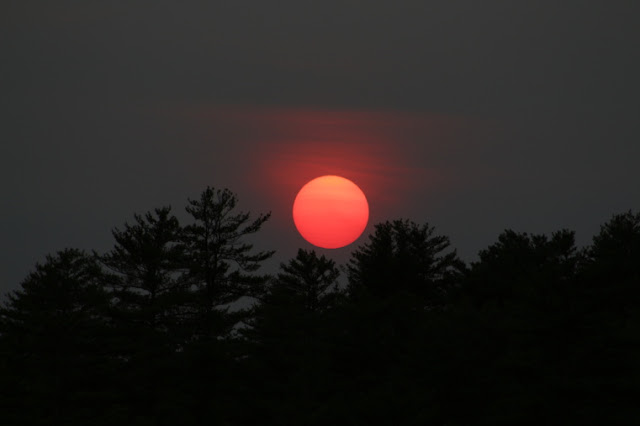
That's about the only good that comes from those wildfires, but we might as well appreciate whatever we can!

Sunday, May 25, 2025

May 25, 2025: Northern Water Snake

Swimmers in New Hampshire lakes might not be pleased to see this, but rest assured that these snakes will flee from anything larger than a big frog, especially humans, so there's nothing to worry about unless you decide to approach one of these guys.

A northern water snake on a midday search for food or a mate.

Northern Water Snakes are very common around all our waterbodies, rarely found any distance from a pond, lake, or stream.  They are excellent swimmers and especially active this time of year when they are searching for mates.  After mating the two snakes will go their separate ways, with the female gestating 10 to 30 young until late summer.  During this time, water snakes feed primarily on fish and amphibians, but also crayfish, leeches, and other snakes.  

Snakes use their tongue as a sensor.  They stick it out to collect airborne molecules on it, then pull it in into their head and place it into an organ that lets them smell what was captured on the tongue.  The forked tongue provides a stereoscopic capability which lets them determine the direction of the source. 

Sticking our its tongue to smell.

Northern water snakes are not poisonous, but do have sharp teeth they use catch and hold onto their prey, which they swallow whole.  With fast reflexes they are able to catch fish, sometimes hunting minnows at night, though they are most active during the day, and are often found sunning themselves on a warm rock or branch at the water's edge.
A good size water snake I found sunning itself on a rock a few summers ago.

Predators of water snakes include birds, racoons, and snapping turtles, as well as other snakes.  Some day maybe I'll see an eagle swoop down and grab a swimming snake off the surface of the lake.


The female water snake is ovoviviparous, meaning it gives birth to live young which are left completely on their own.  This is the time for larger fish to exact revenge, as the infant snakes are especially vulnerable to fish.  Many of the young won't survive, but with a couple dozen snakes born every year over perhaps a five year life span, the species is not in danger - where there is a good food source.  The biggest risk to this species is the loss of natural waterfront habitat which provides the food it needs.


I haven't seen a snake sunning itself on this tree trunk that fell into Lake Wicwas, but lots of other animals have been using it including turtles, geese, ducks, and this week, a Double-crested Cormorant.  

Double-crested Cormorant.
A pair of mallards does their preening on the log.


The water level in Wicwas is still about 10" above normal, but at least one pair of geese was able to incubate their eggs before the lake flooded.

Looks like five goslings.

The loons, however, are still cruising the lake, waiting for the level to go down before building a nest.  One day we saw both pairs of loons floating on their respective side of the line that divides the two territories, and both pairs were vocalizing loudly to let the other pair know they need to stay where they are.  The northern pair did have an intruder one day, which they appear to have quickly sent packing to another lake.

An intruder in the northern territory.


Cool weather has extended the period of the early wildflowers; all the ones noted last week are still in bloom.  This week the Lady's Slippers are in peak color, the Painted Trilliums have started to bloom, the Canada Mayflowers are about to, and the various cherries are in full bloom.

Painted Trillium.

Lady's slipper in a deep color.

Canada Mayflower about to bloom.

I also saw a small Jack-in-the-Pulpit just starting its spring sermon.  

Jack-in-the-Pulpit

There will be more of these soon, but you have to look for them as they hide under cover of their leaves!


Sunday, April 30, 2017

April 30, 2017

Signs of life are poking up everywhere as spring emerges from its long slumber.  The very first of the wildflowers, the Trailing Arbutus, emerged early in the week and are now blooming widely in the warmer locations.
First wildflower buds of the season
Trailing Arbutus (Epigaea repens), also known as Mayflower

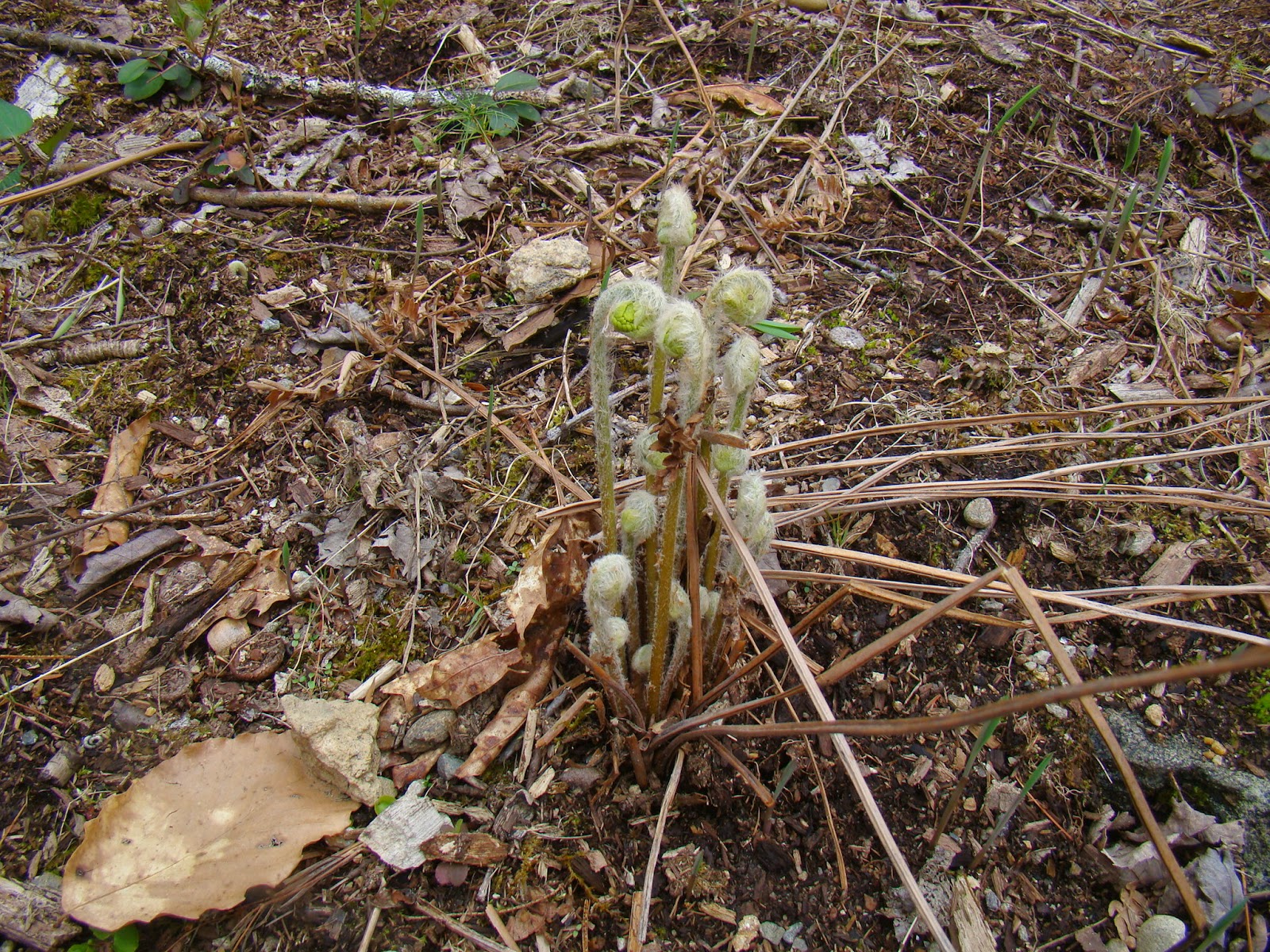
Little Canada Mayflower stalks are starting to push their way up through last fall's leaf litter, even in the most improbable spots.
Canada Mayflower (Maianthemum canadense) also known as false-lily-of-the-valley.  Confusing, isn't it?

Soon the forest floor will be speckled with green shoots.

Even the Red Oak seeds are emerging from their cradle, reaching a toe out to test the soil, revealing their true colors even at this early stage.
A Red Oak is born

It's a wonder of nature that some day such a tiny seed will become a majestic oak.
A pair of Red Oaks along the Blue Trail in the Hamlin conservation area

Most of the Red Maple flowers are gone now and they are starting to push out miniature leaves, as are the Black Cherry trees.
Black Cherry leaves, and fruit in its early form

Allergy lovers, of course, already know this.

I witnessed a couple of displays of aerial acrobatics this week as crows defended their nests.  First I saw one crow attacking another that was just sitting in the top of an oak tree.

The attacker would fly away and circle up to gather energy for a bombing run.  As it dove down at the tree-sitter, the target would raise its sharp beak and let a out a loud "caaaw" and the bomber would make a close approach at high speed, then bank hard and swing away for another strafing run.
A crow protecting its territory

This went on for several minutes - I shared a couple of videos on YouTube:

               Crow Acrobatics                Bombing Run

Another day I saw a small bird chasing a larger bird and thought it was one of the smaller birds such as a blue jay or a black bird harassing a crow. (This is known as "mobbing": when smaller birds harass a larger bird to protect their nesting territory.  Crows for example, are known robbers of young hatchlings from smaller bird's nests.)  But with binoculars I immediately saw it was a crow going after a Bald Eagle.  The eagle flew to the shoreline and found a protected branch on a white pine to land, and the crow went on its way.
The Eagle protected from its smaller antagonist

I know there are crow nests in this area, as when walking nearby the crows put up an awful racket when I'm in the vicinity of their nest tree.  They know eagles love to raid their offspring just as much as the crows love to raid those of smaller birds.  It doesn't matter if you are the largest creature in the forest;  it won't make you invulnerable to less powerful nations who will fight tirelessly to protect their country.

Soon the next bird generation will be hatching out to join with all the other new life that makes up the rebirth of New England year after year.


Postscript:  As you drive the roads in Meredith in the coming weeks, take note how good the roadsides look.  A team of generous volunteers spent their Saturday morning picking up trash along the town's roads.  The event was organized and sponsored by Dave Kutcher and DAK Financial Group in Meredith.  Next time you're down town, stop by to say thank you to Dave and his team. Many thanks all the wonderful people who participated, including employees of Meredith's DPW who took away the mountain of trash collected.  It really makes a difference in how our town looks!

Sunday, May 11, 2014

May 11, 2014

Happy Mother's Day!  Mother nature gave her best today, providing all mothers with a fabulous day at Lake Wicwas - warm and sunny with a deep blue sky reflecting off the water.

The warmer weather has brought along the trees, as more buds are swelling and starting to pop.  The Red Maples are the first to have pushed out early, tiny leaves.
May 9th


And then just two days later, they are already exhibiting the familiar structure of the maple leaf.
May 11th
The Sweet White Violet is blooming in the sunniest locations and the Canada Mayflower and some ferns have sprouted, adding some green to the otherwise brown and drab forest floor.  .

The lake is still high, and the outlet flowing rapidly;  the streams emptying into the lake are full and wide.  The high sun and open canopy allows more light to penetrate than during any other season, which aids in warming the ground, fostering the growth of the new plants.

And my now good-friend, the garter snake was out enjoying the sun again as well.

Watching the surface of lake I noticed little wakes being made by small animals, thinking at first it was a snake, but soon realizing there too many of them and their travel pattern wasn't consistent with a Water Snake.  So I took my first kayak trip of the year to investigate.  They were made by an insect about half an inch long, which I think is the Water Boatmen.  I couldn't get a picture but here's a photograph of a Water Boatmen from the North Carolina State University web site.
http://www.cals.ncsu.edu/course/ent525/water/aquatic/images/09.jpg
Water Boatmen (NCSU photo)

Continuing along the shore of the lake, taking advantage of the high water and lack of pond weeds, I saw many turtles sunning themselves wherever a spot providing good exposure.  This log had six or eight turtles all lined up it, which I didn't notice until I heard them splooch, splooch, splooch, one after another into the lake.

Soon their scout came back up to see if the coast was clear.
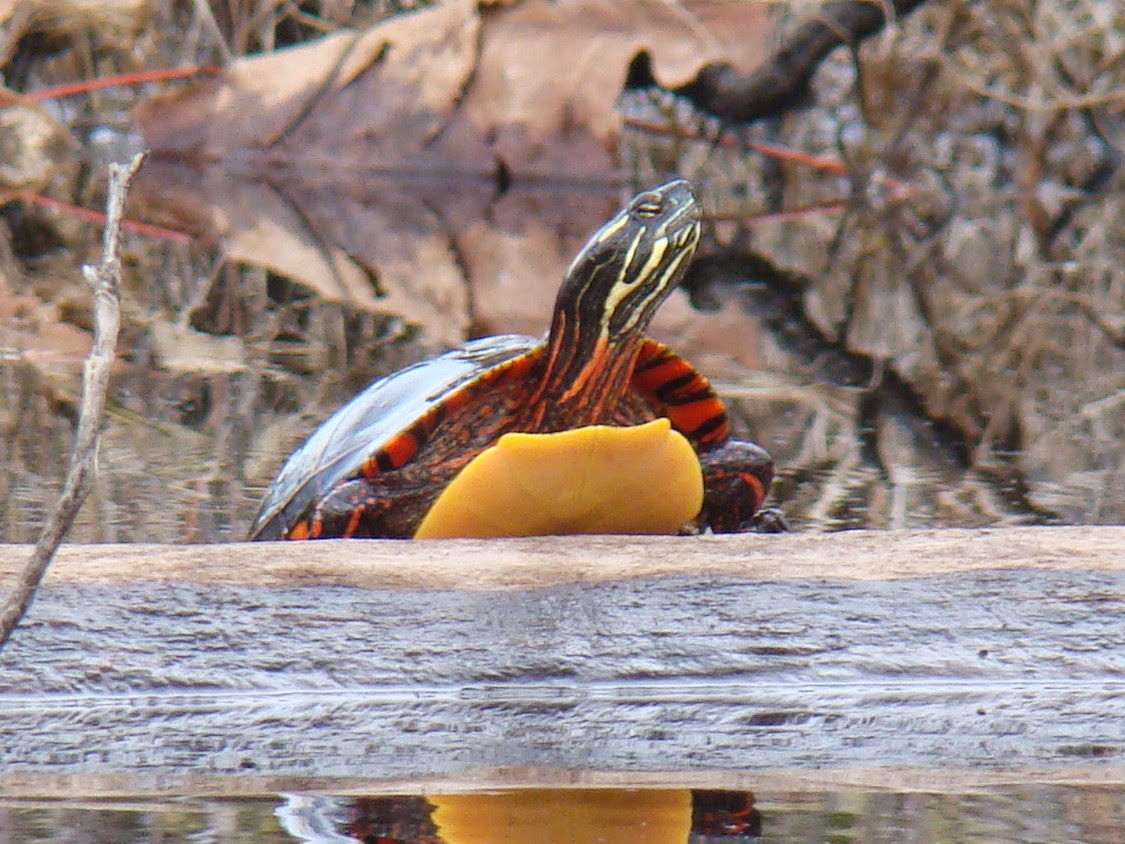
Painted Turtle

I identified a new shoreline plant that is blooming around Lake Wicwas.  This is known as bothLeatherleaf and Cassandra, and is an evergreen member of the Heath family.  It is responsible for much of the deep red and maroon color that appears all along the shore of the lake in the late fall when its foliage turns.
Leatherleaf or Cassandra (Chamaedaphne calyclata)
Meanwhile, at the bottom of the lake, plant growth is starting as well;  in the shallows I could see the pond lilies putting out leaves that will soon rise to the surface.

Pond Lilies Sprouting from the Lake Bottom


The flycatchers and song birds are arriving in large numbers now;  I watched a group of them doing acrobatics as they feasted on bugs over the water, and the raspy call of the Phoebe is heard frequently.

Last night I captured a picture of a fox;  it still had its bushy winter coat on.
Gray Fox

I suppose it is still cold in their den, and with nighttime hunting, a warm coat is in order for a little bit longer. 

Back up at lake level I came upon the male Wood Duck in the cove near its nesting site.  No sign of mom - she's at home working at the nest.  I'm sure dad is out finding her something special to bring her for a mother's day treat!
Wood Duck

Sunday, May 5, 2013

May 5, 2013

Lake Wicwas has been enjoying a fabulous stretch of spring weather - days on end of warm, sunny days with crystal blue skies, followed by cold nights with very little humidity to keep the atmosphere warm.

Daily temperature swings of 40 degrees have been common, with lows in the 30s and highs well into the 70s.  There was someone out on a tube this afternoon, and I even saw someone swimming!

I didn't see as much bird activity this week, but the warm weather has encouraged the trees to push out their leaves.  The beech and maple are well on their way, with the oaks lagging behind as usual.

Beech
Maple

I love the interesting colors the leaves make when they first emerge. 

Scrub Oak (I think)


By next week the hills will have a pale-green tinge to them as the trees start to form chlorophyll.

There are now many Trailing Arbutus blooming;  I haven't seen any other wildflowers yet, though the Canada Mayflowers have sprouted.

Canada Mayflower (Wild Lilly of the Valley)
 And the blueberries have started their work in creating one of my favorite summer treats.
High Bush Blueberry
The lack of rain and the dam lowered in preparation of spring flooding has let the water level in the lake get very low.  With a board restored to the dam last week, it is rising again.

I don't know how long this weather can last, but it sure is nice while we have it.
Tubing on May 5th!