Showing posts with label Song Sparrow. Show all posts

Sunday, March 31, 2024

March 31, 2024: Song Sparrow Surprise

Happy Easter!

We are lucky to fit Easter in between late winter snow storms.  I was up in Franconia Notch after last weekend's big storm for what I though would be my last powder day of the season - Cannon Mountain is beautiful on a bright winter day.

Cannon Ski area with the Franconia Range looming behind.

I don't have a lot of confidence in weather forecasts after the last storm dropped twice as much snow as predicted, but they're forecasting another nice snowfall in the middle of this week, so maybe we'll get one more last powder day of the season.

With both the winter birds and the early migrating birds in the area we had quite a few visitors to the bird feeder which we put back out for a couple of days during and after the snow.  There was one very pretty bird on the feeder that I didn't recognize.


It had a long bronze colored tail and sharp markings on its back.  I'm embarrassed to say that when I looked it up I found it was a Song Sparrow.  I guess they've never shown me their backside before - I've always considered them to be rather plain brown bird, but this perspective taught me to never judge another being until I thoroughly understand it!

We saw plenty of snowbirds, chickadees, goldfinches and mourning doves, as well as more pine siskins, and they all very much enjoying food not buried under the snow.  Goldfinches, snowbirds, and pine siskins are plenty happy with the small millet seeds.

Small birds with small beaks are very happy with small seeds.

But not the White-breasted Nuthatches.

No thank you.

Nuthatches are never satisfied with small seeds - it dropped this rejected morsel down onto the snow for some other bird to have and went back to shovel through the feeder for a seed more to its liking.

This one will do.

One of our many beavers came by early enough in the evening for me to get a good picture of it swimming by.

A large beaver cruising the lake early one evening.

When you have something for perspective you can see how much larger this rodent is than the mink that went by a couple of weeks ago.

As everyone has heard, the big astronomical event of the decade for New England occurs in just over a week on Monday, April 8th when there will be a total eclipse of the sun in northern New Hampshire.  It may be my last opportunity to experience a total eclipse, though being April, my expectations for a clear sky aren't high.  But with such a rare event, I'll be ready for it if we get lucky.  The Lakes Region isn't quite in the path of totality, but it will still be a good show with about 97% of the sun blocked by the moon.  If conditions are even slightly favorable I'll probably fight the crowds and head up north to experience the complete blotting out of the sun.  Lancaster is right on the edge of totality, and I expect there will be a lot people heading up Route 93 to Lancaster and points north, so it might be a bit of fiasco.  But with another total eclipse not visible in New England for over 50 years, I'll give it a shot.  From my recollection of an eclipse years ago it won't get totally dark, but it will still be neat to be able to see the corona around the sun.  I even got a solar filter for our binoculars so we can get a good look at the event, and I purchased another filter for my camera.  I know I won't be taking pictures that rival what the professionals will capture, but it will be fun to see what I can get.  

From what I've read, taking pictures of an eclipse is challenging due to the dramatic changes in light intensity between even a sliver of sun being exposed and the moment of total eclipse, especially when you have only seconds during totality.  So I did a little practicing with the sun and the moon.  The solar filter is pretty neat, letting me see sun spots on the surface of the sun.

Sunspots visible with a solar filter that blocks over 99% of the light.

A new crescent moon a couple of weeks ago showed the challenges of photographing different brightness levels.


Those two pictures are of the same moon just moments apart, but with the first photo exposed to show craters on the crescent of the sunlit surface and the second showing the dark side of the moon.  The second photo has a much longer exposure to capture what appears as total blackness in the first picture, but is actually lit up very dimly by light from the sun, reflected off the earth back toward the dark side of the moon, then after hitting the moon being reflected back to earth into my camera.  The long exposure means the lit crescent is highly overexposed, and even a few bright stars are visible in the second photo.

All this preparation before an event that might not even be visible in the often cloudy days of April, but if we can see it, it could be a once-in-a-lifetime experience.  

But before that happens, maybe there's one more good powder day in store for us?


Sunday, April 9, 2023

April 9, 2023: Spring Overture

Happy Easter!  

And with Easter came the early sounds of spring.  It's just the opening overture before the full spring musical arrives, but the early spring songbirds are here and they are singing the opening of the first act as the spring migrants are arriving now in droves.  This week I saw an eastern phoebe, a brown creeper, a song sparrow, a few great blue herons, several robins collecting nest material, a flock of over two dozen American black ducks, and the first pair of mergansers. 

A pair of common mergansers fishes in a sliver of blue water.


Most exciting to see was the brown creeper, a small bird that mostly keeps hidden in dense forest as it creeps up and down tree trunks looking for insects. 

A song Sparrow and a brown creeper glean seeds as the snow recedes.
Brown creepers are resident year round but I only hear them in the summer, and only once or twice have I been able to follow the song to actually see the bird.  But here in spring, there was a single bird collecting leftover seeds below where the feeder had been.
Brown creepers have a long, down-curled beak that helps them probe into bark crevices in search of insects.

The birds are relegated to finding leftovers now that the feeders have been removed for the summer as bears are up and on the prowl, very hungry, and bird feeders are a strong attractant to unnatural habitats.  

The first heron that I saw came flying in low over the still frozen lake and plopped itself down on the shoreline in front of a gap of five feet of open water.  


Just moments before this we thought we saw a duck sitting on the ice near this stretch of open shoreline, but when we looked closely we realized it wasn't a duck, but in fact was a mink.  The mink tramped around on the ice a little bit before sliding off the ice into the water and swimming along the shore out of sight.  But when the heron flew in, that obviously caught its eye because the mink swam right back up that sliver of water and stopped at the edge of the shoreline right in front of the heron.
You can just barely make out the mink to left of the tree reflection in the water.


Upon reaching the shore, the two of them had a stare-down.  


I'm pretty sure a heron wouldn't go after a mink, but less sure that a mink wouldn't attempt to grab a heron, though I think once it encountered that pointy four-inch beak it would regret that decision.   But we won't know because that heron decided there were other places to fish and it flew off to a less crowded fishing spot.


Strong April sun and a brisk northwest wind on Friday started to break up the ice with large cracks forming miniature icebergs.  A few more warm days next week and we may be getting close to ice-out.  Ice-out on Winnipesauke was called on Friday, April 7th.
The ice started to break up on Friday.

Yes, it's the dichotomy of spring.  Remnants of a frozen winter,
A snow-covered trail on Arbutus Hill.

slowly melting away into a liquid spring,
Spring snow melt cascades down a stream in the Hamlin Town Forest.

which the trees soak up to resurrect their eternal life.
Red maple buds getting ready to burst on the next warm day.

I also had a report of spring peepers being heard just south of the Lakes Region.  (Thanks GP!)  That always adds a fine soprano voice to the spring orchestra!


Sunday, June 9, 2019

June 9, 2019: A Second Nest Appears

For the second year in a row there are two loon nests on Lake Wicwas.  I expect we'll see a band on the first pair to know it's our long-resident female, but without bands to identify the second pair we we can only postulate these are the same birds which have returned for another year.

The second nest is in a secluded spot on the lake where there isn't much boat traffic so it will not be marked with signs and its location won't be advertised.  If you do happen to come across it or observe a loon behaving strangely just move away from the area.

I noticed the nest because two loons were close together near shore but clearly not fishing.  Thinking something was going on, I took some pictures from a distance but only after blowing them up did I see they were building a nest on a tiny mound of earth.  One bird was at the nest pulling up weeds while the other loon was farther out searching for more substantial building materials and bringing them back.
A dive down to find some nesting material

What did we find?
A pretty little lily pad for the nursery


According to the Loon Preservation Committee, both the male and female participate in home building.
The second loon gathering sticks for the foundation


As of today a loon is sitting happily on the nest, though it has no shade at all so when the weather gets hot it might not be so happy.  It will be important for one parent or the other to stay on the nest as an egg can cook quickly if exposed to the hot sun.  They'll switch positions frequently to allow their partner to go for a swim and cool off.

Last year both of our loon pairs laid two eggs and each hatched a single chick, but both of them succumbed to the many threats a loon chick faces. Let's hope things go better this year.

The other large birds that nest on local lakes seem to fare much better, and the parents have already hatched their eggs and are out on the water tending to their brood.
Seven little goslings in a row

Geese and loons will sometimes interact but mostly they keep their distance from one another.

When I was out attending to some conservation areas on the lake this week I was visited by a few other birds including one I don't see very often.
A curious song sparrow wondered what I was up to

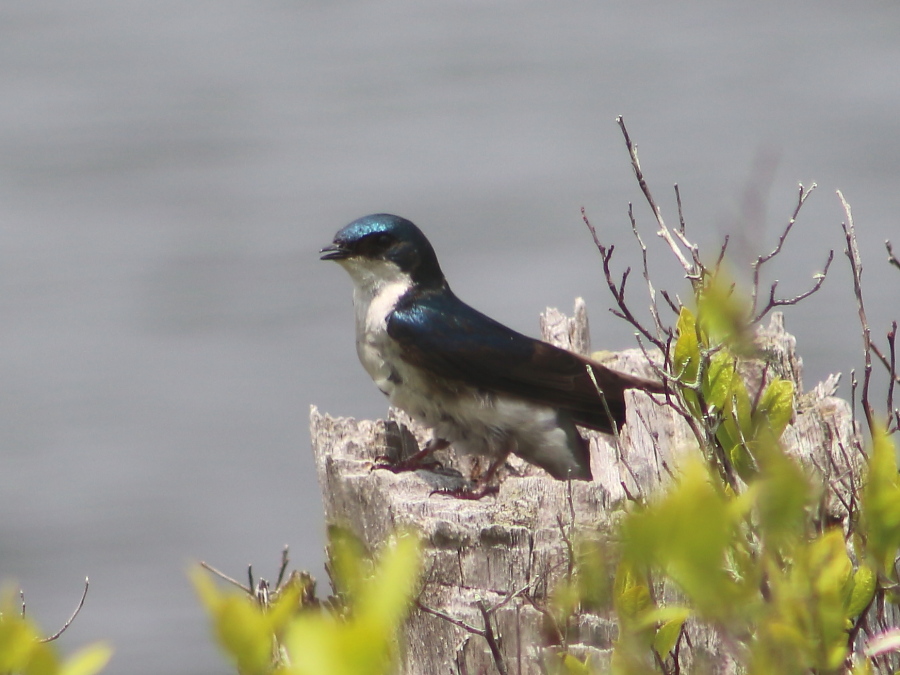
And a tree swallow sat for a long time and watched
 Both of these were on Turtle Island.  This next one was poking along the rocks over at Bryant Island looking for insects to eat.
I don't see a spotted sandpiper on the lake very often.

It's always nice to have some company to share the beautiful sights of early summer on the lake.

Sunday, April 14, 2019

April 14, 2019: The Caravan has Arrived

The first wave of migrants has hit New Hampshire.  The initial sign was the geese, but this week many others started to arrive in droves.  The unmistakable call of the phoebee from the tops of the trees was heard first, and that was soon followed by flocks of dark-eyed Juncos travelling back to the north country.
Dark-eyed junco (Junco hyemalis)

 I find it's one of the hardest birds to photograph, especially on a dreary day


It was unusual for me not to see any of these little "snow birds" around this winter;  they must have traveled to other climes which had better food sources for them.  The first flock arrived on a cold snowy morning, followed shortly by mixed flocks of sparrows and finches making their appearance.
 A common redpoll


Even without the bird feeders in place and after raking as much of the seed from the ground as possible these specialist in small seeds found plenty to keep them busy.
A couple of redpolls share the leftovers

The nuthatches are far too demanding of their large seeds and nuts to bother with little millet seeds down on the ground.  And it was sad to see the wood peckers come by looking for their usual feeding stations, circling around trees and posts wondering what happened to the easy pickings.  One of the less common birds I see, the common redpoll (an oxymoron there?) was in the flock.
Common Redpoll (Acanthis flammea)
A distinguishing feature of the redpoll is its black face

Just because I don't see them often doesn't mean they aren't numerous.  Estimates of the redpoll population is in the tens of millions, all located in the far northern latitudes.  Though not a finch, they are in the same family as finches and share many of the same characteristics including the preference for tiny seeds as fits their small beak.  Studies have shown that during the winter their diet consists of almost entirely birch seeds.  [REF:  Cornell Lab of Ornithology]

Other members of the flock include the very common Song Sparrow, which in a few weeks will be serenading us with its melodious song on warm spring mornings.
The song sparrow (Melospiza melodia) lives up to its name

We did suffer a set back on those elusive summer mornings this week when a coastal storm brought in some cold weather and an inch or two of wet, soggy snow.
April showers, New England style

But it won't last long, and we're already back to opening up larger bits of lake to attract more migrants to our lake, including, soon, we hope, our loons!
More open water will attract beavers and ducks soon, and the loons won't be far behind.


Sunday, April 16, 2017

April 16, 2017

Happy Easter!
Easter Morning at Lake Wicwas
Yes, with warm weather this week, real signs of spring are visible around the lake.  The ice on Wicwas still has a ways to go, but it is opening up good size gaps around the shore now and the surface is getting that translucent blue appearance indicating the end is near.
Saturday at the boat ramp

That's what a couple of days in the 80s will do for us - in addition to a good attitude adjustment!

When that warm humid air descended on the frozen lake it formed wisps of fog that blew across the ice.

Then as the wind shifted to the north in the late afternoon, blowing in colder air to attack the moist air from both sides, the fog turned dense.

By evening the fog was dissipating just enough to provide an eerie sky and an orange sunset.
Mysterious Evening.  Photo credit: Sue DeMund Mangers

We lost a good foot of snow pack in two days, revealing the first signs of color in a long time.
Partridge Berries revealed in time for Easter
Though there is still snow to be found in cool, shaded areas.
Plenty of snow around on Saturday
On any walk now the air is filled with the song of birds praising the spring warmth - and attracting mates.  The pretty call of the Song Sparrow can be heard everywhere;  you can listen to it here.

They aren't as well camouflaged when they sit on the snow.

We also had the first beaver sighting of the year.  We saw ripples in the skinny channel of open water far away along the shore, and were pretty sure what was making them, as the time was about quarter-past-beaver in the evening.  It took a while, but eventually it made its way along the shore to our vantage point, at which point it hopped up out of the water and onto the ice.

It snuffled around in the water where we had cut some branches on the ice this past winter.

It somehow detected there was food there and found a few scraps left behind to nibble on.

It turned to wave goodbye to us before slipping back into the ice cold water to go on its way.

What's one of the best, brightest, and surest signs that spring is here?  Male goldfinches shedding their drab winter feathers for their spring, get-a-girl plumage.
Still a few gray feathers left, but almost dressed and ready to go out for a date
It is spring, and love is in the air.

Late breaking update:  The Thorpes saw a pair of Bald Eagles on the lake, and Sue Mangers just reported the first loon has arrived!
More animals waiting for the ice to melt!  Photo by Dave Thorpe
Photo by Dave Thorpe
The first loons!  Photo by Anne Crane