Showing posts with label Red Fox. Show all posts

Sunday, May 10, 2020

May 10, 2020: The Ear of a Fox

Old man winter is having a hard time letting go this year.
Saturday, May 9th


I've heard of April Showers, but Snow on Mayflowers?
Snow on the mayflowers (trailing arbutus).

Yes, we had a bit of snow yesterday, and some cool weather all week.  There haven't been a lot of birds singing their spring songs on those cold mornings, but I did hear one bird that was appropriate for the weather:  a winter wren.  These are easy to hear as they have a loud, bright song for such a tiny bird, but they are much harder to see since they spend their time down on the forest floor poking around in the leaf litter.  The guide books will tell you they like to hop along fallen trees looking for insects, and that's just where I was able to spot one, right as it was belting out its effervescent song on this early, cold, dark morning.
A winter wren sings its outsize song.

Well, that's New England weather, and being New England, of course there were beautiful days this week too.  On one of the nice days I learned yet again that you don't have to travel off the beaten path to find interesting nature sights.  During a run along Chemung Road on one nice day I looked down and saw these emerging lily pads in Lake Wicwas right beside the road.
New lily pads under the water.

We've all seen lily pads many times in the summer and they are always green, packed with chlorophyll from photosynthesis.  But these new leaves are just forming and were still a couple of inches below the surface of the lake.  Like the leaves of the red maple tree, lily pads must have red pigment in them that's only visible before (and after) photosynthesis dominates the color palate.  It's the same reason leaves turn color in the fall as photosynthesis ceases.  Very soon these lily pads will rise to float on the surface of the water where they will become green with chlorophyll as they turn sunlight and carbon dioxide into energy for the plant.  It's nature's little power plant.

Now to the fox.  Our local fox has been relegated to walking on land since the ice left the lake, and on another early morning I found it on the hunt for breakfast.  It was so intent on tracking down its meal that it didn't notice me and I got to watch it for a couple of minutes - it was on the track of a small rodent.


I have seen chipmunks in the the pile of rocks it was studying so that may have been the source of its attention, but there are likely mice in there too.  Even though fox have good noses, they hunt by sense of sound.  Scent can linger for a long time, so if they went searching after every scent they came across they'd have a low success rate.  But if they hear something, they know their meal is present right now.  This fox stood silently listening.  It cocked its head one way and the other to best hear the rodent.


Then it would tip its ears forward, or rotate them to the side, all in an attempt to geo-locate the exact spot.


Now if it were winter, once pinpointed under the snow, the fox would jump up in the air and pounce down upon it, catching it under the snow with its paws.  But in this case, it either lost the track, or decided the rampart was too much to breach, and it went on its way to search for a more accessible meal.

Hopefully I won't be seeing fox tracks in the snow for many months now - we just need old man winter will let up a bit and let mom enjoy some nice spring weather.
Primrose, courtesy of Linda.

Happy Mother's Day to all, wherever you are and whatever weather your day brings you!

A virtual hug for mom.


Sunday, March 29, 2020

March 29, 2020: Turkey Trots

March came through for us with one more late winter snow, and as March snows tend to be, it was beautiful.

Morning breaks on the fifth day of spring.


We are now past the spring equinox so the sun is bright and high in the sky which baths the pristine world in a softness that January just can't deliver.

Mountain streams are flowing with snow-melt.

March skiing in the Ossipees

It also means the snow doesn't last long especially when it falls on bare, warmed earth.

Just a few hours of late March sun has already taken its toll on the snow.
Shannon Pond in Moultonborough.

On the still-frozen lakes however, late snow can set back ice-out quite a bit.  Before the snow fell the lakes were getting soft and dark and absorbing much of the sun's energy, but the fresh cover of bright white will reflect the sun's rays for several days and greatly slow the process.  At this point we are probably looking at an average or slightly early ice-out in the Lakes Region.

The nice soft snow also rejuvenated the world of tracking.  In one short wander around Lake Wicwas the day after the snow fell we found the tracks of at least eight different animals, all of which had traveled by in just the prior 36 hours:  deer, fox, turkey, otter, mink, squirrel, mouse, and mole.  The most entertaining of these was a set of tracks left by a flock of turkeys taking a long stroll to enjoy the pretty spring day.

A flock of turkeys passed this way.


A hen (female) and her brood (chicks) will join other families in large flocks in the fall and winter and cover a range of 4 to 5 square miles searching out the best food supplies as the seasons change.  [Ref:  NH Fish and Game]  I always get a reminder of turkey history when I refer to one of the more unique NH wildlife books, Hilbert Siegler's New Hampshire Nature Notes written in 1962;  it is completely silent on turkeys.  That's because there were no turkeys in 1962 after being hunted to extinction in the state (which is called "extirpation").  A first attempt at reintroducing turkeys in 1969 failed, but a second attempt in 1975 was successful, and today there are 40,000 turkeys in NH, the maximum carrying capacity of the state.   There is a nice historical article about the turkey reintroduction in the March/April 2020 issue of the New Hampshire Wildlife Journal.


Right about now the Toms (males) are attracting their harem with impressive gobbling and bold plumage displays - mating will take place in April and nesting in May.  By June we'll be looking for cute little turkey poults running around, eating up tics, ants, and other annoying insects.  Thank a turkey!


But they best keep a careful lookout - the foxes are making regular patrols of the local area, still using the lake for travel.

The fox is still making its daily excursion across the softening lake.


I was a bit surprised to see people out fishing on Lake Wicwas yesterday, even if they were staying close to shore.

The last hurrah of ice fishing.

They told me there's about 6 inches of ice (that's near the boat ramp).  That seems about right as there's still open water only close to shore.

Open water is expanding, but only at the edges.


But every day we make progress - first the snowdrops, and now crocuses.

Perfect New Hampshire juxtaposition:  flowers with a snow shovel.


There is even a little red appearing through the melting snow pack.

An over-wintered partridgeberry, just waiting for a partridge or turkey to gobble it up.

Time may be passing slowly, but each and every day, we move forward.
Snowdrops keeping the faith.

Sunday, March 22, 2020

March 22, 2020: Fox Are Still On The Ice

I may be done on the ice for the winter but the fox still trust the ice enough to use it for a short cut to the other side of the lake.  One morning after a cool night, this healthy looking red fox came trotting across the lake and stopped at the shoreline.
Hmmm, do I want to go up here?


It seemed to know the ice at the shore is treacherous, as it decided not to go up on land there, but work its way along the shoreline.


It soon found an area where the gap from ice to land was small, and due to the cold overnight, the open water had a light skim of ice over it.
This looks better.

The fox studied the situation carefully.

Appearing solid, it carefully tiptoed over it, quickly bounding up onto dry land without so much as getting a toe wet.
One small step for foxkind


And soon it was on its way, probably back to its den to sleep the day away, hopefully with belly full of mice.


Most foxes have mated by now, so if this was a female she may need enough food to develop up to 12 pups - though more typically half that number, depending on food availability and other factors.  With a 50 day gestation period, the young are typically born in the April to May time frame.  Friends who live on the north end of Lake Wicwas had a fox den near their yard a couple of years ago and enjoyed watching the young pups play together in the early summer.  I've never had the opportunity to experience that, as foxes like warm, south facing slopes to build their dens, and we don't have that exposure near by.

In addition to cool nights we had a few light snowfalls, one that provided some tracks including this nice gray squirrel sample.
Gray squirrels are another fox delicacy.

Farther north the snow accumulated enough to refresh the mountains' coat of white.
The Lafayette Range is white again, as seen from the summit of Mt. Flume.


 .

And the fast track of storms blowing through have made for dynamic atmosphere conditions with interesting clouds and sunsets forming as warm and cold air masses bump into each other.
Three different layers of clouds formed as the temperature rose 20 degrees in a few hours. 
Fog on the ice, low clouds above the trees, high clouds on top.


The cool weather and snow slowed, but didn't stop, the process of the lakes returning to liquid form.  Cracks are opening in the ice with ice flows starting to break away.


Meredith Bay is opening up more each day, but it still has a ways to go.


.

We enjoyed fine waterside dining with take-out lunch in our car overlooking the bay, and then went for a walk to a waterfall we haven't visited before in Plymouth.
Rainbow Falls in the Walter-Newton ConservatConserion Area in Plymouth.

With so many things closed down we're spending even more time outside with nature - it's nice that the forest is still open for business.
The Sky is still open too.


 .

If I see you on the trails, I promise I'll keep my distance.


Sunday, December 15, 2019

December 15, 2018: There's a Story in these Tracks

There's a story to be told in these tracks, but I don't know what it is.  On Monday I noticed a plethora of turkey tracks running along the ice near the shore, and following them I saw that they came from far across the lake.
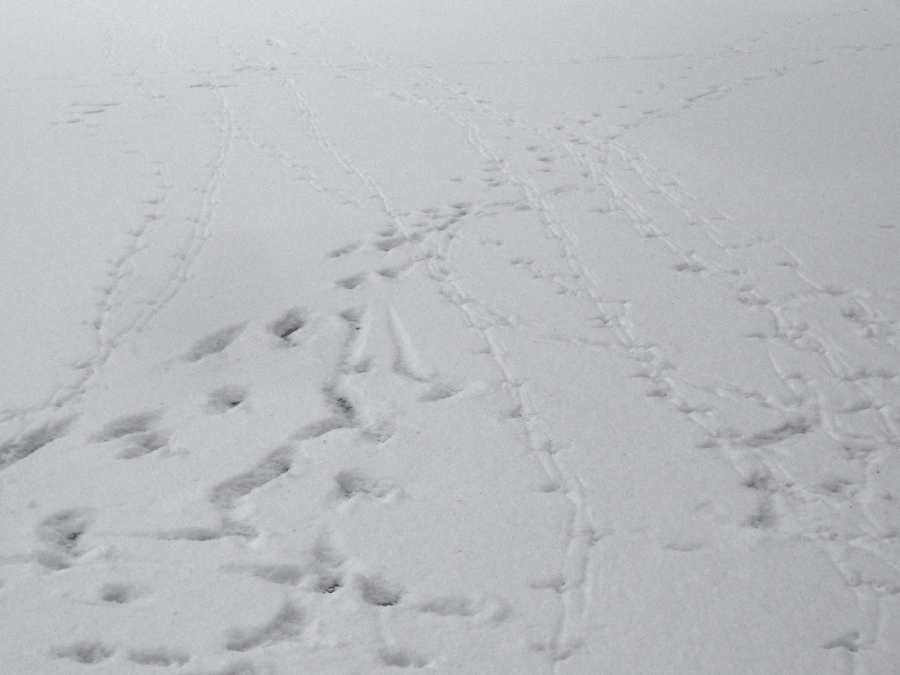
Co-mingling fox and turkey tracks.
The turkey highway turned right to follow the shoreline.


With the ice being thin, I wasn't about to follow them to see where they came from from, but I did venture out a few feet to investigate a larger disturbance in the snow amidst the turkey highway; I could something occurred where a set of fox tracks collided with the turkey tracks.
Even fox slip and slide on the ice.

The fox had clearly spent some time here poking around on the ice.
Looking for something of interest.

But what's the story?  Who was there first?  I couldn't tell which tracks were on top of the other.  The animals certainly didn't encounter each other as both animals would be extremely obvious on the open lake in daylight (turkey roost at night) and there is no sign of concern on the part of the turkeys - the tracks pass straight through.  I'd say the flock of turkeys just took a path across the lake and the fox happened upon the tracks sometime later.  But why all the interest paid by the fox?  Perhaps a turkey left a dropping there that caught the nose of the fox.  It will be just one more mystery of nature that goes unsolved.

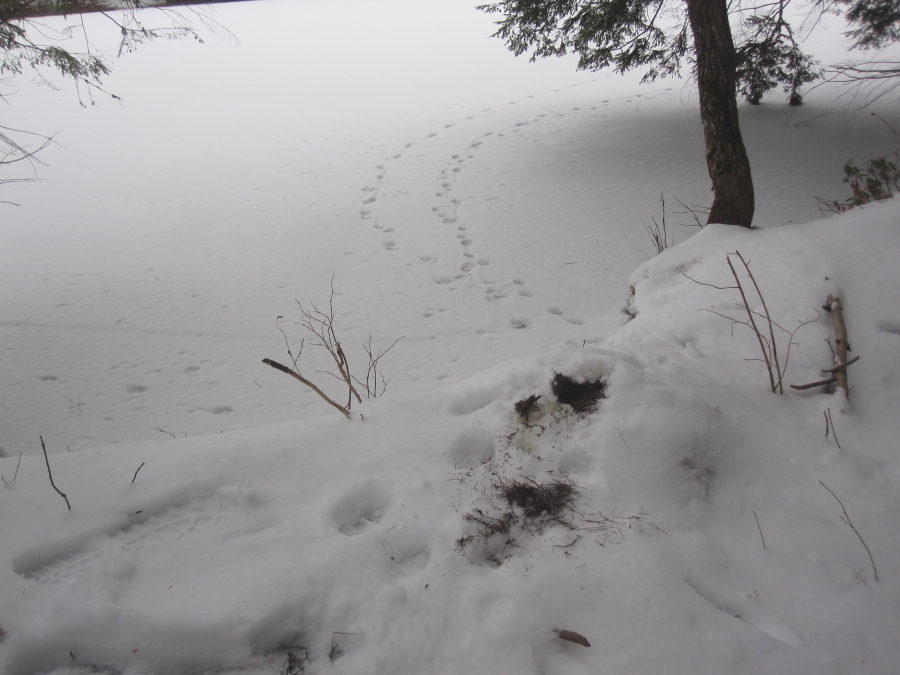
A bit farther along the lake I saw where the fox came up off the lake to leave its marker on the shore.
Several sets of tracks here - a pair, or a repeat visit?
A little scratching and a urine deposit.

It then turned around and backtracked on its tour of the shoreline.  In the track I found some prints on the ice which showed good examples of fox prints with the two toe claws visible.
If you see claw imprints (on left) you can be pretty sure it's a fox rather than a bobcat.


Then a couple of days later I saw the likely culprit taking another late afternoon trip across the lake.

It's looking like this could be a fun winter for fox watching.

Alas, all the snow is now gone.  The warm weather on Monday melted all the snow we had on the ground, but it didn't re-open the lake, so ice-in on December 8th looks secure.
A warm, rainy day on Monday meant the end of tracking, but it provided good skating conditions.


Ice in was a few days earlier than the recent trend line but well within the normal range.  On Thursday, after a couple of cold days I cut a hole about ten feet from shore and found 4" of solid ice.  By Friday afternoon after cutting a few more test holes I decided it was safe enough for a skate within Marion Cove, but no venturing farther out than that.
Good ice for skating on Friday in the cove.

Rain yesterday could mean even better skating conditions.  Winter activities have arrived, but New England weather will dictate whether we'll be skiing, skating, or hiking next.
Standing water on the ice this morning, just waiting for a quick freeze.