Showing posts with label Painted Trillium. Show all posts

Sunday, May 24, 2026

May 24, 2026: Woodland Flower Exhibition

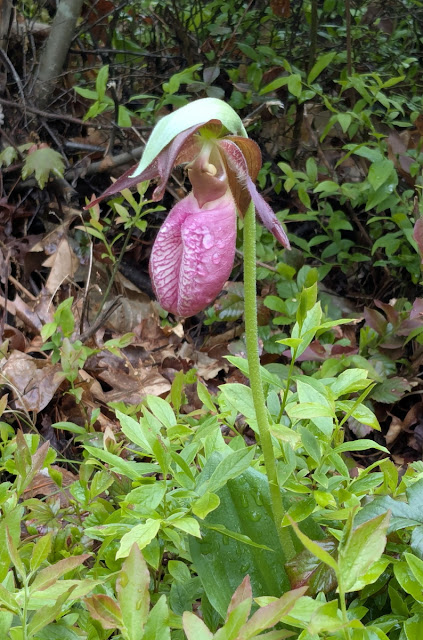
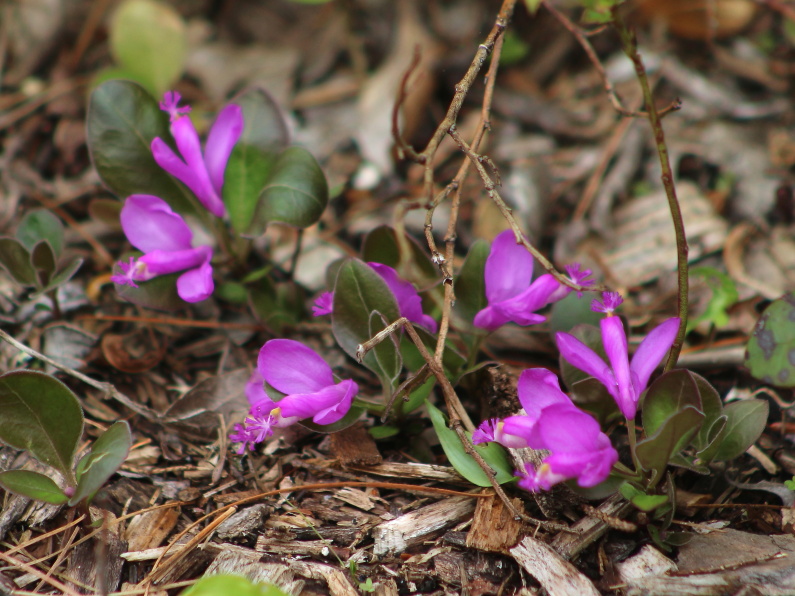
It's the time of year when the elegance of woodland flowers, those ephemeral wonders of evolution, draw me into the forest each spring.  Last week the trilliums were blooming.  This week the Eastern Starflower, Fringed Polygala, and even an early Pink Lady's Slipper burst onto the scene.

A Lady's Slipper in a sunny spot makes an early appearance.
The lady's slipper is one of our more ancient woodland flowers, having evolved when the last dinosaurs roamed the earth some 70 million years ago.  They can be long-lived, up to 50 years, but are slow growers, requiring over a decade before they form their first flower.  The starflower and trillium are more recent arrivals.

Eastern Starflower
 
Painted Trillium

High above these small plants, the pale-green color of the forest canopy shows the deciduous trees are about to pull the shades on the forest floor, dimming the light that granted these flowers their chance to shine. 

Pale green leaves as chlorophyll starts to develop in them.
Maples are fast growers and already have leaves and even seeds well formed.
Red Maple with many "helicopter" seeds

The slower-developing oaks are farther behind.  But with long days and warm temperatures, they're coming on strong now, and are dumping copious amounts of pollen from their abundant flowers.

Those long dangling flowers are full of pollen to torment allergy sufferers

Perhaps you noticed the hummingbirds in last week's blog were all female ruby-throated hummingbirds which lack the ruby throat of the male.  This week, I saw both male and females at our feeder. 

Mr. Ruby comes in for a drink, landing gear deployed.

Here is Mrs. Ruby-throat, waiting patiently for her turn.
Mrs. Ruby - lacking a ruby throat.


I'll end today with nature's sky show from the week.  Venus has been bright in the western sky all week (and still is, along with Jupiter). 

Venus hugging the moon with Jupiter above to the left.

On Monday evening it was in close proximity to the crescent moon. 

Venus and Moon were alright that night.  (With apologies to Sir Paul McCartney.)

There was probably some astrological meaning there!


Saturday, May 16, 2026

May 17, 2026: Busy Beavers

A beaver dam holds back the large pond in the Sherman Easement at Page Pond.

I was out with the trail crew on Tuesday morning doing winter clean up and spring brushing of the trails at Page Pond.  One team worked on the wetland loop, while I was on the team that patrolled the Brook Trail and the Beaver Pond Trail, the later of which is living up to its name.  Beaver activity is evident by cut trees and the well maintained dams.  (There are several dams visible from the trail, including a series of dams along the stream that drains the large beaver pond on the Sherman Easement).

For food, beavers prefer deciduous trees with nutritious bark and low tannins and noxious chemicals:  aspen, birch, maple.  They get less picky when food is in short supply, and they'll cut down almost any tree for use in dams and lodges.

I think this is an Eastern Hemlock
Their well constructed dams kept the pond full even with our dry spring (until later in the week).
Much of the right had side of the pond is a dam.

I would have been interested to see what the pond looked like after we received 2.75" of rain on Thursday.  The Beaver Pond Trail is especially beautiful in spring when many wild flowers bloom along the trail, and both purple and painted trillium are blooming right now.  The trail is most easily accessed from the Blueberry Hill Road Trailhead.
Painted Trillium

Lake Wicwas rose about 11" as a result of that storm, and low-lying areas of the shoreline are flooded.
+12" at the Wicwas Dam on Saturday.

On my check around the lake, I came across quite a bit of beaver activity on Wicwas too. 
These are also hemlocks.  The bark and cambium were removed from most of them; only the one on the far right was cut down and taken away.  Trees with bark removed all the way around will likely die.  If you'd like to learn more about beavers, here's a fun, two-minute video from NH Fish and Game that a friend sent me. (Thanks DM!)

Beaver aren't the only animal munching on trees.  Early in the week I saw that the Hobblebush Viburnum were starting to bloom.
Hobblebush Viburnum

These large flowers last a long time and transition through multiple stages of flowers and fruit.  However, all the flowers and most of the other buds and branch tips on the entire stand of hobblebush were soon cut off.  A few days later I found where they had gone.
A fresh pile of deer droppings near the viburnum.

Those hobblebush flowers have been processed into fertilizer to nourish the next generation of forest plants.  Deer right now are feasting on plentiful tender, new spring growth, especially does which will soon be giving birth to one or two fawns.  

Here's evidence of one more animal that feasts on trees, and not one we're fond of.
Emerald Ash Borer damage.
The Emerald Ash Borer is an invasive species that has decimated the ash trees in North America.  The larvae bore under the bark and feed on the cambium just like the beaver, and once the tree is girdled, sap carrying water and nutrients can no longer pass from roots to leaves and vice versa.  You can see this tree is right beside the Yellow Trail in the Hamlin Town Forest; it was cut down after it died to keep the trail safe.


I'll end with a small bird report - a really small bird, the Ruby-throated Humming bird.  A couple of friends put up a hummingbird feeder with a camera built into it which automatically records both still shots and videos whenever a bird comes to the feeder and triggers the motion sensor. 
Photos by Pam Hunt.
Being within inches of the birds, the camera captures a lot of detail.
In the video below you can see how rapidly it cycles its tongue in and out, and how fast it breaths - about 4 breaths per second - by the way its abdomen vibrates while it's feeding.  Turn up the volume so you can hear it chirp when it first lands.
Here's a slow motion version where you can see its tongue, and get a glimpse of its wings which are flapping about 50 times per second.
This is a fun camera - thank you Pam and Bob for sharing!


P.S.  Remember that as lake temperatures rise, the concern of cyanobacteria rises as well.  The Lake Winnipesaukee Alliance is sponsoring an open event on June 17th at the Meredith Community Center for people to learn more about how to deal with this increasing threat to our lakes.  It runs from 6:00 to 8:00 pm; you can learn more about the event and the cyanobacteria threat here.


Sunday, May 25, 2025

May 25, 2025: Northern Water Snake

Swimmers in New Hampshire lakes might not be pleased to see this, but rest assured that these snakes will flee from anything larger than a big frog, especially humans, so there's nothing to worry about unless you decide to approach one of these guys.

A northern water snake on a midday search for food or a mate.

Northern Water Snakes are very common around all our waterbodies, rarely found any distance from a pond, lake, or stream.  They are excellent swimmers and especially active this time of year when they are searching for mates.  After mating the two snakes will go their separate ways, with the female gestating 10 to 30 young until late summer.  During this time, water snakes feed primarily on fish and amphibians, but also crayfish, leeches, and other snakes.  

Snakes use their tongue as a sensor.  They stick it out to collect airborne molecules on it, then pull it in into their head and place it into an organ that lets them smell what was captured on the tongue.  The forked tongue provides a stereoscopic capability which lets them determine the direction of the source. 

Sticking our its tongue to smell.

Northern water snakes are not poisonous, but do have sharp teeth they use catch and hold onto their prey, which they swallow whole.  With fast reflexes they are able to catch fish, sometimes hunting minnows at night, though they are most active during the day, and are often found sunning themselves on a warm rock or branch at the water's edge.
A good size water snake I found sunning itself on a rock a few summers ago.

Predators of water snakes include birds, racoons, and snapping turtles, as well as other snakes.  Some day maybe I'll see an eagle swoop down and grab a swimming snake off the surface of the lake.


The female water snake is ovoviviparous, meaning it gives birth to live young which are left completely on their own.  This is the time for larger fish to exact revenge, as the infant snakes are especially vulnerable to fish.  Many of the young won't survive, but with a couple dozen snakes born every year over perhaps a five year life span, the species is not in danger - where there is a good food source.  The biggest risk to this species is the loss of natural waterfront habitat which provides the food it needs.


I haven't seen a snake sunning itself on this tree trunk that fell into Lake Wicwas, but lots of other animals have been using it including turtles, geese, ducks, and this week, a Double-crested Cormorant.  

Double-crested Cormorant.
A pair of mallards does their preening on the log.


The water level in Wicwas is still about 10" above normal, but at least one pair of geese was able to incubate their eggs before the lake flooded.

Looks like five goslings.

The loons, however, are still cruising the lake, waiting for the level to go down before building a nest.  One day we saw both pairs of loons floating on their respective side of the line that divides the two territories, and both pairs were vocalizing loudly to let the other pair know they need to stay where they are.  The northern pair did have an intruder one day, which they appear to have quickly sent packing to another lake.

An intruder in the northern territory.


Cool weather has extended the period of the early wildflowers; all the ones noted last week are still in bloom.  This week the Lady's Slippers are in peak color, the Painted Trilliums have started to bloom, the Canada Mayflowers are about to, and the various cherries are in full bloom.

Painted Trillium.

Lady's slipper in a deep color.

Canada Mayflower about to bloom.

I also saw a small Jack-in-the-Pulpit just starting its spring sermon.  

Jack-in-the-Pulpit

There will be more of these soon, but you have to look for them as they hide under cover of their leaves!


Sunday, May 19, 2024

May 19, 2024: Eastern Kingbird

A pair of Eastern Kingbirds appears to have taken over the local hunting grounds from the Phoebes.
Eastern Kingbird

The Phoebes are still around as proven by their loud raspy calls every morning, but the larger and more aggressive Kingbirds have achieved air superiority over the prime airspace near the edge of the lake.  Kingbirds are known to harass much larger birds like crows, and even hawks, that dare invade their territory, so the little Phoebes had no choice but to move over.  Being flycatchers, Kingbirds perch on trees near the water, darting out to catch insects, sometimes rather large ones like bees and dragonflies.  They like to assume a position at the very top of a small tree where they have a 360 degree view of their world.

So it was unusual to see one fly down to terra firma and land on a rock.  

It then flew over and landed near the edge of the woods.

But when it turned around, the reason was clear.
"This looks like a good floor joist for our nest."

It was pleased with its selection and quickly flew off to wherever they are making their nest.

A Kingbird nest is formed with sturdy sticks to be strong enough to withstand the wind at the edge of a lake. The female kingbird does most of the nest building but the male will assist with bringing in sticks, so this is possibly the male.   The nest is finished with a lining of soft material to protect the chicks and keep them warm.  It's hard to believe it was eight years ago (June 26, 2018) that I was invited by good friends to observe a kingbird nest in a pine tree that had fallen into the lake near their home.  
A nest well isolated from predators, but that must be sturdy enough to withstand the weather.


That was a once-in-a-lifetime opportunity to watch a family of Eastern Kingbirds in action that I'll never forget! 

I'm keeping watch to see if I find where this pair's nest is, but so far, they're keeping it a secret.
 🐦

I was dismayed to receive an alert from the NH DES this week that there are already two cyanobacteria blooms on New Hampshire lakes, including one far north in Littleton with a bacteria level more than twice the safe limit.  The same day the warning was posted in Littleton, I drove by Lake Kanasatka and noticed all the activity at the boat launch on Rt 25 - they have started chemical treatment of the lake.


This $500,000 project involves putting aluminum sulfate into the lake to address their phosphorus and cyanobacteria problems. 
I assume these tanks contain aluminum sulfate which is transferred to the small tanks on the boat.

The equipment used to inject the chemicals into the lake.

The Aluminum sulfate will bind to phosphorus in the lake to form aluminum hydroxide which then sinks to the bottom of the lake.  This forms a barrier that reduces the amount of phosphorus released into the water, providing less nutrients to feed the cyanobacteria.  You can read a detailed description of aluminum sulfate treatment in lakes here.  Refer to last August for a reminder of the cyanobacteria bloom that shut down Lake Kanasatka for a good portion of last summer.  

The state has now recognized the magnitude of this problem and appropriated $1M through HB2 for cyanobacteria mitigation in our water bodies.  Here at Wicwas we are working proactively on steps to address the causes of high phosphorus levels in the lake before they get bad enough to close our lake or to put chemicals into it.  There will be more to say on this topic in the coming weeks as well as at the annual lake association meeting in August.


Let's move on to cheerier subjects:  spring wildflowers - the season is here!  The Painted Trilliums have joined the Purple Trilliums in adding joy to the forest floor.
Painted Trillium


Other flowers to keep a watch for on your journeys are the Starflower, Jack-in-the-Pulpit, Fringed Polygala, and violets (the violet ones).
Starflower

Fringed Polygala


Soon the Lady Slippers will join the party, so grab your bug spray and go smell the flowers!