Showing posts with label Eastern Starflower. Show all posts

Sunday, May 24, 2026

May 24, 2026: Woodland Flower Exhibition

It's the time of year when the elegance of woodland flowers, those ephemeral wonders of evolution, draw me into the forest each spring.  Last week the trilliums were blooming.  This week the Eastern Starflower, Fringed Polygala, and even an early Pink Lady's Slipper burst onto the scene.

A Lady's Slipper in a sunny spot makes an early appearance.
The lady's slipper is one of our more ancient woodland flowers, having evolved when the last dinosaurs roamed the earth some 70 million years ago.  They can be long-lived, up to 50 years, but are slow growers, requiring over a decade before they form their first flower.  The starflower and trillium are more recent arrivals.

Eastern Starflower
 
Painted Trillium

High above these small plants, the pale-green color of the forest canopy shows the deciduous trees are about to pull the shades on the forest floor, dimming the light that granted these flowers their chance to shine. 

Pale green leaves as chlorophyll starts to develop in them.
Maples are fast growers and already have leaves and even seeds well formed.
Red Maple with many "helicopter" seeds

The slower-developing oaks are farther behind.  But with long days and warm temperatures, they're coming on strong now, and are dumping copious amounts of pollen from their abundant flowers.

Those long dangling flowers are full of pollen to torment allergy sufferers

Perhaps you noticed the hummingbirds in last week's blog were all female ruby-throated hummingbirds which lack the ruby throat of the male.  This week, I saw both male and females at our feeder. 

Mr. Ruby comes in for a drink, landing gear deployed.

Here is Mrs. Ruby-throat, waiting patiently for her turn.
Mrs. Ruby - lacking a ruby throat.


I'll end today with nature's sky show from the week.  Venus has been bright in the western sky all week (and still is, along with Jupiter). 

Venus hugging the moon with Jupiter above to the left.

On Monday evening it was in close proximity to the crescent moon. 

Venus and Moon were alright that night.  (With apologies to Sir Paul McCartney.)

There was probably some astrological meaning there!


Sunday, May 18, 2025

May 18, 2025: One Big Loon

This week the banded male in the northern territory gave us a lesson on how it manages to stay strong enough to defend what is clearly a highly desirable breeding territory.  

Yup, he's going to swallow that whole.

We watched him catch and devour not one, but two huge fish.  Someone may be able to estimate the weight of these fish, but I expect each one accounted for a significant portion of his daily two-pound diet.  Here's the process he went through to get it down its throat after taking a good five minutes playing with it to weaken it enough to swallow.


At this point something wasn't going right and he coughed the fish back and started over again.

Getting farther down this time.

Swimming hard seemed to be part of the final swallowing process.

A big lump in that throat.

Almost down.

Always a big shake to get that neck bulge sent all the way down.

So that was a pretty good meal.  Two days later it was back in the same spot like any fisherman that returns to a spot where he once caught a big one.


This fish is also sliver with dark spots.  Are they Black Crappies?

I'll short cut the process this time, but it took just as long as before to accomplish the whole thing.


With plenty of fish in his belly he's got the energy he needs to keep up his weight and fight off the endless challenges on his territory.


In case you didn't catch the update to last week's journal, Lake Wicwas eventually crested over two feet above normal level, lapping over the edge of the dam.  Not the highest it's ever been, but close, and it's still about a foot higher than normal.  With three boards removed from the dam it's dropping at a rate of about 2" per day so without any more rain it will take another week before it's back to normal level.
Aren't fish supposed to swim under the dock?


We must be pretty close to a full complement of summer birds now.  Arriving this week were the Eastern Kingbird, Scarlet Tanager, and Great Crested Flycatcher.  The latter has a sharp call that's easy to recognize once you've learned it.  Wildflowers came on strong this week with the warm sunny days, and that green Lady's Slipper I found last week did in fact bloom.  
Pink Lady's Slipper

A few other flowers popped out as well including the Eastern Starflower and the Fringed Polygala.
Eastern Starflower

Fringed Polygala


We know "poly" means many, and this week I learned that "gala" means milk.  I also learned that's where the word "galaxy" comes from, originating as the "Milkyway Galaxy".  Though it looks like an orchid, this fringed polygala is a member of the Milkwork Family.  [Ref:  US Forest Service]  

Keep an eye for more flowers appearing on the forest floor in the next couple of weeks.


Friday, May 19, 2023

May 19, 2023: Woodland Wildflowers

I'm publishing early this week in case anyone wants to go out this weekend to look for woodland wildflowers.   Most of the deep-woods flowers are blooming now, and by next weekend they may be going by, depending on the weather.  One exception is the Lady's Slipper which usually doesn't bloom until late May, but you might get lucky and see an early bloomer this weekend.  Last week I noted I found a couple of trilliums blooming, but this week there were many to be found.

Painted Trillium

Several of the tiny white woodland flowers are also blooming, including the starflower and the goldthread.  

Starflower
Goldthread

There are still a few trailing arbutus around, but these, the earliest of the wildflowers, are mostly gone.  All of these deep-wood flowers take advantage of a narrow window of opportunity after the ground warms up, but before all the trees leaf out.  The bare branches of deciduous trees allow sufficient sun to reach the forest floor for these plants to collect enough energy to grow and flower before they are relegated to the dark shade of the forest.  They will continue to photosynthesize throughout the summer with what little light does reach them, but that short window is what really keeps them going.  

If your travels take you by more open sunny areas you're likely to see several other pretty blooms growing down at your feet.  Two violets, the sweet white and the common blue are in bloom now.
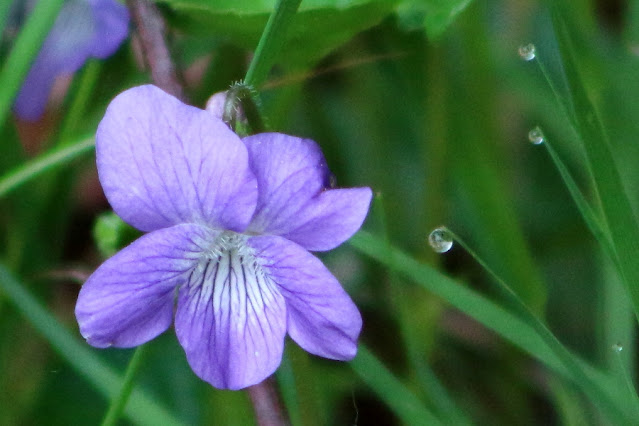
I love the perfect spheres of dew on the blades of grass,

Also down at ground level, wild strawberry are flowering, hoping to attract an early pollinator to let them set fruit for the birds later in the summer.

A future strawberry in the making.

Another fruit-bearer is blooming as well, and judging by the quantity of blossoms, it appears another good blueberry season might be in store for us.

Lots of blossoms have been set on the blueberry bushes.

Of course, this depends on sufficient rain coming during June and July, something we haven't seen in two weeks now.  

Bridging the borders between sun and shade is one of my favorite flowers, the fringed polygala, which can spread into large patches.

Fringed Polygala

I think it's the unusual color, somewhere between magenta and violet, that I find intriguing.  You might also see bluets and lily-of-the-valley blooming right now.

Lily-of-the-valley

The last flower I'll mention is a new one for me, and I had to work to determine what it is.  Though I found it on the forest floor, it's not one that blooms down low, but rather up high in the forest canopy.


I expected it was a flower from a tree, but which tree?  I found many of these flowers under hemlocks, but I knew that wasn't its host.  Eventually, by looking up flowers of the various trees that grow in our forests, I determined it's the flower of the American Beech; it perfectly fits the description of the male beech flower in the Audubon guide "Eastern Forests".  [Alfred A. Knopf, Inc, publisher, 1985]  The flowers are very light, and with the strong winds this week, they could have blown a long way.

The tiny flower of the mighty beech tree.

The variation in relative size between plant and flower that different species have developed is remarkable.  A trillium flower is about one third the height of a mature plant, while the flower of the American Beech is less than one one-thousandth of the height of a mature tree.

Moving on to the animals, I saw a couple of new bird arrivals this week, the American Redstart the Baltimore Oriole and the Chestnut-sided Warbler.
Chestnut-sided warbler.

These birds tell me that we're nearing the end of the migration, as these birds, based on my observations, are among the last to arrive.  I heard the oriole on the Wetland Loop Trail at Page Pond, high up in a tree with no chance to see it.  Chestnut-sided warblers flit around in the thickets of young successional forests, but its song is so loud you can easily track it, and if you watch long enough you can usually get a glimpse of him (it's always him that sings).  You're likely to see one along the Page Pond Field Trail at the Barnard Ridge Road trailhead.  Listen for its distinctive "Pleased, pleased, pleased to MEET you" song.

It can be hard to get past the bugs, but if you can, the sights and sounds of the forest are now reaching their spring climax.
Singing loudly to defend his territory.


Sunday, May 31, 2020

May 31, 2020: The Sounds of Summer

But first this: 
 

Yes, the song birds are now nesting.  I found this small ground nest only because the inhabitant fluttered away as I walked past the nest which was located right beside the trail, perfectly hidden under a branch of a low-bush blueberry; I really had to look to find it.  They look like Robin eggs, but I think more likely this is a nest of either a hermit thrush or a veery.  I frequently hear the thrush in this vicinity so the odds suggest that's what it is.  Maybe I'll learn more as time goes on.

I didn't see the goslings this week, but Mrs. Mallard did come by with her ten chicks in tow.

The waterfowl nest long before the songbirds.


Before I get to the sounds of the week I really must mention the sights because the spring wildflower season is peaking now.  My personal favorite, the painted trillium, has been blooming for over a week but can still be found throughout the Lakes Region.
Painted Trillium


Just popping out this week is a flower everyone loves to see, the pink lady's slipper.  The photo of this beautiful patch was sent to me by Marge Thorpe.
Pink Lady's Slipper, photo by Marge Thorpe.


A smaller, more delicate flower now blooming isn't quite as prominent, but it's worth taking the effort to look at the fine detail in its delicate star-like bloom.  
Easter Starflower

The blossoms on the hobblebush are gone now - leaving behind tiny specks that will grow into fruit this summer - but here's one picture from their peak of beauty.
Hobblebush Viburnum


I've been watching this particular plant as it evolves and will continue to watch as its fruit grows, turns red, and eventually black when fully ripe.

Now to the sounds.  All the animals are loving this warm weather as much as we are and they're singing their praises out loud and clear.  The combination of birds, frogs and toads blend together to create symphonic entertainment each morning and evening.  Add the occasional crash of a beaver tail into the water for some percussion and it's a full Wagner opera.  

Having such a long stretch of warm weather this early in the year means sleeping with the windows open when so many animals are still at a high level of spring activity.  Some of the sounds to be woken up by include turkeys gobbling, owls hooting, tree frogs trilling, large animals crashing through the woods (bears?) and of course, the beaver alert.  I remember sitting in the Marion's cabin 35 years ago when were considering purchasing our land on Lake Wicwas and Mrs. Marion warned us that it was a very noisy neighborhood.  Confused, we asked her what she meant, and she said "The birds!  They wake you every morning!"  That has always stuck with me, especially considering the Marions lived in downtown Boston!

A loud member of  nature's orchestra, sitting in the percussion section, is the woodpecker.  Though they do chirp now and then in the choir, their drumming is most distinctive and great fun to hear.  One morning there were two yellow-bellied sapsuckers out drumming in a round.  One would drum first, then the second would answer.  I couldn't find the musicians, but I sure heard them.


This behavior is used to define their territory.  I learned from UNH biologist Matt Tarr that spring bird singing is primarily to define territory - two male birds of the same species will wake up in the morning and immediately start singing to say "I'm still here".  As long as each bird stays on its side of the agreed-to dividing line everything is fine.  But cross that line, and trouble ensues.  Since woodpeckers don't have a song to sing - only their short calls - they find a resonant object on which to drum to make their presence known, usually a dead tree or branch, and the louder and greater its resonance, the larger a territory the sound can cover.  

Regarding sights under water, the crystal clear lake water is about to change.
Pollen covers the surface of Lake Wicwas


All that pollen in the air has now found its way to the ground.  Add to that the multitude of microscopic life that will start to grow in the lakes, as well as some churning up by animals and humans, and the visibility will be much reduced from its early spring clarity.  But all the trees aren't quite done:  the white pine is just starting to release its dose.  Pines produce the thick green pollen that is so visible on surfaces, but thankfully, due to the large size of the pollen particles it isn't an allergy nuisance for most people.

With all the pollen out of the atmosphere there were some spectacular summer days on the lakes this week.

Now that's something to sing about!