Showing posts with label Lupine. Show all posts

Sunday, June 14, 2026

June 14, 2026: Pollen Aplenty

Before we look at pollen, a disclaimer is in order:  When we get to the loon update, this post will get a little racy, so be warned. 

If you're in the Lakes Region, you know that the white pine trees released their copious load of pollen this week. 

Lakes were yellow, cars were yellow, even indoor surfaces near open windows were coated with a thin layer of yellow dust.  Pine marks the end of tree pollen season and the good news is that the large yellow particles, which are so visible, are too large for your immune system to interpret as a virus, so they don't trigger your immune system.  But they sure do make a gunky mess in the lake.

I mentioned on May 24th that Jupiter and Venus were visible in the western sky shortly after sunset.  Since then they have been on a course for a close encounter, with their closest alignment occurring on June 9th. 
Jupiter and Venus shine in the evening sky over Lake Wicwas

Venus is the brighter of the two, about seven times brighter than Jupiter.  The hot weather this week - it hit 93.4 degrees on Friday - made for pleasant nighttime sky-gazing.  The frogs and toads loved it too.  On the night of the conjunction, the Gray Tree Frogs celebrated the event by serenading me with musical accompaniment as I enjoyed the celestial light show. 
In daylight hours it was the Green Frogs that were providing the background music.
If you turn the volume up you'll hear some mosquitoes buzzing in addition to the frogs and the blue jays.

Last week I noted a painted turtle nest that had been raided for the eggs.  This week it was a snapping turtle nest.  
The consumed eggs of the nest (the hole on the left) were spread out on the ground.

This nest was very near where I saw the snapping turtle I mentioned last week laying eggs beside Chemung Rd.  There are a lot more eggs in a snapping turtle nest than in a painted turtle nest.

And snapper turtle eggs are rounder, whiter, and a little harder - not as leathery - as painted turtle eggs.


We didn't get up to Sugar Hill this year to see the lupines, but I'm guessing there's a good showing based on how many we have blooming in our yard.  The bumblebees been out doing their part to make sure there will be another good crop next year too.
A bumblebee comes in to add more pollen to the bundle on its leg.


Now to the loons. The northern pair is still tending their eggs, though sitting on the nest in 90 degree heat must be excruciating.  We can only hope they're able to keep the eggs from overheating.  As for the southern pair, Deb Crowley saw them starting to build a nest in the same spot they successfully fledged a chick in 2022. 
Photos by Deb Crowley
They got right down to the business of making a family after they started nest construction.  Guy Sanderson caught the southern pair in the act of copulation (this is where things get R-rated).
Video by Guy Sanderson

It may not be very graceful, but it appears to be effective! 

A female will develop and lay her first egg three to five days after successful fertilization, and a second egg, if laid, will follow one or two days later.  By Friday the pair was on the nest so we assume there's at least one egg present.  It was a little later start than typical due to the heavy rain, but at this point we're in good shape for two potential nests.  We'll keep an eye on things and provide an update next week.


On the way out this week, I'll note it also seems to an especially favorable year for the Larger Blue Flag.

Keep an eye out for these beautiful native lilies as you paddle around any lake in New Hampshire.


Sunday, June 12, 2022

June 12, 2022: Lupine Time

We did get up to Sugar Hill this week and the lupines are putting on a fine show this year.

Lupine (Lupinus perennis)

So fine in fact that a painting class was taking place in the upper field where Cannon Mountain and the Lafayette Range set the background for the artists.


I think the lower field was the most spectacular I've ever seen it, awash in deep blue and purple with the occasional burst of pink or white sprinkled here and there.


It's always worth the drive up through Franconia Notch in Lupine season, but I also found mountain color closer to home.  On a hike to Mt. Shaw in the Ossipee Range I found several flowers in bloom including lady's slippers around 2000' elevation.  But the most interesting find was a plant that grows in dry, acidic soils as found in rocky granite outcroppings at high elevations.
Cinquefoil
I think this is three-toothed cinqufoil growing in the cracks and crevises in the granite which helps to break down the rock over time.


Granite ledges in the Ossipee Range with Lake Winnipesaukee and the Belknap Mountains in the background.

  Other flowers seen along the trail included bunchberry and bluebead lily.

Bluebead lily (Clintonia borealis)

Bunchberry (Cornus canadensis)

Later this summer bunchberry will have many small red berries while bluebead lily will have large - you guessed it - blue berries.

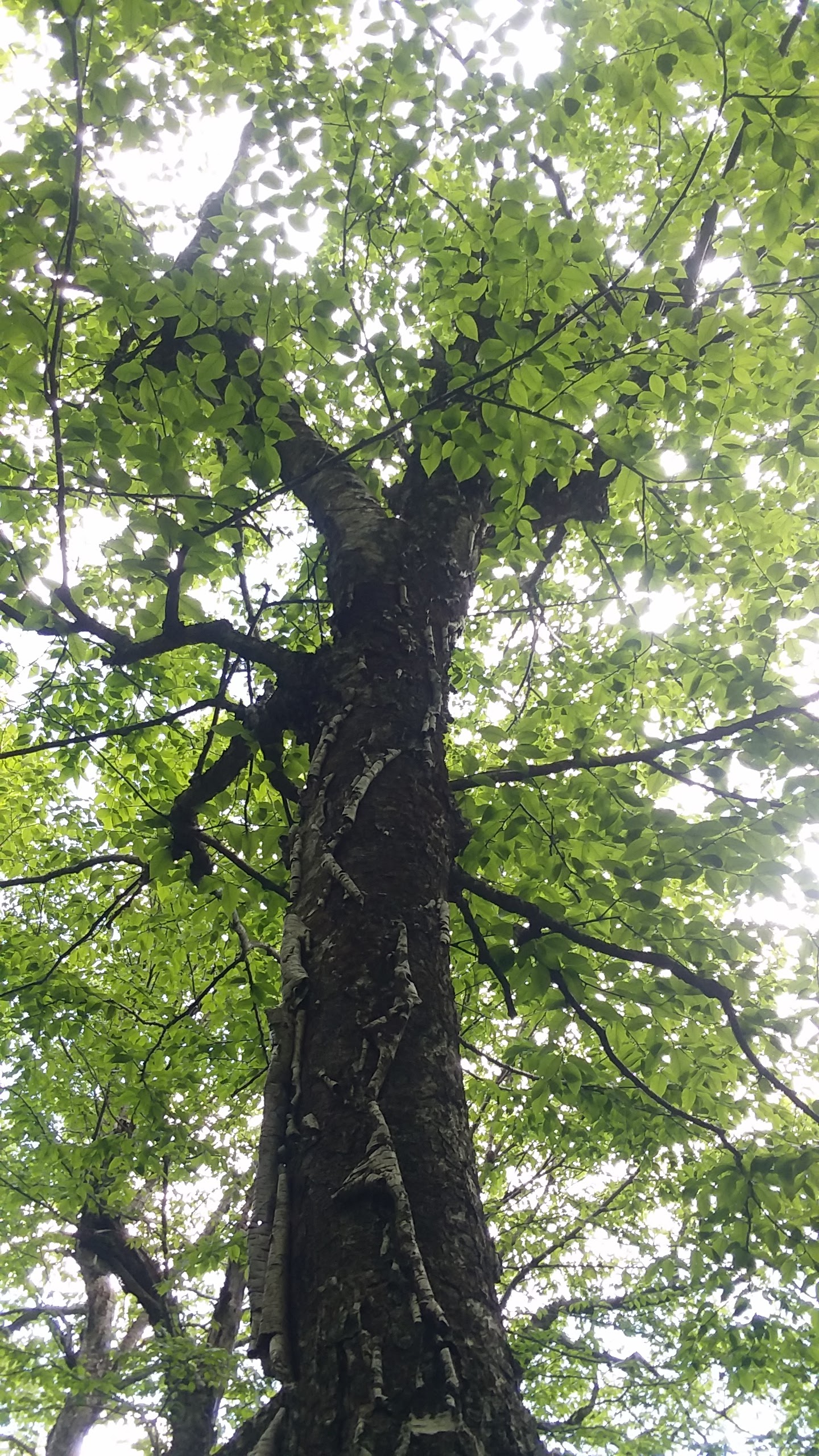
I also came across a towering birch tree right beside the High Range Trail which New Hampshire forester Dan Stepanauskas identified for me as yellow birch and estimated it at over 250 years old. 

An ancient yellow birch in the Ossipee Mountains

The mountains aren't claiming all the beauty though, as there is plenty to be found down at lake level.
Larger blue flag (Iris versicolor)
These wild irises grow in marshes and wet shorelines all around lake.  

One more lake flower I'll share is this wild cranberry viburnum I found growing on Sheep Island:
Cranberry Viburnum (Viburnum trilobum) also called highbush cranberry

I'll end with an update on the loon picture which remains fluid.  As far as I can tell the banded pair is still tending to a nest though I often see both loons together far away from the nest.  Band sightings indicate it is the nesting pair.  But I also believe a second pair of loons is working on a nest in another part of the lake.  I've seen two loons near the island where a pair successfully raised a chick ("Justin Time") in 2018.  One loon observer has seen them bringing nesting materials from the bottom of the lake to the island, and one day when I was near the island a loon popped up right next to my kayak, acting as a decoy to draw me away from the island, which I immediately did, but still managed to get perhaps the closest look at a loon I've ever had.


There have been reports of a possible fifth loon on the lake.  It could be an interesting summer.


Sunday, June 6, 2021

June 6, 2021: Loon Nesting Begins

June could be called flower appreciation month because of the magnificent diversity of wildflowers that can be found as we make the subtle transition from late spring to early summer.  In deep, cool forests with a full canopy as well as up at higher elevations, spring bloomers such as bluebead lily, trillium, lady's slippers, and fringed polygala are still hanging on.

Fringed Polygala

Bluebead Lily


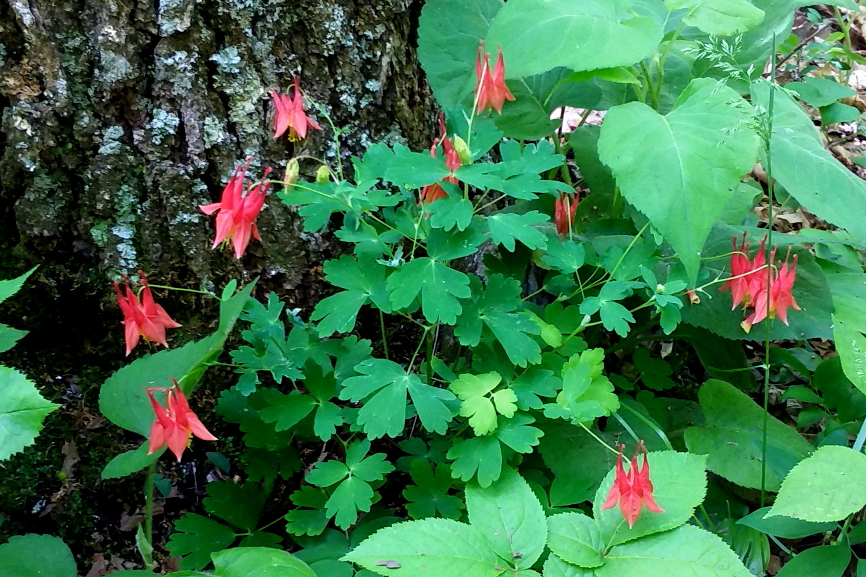
In less shrouded areas that receive more sunlight, larger, more conspicuous blossoms such as lupine, lilac, and columbine are now adding their intense colors of red, violet, and blue to the forest palette.

Columbine along the Mt. Roberts Trail in the Ossipee Mountains.

Lupine in a sunny spot.


And in intermediate areas - forested but with sunlight penetrating for part of the day - low-lying mid-summer flowers such as bunchberry and bluets are starting to perform.


Now on to the big stuff - as in big birds.  We've had regular sightings of eagles around the lake, both mature and immature (much to the distress of the loons) including this immature eagle that glared down on me one morning as I paddled around Bryant Island on Lake Wicwas.  

"I've got my eye on you."

But the eagles haven't stopped the loons from doing their thing.  On that same morning paddle I saw five loons including one group of three that were not pleased with each other.

The distrusting loon-dance.

A bunch of agitated birds.


The big hump on their head indicates stress, and these three circled each other round and round, none willing to take their eye off the others in fear of an attack from one of those 4" long sharp pointy beaks.  It's possible that one of the three was half of a mating pair, making sure the others stayed away from its nest, because later that day I got word of loon on a nest.

One pair of loons has gotten down to business.

Felix Puetsch discovered it.  He reported seeing loons that didn't dive or swim away as he was kayaking, but rather went ashore which is of course, unusual.  That's when he saw the nest with two eggs in it.  He commented on how close it was to the edge of the water, correctly noting that loons don't like to be on land because their legs are so far back on their body that they can barely walk.  

The nest is in a good location to be shielded from boat wakes which is important since a boat's wake can easily wash over a loon nest right on the edge of the lake.  But the nest is also very exposed, so signs have been placed near the nest to alert nearby boaters.  I'll leave it as an exercise for the reader to find the nest - just please stay well beyond the signs and move away quickly, especially if either loon shows signs of stress: the loon on the nest putting its head down low to hide, or the loon on the lake calling or making a display of itself.  If the loon leaves the nest for even a few minutes the eggs can become unviable, particularly if the weather is sunny or warm, as the eggs can overheat quickly.

If you'd like to learn more about how to enjoy the lakes without disturbing wildlife you may be interested in a webinar that NH Lakes is offering called "Enjoying Lakes while Protecting Wildlife".  More information can be found here.

It's not clear if this is the only nesting pair on the lake or not.  Two loons had been building a nest in another location on Wicwas but we don't know yet whether it's the same pair and they just changed their mind or whether it's a different pair.

A nicely built, then abandoned loon nest.

Maybe it's just a decoy!  If we get a look at a leg band we may be able to figure it out.

At any rate, nesting season has begun, and both we and the eagles will be watching eagerly to see what transpires.

Sunday, June 21, 2020

June 21, 2020: Summer Flowers are Here

Happy Fathers Day to all the dads out there! 

The summer heat arrived just in time for Father's Day, and the summer flowers are loving it; they're expressing themselves with brilliant colors from all corners of the spectrum.  I will let them speak for themselves.

Orange Hawkweed (Hieracium aurantiacum)

And the yellow variety (Hieracium caespitosum)

Tiger Swallowtail (Papilio glaucus) on Linda's Lobelia (not wild)

Bunchberry (Cornus canadensis)

Daises and Lupines

Oxeye Daisey (Leucanthemum vulgare)

Ohio Spiderwort (Tradescantia ohiensis)


Not wild, but pretty

Sheep Laurel (Kalmia angustifolia)

Lupine (Lupinus)

With a customer

Mapleleaf viburnum (Viburnum acerifolium)

I'll mention one concern about the heat:  the loons.  The Bryant Island nest is completely exposed to the sun all day long, and with clear, hot days one after another the loons have had no relief for days on end.  On top of that, with yesterday being the solstice, there's 15 and half hours of sun beating on them each day. The Harris Cove nest has a much better site with a good covering of bushes, but even they must be suffering.   It will be a remarkable parenting effort if either pair can keep their eggs cool enough to be viable.  We'll know in a couple more weeks.  

Until then, dads, granddads, and everyone, know that we are thinking of you even if we can't be with you, and take the time to smell the flowers.