Showing posts with label Loon nest. Show all posts

Sunday, June 7, 2026

June 7, 2026: Turtle Time

Like many animals at this time of year, the turtles are active and are getting busy reproducing.  I saw this Painted Turtle sunning on a log in a quiet corner of Lake Wicwas. 


Turtles don't soak in the sun just to feel good; there is important physiological value to their sessions in the sun.  Jen Esten and Jon Waage, authors of  The Nature of Pleasant Lake newsletter, wrote about turtles recently:

Being cold blooded, turtles need to sunbathe to elevate body temperature which in turn raises metabolic rate.  Sunbathing also periodically dries their shells, helping control mold. Rocks and logs are safe places to get some sun.  In addition to the sun’s warmth, they need the UVB rays to produce Vitamin D3 for processing calcium required for shell and bone growth.  UVA rays help with several body functions.  Sunning spots can get crowded!  Allowing fallen trees to stay in the lake helps.  These turtles feed on aquatic plants, algae and small aquatic invertebrates and fish. Young turtles are mostly meat eaters but become more vegetarian as they age.  They can live for 30 years or more!

We have a healthy painted turtle population in Wicwas even though a lot of their eggs are dug up and eaten by various predators before they hatch.  This excavated turtle nest was beside a trail in the Hamlin Town Forest this week.

Leathery egg shells left by a predator that consumed their contents.

Every year I find one of two of these dug up nests, often right on the shoulder of roads near water bodies.  Sometimes I even come across a mom laying her eggs.  This good size snapper was right on the side of Chemung Road at the Chemung State Forest.  

A female snapping turtle laying her eggs a few years ago.

This baby painted turtle was found this week by Lindsey Duggan:

Photo by Lindsey Duggan

If turtles are just laying eggs now, how can we see baby turtles already?  Well, painted turtles that are laid in late summer can overwinter underground after hatching, and emerge in the spring when the ground warms up.  

What's even more unusual is that she also found a baby snapping turtle.

Snapping turtles don't usually have the same wintering trait as their painted cousins - even if eggs are laid in late summer, snapper eggs usually hatch the same year.  But according to MassWildlife, they sometimes do overwinter in the nest, and that is likely how that baby turtle emerged in early June.  Another possibility is that it did leave the nest late last fall and immediately dug into the bottom of the lake for the winter.

-----🐢🐢🐢-----

One morning this week I saw a lot of commotion in the leaves of a maple tree just after sunrise, so I took a moment to see what was in there - it was a Gray Squirrel. 

A gray squirrel amidst the maple leaves.

It was very focused on some activity, running up and down the branches, stopping here and there to chew on something.  I waited for it to come to the end of branch so I could get a good look to see what it was up to - it was munching on maple seeds!


It would pull all little helicopter samaras from a clump, gobble up the seeds, and let the wings flutter down to the ground.  Then it would move on to the next clump. (Sorry about the focus, the moving branch made focus difficult.)
Just one tree seems like it must have an inexhaustible supply of these seeds!
The double winged "helicopter" seeds of a maple tree are called samaras - a latin name for a seed.


This week's off-lake exploration was to Mt. Liberty in Franconia Notch, from which the recent snow was still visible on Mount Washington.

Down at the snowless base of Franconia Notch, both sides of the Appalachian Trail were carpeted with large patches of Bluebead Lily.  

These are often inconspicuous plants, scattered here and there, hidden under other small plants, and with their blossoms hanging downward.  But in large patches along the trail edge, they were hard to miss.

Close up, they have their own hidden beauty. 

Later in the summer each blossom will produce a large, hard blue fruit - that is, assuming a friendly pollinator does its part!  

The fruit is inedible by people though many animals can and do eat them.

I'll  close with the loon update.  The LPC summer biologist came to survey the lake this week. 

Nicole, our summer loon biologist.

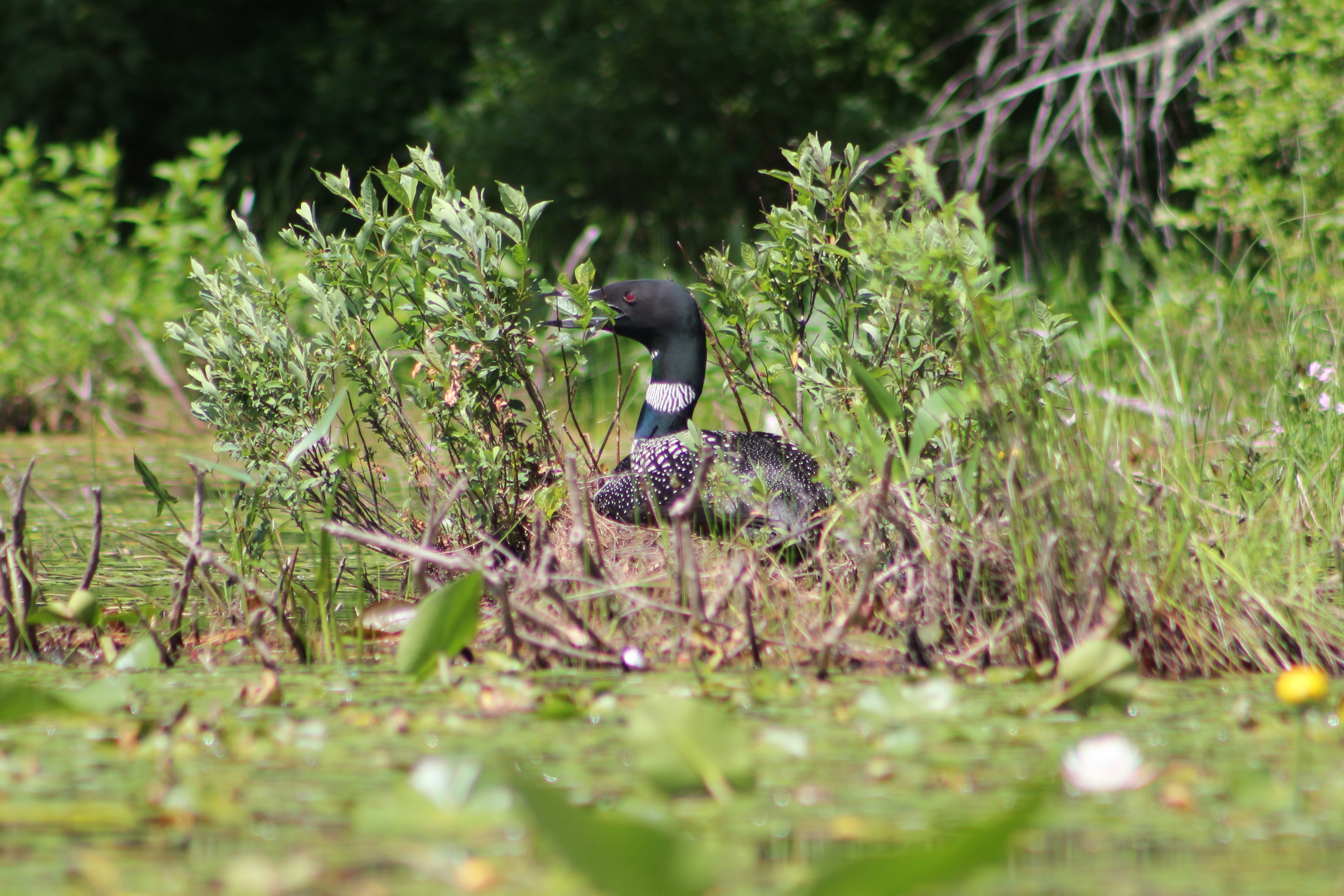
We observed the northern loon nest - it's a well hidden nest. 
Can you see the loon in there?


As of today, we still don't know if the southern pair has nested.  We'll keep you abreast of the latest developments!


Sunday, May 31, 2026

May 31, 2026: Challenged by Cherries

I've always been challenged by the various cherry trees we have in the Lakes Region, and this spring, with many blooming, once again I couldn't tell them apart.  So I decided to make a concerted effort to finally figure them out.  There seem to be four species that grow here, although I learned that one of them isn't actually a cherry tree, but a fruiting shrub, growing up to six feet high.  That's the one that's blooming widely all around the lake, the Black Chokeberry.

Black Chokeberry (Aronia melanocarpa)

Black Chokeberry grows along the shores of lakes and wetlands, and also on field edges - I've seen them at 2000' elevation on the ledges of Mt. Roberts in the Ossipee Mountains.  Their flowers grow in clusters, as do their fruit.

Chokeberry is flowering now all around the Lakes Region

Chokeberry fruit in September.
The fruit stays on the plant into winter, providing a late winter food source for year-round fruit-eating birds like bluebirds and cedar waxwings.


There are two varieties of chokeberry that grow in New Hampshire, black chokeberry (Aronia melanocarpa) and red chokeberry (Aronia arbutifolia), but I'm pretty confident most of what I see is the black variety as they are a more northern species, growing as for north as Canada.  Also, the color of the fruit I've seen in the fall is a good indicator.  If you look inside a chokeberry fruit you'll find multiple seeds (like a fruit) rather than the single pit of a cherry.


Moving on to the true cherries (genus prunus), the grand champion is the Black Cherry (Prunus serotina) which can grow up to 80' tall and is highly valued by craftsmen for its beautiful wood.  It has blossoms and fruit that grow in racemes - a long, thin tubular shape. 

Black Cherry (Prunus serotina)

Black cherry was planted on many New England farms and you can find them at the Meredith Page Pond Town Forest near the Barnard Ridge Road trailhead.  There is a very large one in the old orchard being rejuvenated, as well as several smaller ones in the field.   


Common Chokecherry (Prunus virginiana) has flower clusters similar to black cherry, but its leavers are wider and more rounded, and it's a smaller tree, growing only to 18' tall.

Common Chokecherry


Pin Cherry (Prunus pensylvanica) is also a small tree, growing to about 20'.  Its flowers and fruit grow in clusters similar to Black Chokeberry.

Pin Cherry (Prunus pensylvanica)


The three prunus cherries are all considered pioneer species, as they quickly emerge in open areas following fire or logging (the chokeberry is not).  A great example of this is the stand of pin cherry trees that rapidly took over a clear cut abutting the Eames Conservation Area in the Hamlin-Eames Town Forest.  If you hike the White Trail where it runs along the boundary line you can see this stand just over the stone wall that is the boundary.


So, we have pin cherry, black cherry, common chokecherry, and black chokeberry.  No wonder I've been confused by cherries!

Black Cherry:

Habitat:  old fields and woodland edged
Height:  40'
Flowers:  5" long racemes 
Fruit:  1/2", dark red to black
Leaves:  5", elliptical, toothed

Pin Cherry:

Habitat:  clearings
Height:  20'
Flowers:  1/2" in clusters 
Fruit:  small, red
Leaves:  4", lanceolate

Common Chokecherry:

Habitat:  water edges, roadsides
Height:  18'
Flowers :  4" racemes
Fruit:  1/2" red to black
Leaves:  elliptical, finely toothed

Black Chokeberry (not a cherry):

Habitat:  water edges
Height:  12'
Flowers : 3" clusters 
Fruit:  1/4", black, in clusters
Leaves:  2", oval, finely toothed


This week found me near Squam Lake, hiking up Eagle Cliff  (where I found many black cherry trees!) and over to Red Hill.  It was a cool, sunny morning and the lake and mountains were beautiful.

Squam Lake from Eagle Cliff.

The hike along the ridge from the cliff to the Red Hill fire tower was a spring nature tour.  I heard 17 different birds, including a loon carrying all the way from the lake on that quiet morning.  Other treats included seeing a bright red Scarlet Tanager (which I often hear, but rarely can see high in the canopy) and hearing both Hermit and Wood Thrushes.  

The wildflowers were as captivating as the birds, and I even found a new flower I hadn't even heard of before:  Rock Harlequin.

Rock Harlequin  (Capnoides sempervirens)

It's a tall, spindly plant with pretty pink and yellow blossoms at the top.

The North Carolina State Extension states rock harlequin thrives on rocky cliffs, granite domes, and in rock crevasses with poor drainage.  They prefer acidic soils in climates with cold winters and cool summers. [Ref:  NC State Extension]  This is exactly where I found these; they were growing in a sunny spot right at Eagle Ledge, amidst a large patch of bluets.   
Bluets
Often when I see bluets they're more white than blue, but these flowers up high had a nice blue hue.

A few wild columbine were also blooming alnog the ridge trail.
Columbine


May and June spring hiking can be slow with all the nature to observe, so remember to bring along the bug spray when you're out.  It is also loon nesting season, and there is news on that front.  The Wicwas northern pair has selected a site and is now on the nest, hopefully with two eggs to incubate.  They chose the same site as 2024, which didn't work out for them - the nest was predated, after which they built a second nest in a different location.  Let's hope things go better this year.  The site is well hidden and well away from boating traffic, so no signs will be placed there.

Both members of the southern pair have now been confirmed by their bands (thanks DT!) and with only a single loon being seen in their territory now, it's likely they have a nest with eggs too.  If you happen to come across it on your travels, please let us know so we can take any precautions needed to protect it.  

Friday's 3" of rain raised the lake level by 6" even with the dam lowered in preparation.  Hopefully both pairs can defend their nests from the rising water.  Last year we fledged only one chick, Spangle.  We hope to increase that number in 2026!
Spangle, shortly before leaving the lake in early December 2025.


Saturday, June 28, 2025

June 29, 2025: Catching up around the Lake

It's always comforting to return to the lake whether I've been away for a day or a month.  The enormity of a place like Alaska dwarfs the entire state of New Hampshire, but this small verdant patch of our planet has a charm that's truly special. How fortunate are we to able drive along a quiet stretch of road and see one of the iconic birds of the Northern Hemisphere incubating it's eggs?  

Many people put seeing a single loon on their life-list.  

This nest is in a good spot to be protected from boat traffic and is far enough off the road to not be bothered by cars.  You can see it at the first opening where you see the lake on Chemung Road when coming from Meredith Center.  Bring a pair of binoculars and scan the small islands in the cove - you won't bother it.

Hopefully this pair has survived the floods and a couple days of record heat this week and is carefully tending one or two viable eggs because it appears the northern-territory pair isn't going to have a nest this year.  I've seen a pair in the northern territory together with no recent signs of nest-building


Perhaps you saw this photo in the Laconia paper:

Assuming we do have a chick or two in a couple of weeks, there will be plenty more challenges for these birds to deal with!


There are other signs of nature to be found on a slow walk along country roads.  This small disturbed area caught my eye, and looking closer I found the tell-tale sign of a turtle nest.

An excavated Painted Turtle nest.

Painted turtles clamber out of the lake to find suitable nesting sites in soft gravel, sometimes having to travel long distances especially when the riparian area around a lake or stream has been developed.  They often find the first suitable spot along the shoulder of a road - which presents a couple of problems.  One is obvious from the number of squashed turtles in roads from car tires.  The other is the lack of protective cover as raccoons, fox, skunk, and crows also travel the roads looking for road kill.  When any of these come across a turtle nest they dig right because fresh turtle eggs, like chicken eggs, are an excellent source of much needed protein. 

Consumed turtle eggs.

Fortunately, the populations of both turtle species we have in Wicwas (painted turtles and snapping turtles) are strong.  

If you're on or near the water, especially in a small boat, look closely at the aquatic vegetation growing at the shoreline.  Many of our dragonflies and damsel flies are now emerging from their larval stage in the lake and drying out their wings for flight.  


You can find them doing this all summer long early in the morning to dry off nighttime dew.


I led a walk on the Laverack Nature Trail in Meredith Village with the Taylor Community this week.  Many fruiting trees are now in blossom along the boardwalk; we found native dogwood, winterberry, and many others.  

Silky Dogwood
Winterberry

Come fall and winter these provide valuable food for birds.  There are also blueberries with fruit already set; it looks like it might be a good blueberry season.  If you haven't been to the Laverack Trail (or even if you have!) this fully accessible trail is always worth a visit.


Finally, here's one more item from Alaska.  It's a slow motion video of a Tiger Swallowtail butterfly gathering nectar from lilac blossoms.  This is one-quarter actual speed; it was actually working those flowers very quickly.  It's a large file so it may take a minute to load.


After experiencing the untouched expanse of much of Alaska's Denali National Park and Tongass Natural Forest, flying over Boston and Seattle is a stark, almost overwhelming reminder of why we cherish even small pockets of undeveloped nature.  It is far too easy to take for granted all that Lake Wicwas gives us.

Sunday, June 8, 2025

June 8, 2025: Great Crested Flycatcher

The dragon flies came out in full force with the warm temperatures this week which means it's feast time for the birds - no more need to go after tiny mosquitoes and black flies when there's much larger game available.  I mentioned recently the distinctive call of the Great Crested Flycatcher and on a paddle this week there was one calling loudly near me which I was able to locate perched on its branch waiting to attack whatever flew by its outpost.
Great Crested Flycatcher


In addition to the Phoebes which have been here for weeks, the Eastern Kingbirds now have a large presence around water as well.
Eastern Kingbird

All three of these flycatchers are quite noisy birds.  I also saw a couple of Belted Kingfishers this week.  

On the loon front, it appears the southern pair has decided to build a nest on a tiny hummock deep in Harris Cove.  It's well protected from boat traffic but won't have any protection from the sun which could be a problem for them.  At last check they weren't on the nest, so there probably wasn't an egg yet, but by today there might be.  If all goes well, mark your calendar for a chick just after the fourth of July.

One morning this week a pair of float planes landed on Wicwas.  

The two are the same model of pusher-plane with different paints schemes.
Note they have wheels as well as floats for water.
The loons were not pleased with these large noisy birds flying over them.

There are so many birds in the trees now feeding happily on flying insects as well as the crawling ones:  caterpillars.  One native caterpillar that has developed an excellent defense mechanism is the Tent Caterpillar.  
Tent caterpillars create a defense shield against predators.
Tent caterpillar are not a species at risk and since they can defoliate small trees there's generally no harm in removing them if you wish.

The bunchberry is booming now; I saw these up by Arbutus Hill Pond in the Hamlin-Eames property behind Lake Wicwas.
Bunchberry

More white flowers are adorning the False Soloman's Seal plants.
False Soloman's Seal

Later in the summer these will have large bunches of red and white speckled berries which are consumer by birds and rodents.  The Canada Mayflowers didn't quite live up their name this year, but they only missed it by a few days as they are blooming now in early June.
Canada Mayflower

And thank you Canada for giving us some gorgeous red sunsets this week.

That's about the only good that comes from those wildfires, but we might as well appreciate whatever we can!