Showing posts with label Yellow-bellied Sapsucker. Show all posts

Sunday, May 10, 2026

May 10, 2026: Spring Multimedia Show

In addition to the spring warbler invasion that's serenading us with the joyous sounds of nature, we're now being treating to an influx of visual beauty as spring flowers erupt everywhere.  It's nature's live, multimedia show in full 360 degree non-virtual reality!  Last week the tiny Trailing Arbutus provided the trailer with the first blooms in the forest, and this week, the main event is on, starting with a large and showy shrub on display throughout the Lakes Region.

Serviceberry (aka Shadbush)

Serviceberry is widely spread around lake shores as well road sides, especially in damp damp soils.  The tree above is in Chemung State Forest along Chemung Road.  

In sunny spots, violets are blooming, both the Common Blue and the Sweet White.

Common Blue Violet

Sweet White Violet

A walk through the field at Page Pond Town Forest revealed Wild Strawberry joining the cast as well.

Wild Strawberry

High up on the summit of Belknap Mountain, a lone elderberry bush was just starting to come on stage to display its purple flowers.

Red Elderberry

I've had reports of Bluebead Lily flowering, but in the Belknap Range, they weren't quite far enough along, at least as of Thursday.

Bluebead Lily about to bloom.

They are probably in bloom by now, because this is a magical time in the New Hampshire forest.  The days are long - over 14 hours between sunrise and sunset - but leaves aren't yet on the trees, so for a very short period, direct sunlight shines down onto the forest floor.  The woodland flowers thus have a brief window after snowmelt to sprout, photosynthesize, and put out flowers, before the curtain closes and they are immersed in deep shade for the next five months.  

There was a surprising guest appearance on my hike in the Belknap Range:

Red Eft

I didn't expect to see an eft this early in the year, especially on a cool and partly cloudy morning at elevation.  It was resting on an exposed piece of granite which was being warmed when the sun shone down around the clouds.


The sound track to accompany this week's multimedia presentation was provided by Black and White Warblers, Ovenbirds, Black-throated Green Warblers, Bluebirds, Common Yellowthroat, and many more.  I heard nine species in the Belknap Range, and I participated in a bird walk sponsored by the Meredith Conservation Commission at Page Pond Town Forest yesterday, where, under the expert guidance of Dan Mullarkey and Kelly Hanson, we observed 20 different species.  My favorite was the Yellow-bellied Sapsucker which we heard several times.

A Yellow-bellied Sapsucker seen on yesterday's bird walk at Page Pond.

Back on Wicwas we had a huge flock of Yellow-rumped Warblers at the lake for several days, feeding on caterpillars on the trees.  

Yellow-rumped Warbler on a broken maple branch at Lake Wicwas

There are also dozens of Tree Swallows zooming all around the water picking off insects on the wing.  They are too fast for me to capture their acrobatics, but our pair of Eastern Phoebes gave me nice show right at the house. 


Spring is in full swing now, and there will be many more birds and blooms to look for in the coming weeks!

                                                     
  Happy Mother's Day!  


Sunday, May 31, 2020

May 31, 2020: The Sounds of Summer

But first this: 
 

Yes, the song birds are now nesting.  I found this small ground nest only because the inhabitant fluttered away as I walked past the nest which was located right beside the trail, perfectly hidden under a branch of a low-bush blueberry; I really had to look to find it.  They look like Robin eggs, but I think more likely this is a nest of either a hermit thrush or a veery.  I frequently hear the thrush in this vicinity so the odds suggest that's what it is.  Maybe I'll learn more as time goes on.

I didn't see the goslings this week, but Mrs. Mallard did come by with her ten chicks in tow.

The waterfowl nest long before the songbirds.


Before I get to the sounds of the week I really must mention the sights because the spring wildflower season is peaking now.  My personal favorite, the painted trillium, has been blooming for over a week but can still be found throughout the Lakes Region.
Painted Trillium


Just popping out this week is a flower everyone loves to see, the pink lady's slipper.  The photo of this beautiful patch was sent to me by Marge Thorpe.
Pink Lady's Slipper, photo by Marge Thorpe.


A smaller, more delicate flower now blooming isn't quite as prominent, but it's worth taking the effort to look at the fine detail in its delicate star-like bloom.  
Easter Starflower

The blossoms on the hobblebush are gone now - leaving behind tiny specks that will grow into fruit this summer - but here's one picture from their peak of beauty.
Hobblebush Viburnum


I've been watching this particular plant as it evolves and will continue to watch as its fruit grows, turns red, and eventually black when fully ripe.

Now to the sounds.  All the animals are loving this warm weather as much as we are and they're singing their praises out loud and clear.  The combination of birds, frogs and toads blend together to create symphonic entertainment each morning and evening.  Add the occasional crash of a beaver tail into the water for some percussion and it's a full Wagner opera.  

Having such a long stretch of warm weather this early in the year means sleeping with the windows open when so many animals are still at a high level of spring activity.  Some of the sounds to be woken up by include turkeys gobbling, owls hooting, tree frogs trilling, large animals crashing through the woods (bears?) and of course, the beaver alert.  I remember sitting in the Marion's cabin 35 years ago when were considering purchasing our land on Lake Wicwas and Mrs. Marion warned us that it was a very noisy neighborhood.  Confused, we asked her what she meant, and she said "The birds!  They wake you every morning!"  That has always stuck with me, especially considering the Marions lived in downtown Boston!

A loud member of  nature's orchestra, sitting in the percussion section, is the woodpecker.  Though they do chirp now and then in the choir, their drumming is most distinctive and great fun to hear.  One morning there were two yellow-bellied sapsuckers out drumming in a round.  One would drum first, then the second would answer.  I couldn't find the musicians, but I sure heard them.


This behavior is used to define their territory.  I learned from UNH biologist Matt Tarr that spring bird singing is primarily to define territory - two male birds of the same species will wake up in the morning and immediately start singing to say "I'm still here".  As long as each bird stays on its side of the agreed-to dividing line everything is fine.  But cross that line, and trouble ensues.  Since woodpeckers don't have a song to sing - only their short calls - they find a resonant object on which to drum to make their presence known, usually a dead tree or branch, and the louder and greater its resonance, the larger a territory the sound can cover.  

Regarding sights under water, the crystal clear lake water is about to change.
Pollen covers the surface of Lake Wicwas


All that pollen in the air has now found its way to the ground.  Add to that the multitude of microscopic life that will start to grow in the lakes, as well as some churning up by animals and humans, and the visibility will be much reduced from its early spring clarity.  But all the trees aren't quite done:  the white pine is just starting to release its dose.  Pines produce the thick green pollen that is so visible on surfaces, but thankfully, due to the large size of the pollen particles it isn't an allergy nuisance for most people.

With all the pollen out of the atmosphere there were some spectacular summer days on the lakes this week.

Now that's something to sing about!

Sunday, July 23, 2017

July 23, 2017 - Lightning Strikes

Meredith and much of the Lakes Region was treated to a dramatic electrical storm on Monday night.  There were thunderous lightning strikes, sometimes two or three in quick succession, and almost two inches of rain fell in an hour or two.  Harry Clymer sent me a chart showing the areas where lightning struck, which indicates three hit around Lake Wicwas, though Meredith Village really won the jackpot.

Somehow Debby Crowley was able to capture this incredible picture of a bolt that appears to have struck the surface of the lake south of Bryant Island.
Lightning over Wicwas - photo by Deborah Crowley
Thank you Ken and Debby for sharing that!  Fortunately there was no reported damage and I'm not aware of any significant power outages.  I looked for signs of strikes around the lake but didn't find anything.

The lack of rain lately has let the earth dry out a bit, but given such torrents of rain, most still ran off into the streams and lakes, and Lake Wicwas immediately rose four or five inches.  A quick check of the loon nest showed that their kingdom had become smaller, but it was still intact.
Its world looks a little smaller today
Like a dog, on a hot day a loon will cool itself by breathing with its mouth open.  The cool water below will help cool the egg while the parent protects it from the mid-day sun.  The parent may take a quick dip if needed before being spelled by its mate, but it won't be off the nest for long lest the egg cook in the hot sun.

Neil Crimins had observed on Sunday that the loons were augmenting their little island, dredging up mud and debris to build up the land.  It's fun to think they knew a storm was coming and were preparing for it, but more likely the island had been eroded by waves over the busy, beautiful weekend and they were just doing some restoration.

I continue to watch this year's premium crop of Black Cherries, and this week they are starting to ripen - perhaps two weeks behind the blueberries.

I hope to be able to determine who consumes them in the coming week or two.  Certainly birds will get many of them, but I expect the neighborhood bear will also get his or her fill.  I know it's still around, as it made a return visit to the yard to take out our second bird house.
The scene of the crime
It takes a big bear to bend that heavy steel stake
At this point, we have decided to post the houses "No Trespassing - Crime Scene" and board up the doors.  Not that their nests elsewhere are necessarily safe from predators, but we don't want to attract bears to human areas, and at least we won't feel complicit in crimes they commit elsewhere!

And just to make sure there's no doubt, one morning this week I came almost face to face with Mr. Black Bear.  I heard crunching the woods ahead of me on an early morning walk, and assumed it was a deer since I was in an area where I frequently come across deer at that time of day.  So I raised the camera hoping to get a picture in the dim light.  But instead of a deer poking its curious head out, it was a tremendous black bear.

Bears have poor eyesight, but stupendous sense of smell and excellent hearing.  One click of the camera and even at that distance it heard the shutter and looked right at me.

For all of two seconds - then it turned tail and bolted off into the woods.  It stopped not too far away, maybe 50 yards, but a couple of loud shouts and it was off and running far up and over a hill.  It must not have been a mother with cubs or it would have collected its cubs before it ran so I felt safe, but nonetheless decided to continue my walk in the opposite direction.

I've had this experience before - upon a bear hearing or smelling me it runs away a few yards, then stops and looks back as if to make sure it really needs to alter its planned route for the day, then decides, yup, it's time to go and disappears off into the forest.

As the ruckus caused by the bear dissipated, the tranquility of early morning returned, the rising sun bathing the world in soft, silken light, revealing, as it always does, a bounty of beautiful scenes.
The mushrooms love this weather  (Fly Amanita)

A yellow-bellied sapsucker soaks up the morning sun

Eastern newt, red-eft phase
Pickerel Frog
And finally, an old birch tree creates a home for new life to flourish.

Be sure to enjoy this great summer weather - we're already into the last week of July.


b

Sunday, May 17, 2015

May 17, 2015

The parade of spring wildflowers continues its march across the New Hampshire landscape, with new shapes and colors being presented every day.  My all-time favorite show, the Painted Trillium, went on display this week and will be on tour for the next week or two.
Painted Trillium

Some of the tiniest flowers are hitting their stride now, some of them blue, some white, and some that can't make up thier minds.  One might expect the Bluet to be blue as it name suggests;  I find they are more commonly white. 
Bluets

Another entrant in the parade is the Goldthread, a miniature white flower on a single, threadlike stalk.
Goldthread

And there are both white violets (oxymoron?) and violet violets (redundant?) performing, mostly in sunny, exposed areas.
Violets

A taller shrub, the Swamp Azalea, has it's white, trumpet blossoms ringing out high above the ground-level performers.  This is a new plant that I just discovered right behind our house.
Swamp Azalea (Rhododendron viscosum)

These flowers have a touch of red in them, completing the patriotic theme.


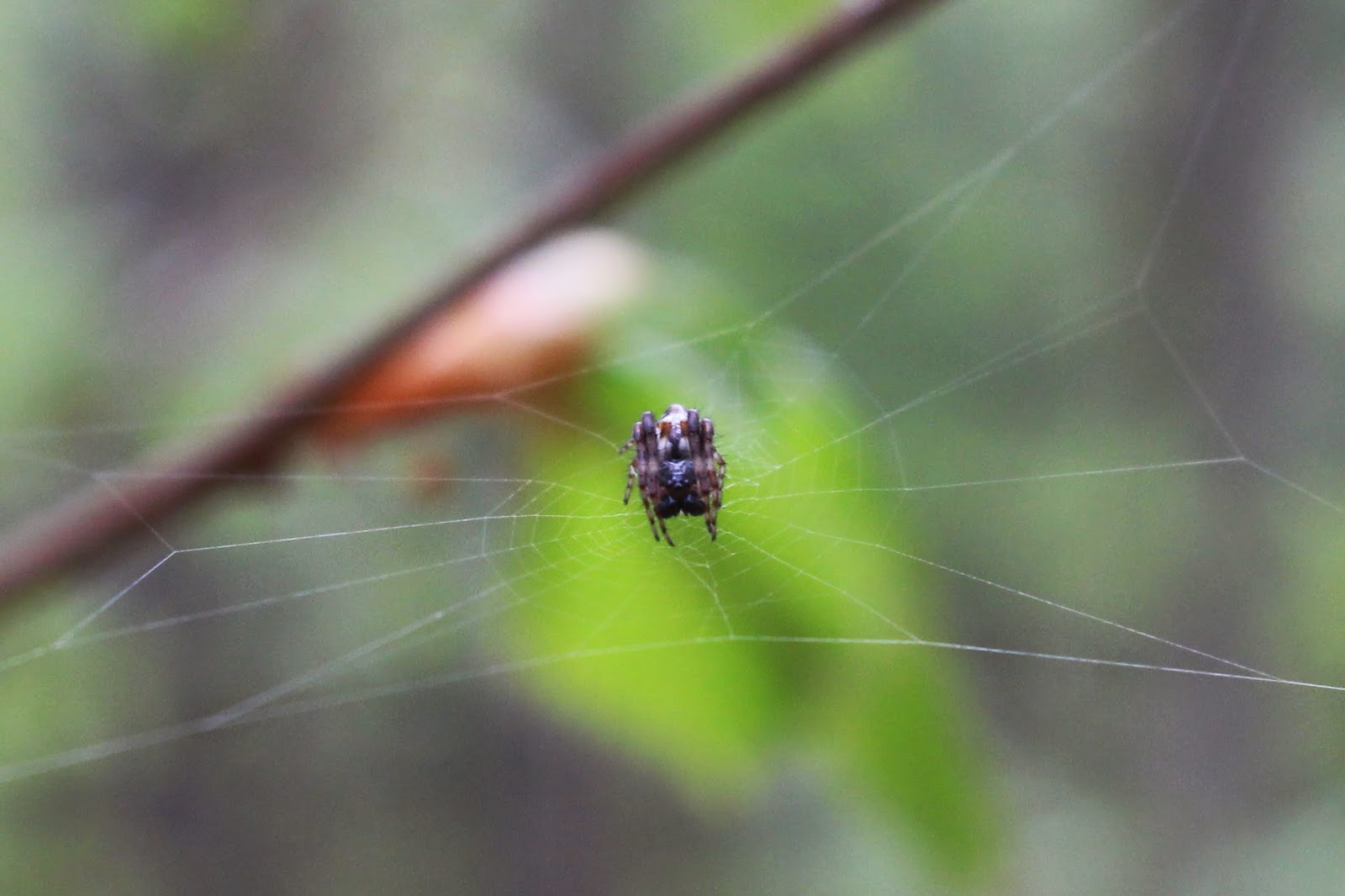
The spiders have come out to watch the parade;  they have the fortunate ability to build their own viewing stands well above the crowds, giving them an excellent birds-eye view of the spectacle. 
Watching the parade from its front doorstep

Spiders will construct their webs in the same location every day if they find a productive spot.  But if the web gets taken down two or three days in row - as happens when they build a web across a deer trail (or by my face when they build on a hiking trail), they will wisely (and thankfully) move on to a new location. 

I also was treated to a new bird sighting this week, a woodpecker I've long know the name of but have never seen - the Yellow-bellied Sapsucker. 

Yellow-bellied Sapsucker (Sphyrapicus varius)

This bird may have been the original maple sap farmer.  It drills shallow holes in trees to let the sap flow out, and then collects the sap with its tongue.  It will also eat the insects that get stuck in the sap.  I have heard the drumming of this bird lately, and will look to see if I can find any of the tell-tale shallow holes drilled into trees with sap running out.  These are much different from the large cavities the pileated woodpecker makes in its search for ants.


It's yellow belly is clearly evident;  this bird is a female, as it doesn't have the red spot under its neck that a male sapsucker has. 

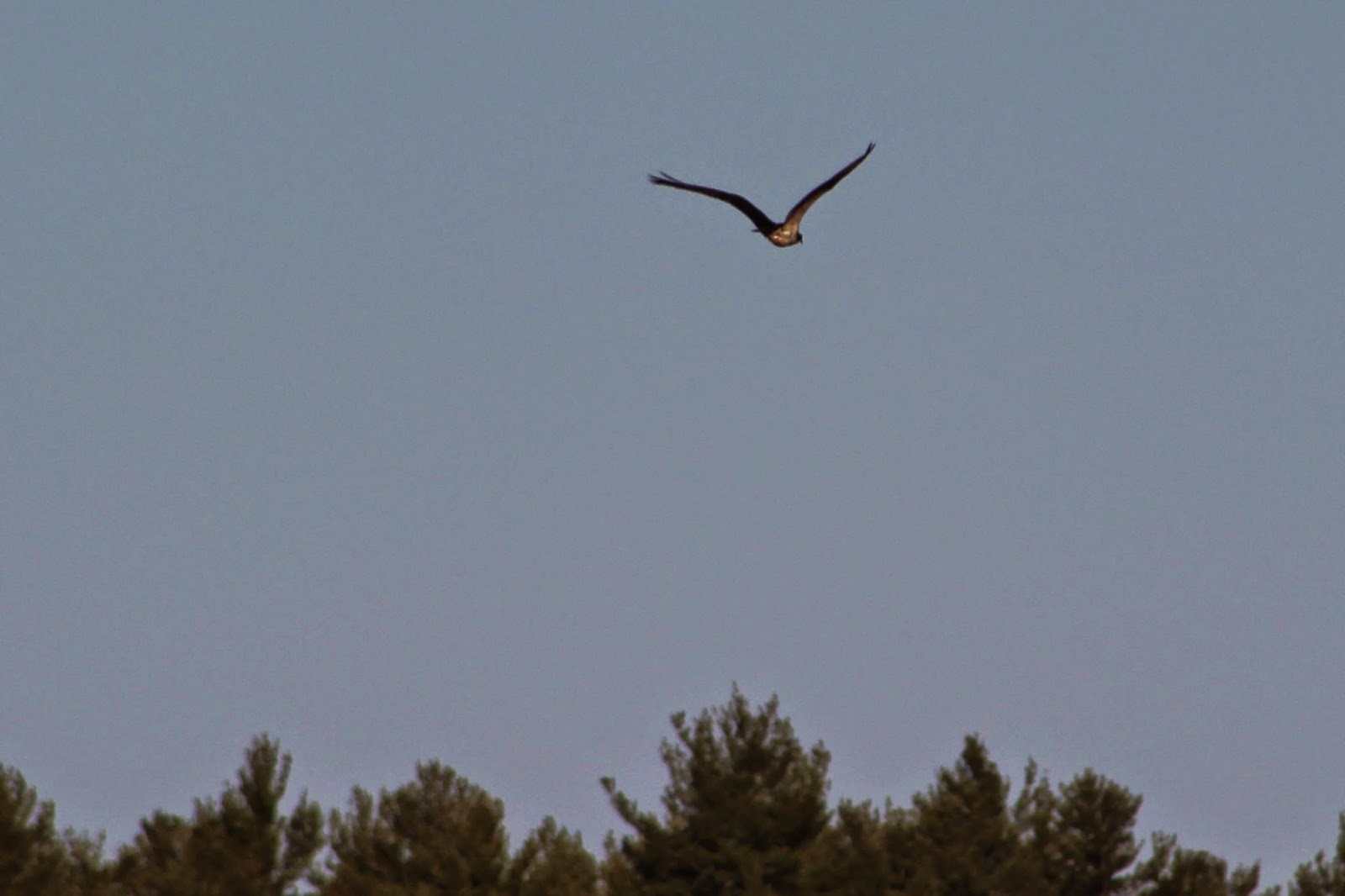
I have spotted the Osprey several times the past couple of weeks, so it appears it has put Lake Wicwas on its parade route again this year as well.
Osprey over Sheep Island