Showing posts with label yellow birch. Show all posts

Saturday, January 24, 2026

January 25, 2026: Dark-eyed Junco

One of our delinquent birds mentioned last week appeared after this week's snowfall:  the dark-eyed junco.

Juncos are one of our most common and wide-spread species, ranging from New Mexico to Alaska to northeastern Canada, and they are winter specialists, earning the nickname "snowbird".  They're present in New Hampshire year-round, though in the warmer months they stay hidden on the forest floor and at high elevations.  Juncos have some similarities to finches, particularly their beaks, but they're in the New World Sparrow family as they forage mostly on the ground, hopping around on two feet, to collect small seeds which they crack open with their beak using their tongue to maneuver the seed as needed.

They do good job cleaning up the deck, though they aren't very neat diners. 
Searching the snow for dropped millet.
Here's a short video of one cracking a small seed and dropping the shell:


In central New Hampshire, we see juncos mostly in winter after snow has covered much of their food supply, so they come to glean food under the bird feeders.  Here, nuthatches are their best friends.  The White-breasted Nuthatches in particular do much for the juncos as they shovel piles of small seeds from the feeder onto the ground while mining for the biggest nugget in the seed mix.

"This one will do."


We received a few inches of snow this past week which got me out on the skis for a short trip along the lake and up to the White Mountain Ledge.  Snow caught in a tree on the shoreline with a bright blue sky behind caught my eye and helped me notice one of the natural sources of food for juncos in deep winter:  Yellow Birch seeds.

Catkins on a Yellow Birch Tree.

These seeds aren't a staple of the juncos' diet because they don't pack a lot of nutrients, but they stay on the branches above the snow cover and they're better than nothing, becoming a factor in winter survival.  Hemlock cones, which also stay on their branches into winter, and which we saw the red squirrels dining on last week, are another source of winter food for juncos and other birds.


Heading into the woods for the ledges behind Lake Wicwas, I found a winter wonderland of snow-draped forest.


The January thaw is over.  Now we're heading into the deep freeze - yesterday's high at the Lake Wicwas Weather Station was 6.6 degrees F.  Along with much of the country, a polar vortex is sending New Hampshire a blast of cold air down from the north.  And it will usher in a good snowfall, beginning this afternoon.  We may get over a foot of light fluffy snow which is a whole lot better than the severe hit of wet heavy snow and freezing rain the storm may bring to areas south of New England.  With a long stretch of cold weather to follow, there may be some longer power outages in parts of the country, which makes a foot of dry snow look pretty good!

Looking north from the White Mountain Ledge.

Keep safe and warm this week, and don't forget about Pond Hockey on Meredith Bay next weekend.


Sunday, March 26, 2023

March 26, 2023: Old Growth Forests

I've known for years about a stand of old growth sugar maples in the Hamlin Town forest in Meredith.  The maple grove is noted on the trail map of the property and I'm always amazed at their size and age.  During a snowshoe trip on that trail this week my eye was caught by another very large tree, which on inspection, is a huge old American beech.  

American Beech

I didn't have anything to measure its circumference, but I estimated it to be about 65 inches.  


Beech has smooth gray bark in its early years but as it ages is becomes rough and cracked, so I know this is an old tree, but I'm not able to guess at its age, though the sugar maples here have been estimated at over 250 years old.  

Now my eye seemed to be tuned to looking up, and soon I noticed another large tree.

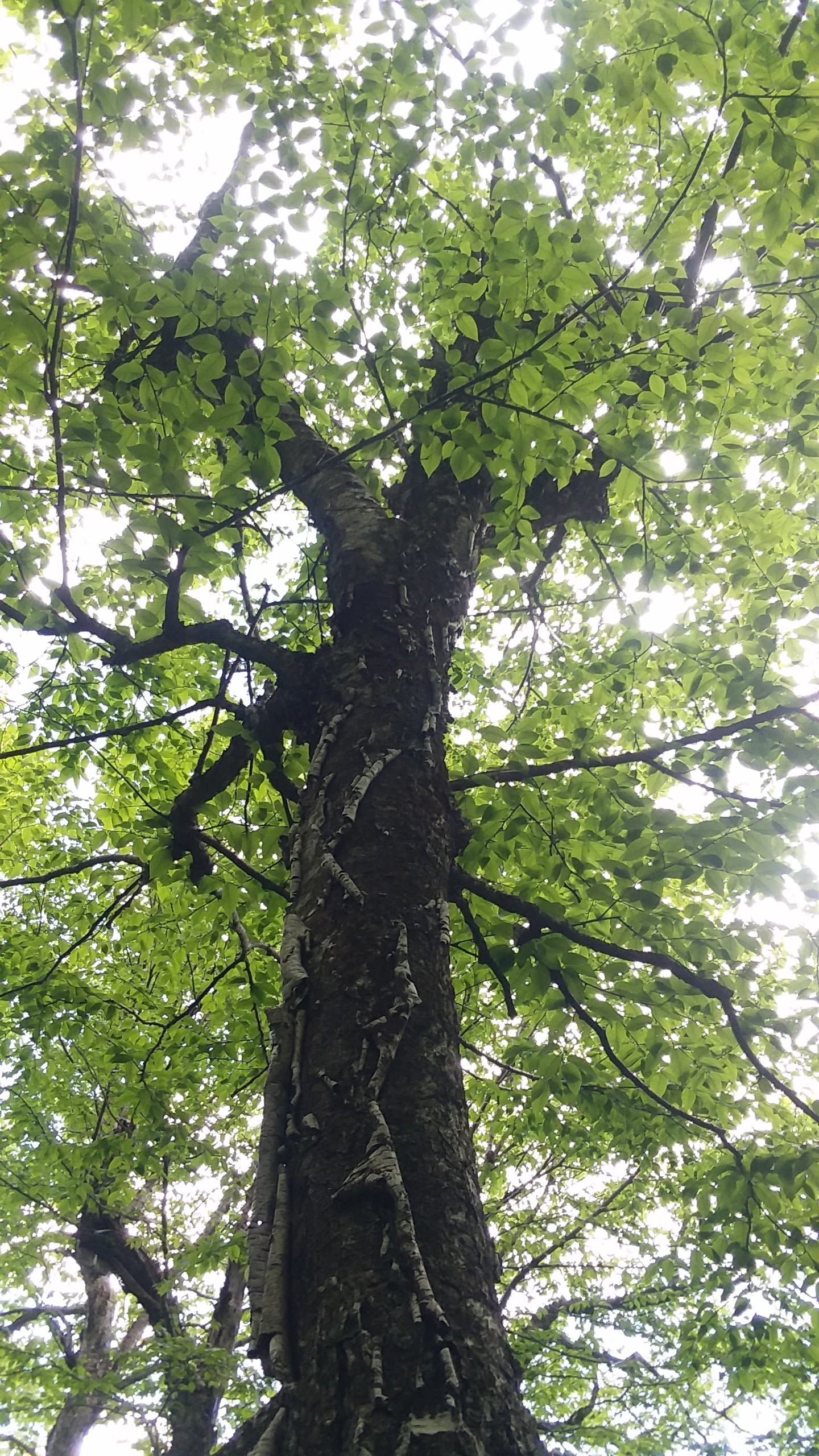
Yellow Birch

This I identified as a yellow birch based on its distinctive soft and peeling bark.  Unlike white (or paper) birch, yellow birch is a very long living tree.  Could this also be a couple of hundred years old?  Yellow birch is supposed to have a sweet, minty aroma in its leaves and twigs; it would be long climb to scrape a twig to smell it on this specimen.

Next to be found was a red pine:

Red Pine

Red pine, though not rare, have a specific habitat they prefer, dry and sandy, so I was a little surprised to see it here.  But based on the bark I'm pretty sure it's a red pine.

Red pine has a smooth, scaly, reddish bark.

The crown and needles are also rather distinctive, though the needles were too far away to examine.


All four of these trees were in close proximity to each other.  A short distance away I came upon yet another majestic tree, a towering white ash.

White Ash

Ash is another tree with a distinctive bark pattern which makes it identifiable in winter.

Diamond shaped furrows on white ash.

This is one of the largest ash trees I've seen and it may be largest I'll ever see as the emerald ash borer works its way through New Hampshire, destroying all the large ash trees.  Perhaps this one, hidden among all these other tall timbers won't be found by the invasive insect - wishful thinking, I know.

I didn't pass by the grandfather of all the trees in this forest on this excursion:  the ancient black tupelo (or black gum) tree that has been documented at 450 years old.  I understand why this tree and the sugar maples were not cut down years ago:  the wood of the black tupelo is so hard that no one wants to work with it, and the sugar maples were more valuable as a maple syrup cash-crop than as saw logs.  Why the other large trees are still standing is more of a mystery.  Clearly the area has been logged in the past based on the lack of mature white pine and hemlock.  Perhaps the wood of these trees just wasn't in demand when it was logged in the past.

Another question:  why hadn't I noticed these trees in my many prior hikes on this trail?  I'm sure the good visibility due to the lack of leaves on the trees was a factor, but I think the bright sun, blue sky, and white snow also made these handsome trees stand out on that pretty March day.


We may be well into March but there is still 17 inches of ice on the lake, and even taking out the four inches of porous frozen slush on top, that's over a foot of ice the March sun still has to bore through.  With a bit more snow yesterday, we've got a long ways to go before ice out.

Open water slowly works its way back from the outlet of Lake Wicwas.

Sunday, June 12, 2022

June 12, 2022: Lupine Time

We did get up to Sugar Hill this week and the lupines are putting on a fine show this year.

Lupine (Lupinus perennis)

So fine in fact that a painting class was taking place in the upper field where Cannon Mountain and the Lafayette Range set the background for the artists.


I think the lower field was the most spectacular I've ever seen it, awash in deep blue and purple with the occasional burst of pink or white sprinkled here and there.


It's always worth the drive up through Franconia Notch in Lupine season, but I also found mountain color closer to home.  On a hike to Mt. Shaw in the Ossipee Range I found several flowers in bloom including lady's slippers around 2000' elevation.  But the most interesting find was a plant that grows in dry, acidic soils as found in rocky granite outcroppings at high elevations.
Cinquefoil
I think this is three-toothed cinqufoil growing in the cracks and crevises in the granite which helps to break down the rock over time.


Granite ledges in the Ossipee Range with Lake Winnipesaukee and the Belknap Mountains in the background.

  Other flowers seen along the trail included bunchberry and bluebead lily.

Bluebead lily (Clintonia borealis)

Bunchberry (Cornus canadensis)

Later this summer bunchberry will have many small red berries while bluebead lily will have large - you guessed it - blue berries.

I also came across a towering birch tree right beside the High Range Trail which New Hampshire forester Dan Stepanauskas identified for me as yellow birch and estimated it at over 250 years old. 

An ancient yellow birch in the Ossipee Mountains

The mountains aren't claiming all the beauty though, as there is plenty to be found down at lake level.
Larger blue flag (Iris versicolor)
These wild irises grow in marshes and wet shorelines all around lake.  

One more lake flower I'll share is this wild cranberry viburnum I found growing on Sheep Island:
Cranberry Viburnum (Viburnum trilobum) also called highbush cranberry

I'll end with an update on the loon picture which remains fluid.  As far as I can tell the banded pair is still tending to a nest though I often see both loons together far away from the nest.  Band sightings indicate it is the nesting pair.  But I also believe a second pair of loons is working on a nest in another part of the lake.  I've seen two loons near the island where a pair successfully raised a chick ("Justin Time") in 2018.  One loon observer has seen them bringing nesting materials from the bottom of the lake to the island, and one day when I was near the island a loon popped up right next to my kayak, acting as a decoy to draw me away from the island, which I immediately did, but still managed to get perhaps the closest look at a loon I've ever had.


There have been reports of a possible fifth loon on the lake.  It could be an interesting summer.