I’ve walked the Laverack Nature at Hawkins Brook many times
now - most recently with Linda, my mom and my sister - and each time I've noticed something new and different. This time of year there are quite a few
shrubs or low trees that are covered with berries of various colors: red, orange, green, and blue. Most of them I didn’t recognize, the only one
I did was winterberry, so I took some pictures and spent some time back home working
on identifying them. The one with bright
red berries I decided is cranberry viburnum, also called highbush cranberry.
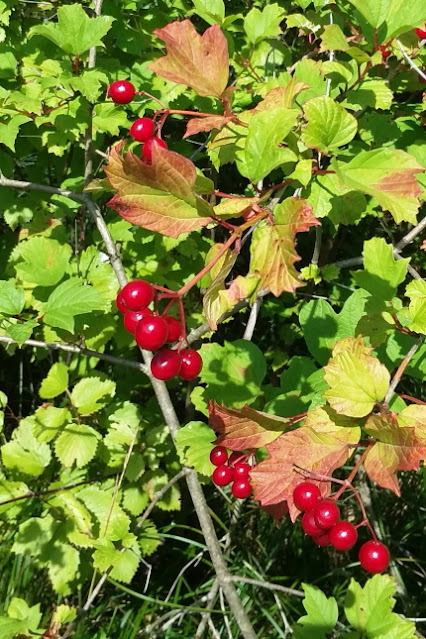 |
| Cranberry viburnum (Viburnum tribolum) |
Because the foliage looks like maple leaves (trilobum -> three lobes!) I thought
it might be maple-leaf viburnum, but they have dark blue berries; I eventually came
upon cranberry. Plus, the habitat of
cranberry virburnum is wetlands which is where they are in Hawkins Brook, whereas
maple-leaf viburnum is found in forests. The cranberry-like appearance gives the plant its name, but they
are not cranberries. The fruit however is
edible, juicy and sour and with large seeds (that are not edible).
They are used in jellies and jams as well as cooked into a sauce for hardy meat dishes such as venison. I didn’t try them, but if they’re still there
on my next visit perhaps I’ll sample a couple, though after my prior experiment
with beechnuts, I don’t hold much optimism.
So, beechnuts. After I collected a few nuts from under a beech tree a couple of weeks ago (see August 29), I
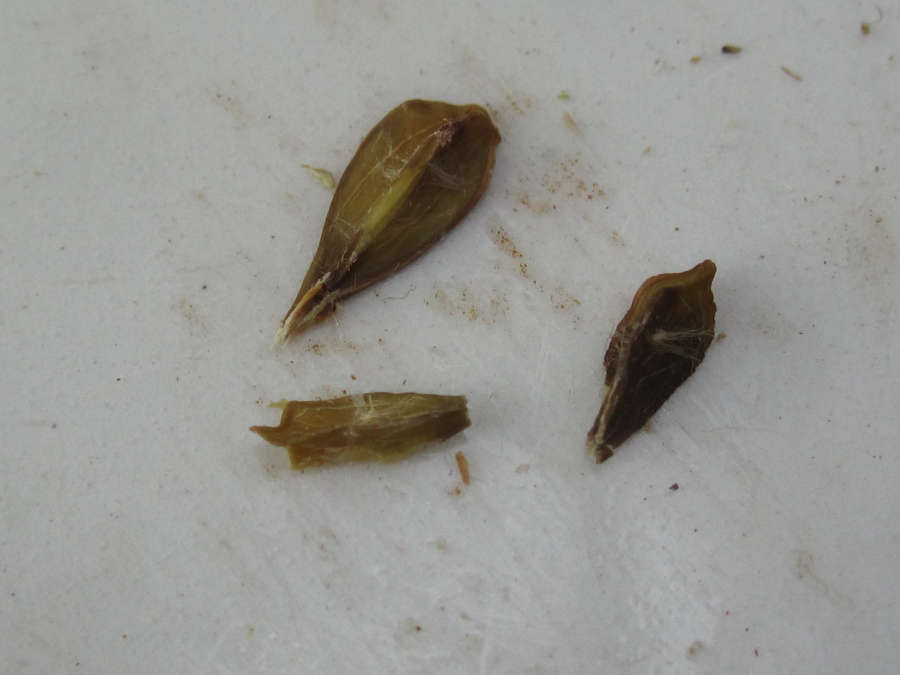
let them dry as recommended and then opened up the small, triangular inner seeds. I was quite disappointed. Out of the 16 seeds I had, only three contained any kind of nut meat in them and only one of these was of appreciable size.
 |
| My harvest of beechnuts after drying. |
 |
| The contents of those nuts. |
 |
| The entire harvest. |
Four of them contained little tufts of fuzz that looked like
feathers.
Perhaps these are seeds that didn’t get pollinated. The rest of the seeds were empty. So this brings me back to my theory that the
squirrels ate all the good ones, and left only the rejects on the ground for
me. But I did try the sorry little nuts
I had since I had gone through the effort, and I can say they did maybe taste
like nuts, perhaps between a pecan and a filbert. But there was so little to chew on I really
don’t feel I have much to offer. In the
end, that excursion into foraging didn’t work out so well; maybe cranberry
viburnum will be better.
In my travels this week I found several other berries, some
at Hawkins Brook as I mentioned, and others I found while monitoring the Marion conservation easement .
This latter area had mountain ash and another new plant I had to look
up.
 |
| Virginian creeper (Parthenocissus quinquefolia) |
Though I didn’t recognize this shrub, the distinct leaves in
groups of five made identification easy once I came upon it in the field guide. The guide mentions Virginia creeper often grows along stone walls, and that’s exactly where I found it; the plant is a
vine which can attach to stone or masonry to climb. It’s a member of the grape family though the
fruit is not edible, at least to humans – it is a valuable food source to many
birds.
If you’ve been around the lakes early in the day you’ve
noticed that morning fog is a common occurrence now, with cold air and warm
water conspiring to create a ghostly scene.
But it burns off quickly as the late summer rays beam down
and heat the atmosphere to a temperature above the condensation point. By mid-morning that clear blue September sky is revealed.
 |
| Scrub oak (Quercus ilicifolia) along Lake Ossipee in the Ossipee Pine Barrens |
I've been told acorns are edible too, but I'm not ready to try them yet!


.jpg)

a.JPG)