Showing posts with label Ossipee Mountains. Show all posts

Sunday, April 5, 2026

April 5, 2026: Happy Easter!

Spring is coming to New Hampshire.  The crocuses have joined the snowdrops in bloom, and the early spring birds are singing their joyous Easter songs. 

Crocus
Snowdrops
This week I heard the spring songs of phoebes (the first of the flycatchers to arrive), brown creepers, red-winged blackbirds, the singing-star Song Sparrow, and even a northern parula - all promising signs of spring.  Meanwhile, the lake is still firmly iced in, though with a beautiful warm and sunny day yesterday, the ice is turning dark, large cracks are forming around the edges - large enough to support the occasional pair of ducks - all of which mean the end of ice is near.  
Looking north over Wicwas yesterday from Wicwood Shores Road.

I doubt there will be any more coyotes crossing the ice unless we get an unexpected cold snap.

Last week's mid-day sighting of a coyote in the open was unusual because coyotes are primarily nocturnal.


There's not a clear story of the evolution of the Eastern Coyote, but a widely accepted theory is they are a mix of the Western Coyote and the Eastern Timber Wolf.  DNA testing of our coyotes shows roughly equal parts of these two species, with a small amount of domestic dog DNA as well.  The theory is that two major factors lead to this as a new species.  First, Europeans cleared the eastern forests where the timber wolf was present, all the way to the mid-west which was the eastern limit of the Western Coyote.  The presence of wolves probably kept them out of the east, but as the wolves were removed, there was the opportunity for coyotes to move in.

The second factor is that both wolves and western coyotes were hunted in a relentless effort to exterminate them.  As the popultion of both species declined, mating opportunities became scarce, and a result, they started interbreeding.  The extermination of wolves was largely successful, but it was not for coyotes which have incredible survival characteristics.  The result of the interbreeding is the eastern coyote, which weighing 30 to 50 pounds, is noticeably larger than the western coyote at 20 to 30 pounds.

Between the wolf extermination project and the decimation of the large mammal population (caribou, moose), wolves are no longer present in New England.  But coyotes have extremely wide diets including mammals large and small, birds, insects, amphibians, fruit, vegetation, and human garbage, so they thrived as the wolves departed the scene.  Despite governments spending millions of dollars to kill coyotes (in 1971 alone, the US government spent $8 million on the coyote extermination project), their numbers continued to grow.  The effort was self-defeating.  It turns out that coyotes have a remarkable survival instinct:  when their population is stressed for any reason, they actually increase their rate of  reproduction to ensure their lineage continues.  Coyotes are probably here to stay.

I rarely hear coyotes, though people west of the lake report hearing them at night on occasion, and I see their tracks and their scat regularly all around the lake.  

Coyote  tracks and scat after a light snow earlier this winter.


I've seen several instances of successful coyote hunts, most dramatically, deer killed on the ice in winter (See January 22, 2012).  One winter I set a camera at a kill site and captured a lot of nighttime action. 
A coyote approaches a deer carcass.

One coyote came near the site during the day, but it didn't venture out in the open; it crept along the shoreline, deciding to wait for the safety of dark.

As to why a coyote was out in daylight last week, it may have been needing extra hunting runs for its family.  Coyotes mate in winter, giving birth in spring, and the female remains with the pups in the den while the mate and other males in the pack hunt for food for her and the pups.  Both the male and female as well as perhaps an older sibling will care for the young.  The book "Tracking and the Art of Seeing" by Paul Rezendes [HarperCollins, 1990] provides an excellent portrait of coyotes.


I was in the Ossipee Mountains this week, and even in that southern part of the White Mountains, it's still winter at higher elevations.

Mount Washington viewed from the summit of Mt. Shaw in the Ossipee Range.

Ice formations on the Mt. Shaw Trail.
The warm day was sending a lot of snow melt into the streams.


I'm always happy to come across signs of moose wherever I am.  These tracks and droppings were near the Black Snout summit at an altitude of 2800'.
A pile of moose droppings near the summit of Black Snout.
Moose prints are huge compared to white-tailed deer.
The large animal followed the trail for quite a distance;  it requires a lot less energy than breaking its way through deep snow and dense forest. 

Down at the base however, it was back to spring, and there is a large sugarbush near the trailhead.

They were collecting sap as I arrived in the morning.  When I returned after my hike, I took a peak in one of the buckets.
In just a few hours, a couple of inches of sap had been collected.
The sap was flowing nicely.  
They must have to empty the pails every morning when the sap is flowing this well.


A lot is changing now in the Lakes Region.  Warm days and cold ice sometimes conspire to give us unexpected experiences.
Fog settles in on Lake Wicwas as the sun sets.

Spring is a beautiful season in New Hampshire, something worth waiting for - and appreciating when it finally arrives.  

Happy Easter!


Sunday, June 12, 2022

June 12, 2022: Lupine Time

We did get up to Sugar Hill this week and the lupines are putting on a fine show this year.

Lupine (Lupinus perennis)

So fine in fact that a painting class was taking place in the upper field where Cannon Mountain and the Lafayette Range set the background for the artists.


I think the lower field was the most spectacular I've ever seen it, awash in deep blue and purple with the occasional burst of pink or white sprinkled here and there.


It's always worth the drive up through Franconia Notch in Lupine season, but I also found mountain color closer to home.  On a hike to Mt. Shaw in the Ossipee Range I found several flowers in bloom including lady's slippers around 2000' elevation.  But the most interesting find was a plant that grows in dry, acidic soils as found in rocky granite outcroppings at high elevations.
Cinquefoil
I think this is three-toothed cinqufoil growing in the cracks and crevises in the granite which helps to break down the rock over time.


Granite ledges in the Ossipee Range with Lake Winnipesaukee and the Belknap Mountains in the background.

  Other flowers seen along the trail included bunchberry and bluebead lily.

Bluebead lily (Clintonia borealis)

Bunchberry (Cornus canadensis)

Later this summer bunchberry will have many small red berries while bluebead lily will have large - you guessed it - blue berries.

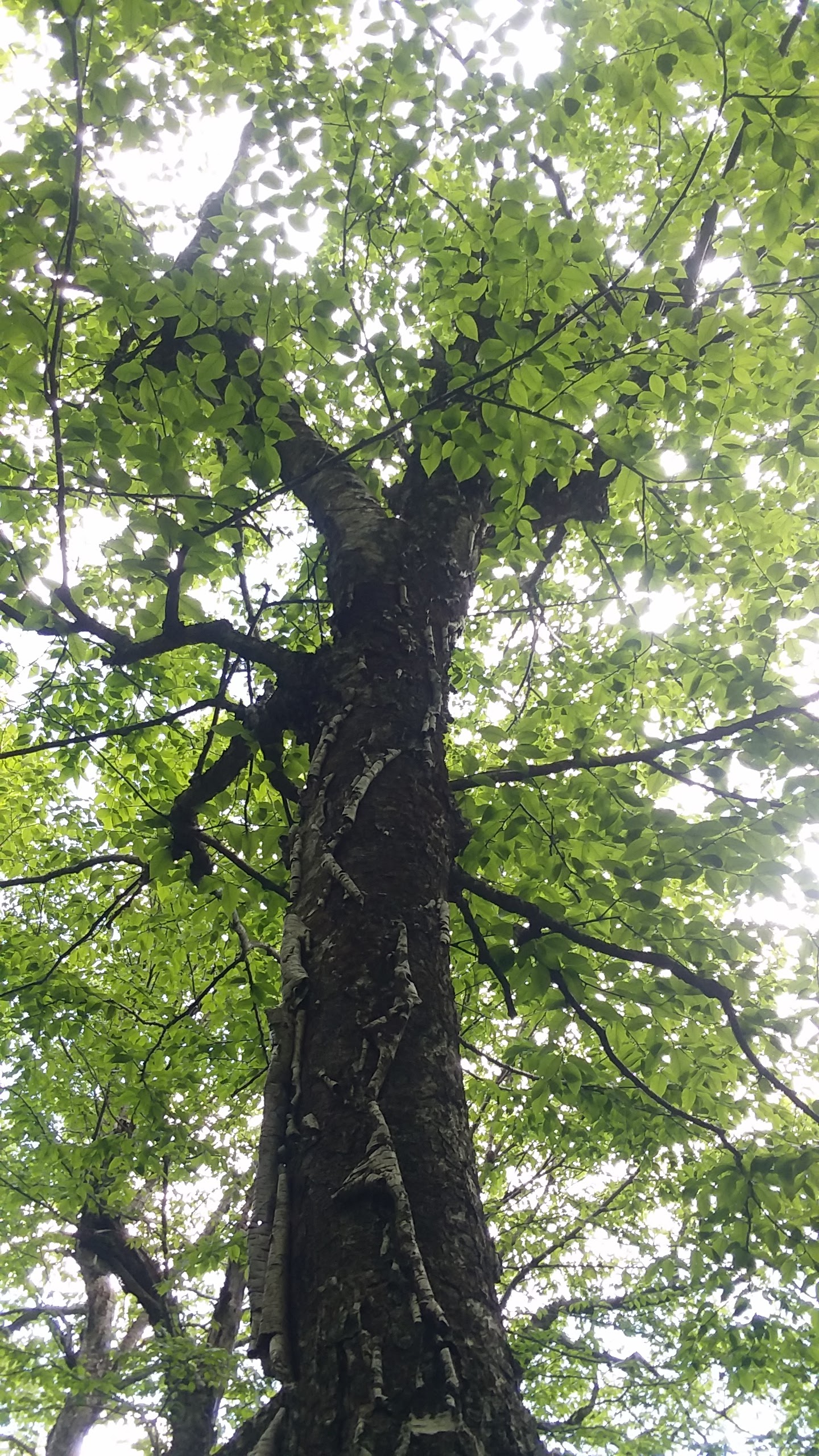
I also came across a towering birch tree right beside the High Range Trail which New Hampshire forester Dan Stepanauskas identified for me as yellow birch and estimated it at over 250 years old. 

An ancient yellow birch in the Ossipee Mountains

The mountains aren't claiming all the beauty though, as there is plenty to be found down at lake level.
Larger blue flag (Iris versicolor)
These wild irises grow in marshes and wet shorelines all around lake.  

One more lake flower I'll share is this wild cranberry viburnum I found growing on Sheep Island:
Cranberry Viburnum (Viburnum trilobum) also called highbush cranberry

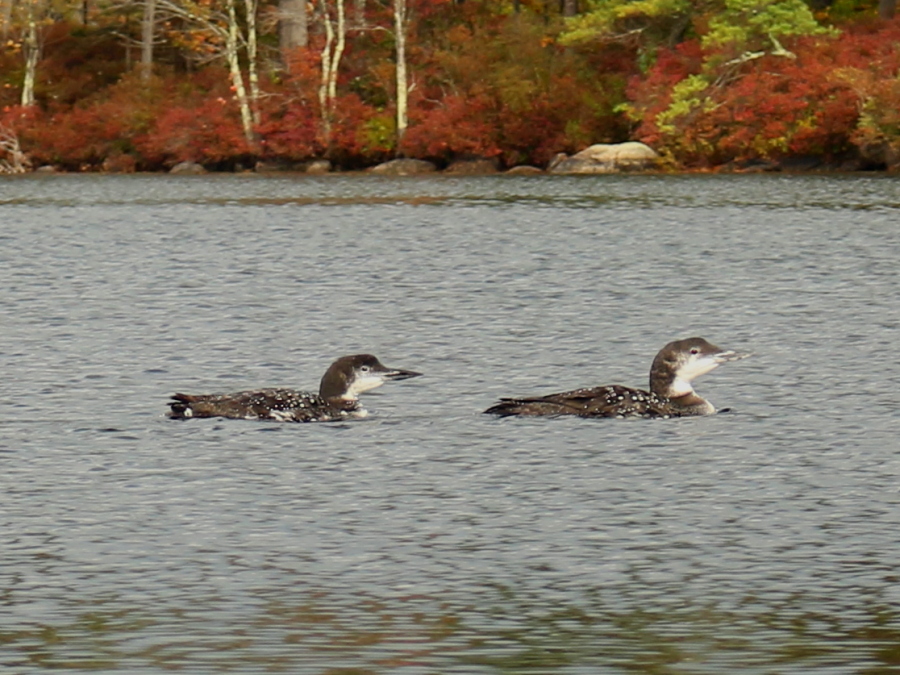
I'll end with an update on the loon picture which remains fluid.  As far as I can tell the banded pair is still tending to a nest though I often see both loons together far away from the nest.  Band sightings indicate it is the nesting pair.  But I also believe a second pair of loons is working on a nest in another part of the lake.  I've seen two loons near the island where a pair successfully raised a chick ("Justin Time") in 2018.  One loon observer has seen them bringing nesting materials from the bottom of the lake to the island, and one day when I was near the island a loon popped up right next to my kayak, acting as a decoy to draw me away from the island, which I immediately did, but still managed to get perhaps the closest look at a loon I've ever had.


There have been reports of a possible fifth loon on the lake.  It could be an interesting summer.


Sunday, October 11, 2020

October 11, 2020: Snow on the Rock Pile - (Important Update on the Eagle!)

Mother nature gave me my first glimpse of winter this week:  snow on the top of Mount Washington. 

A snow-capped Mount Washington behind the Mountain Ash berries on the summit of Mt. Roberts.

I had a beautiful hike with a good friend up in the Ossipee mountains on Friday, and there it was, the first snow, along with ice in the shallow ponds at 3000' elevation, still there after noon.  The foliage in the vast hardwoods throughout the Ossipee range was good, though a little muted at the highest elevations.

Turtleback Mountain and Lake Winnipeaukee from the summit of Black Snout.
   
Yellow birch and beech leaves glow along the High Ridge Trail.

There is a bit of sad news to report from Lake Wicwas this week.  Dean Cascadden reported that an injured eagle, first noticed by another Wicwas resident, was resting on the shoreline of Bryant Island, appearing very lethargic.  He called NH Fish and Game to report it and they said if it was still there 24 hours later they would come and assess the situation.  I went out to take a look, and by that time it has made its way up on shore and was roosting on railing, but it was the saddest, most sickly looking bird I've ever seen.  

A very sick-looking bald eagle.  Photo by Dean Cascadden.

The next day, being still on the island, Fish and Game went out and had to euthanize it - it had been shot by a shotgun and could not be saved.  I'd like to think it was a case of mistaken identity as hunting season is in progress (as noted by the shotgun blasts around the lake) but it's hard to imagine any bird could be mistaken for a bald eagle....

UPDATE:  After publishing this entry, a reader (many thanks Tony!) sent me this letter from Iain MacLeod, Executive Director at the Squam Lakes Natural Science Center.  Apparently the initial assessment by Fish and Game of a shotgun injury was incorrect.  A later necropsy determined that the eagle was "likely" on the losing end of a fight with another eagle.  And this bird has a well known history, being banded in 1999, and since 2003 has been breeding on Squam lake where she has raised 26 chicks!  There is more information in Iain's letter, including, while still sad to lose an eagle, it is all part of the normal - and healthy - circle of life.  Here is Iain's letter (apparently not everyone has picked up on how to spell "Wicwas):  

The old female eagle from our Squam nest was found mortally injured this week. She was found on an island on Wickwas Lake and subsequently died. She was initially thought to have been shot, but x-rays revealed no shot and the cause of death was determined to likely be from a fight with another eagle. This location is well outside her territory and means perhaps that she was ousted from her breeding territory and was roaming into other territories.


She was hatched/banded in 1999 at Little Quabbin Island in Ware, MA. She has been breeding at our nest on Squam since 2003.


I saw her on February 18 of this year along the Squam River in Ashland and I assume that she was the breeding female this year at our nest. On May 22 I photographed an adult eagle with the two small eaglets at the nest on Big Loon Island and that adult was banded (presumably our girl).


So, it will be interesting to see what happens around the nest this winter and next spring. We perhaps now have a new younger female in residence.


Although it’s sad to lose her (she has raised 26 chicks here), this is all part of life as an eagle. The leading cause of mortality in NH’s wild Bald Eagles is fatal injuries from fights with other eagles – a sign of a healthy population with plenty of young fit eagles ready to take over territories.  


Iain MacLeod

Executive Director

Squam Lakes Natural Science Center

PO Box 173, 23 Science Center Road

Holderness, NH 03245

Phone: 603-968-7194 x123

www.nhnature.org

On a happier note, Harold and Betty's parents did return!  There were happy reunions upon their arrival from their short time away.

The happy reunion.

But the parents seem to be leaving regularly, only to come back again, and in the process the chicks are adapting.  On Wednesday Harold and Betty were back in Marion Cove, again searching for their parents.  

But this time their calls were much less mournful, and had more of a demanding tone, kind of like, "Come on mom and dad, when are you going to get back - it's time to eat."


And yesterday, while Lake Hosting at the Wicwas boat ramp, Marge Thorpe observed the terminus of a training flight when the entire family came zooming in for a landing.  They can fly!  Normally we expect the parents to depart the lake weeks before the juveniles do, but this makes me wonder if Harold and Betty are now tagging along with their parents on their flights, so maybe when the parents leave, the kids will go with them.  From this point on I'd be most interested in hearing about any loon sightings you might have on the lake.  (You can leave a comment below or send an email to lakewicwas@aol.com.)

I'll close with a few displays of nature's beauty in New Hampshire.  If you can get out this afternoon or tomorrow you'll still find plenty of good leaf peeping opportunities in the Lakes Region.