Sunday, June 15, 2014

June 15, 2014

Happy Father's Day!  And thank you to all who sent your wishes my way!

Father Robin should be proud of its labor, as both he and mother robin continue to spend many hours collecting ants, worms, caterpillars, and other insects to feed their young.
Dad Watching Carefully between Feedings

The young are getting larger, and the nest is starting to get crowded.
June 10

June 14, 2014

It has been about 12 days since the chicks hatched, so they should be leaving the nest any day now. 

On a run along the ridge behind Lake Wicwas, right on the Yellow Trail, I saw a bright green ball on the ground.
Oak Gall

One often finds these Oak Galls in the fall when they are brown and dried out, but less commonly in the spring.  This one may have been blown off its oak leaf by the strong winds this weekend.  I couldn't resist stopping to open it up, as I have never really been able to understand just how these unique formations work.  They are instigated by the Oak Apple Gall Wasp (Amphibolips confluenta), when the female wasp lays a single egg inside the central vein of an oak leaf.  As the egg develops it excretes a chemical that causes the oak tree to form a gall around the egg, creating a protective shield. 

On the inside I found hundreds of tiny filaments connecting the egg to the inside surface of the gall.  

I surmise these connections are propagated by the oak tree as a result of the egg's secretions, and provide sustenance for the egg like a hundred umbilical cords.  I cracked open the inner egg shell with my thumbnail and found the tiny, not-yet well-formed lava inside.  
The Inner Shell
Larva Just Forming

This is not a synergistic relationship, as the wasp doesn't provide any benefit to the oak tree, but it is not a harmful relationship either, with the gall not injuring the tree.  It is an example of "commensalism" - an association in which one organism is benefited and the other organism is neither benefited nor harmed (credit Terry Gouthro).

Closer to the edge of the lake I discovered another new species for me:  a Rosy Maple Moth.  

Rosy Maple Moth (Dryocampa rubicunda)
This is another rather finicky insect, feeding predominantly on - what else? - maples, especially red and striped maples.  Only the caterpillar feeds - the adult moths do not eat;  once they emerge from their pupae they search for a mate and lay their eggs on, yes, a maple leaf.  They are pretty neat-looking moths, with furry bodies, purple legs, and big black eyes.


In a complete coincident, someone gave me an article written by Cheryl Kimball in the Union Leader (thank you!) that spoke of these very moths (Nature Talks, June 13, 2014).

One last note for the Wicwas wildlife journal:  New deer will be joining the Lake Wicwas community soon.  This shy doe was peeking out from the undergrowth near the lake.

She eventually emerged and worked her way along, enjoying the tender, new growth.  

When she stopped to scratch, it became evident that there will be another proud father celebrating Father's Day next year!
An Expectant Mother
As I was writing this I decided to do one last check on the robin nest, and wasn't I surprised to see only one chick left - the other had fledged!

Only One Left in the Nest

And I was even more surprised when just after I took this picture, this little guy took its first flight too!  We saw it embark on a not very graceful, but nonetheless successful flight of about 20 yards to a smooth landing on a nearby tree, and already flaunting some robin color.
Perched after its First Flight
I couldn't see them, but I'm sure its proud parents were close by, watching and encouraging it.  What a great Father's Day for this new dad!

Sunday, June 8, 2014

June 8, 2014

I was awakened this morning by the sharp call of an Osprey from  the open window.  A few minutes later I heard the explosion of water that is distinctive to an osprey crashing into the lake to catch a fish.  Osprey make a striking sight and sound, as they actually plunge under the water, talons first, to catch a submerged fish, unlike an eagle which is more likely to glide over the water and extract its prey with just its claws getting wet.  That sound brought me to the window, where I saw two osprey circling, one with a small fish in its grasp;  it landed on an oak with a large dead branch hanging over the lake - the osprey equivalent on breakfast on the deck!  I didn't get a picture, but here's one from Lake Wicwas in 2012.
Those poor fish don't seem to have much of a chance against those weapons!

I was busy last weekend with concerts, and a lot has changed in two weeks.  Perhaps the greatest transformation took place in the Robins nest, where four blue eggs turned into three little chicks. 

June 5
This picture was taken on June 5th, 18 days after the first egg was laid (May 18 post)  It looks like two of the chicks are several days older than the littlest one, which still has its eyes closed.  The next morning, however, the little one was gone. 

June 6
Perhaps it wasn't viable, or perhaps mother decided it couldn't support three chicks.  Either way - nature can be cruel.  Over the next two days the remaining chicks grew quickly, with distinct feathers appearing by today. 

June 7

June 8
Mother has been very busy collecting ants and other insects to keep them nourished.

A couple of less dramatic changes occurred in the woods, with the Black Cherry blossoms converting into tiny green cherries.  
Black Cherry

In a couple of short months these will be attracting Black Bears.

The bunch berries also came into bloom - red berries will follow next.
Bunchberry

One thing that didn't change very much is the status of the Lady Slipper - this orchid has a long bloom period, and can still be found in many places - this one is blooming right beside the Yellow Trail, perhaps half a mile from the trail head in the Hamlin/Eames/Smyth conservation area.
Lady Slippers
Perhaps you have seen it also!


Monday, May 26, 2014

May 26, 2014

Memorial Day - thank you veterans and all who served their country, making the ultimate sacrifice for us.  There are so many Americans who put their lives on the line every day for all of us, as we so sadly witnessed in Brentwood, New Hampshire last week.

In Memory of Steve Arkell

There are more and more people around Lake Wicwas as summer approaches, and boats, docks, and floats are starting to appear on the water.  It's also a time when people get together to visit again after a long winter, with Memorial Day celebrations and BBQs.

While we are coming out of hibernation, more plants and animals are doing the same, including my favorite wildflower, the Trillium.


Painted Trillium (Trillium undulatum)
Trillium thrive in rich, acidic soil, usually in the shade of pine or spruce trees.  This pair lives hidden under the dense cover of a hemlock tree some 40 feet from Lake Wicwas.

Also deep in a hemlock forest, I heard the pounding of a Pileated Woodpecker working for its supper.  I followed the sound slowly and carefully, being fortunate enough to get a glimpse of it hewing into an old dead snag.  I watched for several minutes as it attacked one hole after another, harvesting whatever insects, grubs, and eggs it could find.


Black Cherry is blooming now, attracting pollen-collecting insects of all shapes and sizes to their flowers.  If you walk by on a calm afternoon, you can hear the collective buzzing of hundreds of tiny wings from three of four feet away.
Black Cherry


This unknown bee has good-sized pollen sacs - called corbicula- on its hind legs.
Bee with Corbicula from Black Cherry Pollen

The Red Maple leaves were nearly full size last week;  compare that to the oak leaves, which are now just forming.
New Oak Leaves just Forming

Here's a size perspective - why are these trees on such different schedules?


The vernal pools will be drying up soon, so  the amphibians that breed there will be moving on. I found this Red Eft (newt) on a damp trail one morning.
Eastern Newt (Notophthalmus viridescens)

The terrestrial eft is a juvenile, having spent the first phase of its life in water as a larva, but not yet mature enough to be an adult when it will return to water to breed.

The wet weather this spring has been favorable for moisture loving creatures, such as this Leopard Slug, sliming its way along the ground.

Leopard Slug (Limax maximus)
This big, juicy shell-less mollusk would be great meal for a snake.  This thought came to mind after I discovered a reptile I have never seen before, and may not again:  a Smooth Green Snake (what a great name!).  They are reportedly rarely seen due to their superb camouflage and tendency to stay amongst the low grasses and green plants, feeding on spiders and insects. 
Smooth Green Snake (Opheodrys vernalis)


Speaking of spiders, no snake is going to get this spider!
Orb-Weaver Spider

Hanging from its silk three feet above the ground, this orb-weaver is safe from snakes and other ground predators.  However, it was dangling only feet away from the robin's nest;  that seems like an easy meal for mother robin!

And the robins - sure enough, three days later, there were four eggs in the nest.  The incubation period for robins is 12 to 14 days, so perhaps next week there will be tiny birds peeping madly for their first meal.
The robins are doing their part to paint patriot pictures for Memorial Day!


Wednesday, May 21, 2014

May 18, 2014

Signs of growth, renewal, and rejuvenation are everywhere around Lake Wicwas now.  The small, delicate wildflowers that emerge in the spring are coming into their full beauty, and with them arrives a wide range of insects that feed on the blossoms' nectar.
Hobblebush Viburnum


With Visitor


Goldthread

With its own Guest

Wild Strawberry

Fringed Polygala

Common Violet
Continuing with the progression of the Red Maple, the leaves that were tiny proteges grew rapidly in one week to become full-fledged photosynthesizing chlorophyll factories. 


Being the only trees to have developed large, green leaves, the forest is still wearing its early spring blazer of pale, yellow-green hue.


Another sign of renewal - a bright blue Robin's egg appeared one day. 


This particular beam has fledged baby robins before;  it is likely that by now another one or two eggs have arrived.  I hope I'll be able to follow this story of birth and development - it will require care and attention to not alarm the caretakers.

I wonder if the loons have selected their nesting site yet....

Sunday, May 11, 2014

May 11, 2014

Happy Mother's Day!  Mother nature gave her best today, providing all mothers with a fabulous day at Lake Wicwas - warm and sunny with a deep blue sky reflecting off the water.

The warmer weather has brought along the trees, as more buds are swelling and starting to pop.  The Red Maples are the first to have pushed out early, tiny leaves.
May 9th


And then just two days later, they are already exhibiting the familiar structure of the maple leaf.
May 11th
The Sweet White Violet is blooming in the sunniest locations and the Canada Mayflower and some ferns have sprouted, adding some green to the otherwise brown and drab forest floor.  .

The lake is still high, and the outlet flowing rapidly;  the streams emptying into the lake are full and wide.  The high sun and open canopy allows more light to penetrate than during any other season, which aids in warming the ground, fostering the growth of the new plants.

And my now good-friend, the garter snake was out enjoying the sun again as well.

Watching the surface of lake I noticed little wakes being made by small animals, thinking at first it was a snake, but soon realizing there too many of them and their travel pattern wasn't consistent with a Water Snake.  So I took my first kayak trip of the year to investigate.  They were made by an insect about half an inch long, which I think is the Water Boatmen.  I couldn't get a picture but here's a photograph of a Water Boatmen from the North Carolina State University web site.
http://www.cals.ncsu.edu/course/ent525/water/aquatic/images/09.jpg
Water Boatmen (NCSU photo)

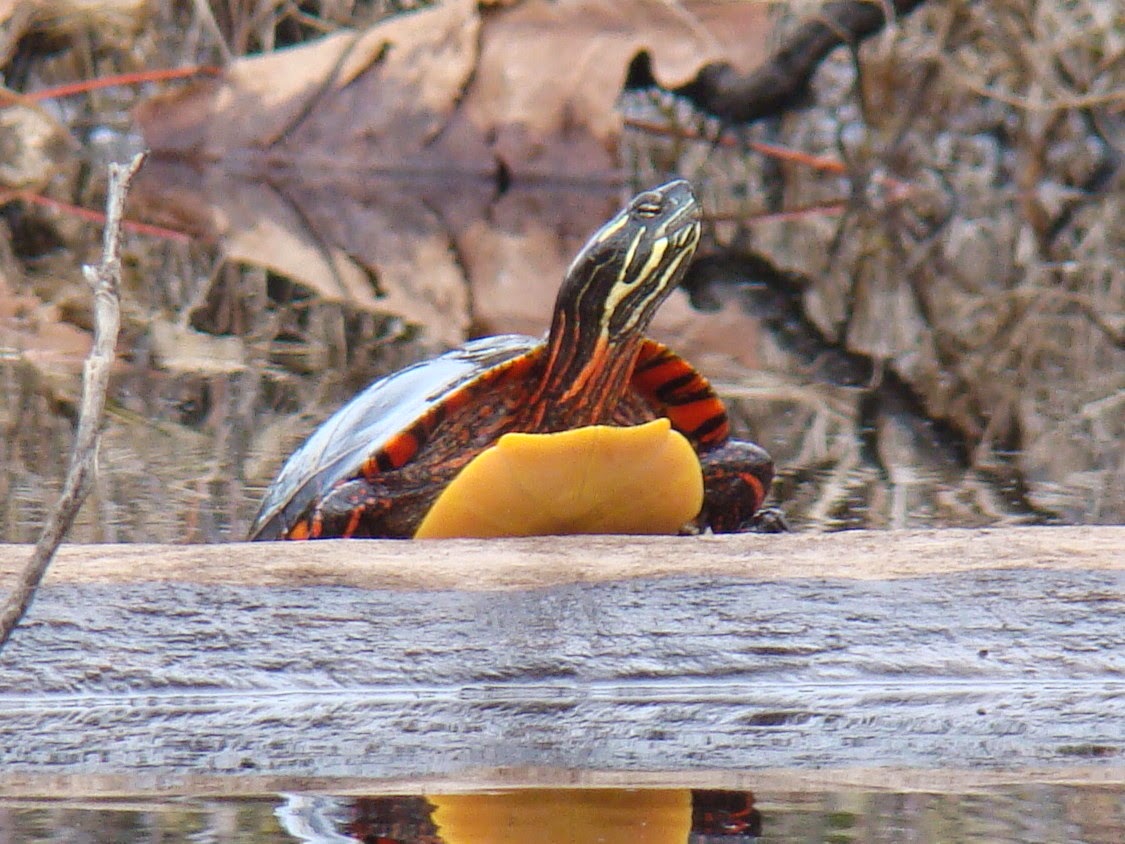
Continuing along the shore of the lake, taking advantage of the high water and lack of pond weeds, I saw many turtles sunning themselves wherever a spot providing good exposure.  This log had six or eight turtles all lined up it, which I didn't notice until I heard them splooch, splooch, splooch, one after another into the lake.

Soon their scout came back up to see if the coast was clear.
Painted Turtle

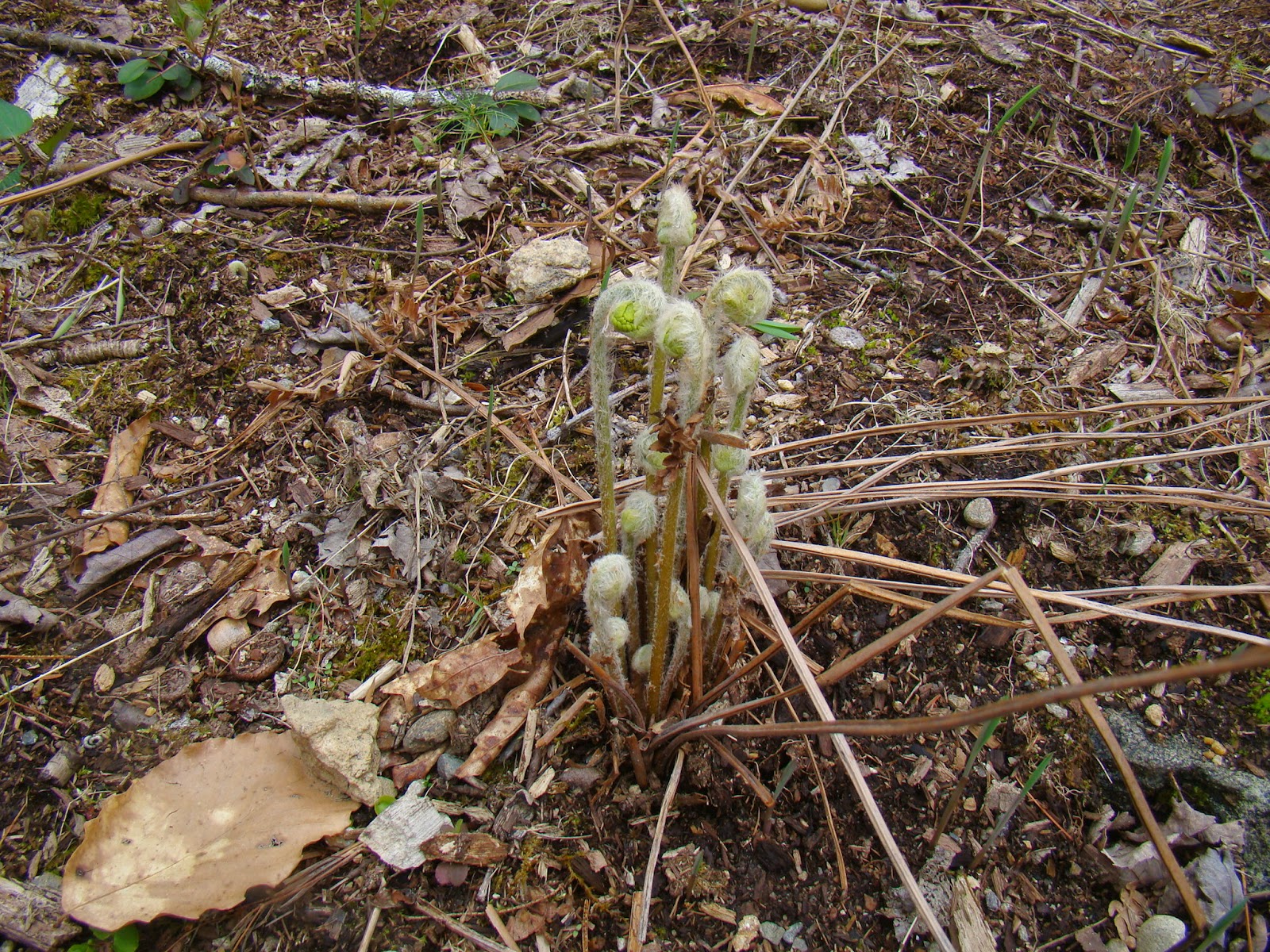
I identified a new shoreline plant that is blooming around Lake Wicwas.  This is known as bothLeatherleaf and Cassandra, and is an evergreen member of the Heath family.  It is responsible for much of the deep red and maroon color that appears all along the shore of the lake in the late fall when its foliage turns.
Leatherleaf or Cassandra (Chamaedaphne calyclata)
Meanwhile, at the bottom of the lake, plant growth is starting as well;  in the shallows I could see the pond lilies putting out leaves that will soon rise to the surface.

Pond Lilies Sprouting from the Lake Bottom


The flycatchers and song birds are arriving in large numbers now;  I watched a group of them doing acrobatics as they feasted on bugs over the water, and the raspy call of the Phoebe is heard frequently.

Last night I captured a picture of a fox;  it still had its bushy winter coat on.
Gray Fox

I suppose it is still cold in their den, and with nighttime hunting, a warm coat is in order for a little bit longer. 

Back up at lake level I came upon the male Wood Duck in the cove near its nesting site.  No sign of mom - she's at home working at the nest.  I'm sure dad is out finding her something special to bring her for a mother's day treat!
Wood Duck