Showing posts with label Painted Turtle. Show all posts

Sunday, June 7, 2026

June 7, 2026: Turtle Time

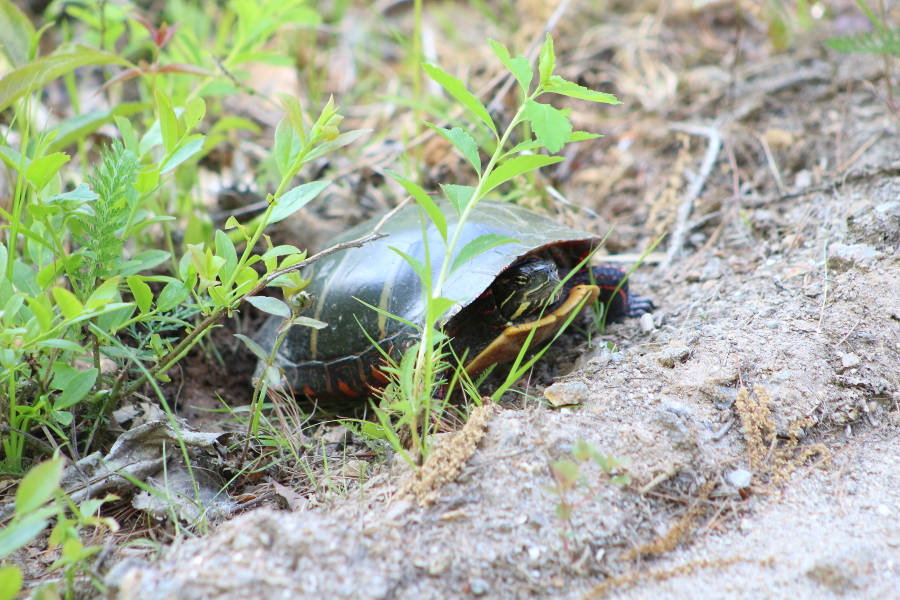
Like many animals at this time of year, the turtles are active and are getting busy reproducing.  I saw this Painted Turtle sunning on a log in a quiet corner of Lake Wicwas. 


Turtles don't soak in the sun just to feel good; there is important physiological value to their sessions in the sun.  Jen Esten and Jon Waage, authors of  The Nature of Pleasant Lake newsletter, wrote about turtles recently:

Being cold blooded, turtles need to sunbathe to elevate body temperature which in turn raises metabolic rate.  Sunbathing also periodically dries their shells, helping control mold. Rocks and logs are safe places to get some sun.  In addition to the sun’s warmth, they need the UVB rays to produce Vitamin D3 for processing calcium required for shell and bone growth.  UVA rays help with several body functions.  Sunning spots can get crowded!  Allowing fallen trees to stay in the lake helps.  These turtles feed on aquatic plants, algae and small aquatic invertebrates and fish. Young turtles are mostly meat eaters but become more vegetarian as they age.  They can live for 30 years or more!

We have a healthy painted turtle population in Wicwas even though a lot of their eggs are dug up and eaten by various predators before they hatch.  This excavated turtle nest was beside a trail in the Hamlin Town Forest this week.

Leathery egg shells left by a predator that consumed their contents.

Every year I find one of two of these dug up nests, often right on the shoulder of roads near water bodies.  Sometimes I even come across a mom laying her eggs.  This good size snapper was right on the side of Chemung Road at the Chemung State Forest.  

A female snapping turtle laying her eggs a few years ago.

This baby painted turtle was found this week by Lindsey Duggan:

Photo by Lindsey Duggan

If turtles are just laying eggs now, how can we see baby turtles already?  Well, painted turtles that are laid in late summer can overwinter underground after hatching, and emerge in the spring when the ground warms up.  

What's even more unusual is that she also found a baby snapping turtle.

Snapping turtles don't usually have the same wintering trait as their painted cousins - even if eggs are laid in late summer, snapper eggs usually hatch the same year.  But according to MassWildlife, they sometimes do overwinter in the nest, and that is likely how that baby turtle emerged in early June.  Another possibility is that it did leave the nest late last fall and immediately dug into the bottom of the lake for the winter.

-----🐢🐢🐢-----

One morning this week I saw a lot of commotion in the leaves of a maple tree just after sunrise, so I took a moment to see what was in there - it was a Gray Squirrel. 

A gray squirrel amidst the maple leaves.

It was very focused on some activity, running up and down the branches, stopping here and there to chew on something.  I waited for it to come to the end of branch so I could get a good look to see what it was up to - it was munching on maple seeds!


It would pull all little helicopter samaras from a clump, gobble up the seeds, and let the wings flutter down to the ground.  Then it would move on to the next clump. (Sorry about the focus, the moving branch made focus difficult.)
Just one tree seems like it must have an inexhaustible supply of these seeds!
The double winged "helicopter" seeds of a maple tree are called samaras - a latin name for a seed.


This week's off-lake exploration was to Mt. Liberty in Franconia Notch, from which the recent snow was still visible on Mount Washington.

Down at the snowless base of Franconia Notch, both sides of the Appalachian Trail were carpeted with large patches of Bluebead Lily.  

These are often inconspicuous plants, scattered here and there, hidden under other small plants, and with their blossoms hanging downward.  But in large patches along the trail edge, they were hard to miss.

Close up, they have their own hidden beauty. 

Later in the summer each blossom will produce a large, hard blue fruit - that is, assuming a friendly pollinator does its part!  

The fruit is inedible by people though many animals can and do eat them.

I'll  close with the loon update.  The LPC summer biologist came to survey the lake this week. 

Nicole, our summer loon biologist.

We observed the northern loon nest - it's a well hidden nest. 
Can you see the loon in there?


As of today, we still don't know if the southern pair has nested.  We'll keep you abreast of the latest developments!


Sunday, October 26, 2025

October 26, 2025: Pied-billed Grebe

I saw a new bird on Lake Wicwas this week:  A Pied-billed Grebe.
Pied-billed Grebe  (Podilymbus podiceps)

It was solitary, and having good success fishing all by itself in the lake, staying and diving for quite a while.  I had to look it up as it wasn't a bird I recognized, but after identifying it I realized I had seen this bird once before - on the coast of Virginia.  Pied-billed grebes breed throughout New Hampshire, but I'd never seen one here.  They are built like a loon with legs far back on their body which make them excellent swimmers, and like loons, very awkward when walking on land.  For that reason they spend almost their entire life in water - even when nesting.  


Unlike our Common Loon, this grebe builds a floating nest, a bowl-shaped nest on a floating mat of vegetation either by constructing a raft from stems of aquatic plants, or maybe even on top of lily pads.  Also like loons, once the chicks hatch they ride on their parent's back for safety.  The pied-billed has a wide range of food sources with crayfish being their primary food, but they also eat fish, snails, mussels, crabs, frogs, leeches, and insects.  [Ref: Cornell Lab of Ornithology]  Unlike loons, these grebes may lay a brood of up to ten eggs.  Here's a photo of a nest from the Southern Wisconsin Bird Alliance.
Pied-billed Grebe nest with ten eggs.  Photo by James Otto.

I saw another uncommon bird on Lake Wicwas a couple of weeks ago:
A Solitary Sandpiper perches on top of a docked boat on Wicwas.

The solitary sandpiper breeds in boreal forests in Canada, so this one picked Wicwas as a nice rest stop on its way to Central or South America for the winter.  We'll soon be seeing more migrating birds making stopovers at Wicwas.


Leaves are falling fast now in the Lakes Region and the open branches continue to reveal new sights I hadn't noticed before.  This week I saw this huge American Beech tree a dozen yards off the trail to Crockett's Ledge in the Hamlin Forest.  

It seems healthy, even with that six foot crack running up the trunk and an enormous cavity inside.  The opening was large enough to put my hand in and take pictures looking both up and down inside the trunk.
The bottom of the cavity inside the beech.

Looking skywards

Fortunately, there were no signs of animal life in there.  I don't think I've seen the inside of a standing tree before!

Farther up towards the White Mountain Ledge I noticed a hemlock tree with a long strip of bark blown off from being struck by lightening.
A long strip of blown off bark where electrical heating
explosively boiled the moisture under the bark.

When lightning strikes a tree the electrical current passes through the cambium under the bark to reach the ground because the live, wet wood is a good electrical conductor.  The heat generated by the current vaporizes the water under the bark which expands violently and blows the bark right off the tree.
Rotting wood indicates this is old lightning scar.


On the trail it was evident that many of the leaves were no longer on the trees, especially the maples.


The beech, oak, and aspen hold on to their leaves a bit longer so there was still some color looking north towards the white mountains.
I could only see as far as Mt. Osceola on Friday.


Closing on a non-nature note, the boat ramp for Lake Wicwas got its rebuild this week.  

There are nine concrete slabs anchored together going out over 20 feet into the water; one is visible as the lake level is still down a few inches.

Hopefully the new design will reduce erosion and sedimentation going into the lake.  
Silt fencing protected the water during construction.


It's worth noting that going into the last week of October, we've still only had one day where the temperature has dropped below freezing and flowers are still blooming.
Daisies at my parents house.

And people are still out enjoying the fall weather on the water.


I hope you're able to take advantage of the quiet season around the lakes!


Sunday, June 4, 2023

June 4, 2023: We have a Loon Nest

The pair of loons we identified several weeks ago, the "northern" pair, has nested! 

Photo by Marge and Dave Thorpe

It's in a rather remote part of the lake that will have minimal impact from motor boat traffic, and probably not a lot of kayak traffic either, so at this point it won't be marked with signs in an attempt to minimize disturbances.  The nest is so well hidden that it was only discovered when someone paddled so close that the loon not on the nest started to act up and gave away the location.  Many thanks to Shayne Duggan for being aware of the loon's behavior and knowing what it meant.  The Loon Preservation Committee has a description of loon behaviors on their website that will help you understand what different behavior means.  You can find it here:  Loon Watching the Responsible Way:  A Guide to Understanding Loon Behaviors.

And now a second pair of loons is starting to exhibit nest-building activities.  I was able to see bands on one of them - it's the male that was banded here last year, and raised the chick Maddie.


We haven't been able to see whether there are bands on his mate, so we're still waiting to confirm if last year's banded female is back.  

Something that is back are eagles.  There were multiple sightings of an immature bald eagle soaring over and divebombing the loons.  Adult loons should be fine, but loon chicks are quite vulnerable to eagles as well as to hawks.  I'd much rather have the eagles go after this critter I saw swimming in the lake on one of my paddles this week:

Northern Water Snake

Northern water snakes are harmless and don't bother me one bit, but they are much more plentiful than loon chicks!

As always, the geese are well ahead of loons in their breeding; I saw three geese families on another paddle, two swimming in the lake, and one up on an island foraging for food.

A family with four goslings on Sheep Island.

The little chicks are awful cute when they are so small and fluffy.


When the parents on the island saw me they encouraged the chicks to move along into the bushes for safety, which they did only reluctantly and with significant prodding - they clearly wanted to continue to find food in the warmth of the sun.

In need of a little prodding.
"Move along junior!"

What amazed me was that the parents were perfectly silent the whole time - you know how loud they usually are when they feel threatened, but not when there are chicks to hide.  A second family with four goslings, and a third family with six, were side-by-side, out for their morning swim.


That makes 14 new geese on the lake this summer!

The late frost we had a couple of weeks ago killed the leaves on quite a few of the beech and oak trees that were exposed to open sky.

One of many oak trees damaged by the late freeze.

I've been watching to see if they would put out a second set of leaves, and this week they started to do that.  

I'll keep an eye on them as the season progresses to see how they do.

Finally, birds aren't the only animals working on nests right now.  Watch out for turtles crossing roads to get from water to the perfect site to lay their eggs!

Momma Painted Turtle laying her eggs on the shoulder of the road.

It's almost peak time for new life on the lakes!


Sunday, July 3, 2022

July 3, 2022: High Altitude Wildflowers

A beautiful stretch of fine weather graced a visit north of the notches this week.  Though it was cool at night the days were bright and clear with a rare cloud-free four days in a row at the summit of Mount Washington.

Looking north down Great Gulf with Mts. Jefferson, Adams, and Madison towering above.

On a hike in the northern Presidentials I spent a fair amount of time relishing the unique wildflowers growing in that harsh alpine ecosystem, and then even more time with the field guide trying to identify them.  Some, such as Diapensia I should have known.

Diapensia (Diapensia lapponica) at 5600' on Mt. Washington.

This alpine plant grows only a few inches high and was just starting to boom.  

Another alpine flower I saw was the mountain avens.  

Mountain avens (Geum peckii) at 5400' on Mt. Clay.  (Accompanied by bunchberry.)


This plant is found only in the White Mountains in New Hampshire and on a single tiny island off the cost of Nova Scotia, Brier Island.    Although the leaves remain close to the ground, the flowers are on stems a couple of inches high which allows them to track the sun as it traverses the summer sky.  There are eight other species of avens in North America but this is the only one that grows above the tree line.  [Ref:  US Forest Service]

Next is the Labrador tea, a member of the rhododendron family.

Labrador tea (Rhododendron tomentosum) at 5100' on Mt. Clay.

This low-growing shrub is found in many areas above and below tree line in the white mountains, and as its name suggests, it has been used by native Americans for centuries to make tea as well as medicines to treat a number of ailments.  [Ref:  Adirondacks Forever Wild]  According to Adirondacks Forever Wild:

Native Americans made extensive use of Labrador Tea to treat a wide variety of ailments, including asthma, rheumatism, burns, and diseases of the liver and kidney. For instance, the Algonquin reportedly used an infusion of the plant for headaches and colds. The Chippewa used a powder containing powdered root to apply to burns and ulcers. The Cree used an infusion of the flowers for insect sting pain and rheumatism; they used a poultice of leaves to apply to wounds. The Oweekeno used an infusion of leaves as a remedy for a sore throat.

There were also many bluets lining the path along the Gulfside Trail.

Bluets on the left and the much larger false hellebore on the right side of the Gulfside Trail.

Another excursion in the Mount Washington area took us along the Presidential Rail trail to Cherry Pond where we found, believe it or not, loons!   And this pair of loons is well ahead of our Wicwas pairs, already having a chick hatched which is old enough to have molted at least once, replacing its dark brown baby feathers with lighter-colored plumage.

The loon pair on Cherry Pond in Jefferson.

They apparently have only one chick so it's getting all the food the parents collect, fueling its rapid growth.


Back on Wicwas there's not much to report on our loons as they patiently wait for their eggs to hatch, sharing duty on the nest.  I did see the male of the northern nest off-duty at one point, and he kindly exposed his leg band to prove his identity.

"Yes, it's me."

I had to spend more time with the field books looking up plants I saw in the marshes around the lake, one of which I recognized as having the characteristics of a carnivorous plant;  I need to read more about this one for a future journal entry.  

Round-leaved Sundew (Drosera rotundifolia) -  a carnivorous plant worthy of further study.

While we were away I set my trail camera along the road to see who visited while we were gone and there were a couple of large creatures that passed by.

Papa bear in full daylight.  (Especially for you, Stephanie!)

And mama deer cruising the road at night.

Based on the appearance of this doe I wouldn't be surprised if there were a fawn following along behind her.  She had better keep a close eye out for last week's bobcat!

It's also turtle season - keep a watch out for mother turtles crossing the road to find a sandy spot to bury her eggs.

Mrs. Painted Turtle laying her eggs.

Loon chicks, fawns, turtle eggs - early summer is a time of birth.  I'll end with one more look at the Rock Pile on the birth of a new day.

Mount Washington greets a new day on July first.

Happy Fourth of July - I hope you enjoy a warm and safe weekend!