A somewhat random record of observations of what's happening around Lake Wicwas and the Lakes Region. I hope to post about once a week - your comments are welcomed.
We had a series of cool nights this week with each night falling well into the 40s. One cool morning, with everything drenched in condensed water, I found an extraordinary array of spider webs adorned by the dew that formed overnight. These webs are probably there every morning, they just aren't so visible. I enjoyed examining the different form and structure and site of each spider's web. The variety of approaches each species takes to catch food is its own lesson in evolution. First off, the classic spiderweb of an orb weaver:
The well-planned geometric web of an orb weaver.
This orb weaver built its nest in a small tree at the edge of a field filled with much different spider webs.
A recently mowed field full of spider webs.
These were nothing like the carefully planned and constructed web of the orb weaver, but rather a seemingly random, dense network of threads designed to capture the smallest of insects in the grass.
Thick webs built low down in grass.
This one has a tall spire attached.
Does the tall web perform a particular function in relation to the thick web below?
This next similar web was also in the grassy field, but built on a tall flower stalk, giving it yet different properties.
This could be the same species with a different idea on how to catch breakfast, or a completely different species.
In yet another location, deep in a mature forest, were more dense webs, but these were built high up in tree branches.
Spider silk is made primarily of protein, and spiders create unique types of silk for different uses with each type formed by a different gland in their body. The strong silk that forms the frame of a web is called dragline silk. This silk, which isn't sticky so the spider can walk on it, is stronger by weight than nylon and even Kevlar. [REF: Römer L, Scheibel T. The elaborate structure of spider silk: structure and function of a natural high performance fiber. ] A spider fills in the web structure with a sticky silk called capture silk. There are yet other silks that are used for preserving captured prey, wrapping eggs, and even a light silk used as a balloon to travel long distances on the wind.
The spider's ability to create such useful material made me think that we humans have evolved with the ability to create incredible things with our brains and hands, but there's really nothing useful we create using just our bodies like a spider does. There's a whole world of science that studies spiders and their silk. See the above reference for a glimpse into that world.
The colder nights makes me think about how the next couple of months are critical times for animals bulking up on food stores, either to get through winter hibernation or for a long migration to the south; for some animals this continues through November. As noted last week, many food sources are ripening now, just in time for this feeding frenzy, including berries, mushrooms, and seeds from plants large (oak and beech trees) and small (milkweed and asters). Hobblebush viburnum are highly visible with their red and black berries growing in large clumps on chest-high shrubs.
Hobblebush Viburnum
Old neglected apple trees are ripening their fruit for animals like deer, bear, fox and coyote, all of which will eat them right from the tree or after they've fallen on the ground. Black cherry trees likewise are maturing their fruit as our young robin from last week knows.
Black Cherry
Black cherries are mostly pit with little flesh; the flesh is edible by humans, though the pits, which produce a cyanogenic glycoside, are not. [REF: https://plants.usda.gov/DocumentLibrary/plantguide/pdf/pg_prse2.pdf] Birds consume the flesh but not the seeds, which they distribute widely after they pass through their digestive systems. Rodents on the other hand will eat the flesh, but they also can crack open the pits to eat, or store the pits in their winter caches. Bears and foxes are like the birds in that they eat cherries only for the flesh, and then plant the pits wherever they leave their scat.
Other fall berries I seen now are Winterberry, False Solomon's Seal, and Bunchberry.
False Soloman's Seal
Bunchberry
I'm told the Summer mechanic team at a particular ski area has their own name for bunchberries: "Oh Shoot berries" (or something similar to that ;-) The name derives from the fact that when these berries turn red, it means, oh shoot, we only have a couple of weeks left to finish all our summer maintenance before the snow flies!
I've seen a few garter snakes around lately. In preparation of their winter hibernation, they're probably feasting on the many small frogs that have been hopping all over the place this summer.
Common Garter Snake
It's amazing how large a frog a small snake can swallow whole.
We were in mid-coast Maine for most of this week so I wasn't able to check on the loons. I spent a lot of time along marshes and estuaries where I saw the usual shorebirds including pipers, plovers, eagles, and osprey, but only one new bird, a Killdeer. I first heard it at night as they were calling while hunting beneath a bright full moon illuminating the estuary all week. It was unusual to hear something other than loons or owls at night. For those who love Maine as much as we do, here are a few familiar sights from the Wiscasset Area.
Summer arrived in full force this week with some nice hot humid weather and several waves of good old thunderstorms. On one warm sunny morning I saw our friendly garter snake basking at our front step again, and I thought it looked particularly dark and shiny. Then a few minutes later Linda called to show me what she had found among her flowers:
A ghost of a snake
It was a perfect snake skin that our garden attendant must have just shed. I was able to extract it intact from being entangled among the flowers, and it was still flexible enough to straighten it out and measure it - it was 30-1/2 inches long, but in reading about snake sheds I learned that a shed is actually much longer than the snake itself. [Ref: Wikipedia] A snake exits its old skin through the front after rubbing on a rough surface to loosen it up. It then wriggles out starting at the mouth, which leaves the shed inside out as the snake literally crawls out of its own skin. [Ref: Wonderopolis] This one left a perfect replica of itself.
I can't say whether it's inside out or not, but it sure looks like the edges of the mouth have been turned up.
The fact that our snake is growing and needs to shed proves it's earning its rent-free housing under our front step.
Our tenant shows off its shiny new skin.
The summer weather this week also provided opportunities for warm morning paddles, and there was a lot to see on the water, including wild iris blooming all along the shorelines.
Yellow Flag on the Roger Harris Natural Area. (Iris pseudacorus)
Larger Blue Flag near Sheep Island. (Iris versicolor)
I also had an encounter with a beaver that let me know it was not amused with my presence in its cove.
Mr. Beaver on a morning swim off the Marion Preserve just before giving me a stark warning with a tail slap.
The initial slap of the flat tail on the waters sends the loud alert.
The force of the slap pushes his hind feet right up in the air
which results in a pretty nice splash.
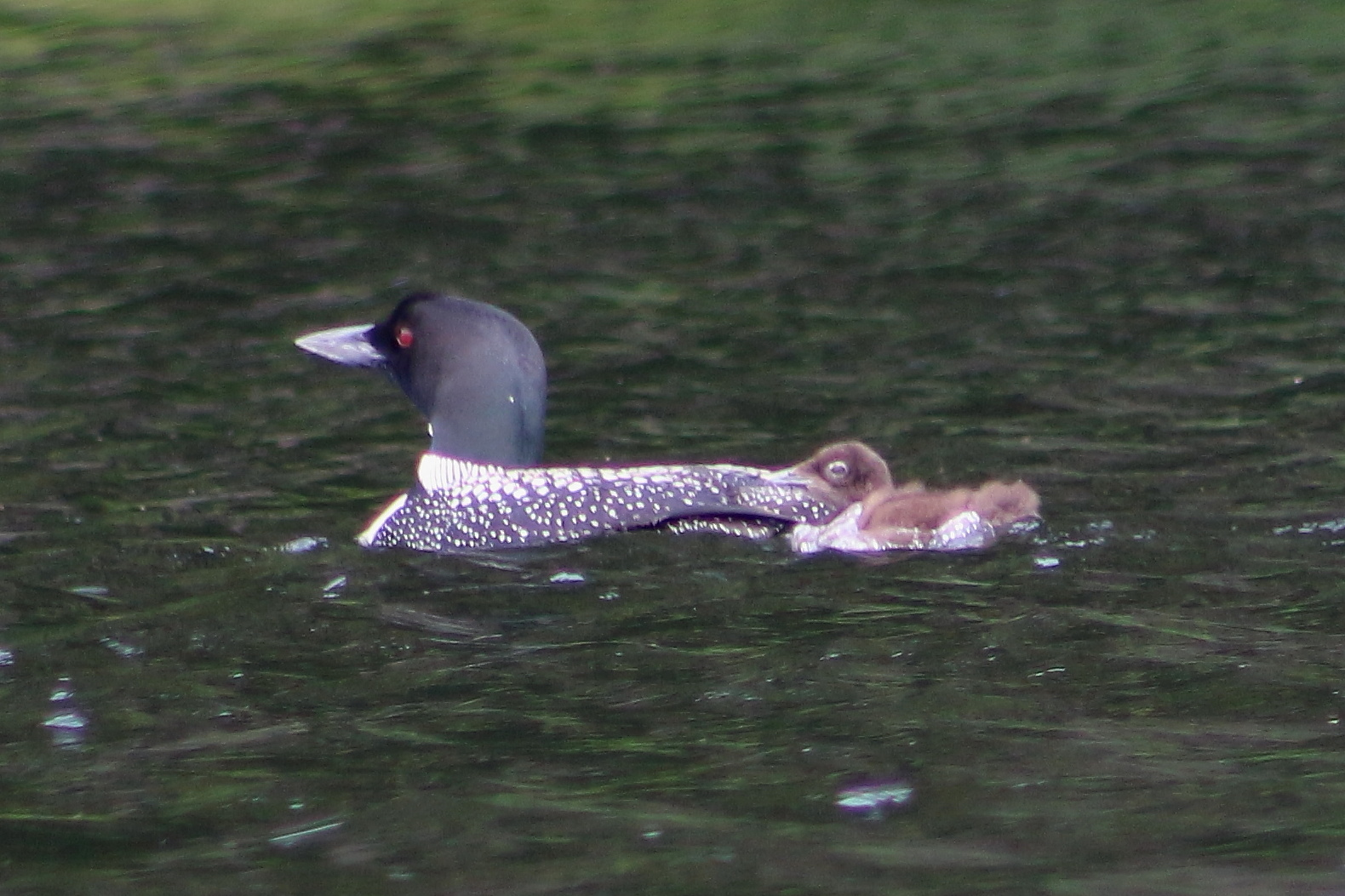
And finally, I did come across our loon family which continues to thrive with both chicks seeming to grow daily - as well as being well behaved.
Harley and Davidson are growing quickly. Photo by Debby Crowley.
A good sized minnow goes down the hatch. Photo by Debby Crowley.
Perhaps you heard the news from Pleasant Lake up in New London. The loon pair there had two chicks, but apparently abandoned one of them. An alert went out to everyone on the lake that one chick was missing, and soon thereafter someone found the little guy all by itself. When it was reintroduced to the family, the larger chick pecked at it mercilessly while the parents watched and did nothing. So the biologists from the Loon Preservation Committee rescued it and brought it to a rehabilitator who determined is was very undernourished but other wise healthy, so it will be cared for and eventually returned to the wild. This behavior is common among birds and other animals; it even has a term: siblicide. The parents somehow decide it is best to commit all their attention to the larger and stronger chick. But we appear to have no such problem at Lake Wicwas.
Harley and Davidson appear to be good friends.
Perhaps it helps that there was very little time separation between the hatching of Harley and Davidson so they are nearly the same size.
And lets not forget we have a second nest yet to produce. As of this morning mom or dad is still on the nest tending to the eggs, but we should have new chicks by next weekend.
They sure did a nice job decorating the nursery. Photo by Debby Crowley.
The lakes and it surrounds are becoming busy with the sounds of summer, and this past week the most prevalent sound was that of the Harley Davidson!
Click here to hear the rumble of the V-twin (then click the play button).
Bikes lined up at George's on Saturday morning
The bikers had some great weather early in the week and only a few damp moments mid-week; attendance was good and by most reports thing went smoothly.
Quieter sounds were found away from the roads, and I always encourage people to go out and enjoy all the wonder that the Lakes Region has to offer, but with this wet spring the mosquito content is way up there. Bug spray is an option, but I find this approach the most satisfying:
Essential armor for a relaxing June walk in the woods
The best part is the bugs can't fly into your face and eyes, and it can actually be amusing hearing them buzz all around you, frustrated they can't get in. You can get a hat like that, or just a simple net that goes on over a baseball-type cap on Amazon for less than $10; I got a pair of them for $7.99 and keep one in my back pack so it's ready when needed.
So outfitted I can walk calmly and quietly, exploring the coolest, darkest, dampest corners of the forest where interesting creatures like to hang out, even in early morning or late in the evening when things really come to life. One morning I stopped near a local marsh and listened to a diverse chorus of woodpeckers, frogs, toads, birds, insects - the whole enchilada from a single vantage point - click here to listen.
I could never enjoy this symphony while slapping at mosquitoes. Here's another recording where the mosquitoes were especially thick.
Frogs, toads, and birds all eat those tasty mosquitoes so it's no surprize they go together. What eats frogs and toads? Here's one thing:
A garter snake prowls for frogs, slugs, crickets, maybe even a small mouse or mole
Linda has seen this guy a couple of time in her gardens, a great resident because snakes eat lots of garden pests especially slugs which love the cool damp gardens around the lakes. Of course toads eat even more garden pests, and since snakes love to eat toads also, it's maybe a trade off. But this snake appears to have taken up resident under our front step, and were happy to have him.
At last report all was was well with the loon nests. The pairs are keeping a pretty low profile at the moment, but this lone rogue, which we have named "Solo" came right up to me in my kayak, perhaps to remind me it owns this cove.
Solo isn't a shy bird
If all goes well we could have a chick by next weekend.
Finally, all this rain is a good reminder of the importance of proper management of drainage and run-off to prevent erosion and pollutants from getting into our lakes. The Waukewan Watershed Advisory Committee is holding a workshop this Tuesday, June 18 from 4:30 to 7:30 pm at the Meredith Community Center. There will be several presentations and many organizations will be there (including the Meredith Conservation Commission) to demonstrate how to best manage runoff from your property. Click here for more details. Lake Winnepesaukee Americorps member will also be attending and they are offering free on-site evaluations for anyone. If you're interested but can't attend you can contact them at mail@winnipesaukee.org. A little extra effort will help protect our beautiful lakes and the animals that depend on them.
Happy Father's Day Dad, and all fathers out there!
The harvest season has begun, which is appropriate, as it has felt like fall the past few days, cool, bright, and dry. Some harvesters have begun collecting the smallest items of the autumn crop as the pollen flies all around.
A heavily-laden bumblebee comes in for a landing
A honey bee with full pollen sacs
It's good thing bees aren't allergic.
Just looking at this makes my eyes itch
The largest animals are also collecting the fall bounty; the bear has completed the removal of the black cherries, bending over the flexible trunks and stripping off all the fruit. It also rolled a rotten log right into the middle of the trail to extract the bugs from underneath.
An old pine log left behind after a meal
The least it could have done was clear the table after its meal and roll the log back off the trail.
The large quantity of ground-based insects this time of year - ants, crickets, grasshoppers, etc. - make it a good time for snakes to be born. I found this new-born garter snake slithering around the wood chips near the house. (Garter snakes are ovoviviparous, meaning they give birth to live offspring rather than laying eggs as most reptiles do.)
The new moon that blotted out just over half of the sun on Monday will, in two weeks, also follow the harvest theme as the September full moon is known as the Harvest Moon.
The eclipse at maximum blockage. Two sunspots are visible on the left side
We were fortunate enough to have clear skies during the entire period of the eclipse.
Well, I guess I can't put off the sad news any longer: Tardy is no longer part of the Lake Wicwas community. The first indication came on Wednesday when I heard news of a long period of awful, mourning loon calls, which was described as sounding like a parent who lost a child. Then a careful loon watcher reported that the chick had not been seen for a couple of days, even though there was a pair frequenting the waters where the nesting family had usually been seen. Next came a report of a loon swimming around for 30 minutes with a minnow in its beak, as if searching for a chick to feed - that sure sounded like a animal with parenting hormones in play. So yesterday I went on two searches for the family, and on the second I found the banded female in close proximity to (presumably) its mate, with no chick to be seen.
There have been many eagles seen circling over the loon family, so that is a likely cause of its demise.
A bald eagle soaring over the loon family - photo by Debby Crowley
There are other possibilities, including turtles and other loons, but unless a body is recovered, we'll never know for sure. Two years ago when we lost both chicks, one of them was found with a neck injury indicative of attack by another loon.
At least mom and dad appear to be fine; mom must have been hungry after all that work raising and defending a chick, as she caught herself a tremendous meal.
Either that or she was consoling herself with the loon-equivalent of a pint of Ben and Jerry's.
She spent a long time catching and releasing this large fish, tiring it out before swallowing it. Here's the whole sequence:
I guess we'll just have to try to enjoy the harvest season without our little Tardy.

.JPG)
.JPG)
.JPG)
.JPG)
.JPG)
.JPG)

.JPG)
.jpg)
.jpg)
.jpg)


.jpg)
.jpg)
.JPG)