Showing posts with label Newt. Show all posts

Sunday, August 20, 2023

August 20, 2023: Little Red Eft

I sure have seen a lot of these little guys lately with all the rain we've had - it brings them onto the trails in droves.  One day mountain biking there were so many that they were the biggest obstacle to avoid on the trails.
Eastern Newt (Notophthalmus viridescens), Red Eft phase

The red eft is the intermediate stage of the Eastern Newt.  These amphibians start their life in the water as green-colored aquatic larvae with gills, then move onto land after a few months when they become this red eft form.  During this time they can travel "great distances" [Ref:  Smithsonian National Zoo] moving to a different water body in the process.  They live in this form for two or three years before a metamorphosis back to an aquatic animal, and their return to water as adults.  They mate in early spring with a single female depositing between 200 and 400 eggs onto various aquatic plants.  According to the above reference however, some populations remain in the red eft stage permanently and only return to water long enough to breed.  The life span of these small amphibians is 12 to 15 years, their long life perhaps helped by their production of a toxin that discourages predation by other animals.


Mid August is a good time to look for caterpillars.
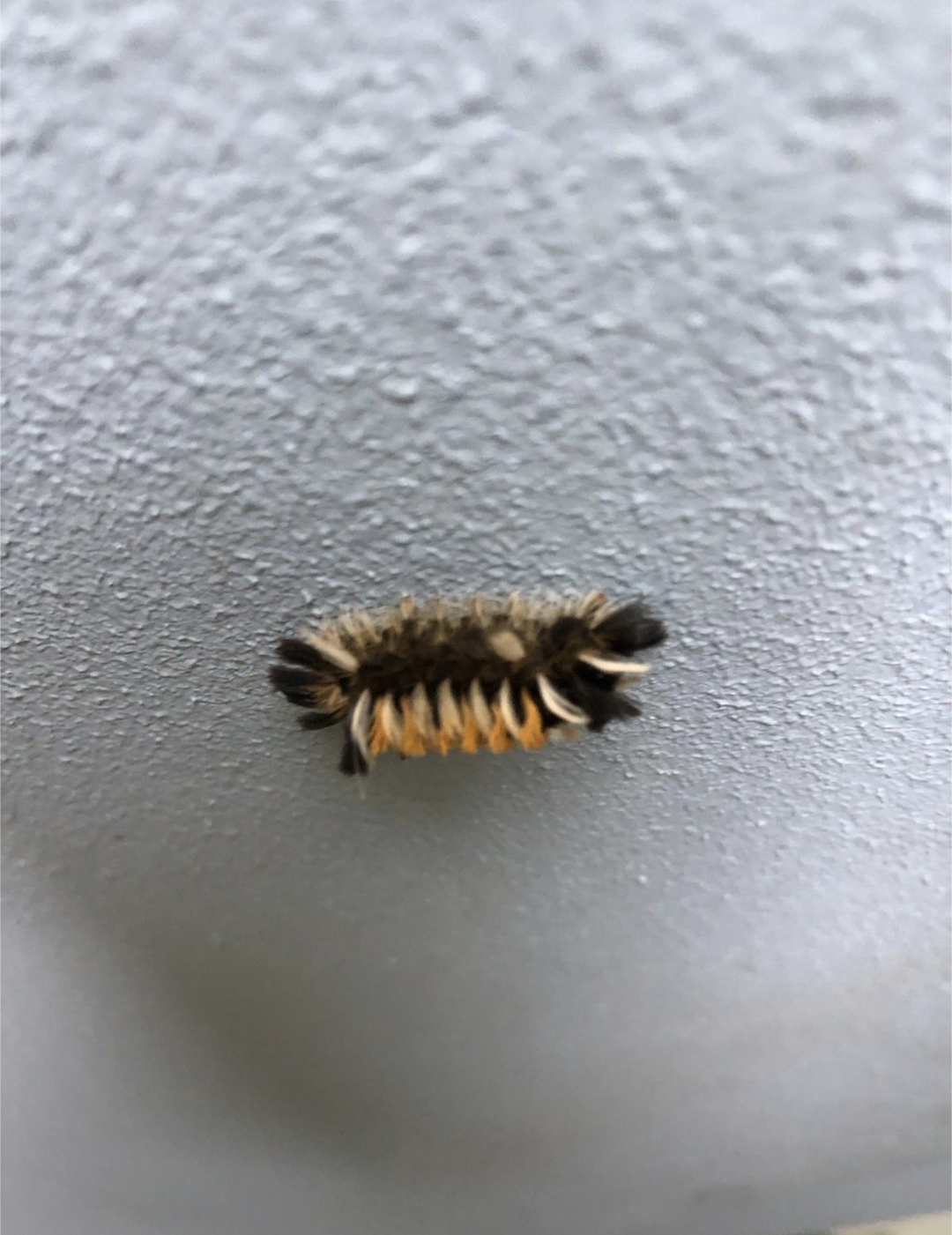
Hickory Tussock Moth Caterpillar (Lophocampa caryae)

This Hickory Tussock Moth caterpillar was on the ground looking for a safe place to spin its cocoon, and nowhere near a hickory tree.  But oak is also a favorite food for these caterpillars and there are plenty of those around.  It's best not to touch any of the various types of tussock moth caterpillars, especially the hickory species as it can cause a severe allergic reaction if its sharp hairs pierce your skin.  

It's also a good time to look for caterpillars on milkweed plants, and not just for monarch butterfly caterpillars.  I found this small army of Milkweed Tussock Moth caterpillars on the underside of a milkweed leaf on the shoulder of Chemung Road.
Another tussock moth caterpillar, the Milkweed Tussock Moth (Euchaetes egle)

The whole tussock moth caterpillar started when a friend (thanks Tutu!) found this guy on a run down in New Jersey!


There are just a few milkweed plants around the lake as they grow mostly in fields that aren't mowed during the summer.  Around the lake we have mostly Swamp Milkweed.
Swamp Milkweed (Asclepias incarnata) on the shore of one of the Rawson Wood Islands.


I mentioned a couple of weeks ago the good pinecone crop this year.  They are really visible now in the tops of the trees, and the squirrels have begun to chew them off the trees to collect them before they release their seeds so they can store them away for winter.

I've also seen beech nuts underneath large beech trees, so the beech are starting to produce mast also.
Beechnuts on a trail in a hardwood forest.

The beechnuts are quite small this year, about half the size of what I expect to see.


There is a new development with the loons this week:  One of the chicks is starting show its independence.  Previously the two have always been close together, but now one of them is moving away from the family, starting to head out on its own.  
They sure have grown in two short months.
I can't tell them apart anymore.

There are still other loons visiting the lake, having daily interactions with the family.  One morning we watched two loons frantically wing-rowing back and forth and around the lake for long time, probably the chicks' father defending their territory.  When the chasing loon got close to the pursued, the later would thrust its head and one wing into the water making an abrupt stop and turn to throw off its pursuer - just like Starsky and Hutch's J-turn with the parking brake in their '76 Ford Gran Torino.  I wish I had some video of the chase for you.

I don't know how much stress eagles add to the loons' lives right now, but they are here, as this fabulous picture taken by Debby Crowley shows.
A bald eagle watches over all activity on Lake Wicwas.


I'll end today with a non-nature picture, but it's a really neat sight.  There are a lot of pretty boats on New Hampshire's lakes, but few as beautiful as this classic.
"N. H. Dreamin' " cruises the waters of Lake Wicwas.

Keep watching for those fuzzy caterpillars!

Sunday, July 10, 2016

July 10, 2016

The holiday is over and Lake Wicwas is back to its quiet self, especially the past few days when after a lovely hot spell (it hit 94 degrees) the weather turned cold and wet.  Linda noted that yesterday's high temperature was lower than this past Christmas day!  But we sure did need the rain.  The moisture gave a great boost to the withering flora, as greenery from blueberries to weeds surged with a dose of moisture.  The blueberries turned plump and blue and consummated the first scrumptious treats of the year.
Warm Scones with Wicwas Blueberries

A little bit of moisture always brings out my favorite, colorful ground dwellers, the red-efts.
The red eft is the juvenile stage of the eastern newt (Notophthalmus viridescens)


One must be careful walking in damp conditions to avoid stepping on these little guys.

On a hike up to Crockett's ledge before the rain hit, one of the nephews spotted this snake sunning itself in a protected crack at the very top of the cliff.
A Garter Snake enjoying the warmth of the sun-heated rocks


It looks pretty safe there from just about every threat!

The deer flies continue to be about as bad as I remember them.  (Do I say that every year?)  But the deer fly strips prove there is good batch of them out there.
Proof that deer fly strips really do work

You can get these - of course - at Amazon.

It's no wonder there are so many flycatchers around here.  Mrs. Phoebee may make a lot of racket, but she does her part in cleaning up the flying insect brigade.
Perched, radar on, and cleared for take-off for its next sortie


A friend and good land steward spent many hours last week picking up the trash that collected along the sides of Chemung Road over the past year;  it looks great!  (Thank you JG!)  But it was sad to see that within hours of his work, the next installment of road litter had already begun.

One would have hoped that someone buying a can with the word "America" on it would have a little more respect for the nation that bears the name.

Before the rain hit late in the week I found this tiny maple tree sprouting in the moss on a tree that fell into the lake many years ago.  It always amazes me how creative seeds can be in finding a place to roost.  This youngster won't make it to old age, but like many lake lovers, it sure will enjoy its childhood growing up on the shore of a beautiful lake.

Sunday, September 20, 2015

September 20, 2015 - Leisurely Walks

Fall is here - it is my second favorite time of year to walk the trails around Lake Wicwas (early spring, with the renewal of life emerging everywhere tops my list).  With the black flies, mosquitoes, and deer flies now gone, I can once again enjoy a slow, leisurely walk in the woods without being hurried on my way by those annoyances.  It's a time to look closely at the lake and forest features I passed quickly by during the summer.  One of my favorites is the red eft.

Red Eft form of the Eastern Newt
As I was watching one recently it dawned on me just why I am so fascinated by these small amphibians.  One reason is that they move in such an interesting manner, like a giant dinosaur or alligator in miniature.  But I realized the critical factor is that I can watch it.  What other forest creature is so slow and calm that you can get right down on your hands and knees and watch it do its thing?  Just about everyone else - frogs, snakes, squirrels, birds, deer - they dash off in an instant.  But these little guys just go slowly on their way for you to watch.


While I was down there, I also noticed another miniature form of a previously giant object:  the Tree Clubmoss.
A forest of Clubmoss

This looks to me like a towering coniferous tree, but is in fact only five or six inches tall.  Similar to how the red-eft looks like a prehistoric creature, the clubmoss has been around for millions of years and is believed to be similar to very earliest plants that evolved on earth.  And in fact, their early relatives were 100 feet tall.  They grew in giant swamps and pumped so much oxygen into the atmosphere that the O2 content was 30 to 35% versus today's 21%.  This was during the "Carboniferous" period, so named because plants like the ancient clubmoss grew so abundantly that when they died their carbon loaded bodies were compressed into the coal and fossil (i.e. carbon) deposits we use today.  Imagine this a forest of 100 foot tall trees.

Much of what I learned on the Clubmoss came from a report on the NH State Parks blog - you can read the full report here.

If you're in the woods this fall, take advantage of the temperate, bug-free zone to look for previously unseen sights - maybe you'll even find a troll residence hidden beneath a moss-covered stone roof!
I hope the troll peeks out in the evening to catch the beautiful fall sunsets.

Sunday, June 21, 2015

June 21, 2015

The sights and sounds of the Lakes Region this week were those of chrome and the thrum of the V-twin as the annual migration of motorbikes passed through the area.

Meredith, and the Harley-Davidson dealer is a key attraction for the herd.

The Laconia motorcycle rally is the third largest in the country, behind Sturgis and Daytona, though it's older than both of them, dating from 1924.  It attracts riders from all parts of the country and a wide variety of mechanical machines.  I had to drive to Center Harbor on Saturday, so I stopped to catch a few sights. 


Back home away from the highways it was much more peaceful;  the gentle brush of a butterfly is somehow a bit more relaxing.  I noted a couple of weeks ago that the summer wildflowers were blooming, and this has drawn the butterflies to their summer homes.

White Admiral (Limenitis arthemis)

This White Admiral butterfly started with the daisies;  I was surprised when it set down on a hemlock tree.


I thought it was just resting for a moment, but then it unfurled its proboscis and started to suck some sort of tree nectar from the where the needles attach to the branches.
Rolling out its proboscis

It sat in one spot and reached here and there with its feeding tube to tap into whatever tiny drops of sustenance it could find.


A few of the wetland flowers around Lake Wicwas are still blooming as well;  these may be visited by bees, but I haven't noticed butterflies on them.
Larger Blue Flag

Sheep Laurel
If you take a trip around the shores of the local lake you are bound to see these two flowers (the Blue Flag grows mostly in marshy areas).

On a run through the Hamlin-Eames-Smyth conservation easement I met up with the Meredith Conservation Commission "Tuesday Trail Crew" maintaining the trails again.  This time they were cutting back the eager young trees - mostly maple and witch hazel - that continually push new branches out into the trail in search of sunlight.  They were also doing bridge maintenance, and addressing any other items in need of attention.
Jim Gregoire and Don MacFarlane of the Meredith Conservation Commission "Tuesday Trail Crew"

We can't thank these great volunteers enough for all they do to protect this valuable resource and make it accessible to all of us.  They are always looking for more volunteers to help out;  you can contact them at Conservation@Meredithnh.org if you would like to help.  Here is just one of the hundreds of creatures you will find if you visit these trails.
Eastern Newt (Red Eft phase)

On Saturday evening if you were outside with a view to the west you were treated to neat coalescence of three astronomical bodies:  Jupiter, Venus, and the moon.

Jupiter is upper-most of the three.  I savored the cosmic display while being serenaded by the tender drone of the V-twin Harley.

Monday, May 26, 2014

May 26, 2014

Memorial Day - thank you veterans and all who served their country, making the ultimate sacrifice for us.  There are so many Americans who put their lives on the line every day for all of us, as we so sadly witnessed in Brentwood, New Hampshire last week.

In Memory of Steve Arkell

There are more and more people around Lake Wicwas as summer approaches, and boats, docks, and floats are starting to appear on the water.  It's also a time when people get together to visit again after a long winter, with Memorial Day celebrations and BBQs.

While we are coming out of hibernation, more plants and animals are doing the same, including my favorite wildflower, the Trillium.


Painted Trillium (Trillium undulatum)
Trillium thrive in rich, acidic soil, usually in the shade of pine or spruce trees.  This pair lives hidden under the dense cover of a hemlock tree some 40 feet from Lake Wicwas.

Also deep in a hemlock forest, I heard the pounding of a Pileated Woodpecker working for its supper.  I followed the sound slowly and carefully, being fortunate enough to get a glimpse of it hewing into an old dead snag.  I watched for several minutes as it attacked one hole after another, harvesting whatever insects, grubs, and eggs it could find.


Black Cherry is blooming now, attracting pollen-collecting insects of all shapes and sizes to their flowers.  If you walk by on a calm afternoon, you can hear the collective buzzing of hundreds of tiny wings from three of four feet away.
Black Cherry


This unknown bee has good-sized pollen sacs - called corbicula- on its hind legs.
Bee with Corbicula from Black Cherry Pollen

The Red Maple leaves were nearly full size last week;  compare that to the oak leaves, which are now just forming.
New Oak Leaves just Forming

Here's a size perspective - why are these trees on such different schedules?


The vernal pools will be drying up soon, so  the amphibians that breed there will be moving on. I found this Red Eft (newt) on a damp trail one morning.
Eastern Newt (Notophthalmus viridescens)

The terrestrial eft is a juvenile, having spent the first phase of its life in water as a larva, but not yet mature enough to be an adult when it will return to water to breed.

The wet weather this spring has been favorable for moisture loving creatures, such as this Leopard Slug, sliming its way along the ground.

Leopard Slug (Limax maximus)
This big, juicy shell-less mollusk would be great meal for a snake.  This thought came to mind after I discovered a reptile I have never seen before, and may not again:  a Smooth Green Snake (what a great name!).  They are reportedly rarely seen due to their superb camouflage and tendency to stay amongst the low grasses and green plants, feeding on spiders and insects. 
Smooth Green Snake (Opheodrys vernalis)


Speaking of spiders, no snake is going to get this spider!
Orb-Weaver Spider

Hanging from its silk three feet above the ground, this orb-weaver is safe from snakes and other ground predators.  However, it was dangling only feet away from the robin's nest;  that seems like an easy meal for mother robin!

And the robins - sure enough, three days later, there were four eggs in the nest.  The incubation period for robins is 12 to 14 days, so perhaps next week there will be tiny birds peeping madly for their first meal.
The robins are doing their part to paint patriot pictures for Memorial Day!