Showing posts with label Wood Duck. Show all posts

Sunday, December 8, 2024

December 8, 2024: Ducks on the Ice

The days of ducks are just about over.  The ice slowly crept its way over the lake this week as cold temperatures settled in.  When you see Wood Ducks walking around on the ice, you know the end is near.

Why don't his wet feet freeze to the ice?!!

This little woody swam along the edge of the ice, then climbed right up and poked around for a while looking for edible bits blown onto the ice.


I found it interesting that the late arrivals were mostly males.  Are they waiting to migrate as long as possible, hoping to yet find a mate?  At any rate, it was a late season treat to see these pretty ducks on the lake right up to the bitter end.


Of course, there will still be plenty of open water on the larger lakes for the late migrants, but on Wicwas, the waterfowl show will now be usurped by passerines - the large family of birds that includes most of our song birds - because with snow on the ground and temps in the teens overnight, it should be safe to put out the bird feeders without fear of acclimating bears to the yard.  

We've already seen most of our winter residents at the feeders, including chickadees, nuthatches, titmice, blue jays, downy, hairy, and red-bellied woodpeckers, even a sparrow.  We haven't seen the Juncos yet though.  
A White-breasted nuthatch departs with his selection from the feeder.

Along with the cold temperatures came the artistic renderings of Jack Frost on the inside of the un-heated sunroom windows.


It was nice to see these because the early snow falling in the open lake before ice formed meant we didn't get the cool ice formations we get when the lake surface freezes on a calm, cold night.  The variety of crystals forming on the glass is always unique, and the detail is beautiful.

I love the way the expanding crystals spawn tiny palm trees in random places.

Lake Wicwas is very close to ice-in.  The next few days will be critical as the temperatures are forecast to rise again, so the small remnants of open water may or may not freeze completely.  

As the temperature rises and falls, and clouds form and disperse, the day to day appearance of the laket his time of year can change dramatically.
Monday
Thursday
The low December sun shines across the Chemung State Forest.

But any way you look at it, it's beautiful.


Sunday, October 27, 2024

October 27, 2024: Fly Away Woodies!

Autumn is fading fast and our last long stretch of summer-like weather is probably behind us.  Hunting season has begun with archery for deer now underway with firearms beginning on November 2nd (muzzleloaders only) and continuing through December 15th, so remember to wear bright colors when out in the woods.  Duck hunting season is in full swing as well and will continue until late December with a two-week break in November.  Why the break in the middle?  It's done to comply with federal hunting rules which allow only 60 days of waterfowl hunting.  Because some birds migrate early while others migrate later in the season, the break in the middle allows hunters to pursue all species through the season while satisfying the 60 day limit.  

Usually we're awakened on opening day at exactly 30 minutes before sunrise, but this year the first shots didn't ring out until Friday, two weeks into the season.  I expect they had good luck as there have been a lot of Wood Ducks on the lake this week.  Going past the boat launch later that morning I saw the hunters taking their boat of the a lake and thought about stopping to ask about their day, but decided I really didn't want to know - between the two hunters they could have legally taken twelve of our pretty woodies.


Wood ducks are pretty skittish this time of year, probably on high alert from being pursed for a couple of weeks as they make their way south through New England.  Detecting the slightest motion causes the whole flock to take flight.

Wood Ducks in Flight.

By first light Wood Ducks are on the move from their overnight spots and just a couple of hours later they are nowhere to be seen until evening comes. 

A flock of woodies at first light.

Wood ducks do molt into winter plumage called the "eclipse phase" but the birds I've seen this week still appear to have their breeding plumage.  As early risers, they get to enjoy salmon-colored sunrises on misty mornings.
Rising sun burns off the morning fog.

Foliage is well past peak in the Lakes Region now but there are still some pretty colors to be seen, especially in the beech and oaks when they're lit up with the warmer hues of autumn sunshine.  


There's a stray maple here and there that's lagging the others for some reason.


Many maple trees now have bare branches but earlier in the week there was still some nice color in the hills behind Wicwas.

Bare branches and morning rays.

The blueberries and huckleberries will be the among the last to hang on to bright red leaves.


As the leaves depart the trees, so do the boats on the lake, but like the trees there are a few hardy souls still hanging on to these last days of the season before they leave the lake.

A quiet boat trip on a late October evening.

Migrating birds are hopefully safely heading on their way as well.


 Fly away Woodies!


Sunday, July 14, 2024

July 14, 2024: A Week of Extremes

It was a week of extremes on lake Wicwas, from great beauty to true tragedy.  We'll start with the beauty from a paddle in one morning as the lake was just waking up.  Dragonflies and damselflies start their days drying off the prior night's dew along the reeds and ferns near shore before starting their hunting excursions for the day. 

Pondhawk


There were quite a few young damselflies that apparently had just hatched out from their larval stage.  

This is a spreadwing damselfly, perhaps an Emerald Spreadwing.

I found their exoskeletons on reeds where they had metamorphized into their flying forms.  

Exoskeletons left on the reed where they climbed up out of the lake.


I also saw that blueberry season has begun. 
They're still mostly green but some have turned a powdery-blue.

The first fruit was just starting to ripen but later in the week I was able to find enough for our first batch of Lake Wicwas summer blueberry treats.  They'll probably hit their peak this coming week so if you're around now is the time to take advantage of this opportunity to taste summer in New Hampshire.


On the gloomy end of the enjoyment spectrum is more sad news for the loons.  Jayden from the Loon Preservation Committee came out on Wednesday for a routine check on our loon nests, and as we approached the north nest everything seemed fine with the male loon at his sentry post, but as we got near the nest we saw a terrible sight.  The female loon was dead on the ground about four feet from the nest. 
The female loon with the nest in the foreground.


Not expecting this event we had to return to shore to get proper protective gear to bag the loon to bring it to the Loon Center for study and hopefully determine the cause of death.  This gets a little grisly now, so you may want to skip over the next two pictures.  There were no visible injuries on the bird such as a spear hole through the sternum which would indicate attack from another loon.  

A scavenger or two had found the carcass but most of the bird was intact.


Possible causes of death include a fight with another loon, perhaps a female trying to evict this female from its mated pair so it could take its place.  (This is in fact what this female did in 2021 when she killed or drove off the prior banded female - she hasn't been seen since.)  Another possibility is of course lead poisoning.  Either of these could have weakened the loon causing it to return to its nesting site where it expired.  There's also a possibility of attack by a predator but it seems unlikely since the bird was not taken away or consumed.  We know it took place at most 48 hours earlier, because two days prior the female was sitting happily on her nest. 
July 8th, 2024


The Loon Center is very busy right now so a necropsy (an animal autopsy) will probably not happen until this fall but hopefully blood tests and examination of injuries and will give us some indication as to what happened.   If we get a report later in the year I'll be sure to pass on what was discerned.  Both of the destroyed eggs were outside of the nest and were collected for study as well.  Before and after this event there has been a lot of loon trauma on the lake, perhaps all caused by a rogue loon that's been here much of the summer.  It's been dubbed "Bad Loon" by someone who's seen it even harassing the ducks!
"Bad Loon"     Photo by Amy Wilson.


We also went to the site of the southern pair where Jaden was able to find some shell fragments from that nest which were also collected to be analyzed.  It's unlikely the southern pair will nest again, but the pair is still staying close together in their nesting territory so it could happen.  At any rate it's been a very difficult year for the Wicwas loons and it may be the first year since 2017 without at least one chick fledged.  It's a painful year to be a loon watcher on Wicwas.


The ducks have done much better.  I've seen a couple families of little ducklings zipping rapidly into the weeds when they hear my kayak approaching, and this week I must have caught them off guard when I rounded a corner because once we saw each other, Mrs. Wood Duck put on quite a show scooting and splashing dramatically along the surface to draw my attention in the opposite direction from where she had sent her little ducklings down around the corner. 

Once she was far enough away she went airborne and circled up and around to make sure she was seen.  But looking back at the ducklings I saw what I'm pretty sure was another adult hen herding the ducklings along.

Mrs. Woodie #2 herding four visible ducklings plus an unknown number around the bend.

I know some waterfowl as well as some land birds (turkeys for example) will merge their broods together and I wonder if that's what happened with these two merganser females. 


OK, we'll end the week back at the beautiful end of the spectrum with some summer flowers blooming right now.
Shinleaf

Swamp Milkweed

Steeplebush

Pickerel Weed
Page Pond
Swamp Rose.  (Those last two pictures were taken at the Page Pond Town Forest on Meredith Neck.)

Bring a pair of binoculars on your travels around the lake to enjoy these heart-warming summer sights.


Sunday, October 22, 2023

October 22, 2023: Fog in the Woods and Woodies in the Fog

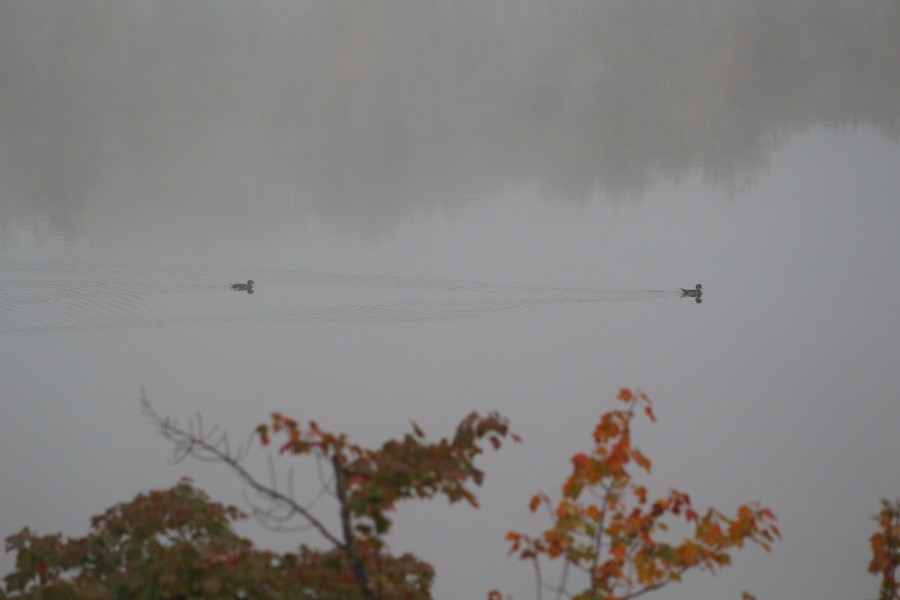
October days often emerge with fog in the valleys and over the lakes that sometimes doesn't burn off until mid-morning.  It's interesting to see what emerges from the fog as it lifts.  This week it has been wood ducks.

A pair of wood ducks in the morning fog.

As the day brightens more and more of them materialize.  


Each day this week I've seen at least half a dozen on the lake.

The loons paddle around in the fog as well, both the two juveniles as well as adults.  This adult was probably stopping by Wicwas for a visit or a rest stop on its way to the ocean.

A mature loon part way through its molt.

I have to look carefully to tell adults and juveniles apart now.  It's possible both of our nesting adults have left the lake as I haven't seen LuLu and Checkers with either parent this week, though it doesn't mean they won't return for visit to check on the kids.  The young ones are very quiet now - no whining and nagging for food when they're on their own.

I found the hobble bush viburnum to be especially interesting this foliage season, transitioning through a sequence of colors from green to red to a deep burgundy.

Hobblebush viburnum on October 13th.

And six days later.

They do this even as they are putting out new growth from the end of their stems.

New growth just emerging.

I'm afraid today's wind is going to bring an end to the best of the foliage for this year.  The oaks will hang on to their leaves for another couple of weeks, but the red, yellow, and orange maples will probably sacrifice most of their leaves to the forest.

A calm morning after the fog.

Damp mornings bring out the bright colors of the leaves that have left their homes and found their way to their final resting place, ready to start the process of giving themselves back to the forest floor to sustain new life as they decompose.


I hope you're able to take in the fall beauty that nature has left to give us before it fades into a much different personality, known as "November".
Two different beings pursue their piscium prey below the rising fog.