Showing posts with label Oak. Show all posts

Sunday, September 24, 2017

September 24, 2017 - Rock Tripe

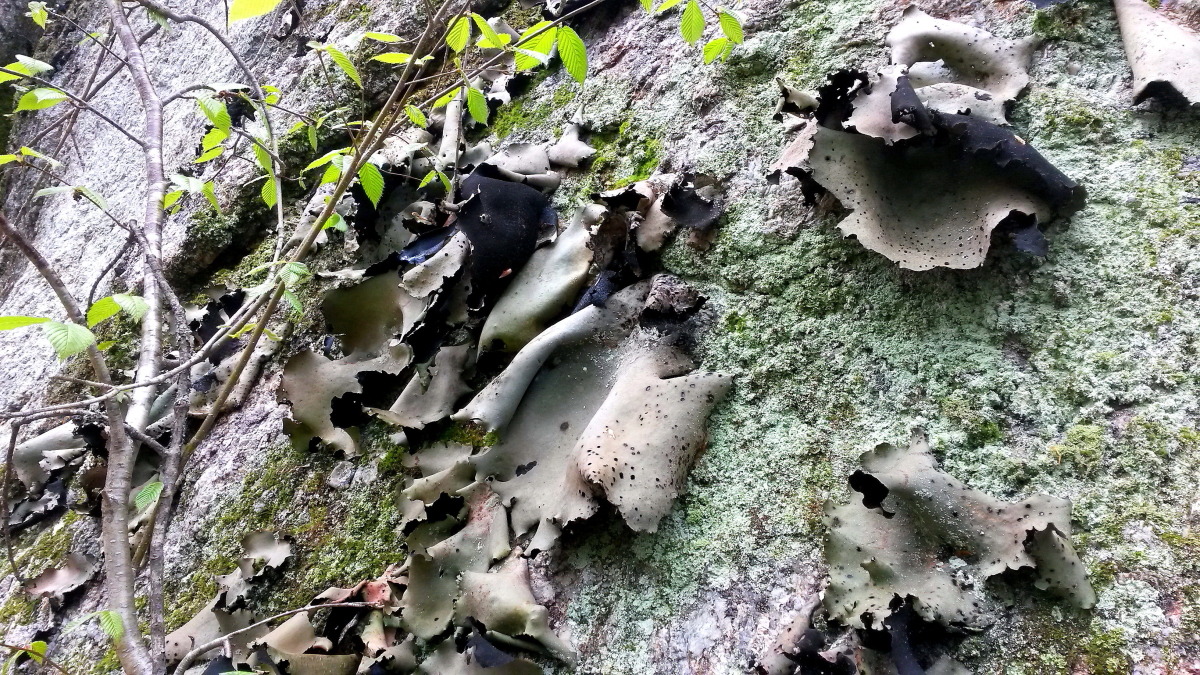
Last week we saw a wide array of fungi, organisms that tend to grow in damp, rich environments - just where you'd expect to find life thriving.  But there are other organisms that somehow defy logic and have adapted to grow in places where they have no right to live.  If you have walked around in some of the darker forests in New Hampshire, particularly near ledges or large boulder fields, you have probably seen this prime example, the Rock Tripe.
Rock Tripe (genus Umbilicaria) growing in the Smyth Conservation Easement

Rock Tripe is a lichen, which are composite organisms made up of at least two, and sometimes three, very different organisms.  One component of lichen is always a fungus, and the second is usually an algae.  The algae lives inside the fungus and the two organisms exchange nutrients - not unlike what a fungus does for a tree. And since algae can photosynthesize using sunlight, CO2, and a few nutrients, [REF: http://allaboutalgae.com/what-are-algae/] it can provide energy to the fungus, which in turn, provides a home for the otherwise structure-less algae.  It's a pretty nice arrangement, and can produce some really large Rock Tripe.

These are nice and green, but in a dry season or on a sunny ledge they can be brown, dry, and stiff.
In case you're ever hungry in the woods, these are edible.  The recommendation is to soften them by boiling, though I can't say I've ever tried it.

We were up in New Brunswick, Canada this week and saw another great example of lichen that grows in an amazing location.
Beard Lichen (Usnea subfloridana)
This is called Beard Lichen, and it's common in the Lakes Region of New Hampshire where I usually see it on the ground after it has been dislodged the tree branches above.  This lichen pulls most of its nutrients right out of the air and it is a great indicator of air quality; it can't live in polluted air, and the better the air quality, the larger it grows.
Beard Lichen on the ground back in Meredith, New Hampshire
Ferns are another plant that often grow on granite, though these use a more conventional approach: they take root in the rotted debris that has collected on the tops of boulders over many years.

They can find the smallest nook to set roots into.
Or they can take over an entire boulder.
Christmas ferns (Polystichum acrostichoides) crowd out all others on this boulder

Christmas ferns got their name because they stay green well into winter, often being seen still bright green when covered with snow.

There are also large plants that manage to take up residence where they have no right to.  White pine and hemlock are both good at this, and all it seems to take is a small crack or depression in the rock which captures both water and a seed, and a tree can take root.
A white pine establishes a toe-hold on Sheep Island in Lake Wicwas

This relationship is more damaging to the host (though even lichen will eventually degrade the rock), as over time, as the root grows, it will slowly pry a granite boulder apart, accelerating the demise of the rock, but helping to create sandy beaches for us (in a few millions years).

Here is a white pine farther along in this process:
This pine has been growing for 10-20 years

During which time it has pried up a large piece of the bedrock
Next is an example of an oak tree that started out trying to grow on top of a boulder, but it didn't work out well for it.  At one point it got toppled over, bringing up some bits of mother earth with it.

But that didn't slow it down much.  It just took a 90 degree turn back up towards the sky and kept right on growing.
Very adaptive in its quest to find the sun

Nature can be both resilient and persistent.  It can also be tolerant.  Take a look at these two trees:
Two different trees with an intimate relationship.  (Credit goes to Jim G. for discovering this.)
The branch of one tree grew right across the trunk of the other, and over the years, the two have grown together.  Even more interesting is that it is an interracial marriage - they are different species. The one on the left with the branch sticking out is an oak, while the receiving tree is a maple. Notice how the oak has grown its bark out, wrapping right around the maple tree.

These trees are in the soon-to-be-conserved extension of the Page Pond Town Forest.  A planned trail will go right by this, so when the property is open I'll provide directions so you can see this natural anomaly for yourself. Until then, be on the outlook for plants growing in unique ways as you travel around the Lakes Region, and let me know what you find growing where it has no right to.


Sunday, April 30, 2017

April 30, 2017

Signs of life are poking up everywhere as spring emerges from its long slumber.  The very first of the wildflowers, the Trailing Arbutus, emerged early in the week and are now blooming widely in the warmer locations.
First wildflower buds of the season
Trailing Arbutus (Epigaea repens), also known as Mayflower

Little Canada Mayflower stalks are starting to push their way up through last fall's leaf litter, even in the most improbable spots.
Canada Mayflower (Maianthemum canadense) also known as false-lily-of-the-valley.  Confusing, isn't it?

Soon the forest floor will be speckled with green shoots.

Even the Red Oak seeds are emerging from their cradle, reaching a toe out to test the soil, revealing their true colors even at this early stage.
A Red Oak is born

It's a wonder of nature that some day such a tiny seed will become a majestic oak.
A pair of Red Oaks along the Blue Trail in the Hamlin conservation area

Most of the Red Maple flowers are gone now and they are starting to push out miniature leaves, as are the Black Cherry trees.
Black Cherry leaves, and fruit in its early form

Allergy lovers, of course, already know this.

I witnessed a couple of displays of aerial acrobatics this week as crows defended their nests.  First I saw one crow attacking another that was just sitting in the top of an oak tree.

The attacker would fly away and circle up to gather energy for a bombing run.  As it dove down at the tree-sitter, the target would raise its sharp beak and let a out a loud "caaaw" and the bomber would make a close approach at high speed, then bank hard and swing away for another strafing run.
A crow protecting its territory

This went on for several minutes - I shared a couple of videos on YouTube:

               Crow Acrobatics                Bombing Run

Another day I saw a small bird chasing a larger bird and thought it was one of the smaller birds such as a blue jay or a black bird harassing a crow. (This is known as "mobbing": when smaller birds harass a larger bird to protect their nesting territory.  Crows for example, are known robbers of young hatchlings from smaller bird's nests.)  But with binoculars I immediately saw it was a crow going after a Bald Eagle.  The eagle flew to the shoreline and found a protected branch on a white pine to land, and the crow went on its way.
The Eagle protected from its smaller antagonist

I know there are crow nests in this area, as when walking nearby the crows put up an awful racket when I'm in the vicinity of their nest tree.  They know eagles love to raid their offspring just as much as the crows love to raid those of smaller birds.  It doesn't matter if you are the largest creature in the forest;  it won't make you invulnerable to less powerful nations who will fight tirelessly to protect their country.

Soon the next bird generation will be hatching out to join with all the other new life that makes up the rebirth of New England year after year.


Postscript:  As you drive the roads in Meredith in the coming weeks, take note how good the roadsides look.  A team of generous volunteers spent their Saturday morning picking up trash along the town's roads.  The event was organized and sponsored by Dave Kutcher and DAK Financial Group in Meredith.  Next time you're down town, stop by to say thank you to Dave and his team. Many thanks all the wonderful people who participated, including employees of Meredith's DPW who took away the mountain of trash collected.  It really makes a difference in how our town looks!

Monday, May 26, 2014

May 26, 2014

Memorial Day - thank you veterans and all who served their country, making the ultimate sacrifice for us.  There are so many Americans who put their lives on the line every day for all of us, as we so sadly witnessed in Brentwood, New Hampshire last week.

In Memory of Steve Arkell

There are more and more people around Lake Wicwas as summer approaches, and boats, docks, and floats are starting to appear on the water.  It's also a time when people get together to visit again after a long winter, with Memorial Day celebrations and BBQs.

While we are coming out of hibernation, more plants and animals are doing the same, including my favorite wildflower, the Trillium.


Painted Trillium (Trillium undulatum)
Trillium thrive in rich, acidic soil, usually in the shade of pine or spruce trees.  This pair lives hidden under the dense cover of a hemlock tree some 40 feet from Lake Wicwas.

Also deep in a hemlock forest, I heard the pounding of a Pileated Woodpecker working for its supper.  I followed the sound slowly and carefully, being fortunate enough to get a glimpse of it hewing into an old dead snag.  I watched for several minutes as it attacked one hole after another, harvesting whatever insects, grubs, and eggs it could find.


Black Cherry is blooming now, attracting pollen-collecting insects of all shapes and sizes to their flowers.  If you walk by on a calm afternoon, you can hear the collective buzzing of hundreds of tiny wings from three of four feet away.
Black Cherry


This unknown bee has good-sized pollen sacs - called corbicula- on its hind legs.
Bee with Corbicula from Black Cherry Pollen

The Red Maple leaves were nearly full size last week;  compare that to the oak leaves, which are now just forming.
New Oak Leaves just Forming

Here's a size perspective - why are these trees on such different schedules?


The vernal pools will be drying up soon, so  the amphibians that breed there will be moving on. I found this Red Eft (newt) on a damp trail one morning.
Eastern Newt (Notophthalmus viridescens)

The terrestrial eft is a juvenile, having spent the first phase of its life in water as a larva, but not yet mature enough to be an adult when it will return to water to breed.

The wet weather this spring has been favorable for moisture loving creatures, such as this Leopard Slug, sliming its way along the ground.

Leopard Slug (Limax maximus)
This big, juicy shell-less mollusk would be great meal for a snake.  This thought came to mind after I discovered a reptile I have never seen before, and may not again:  a Smooth Green Snake (what a great name!).  They are reportedly rarely seen due to their superb camouflage and tendency to stay amongst the low grasses and green plants, feeding on spiders and insects. 
Smooth Green Snake (Opheodrys vernalis)


Speaking of spiders, no snake is going to get this spider!
Orb-Weaver Spider

Hanging from its silk three feet above the ground, this orb-weaver is safe from snakes and other ground predators.  However, it was dangling only feet away from the robin's nest;  that seems like an easy meal for mother robin!

And the robins - sure enough, three days later, there were four eggs in the nest.  The incubation period for robins is 12 to 14 days, so perhaps next week there will be tiny birds peeping madly for their first meal.
The robins are doing their part to paint patriot pictures for Memorial Day!