Showing posts with label Eastern Kingbird. Show all posts

Sunday, May 18, 2025

May 18, 2025: One Big Loon

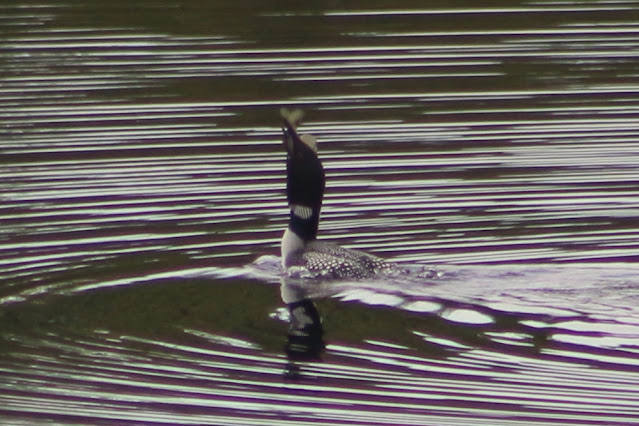
This week the banded male in the northern territory gave us a lesson on how it manages to stay strong enough to defend what is clearly a highly desirable breeding territory.  

Yup, he's going to swallow that whole.

We watched him catch and devour not one, but two huge fish.  Someone may be able to estimate the weight of these fish, but I expect each one accounted for a significant portion of his daily two-pound diet.  Here's the process he went through to get it down its throat after taking a good five minutes playing with it to weaken it enough to swallow.


At this point something wasn't going right and he coughed the fish back and started over again.

Getting farther down this time.

Swimming hard seemed to be part of the final swallowing process.

A big lump in that throat.

Almost down.

Always a big shake to get that neck bulge sent all the way down.

So that was a pretty good meal.  Two days later it was back in the same spot like any fisherman that returns to a spot where he once caught a big one.


This fish is also sliver with dark spots.  Are they Black Crappies?

I'll short cut the process this time, but it took just as long as before to accomplish the whole thing.


With plenty of fish in his belly he's got the energy he needs to keep up his weight and fight off the endless challenges on his territory.


In case you didn't catch the update to last week's journal, Lake Wicwas eventually crested over two feet above normal level, lapping over the edge of the dam.  Not the highest it's ever been, but close, and it's still about a foot higher than normal.  With three boards removed from the dam it's dropping at a rate of about 2" per day so without any more rain it will take another week before it's back to normal level.
Aren't fish supposed to swim under the dock?


We must be pretty close to a full complement of summer birds now.  Arriving this week were the Eastern Kingbird, Scarlet Tanager, and Great Crested Flycatcher.  The latter has a sharp call that's easy to recognize once you've learned it.  Wildflowers came on strong this week with the warm sunny days, and that green Lady's Slipper I found last week did in fact bloom.  
Pink Lady's Slipper

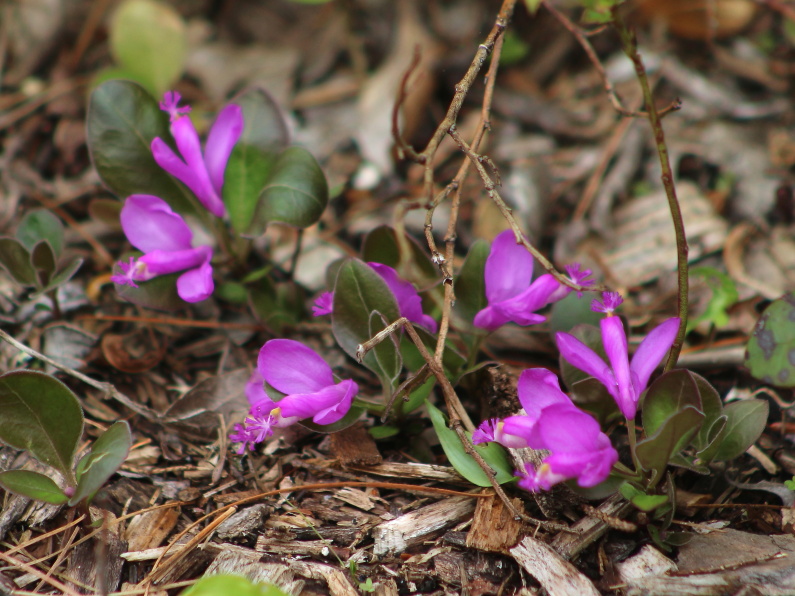
A few other flowers popped out as well including the Eastern Starflower and the Fringed Polygala.
Eastern Starflower

Fringed Polygala


We know "poly" means many, and this week I learned that "gala" means milk.  I also learned that's where the word "galaxy" comes from, originating as the "Milkyway Galaxy".  Though it looks like an orchid, this fringed polygala is a member of the Milkwork Family.  [Ref:  US Forest Service]  

Keep an eye for more flowers appearing on the forest floor in the next couple of weeks.


Sunday, May 19, 2024

May 19, 2024: Eastern Kingbird

A pair of Eastern Kingbirds appears to have taken over the local hunting grounds from the Phoebes.
Eastern Kingbird

The Phoebes are still around as proven by their loud raspy calls every morning, but the larger and more aggressive Kingbirds have achieved air superiority over the prime airspace near the edge of the lake.  Kingbirds are known to harass much larger birds like crows, and even hawks, that dare invade their territory, so the little Phoebes had no choice but to move over.  Being flycatchers, Kingbirds perch on trees near the water, darting out to catch insects, sometimes rather large ones like bees and dragonflies.  They like to assume a position at the very top of a small tree where they have a 360 degree view of their world.

So it was unusual to see one fly down to terra firma and land on a rock.  

It then flew over and landed near the edge of the woods.

But when it turned around, the reason was clear.
"This looks like a good floor joist for our nest."

It was pleased with its selection and quickly flew off to wherever they are making their nest.

A Kingbird nest is formed with sturdy sticks to be strong enough to withstand the wind at the edge of a lake. The female kingbird does most of the nest building but the male will assist with bringing in sticks, so this is possibly the male.   The nest is finished with a lining of soft material to protect the chicks and keep them warm.  It's hard to believe it was eight years ago (June 26, 2018) that I was invited by good friends to observe a kingbird nest in a pine tree that had fallen into the lake near their home.  
A nest well isolated from predators, but that must be sturdy enough to withstand the weather.


That was a once-in-a-lifetime opportunity to watch a family of Eastern Kingbirds in action that I'll never forget! 

I'm keeping watch to see if I find where this pair's nest is, but so far, they're keeping it a secret.
 🐦

I was dismayed to receive an alert from the NH DES this week that there are already two cyanobacteria blooms on New Hampshire lakes, including one far north in Littleton with a bacteria level more than twice the safe limit.  The same day the warning was posted in Littleton, I drove by Lake Kanasatka and noticed all the activity at the boat launch on Rt 25 - they have started chemical treatment of the lake.


This $500,000 project involves putting aluminum sulfate into the lake to address their phosphorus and cyanobacteria problems. 
I assume these tanks contain aluminum sulfate which is transferred to the small tanks on the boat.

The equipment used to inject the chemicals into the lake.

The Aluminum sulfate will bind to phosphorus in the lake to form aluminum hydroxide which then sinks to the bottom of the lake.  This forms a barrier that reduces the amount of phosphorus released into the water, providing less nutrients to feed the cyanobacteria.  You can read a detailed description of aluminum sulfate treatment in lakes here.  Refer to last August for a reminder of the cyanobacteria bloom that shut down Lake Kanasatka for a good portion of last summer.  

The state has now recognized the magnitude of this problem and appropriated $1M through HB2 for cyanobacteria mitigation in our water bodies.  Here at Wicwas we are working proactively on steps to address the causes of high phosphorus levels in the lake before they get bad enough to close our lake or to put chemicals into it.  There will be more to say on this topic in the coming weeks as well as at the annual lake association meeting in August.


Let's move on to cheerier subjects:  spring wildflowers - the season is here!  The Painted Trilliums have joined the Purple Trilliums in adding joy to the forest floor.
Painted Trillium


Other flowers to keep a watch for on your journeys are the Starflower, Jack-in-the-Pulpit, Fringed Polygala, and violets (the violet ones).
Starflower

Fringed Polygala


Soon the Lady Slippers will join the party, so grab your bug spray and go smell the flowers!


Sunday, August 7, 2022

August 7, 2022: More About Bobcats

The Lake Wicwas Association held its annual meeting yesterday at the Wicwas Grange in Meredith Center; it was well attended with lots of catching up with friends over coffee and treats before the meeting began.  The featured speaker this year was Patrick Tate, wildlife biologist at the New Hampshire Fish and Game department who provided a presentation on the life and habits of New Hampshire's bobcats.
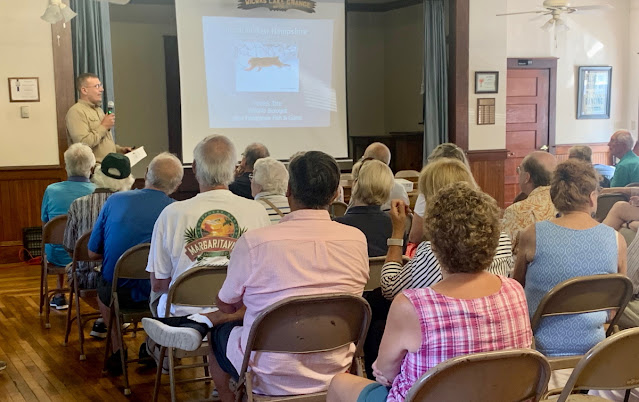
NH Fish and Game wildlife biologist Patrick Tate speaks about bobcats in New Hampshire.
Photo by Shayne Duggan.

One of the new things I learned is that bobcats have a very "plastic" diet, which means they readily change their diet based on the availability of prey.  In some years white-tail deer are their primary food source and in other years it's small animals such as squirrels.  But they are true carnivores, completely dependent on catching other animals for their sustenance - no veggies for them.  Tate also explained that bobcats were considered primarily southern animals but have moved north and now occupy all of New Hampshire except for the white mountains.  Unlike other far-northern species such as the snowshoe hare and the lynx, bobcat do not have large paws to let them hunt efficiently on deep, dry snow, so they aren't found at high elevations in the mountains.  Tate also described how to identify their tracks - round footprints with round toes prints absent claws - as well as their preferred habitat which includes the edges of wetlands and the margins of farms.
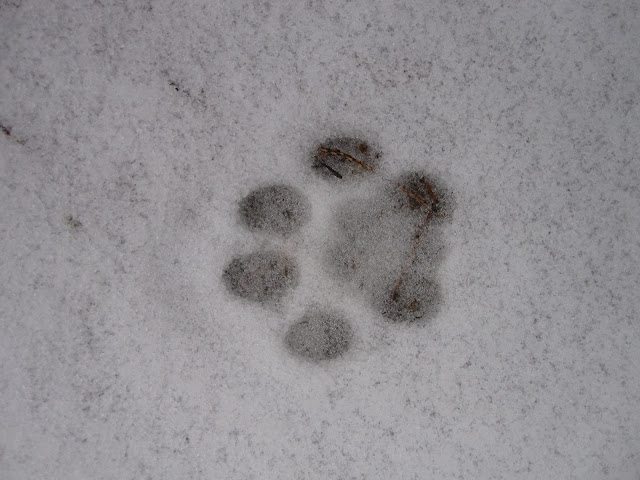
A bobcat print seen near the shores of Lake Wicwas.

We'll all know a bit more about these wild felines when we see them around the lake in the future.  Many thanks to all who attended and helped organize the meeting and asked Mr. Tate such great questions about bobcats.

We also had a very successful silent auction, raising over $2000 for the Lake Host program.  Another big thank you to all who donated items for the auction!
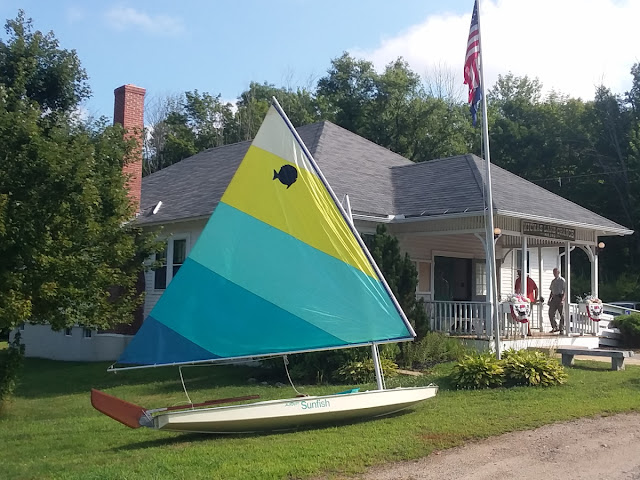
A sunfish donated by the Larsens and prepped by Dean Cascadden was the headliner for the auction.

The loons have captured most of the attention around the lake for the past few weeks and there's still a lot going on with them, but they're not the only birds that are active this time of year.  The songs on my morning walks have changed noticeably, as the spring calls of warblers have been replaced by the sweet summer song of the Hermit Thrush and the tireless singing of the red-eyed vireo which can sing non-stop for an hour at a time even on the hottest summer day.  Both of these birds are difficult to find as they sing from thick brush or in high tree tops, but I know they're in there.  Here's a good look I got of a vireo on a mid-summer day a few years ago.  
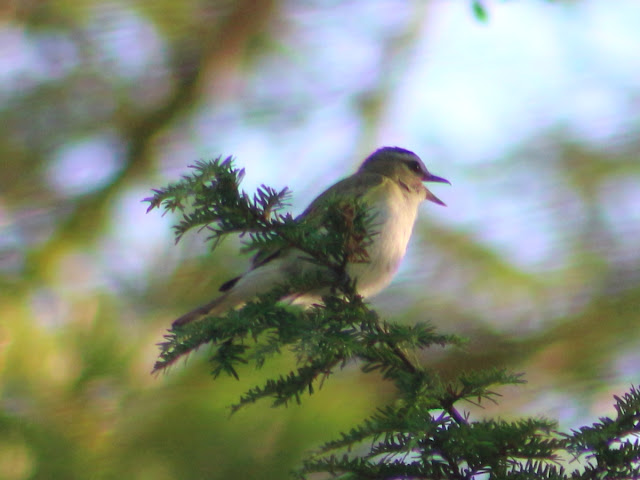
Red-eyed vireo singing from its perch in a hemlock.

Both the belted kingfisher and the eastern kingbird are very visible and active, darting around as they catch insects on the wing.  I watched a nice acrobatic air show put on by the kingbirds one morning on the kayak.


It's also high butterfly season.  Monarchs are in the fields at the Page Pond Town Forest where milkweed is starting to appear.  The great-spangled fritillaries are sipping nectar from clover, and the pearl crescent butterfly is doing the same on bright orange hawkweed.
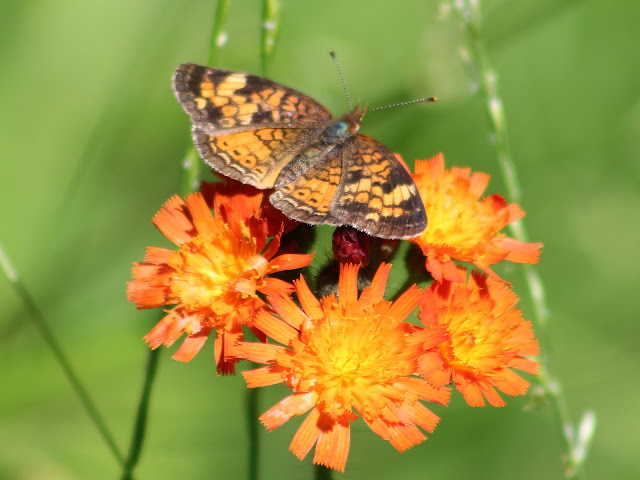
Pearl crescent on hawkweed.

Great-spangled fritillary on a clover blossom.
Sipping nectar through its long hollow proboscis.

On these hot August days the mammals are much less active, but I do see momma deer and her fawn regularly out browsing early on cool mornings before the heat arrives.  (Still no pictures though.)

In the July 24 post I mentioned an injured loon that was observed on the lake.  Since then multiple sightings were received and it looked weak enough that the LPC biologist came and searched the lake to assess it but the loon couldn't be located.  Finally, last week, the bird had beached itself and a couple of intrepid volunteers were able to capture and safely contain it - the loon was very weak and didn't provide any resistance.  The biologist was alerted and came immediately to pick it up and bring it to a rehabilitator in Concord.  Unfortunately, the veterinarian decided the loon was too badly injured, and it had to be euthanized.  

I don't know if we'll get any further information, but from descriptions of its condition it seems it had been involved in a lot of fighting with another loon.  But there is happy loon-news on the lake:  I don't have a recent photo of her, but Maddie was reported on Saturday to be healthy and growing by leaps and bounds.  

Now that the fighting on the lake has passed, is there a better life than that of a loon, spending these hot august days floating on the lake and savoring those steamy, crimson summer sunsets? 

A waxing gibbous moon watches over scarlet clouds after Saturday's storms passed.


Hopefully I'll have a picture of Maddie for the next journal entry.