A somewhat random record of observations of what's happening around Lake Wicwas and the Lakes Region. I hope to post about once a week - your comments are welcomed.
Spring is popping up everywhere now, and I saw my first true wildflower Wednesday on a hike in the Ossipee Mountains - not where or what I expected. But there on a southern exposure on the Mt. Shaw Trail, I saw my first flash of color, a bright Round-leaved Yellow Violet (one of those oxymoronic flower names).
Round-leaved Yellow Violet (Viola rotundifolia)
This was at 1800' elevation, and soon there were many of these violets, sometimes in large clumps.
A little higher up Mt. Shaw, on a ledge overlooking a deep-blue Lake Winnipesauke, I could see there's still snow on the trails at Gunstock.
It was a warm, sunny day, and approaching the trailhead on my way down in the afternoon I started seeing trillium leaves poking up through the leaf litter. Then right at the parking area there were dozens of them.
Dozens of trillium at the Mt. Shaw Trailhead.
A few had buds that were about to open.
So I searched to see if I could find one that had opened, and finally I found one - just one, and just barely open, but that was enough to verify they were Purple Trillium.
Purple Trillium
On the next sunny day there will be a fabulous display of color at the Mt. Shaw trailhead on Rt. 171 for all to see.
A deciduous forest floor only gets direct sunlight for a brief period between snow-melt and leaf-out. These early wildflowers have evolved the ability to emerge early enough to take advantage of this short window to collect enough energy to blossom and survive until next spring.
It wasn't until Friday, back at Lake Wicwas, that I saw my first Trailing Arbutus in bloom.
Trailing Arbutus aka Mayflower
At the same time as the flowers are exploding on the scene, so are the birds. This week I heard the first Hermit Thrush, Blue-headed Vireo, Phoebe, Palm Warbler, and Black-throated Green Warbler. All of these have loud songs, and the hermit thrush is my favorite of the woodland birds.
On a mid-day kayak I saw my first osprey of the season as it flew over the lake and landed in a lichen covered tree on Loon Point.
On the same paddle I came across a promising loon encounter. Two loons were interacting closely, actively enough that I first thought they were in conflict. But there wasn't any chasing or vocalizing, and their behavior didn't seem aggressive, so maybe they were just checking each other out.
When one of them swam right beside my kayak I was able to clearly see the white band with black dot that identified it as the northern male. And later in my trip there were two loons fishing together in the northern territory, so perhaps the behavior I saw earlier was the loon version of flirting. Maybe our male has accepted a new mate after last year's partner was killed.
I also saw a second pair of loons in the south territory which may be the banded south pair, but we'll need to see bands to know that. The busy loon-watching season has begun!
It's an exciting time of year on the lakes and in the forests as nature reawakens for the summer; there were many more new sightings, too many to note, so some will have to wait. But something else is exploding on the scene too. Be aware that biting insects will be out very soon, so the days of bug-free walks are almost over. Here's clear evidence that the insects are coming.
Docks are going in and boats are appearing on the lake - sure signs that summer is approaching. The April showers have come and gone and the lake is down to its proper summer level - just in time as both pairs of our nesting loons have returned and started scouting for nesting sites. I got on the lake a couple of times, and on one of my kayak trips I watched a hawk fly over the lake right towards me and land high on an island I was paddling beside.
Broad-winged Hawk. (Buteo platypterus)
The broad-winged Hawks have returned. These are hawks I often see and hear soaring over the lakes and trees in summer. Their strongly banded tail is visible as they fly, and their high-pitched whistle is easily heard piercing the summer sky.
New Hampshire's broad-winged hawks migrate 4000 miles twice a year, back and forth from Central America, and these birds are survivors. Fossil records show they have been on the planet for 400,000 years. [Ref: Cornell Lab of Ornithology] Cornell also states they usually nest "far from areas of human disturbance," another indicator that the conserved areas around Wicwas are supportive of wildlife species that need large unfragmented lands.
Later on the paddle I saw motion far across the lake in a marsh. I couldn't see what it was but took a picture to blow up later, and saw that it was a Great Blue Heron. And it had some huge object in its beak.
Is that a fish? It doesn't look like a snake. The photo is too poor to tell.
The herons have been back for a while now but many warblers arrived just this week. I saw or heard Yellow-rumped, Black-throated Green, and Blackburnian warblers as well as Oven Birds.
Lots of animals are taking advantage of the trees that got blown into the lake, not just the beavers. I've seen painted turtles sun bathing on them as well as this heron which was using one felled tree as a fishing platform.
Amy and Russ found the Harris Cove loons preening one afternoon and were able to identify both of them by their bands. This provided the confirmation that both nesting pairs are back.
The Harris Cove male. Photo by Amy Wilson.
The two pairs seem to be sharing the lake well so it looks like we're set for another successful breeding season. Between these two pairs, Lake Wicwas has fledged nine new loons over the past five years.
I also caught a glimpse of two deer strolling the woods.
I think they might have been yearlings still traveling together as both appeared rather small. White-tailed deer are curious animals and they watched me for a while, eventually deciding I wasn't a threat, but they walked slowly up into thicker woods just to be safe.
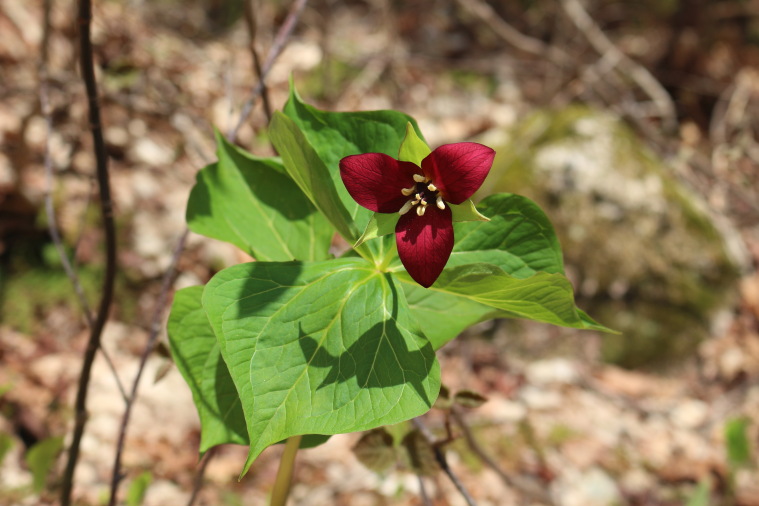
The spring flora is also starting to rev up now. This week I saw my first Trillium, a purple one.
Purple Trillium (Trillium erectum) in Hamlin.
Fiddleheads are poking up in and around wetlands.
Also Violets, the Sweet White and Common Blue, as well as Trailing Arbutus, are in bloom.
Trailing Arbutus (Epigaea repens)
There's a lot going on around the lake in spring, and there's only a short time left to enjoy it all without dealing with the bugs. All those Phoebes and warblers fliting through the bare branches show that bugs are back on the lake too.
I did some boundary monitoring on the Eames and Hamlin properties this week, and the best part of monitoring is exploring remote areas of conserved land, away from the well-travelled parts of the properties. This often provides unique sights and sounds where the animals are less disturbed by humans, and way back in Eames I found this gash on a tree.
This is a Bear Bite, where a black bear sunk its teeth into the trunk of the tree. It's generally accepted that bears do this to mark their territory, perhaps by sight, but more so by smell, as bears have poor eyesight but excellent sense of smell. Black bears have scent glands in their mouth, so biting the tree will deposit their scent and allow it to be blown with the wind for other bears to detect.
Less than half a mile from the bear bite, near a beaver pond, I found some of the most impressive beaver cuttings I've ever seen. There were many trees cut down, and quite a few girdled (the bark chewed all the way around) to make them die. The girdled trees were all hemlocks, a tree that beavers don't prefer to eat, but which grow tall and wide, shading out all the other trees around their pond. Beavers know that killing hemlocks by girdling them will allow space and sun for their preferred species to grow. But I have never seen beaver take on a hemlock of this stature:
I can't estimate the height of these trees; I'll just leave it at "they're big", and they'll let a lot of sun in when they die. The poor trees - between beavers, bears, and woodpeckers, let alone the insects, they can take a beating.
Another exciting find way out there was a nice pile of moose scat.
I used to see moose even from the trails on Eames, but haven't seen them the past few years, or even any recent signs. But the Meredith Conservation Commission created some patch cuts in the area to provide some different habitat for wildlife, and an abutter to the Eames property recently created one as well. Right by that cut is where I found the moose droppings, so maybe they're coming back. That cut has a gorgeous stand of young pin cherries trees that is regenerating right along the Eames boundary line.
A young successional stand of pin cherry.
You can easily distinguish pin cherry from black cherry when they are blooming. Pin cherry have relatively flat clusters of blossoms, while black cherries have tubular shaped clusters.
Pin cherries, which are blooming now.
These are black cherry blossoms; they will bloom in another week or two.
If you hike the Arbutus Hill Pond Trail (blazed white) you can see this stand of pin cherries from the high point on the trail where it passes close to the boundary.
On that trip I also saw the first trilliums of the season, just one small painted trillium and one small purple trillium. There will be many more soon, so keep you eye out for them on your journeys.
Certainly not unusual, but still fun to see, was the first snake of the season:
This garter snake, a cold-blooded reptile, was warming itself in a nice sunny spot.
Back on the lake, more loons have joined the pair that arrived a few weeks ago. I don't know if any of them are our second pair, but they were battling each other right along the dividing line that has separated the two pairs for the past few years. We'll have to wait to see if any of these newcomers stick around. You can watch one of their skirmishes here.
There were lots of new arrivals from lands south this week. For the journal record, these are the new birds I saw this week:
Black-throated Blue Warbler, Black-throated Green Warbler, Blue-headed vireo, Blackburnian Warbler, Broad-winged Hawk, Common Yellowthroat, Eastern Kingbird, Gray Catbird, Great-crested Flycatcher, Northern Parula, Ovenbird, and Tree Swallow.
And, just in time for Mother's Day, the hobblebush viburnum are blooming.
Last week the red maple and the trailing arbutus - two of the earliest plants to wake up in the spring - were on display. This week things really got moving with a lot more gearing up for summer, including some small but pretty flowers.
Common violet (Viola papilionacea)
Bloodroot (Sanguinaria canadensis)
It's not surprising that the tiniest flowers - the arbutus - were first to bloom, followed by slightly larger blossoms, with the largest ones - think sunflowers - not blooming until late in the summer. And then just yesterday I saw my first trillium of the year, a purple one.
Purple Trillium (Trillium erectum)
With the early head start on most other trees, the red maples are already forming small red leaves on their branches.
Early red maple leaves.
Black cherries have also put out leaves and are now forming buds that will turn into bouquets of delicate white flowers, and eventually cherries.
Black cherry (Prunus serotina)
The blueberry buds are swelling and will burst out soon.
Blueberries getting ready for summer eating.
That always gets me thinking of blueberry pancakes even though I know I still have two months to wait.
The oaks are always the laggard in the forest, whether it's putting out the leaves in the spring or hanging on to them late into fall. But they are forming buds now, and some of them will survive long enough to become leaves. Others will meet a different fate:
Look at that tasty morsel.
No leaves on that twig!
As the compost pile has warmed up and started cooking again we've had some visitors digging in it overnight so I set out the camera to see who our late night dinner guests are. My first guess was correct:
This nice plump raccoon seems to have survived the winter just fine.
But it also has a least one other dining companion sharing the table.
A turkey looks for discarded seeds.
The turkeys are just picking over the dry plant debris, not digging down into the pile like the raccoon looking for more substantial items. I guess I need to bury new additions to the pile a bit deeper.
We have seen plenty of of turkeys around the lakes as well as signs of them digging in the leaves throughout the woods; I hope they're eating lots of tics!
Scouring the woods for seeds and bugs.
Scratching up leaves - the dry land version of the snowy egret scratching in the mud in Shem Creek.
It's that time of year where you can find whatever season you want in New Hampshire. You can go to the beach on a warm May day, search for spring wildflowers in the forest, or head to the mountains for a bit of winter.
Snow pack at 4000' on Mt. Tripyramid
There are still two feet of snow even at the lower peaks in the White Mountains just 20 miles north of Meredith.
Tree wells show the snow depth
As I hiked the loop trail over the tripyramids I found dozens of purple trillium in bloom around 1500 feet elevation, while higher up they were still developing.
Purple Trillium
Around Lake Wicwas I see mostly painted trillium which are also blooming now, though I have seen some purple trillium on Meredith Neck.
Painted Trillium
There are also goldthread, fringed polygala, and many others booming now, as we are in peak spring wildflower season.
The pretty and delicate Goldthread
Fringed Polygala
The polygala seem to be having a good year with large patches of them in many places - perhaps they enjoy the cool weather we've had. With all the new vegetation available in the forest I haven't seen deer lately. The does are probably eating well and staying hidden as they are getting close to birthing their young. But many signs can be found so we know they're present. Footprints of course are a definitive sign.
Deer footprints in sand along Chemung Rd.
But browse is also evident.
Black cherry browse at chest height
Deer don't leave a clean cut when they browse, as unlike rabbits which make a clean cut just like a knife, deer tear off the branches with their teeth.
Deer scat this time of year is often different from the small hard pellets one usually sees because the lush diet available now provides much more moisture than winter food.
Spring scat shows their changing diet
And finally, you might still find areas of dry leaves where the deer rustle around looking for acorns.
I followed this path for a little bit looking for confirmation that it was deer (turkey and bear will also search for acorns among the leaves) which I found shortly.
Typical deer scat
This has a fall appearance to it, so I guess that closes the loop and means that you can find all four seasons right now!
Lastly, a reminder there will be a guided bird walk this coming Saturday, June 1st at Page Pond in Meredith. Click here for details. I'm hoping to see some new birds, maybe even a woodcock or a grouse!
And, I just heard that our eagle eye loon spotters have determined that the loons have nested! I haven't seen the area yet, but our great team just put signs up this morning since it's in a high traffic area. Please keep your distance - at least 150 feet away, and we'll hope for loon chicks in late June!