Showing posts with label Deer Browse. Show all posts

Sunday, May 26, 2019

May 26, 2019: Pick your Season

It's that time of year where you can find whatever season you want in New Hampshire.  You can go to the beach on a warm May day, search for spring wildflowers in the forest, or head to the mountains for a bit of winter.
Snow pack at 4000' on Mt. Tripyramid

There are still two feet of snow even at the lower peaks in the White Mountains just 20 miles north of Meredith. 
Tree wells show the snow depth

As I hiked the loop trail over the tripyramids I found dozens of purple trillium in bloom around 1500 feet elevation, while higher up they were still developing.
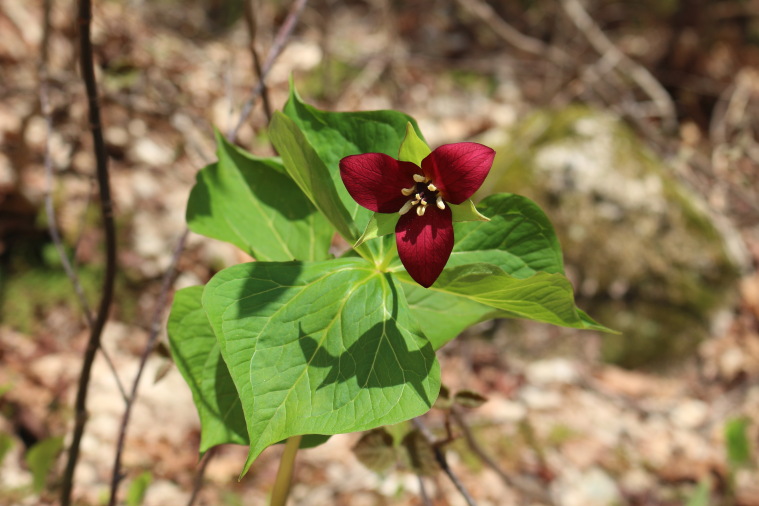
Purple Trillium

Around Lake Wicwas I see mostly painted trillium which are also blooming now, though I have seen some purple trillium on Meredith Neck.
Painted Trillium

There are also goldthread, fringed polygala, and many others booming now, as we are in peak spring wildflower season. 
The pretty and delicate Goldthread

Fringed Polygala

The polygala seem to be having a good year with large patches of them in many places - perhaps they enjoy the cool weather we've had.  With all the new vegetation available in the forest I haven't seen deer lately.  The does are probably eating well and staying hidden as they are getting close to birthing their young.  But many signs can be found so we know they're present.  Footprints of course are a definitive sign.
Deer footprints in sand along Chemung Rd.

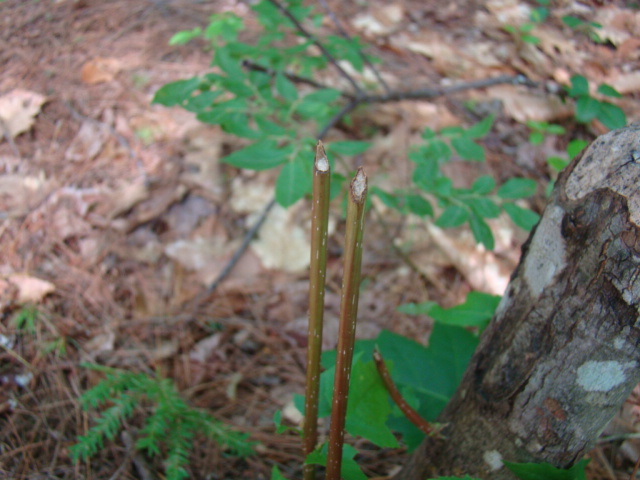
But browse is also evident.
Black cherry browse at chest height

Deer don't leave a clean cut when they browse, as unlike rabbits which make a clean cut just like a knife, deer tear off the branches with their teeth.

Deer scat this time of year is often different from the small hard pellets one usually sees because the lush diet available now provides much more moisture than winter food.
Spring scat shows their changing diet

And finally, you might still find areas of dry leaves where the deer rustle around looking for acorns. 

I followed this path for a little bit looking for confirmation that it was deer (turkey and bear will also search for acorns among the leaves) which I found shortly.
Typical deer scat

This has a fall appearance to it, so I guess that closes the loop and means that you can find all four seasons right now!

Lastly, a reminder there will be a guided bird walk this coming Saturday, June 1st at Page Pond in Meredith.  Click here for details.  I'm hoping to see some new birds, maybe even a woodcock or a grouse!

And, I just heard that our eagle eye loon spotters have determined that the loons have nested!  I haven't seen the area yet, but our great team just put signs up this morning since it's in a high traffic area.  Please keep your distance - at least 150 feet away, and we'll hope for loon chicks in late June!

Sunday, November 18, 2018

November 18, 2018: Tracks Galore

My how quickly things change.  Just a few days ago I was studying deer scrapes in the leaves, and by this weekend they disappeared under a white cloak and all kinds of tracks were waiting to be discovered.

The sudden change in scenery occurred on Friday with a nice soft blanket of snow;  I even got to make my own the tracks in the forest as there was just enough cover for a short ski on the smoothest trails.

An early snow lets one see a great variety of tracks, as animals that will soon bed down for the winter are still active, joining those that will be out and about all winter long.  One big example (no pun intended) is the black bear.
Bear prints are almost human-looking, and similar in size
Photos courtesy of Marge Thorpe

Marge Thorpe found this great set of tracks over on the west side of the lake after a dusting of snow earlier in the week.  It appeared to be a mamma bear with at least one cub in tow.  Marge noted that as she followed the tracks, when they came to the top of a stone wall, they turned around and went back rather than climbing down off the top.  Maybe the cub didn't like the look of that big step!  Weather will determine when the bears settle down in their dens;  it may be a few more weeks before the bird feeders come out.

Another set of tracks not often seen in snow were made by beavers.
Beaver print in the snow

Beavers don't hibernate, but once the lake freezes over they become much less active, staying close to home.  But right now they are still building up their insulating layers of fat and collecting food for winter consumption.
Tender plants cut by sharp beaver teeth
There wasn't the visible tail-drag usually seen with beaver tracks so I wasn't sure it was beaver when I saw the first tracks, but soon enough there was no doubt.

It was also quite clear where they come up from the lake to do their logging work.
A well worn beaver trail coming from the lake
They have even cleared out channels in the thin ice/slush on the lake from their frequent travels. 
There are other tracks there on the ice, but I wasn't about to venture out to investigate.

Where do they take all those trees and branches?  They put them right beside their lodge for handy winter snacking - a sure sign of an active lodge.
A nice pantry is being stocked right outside the front door
A bit farther along I thought I saw another, more ragged beaver channel.

But as I approached I saw only deer tracks leading to the point of entry, so evidently a deer decided to make its way over to the nearby island to browse.  And there are lots of deer tracks everywhere - often following the trails - including these two tracks which were made by a doe and her fawn.

In several places they stopped to feed, in this spot, nibbling on some sheep laurel on the shoreline.

It was just an early taste of getting to see who's been out travelling through the forest all year.  I'm always humbled when I'm reminded that all these animals have been here all summer long without me ever knowing it.
A mink pokes its nose in a hole by the lake - perhaps an entrance to one of its dens?

This snow looks like it won't last long, but there will be more on the way!


Thursday, July 5, 2012

July 5, 2012

Independence Day yesterday, and it was quite a day.  From a rainy start, to an absolutely beautiful day, to a violent summer thunderstorm, this July fourth had it all.

Independence Day!
Celebrations and Bar-B-Ques and enjoying the lake were the themes of the day.


In the evening, prior to man-made fireworks, nature provided her own firworks with a very impressive lightning display that was immediately followed by high winds and torrential downpours - three quarters of an inch of rain in maybe fifteen minutes.  The storm left wires and trees down, and much of the lake without power.  There was a wire down across Meredith Center road, and several trees blown down around the lake, including this oak and cluster of maples that pulled up a good chunk of shore line. 

Storm Blow-Down

After the storm the temperature dropped and the humidity went up, making for a misty morning today with sunbeams shining through the forest.

I looked up a couple of creatures I found around the lake this week, including the real name of these insects we call "mosquito eaters":  Large Crane Fly (Family Tipulidae).  There are 10,000 individual species in this family.
Large Crane Flies

The female has a larger abdomen than the male, as it is full of eggs;  it also has a pointed tail as seen on the female on the right.

And of course, they don't eat mosquitoes, although some species, when they are in the larval stage, will eat mosquito larvae, so they're a good insect.  They look a bit scary, but are harmless and don't bite or sting.   They are an important food source for birds, amphibians and reptiles, keeping the widlife round Lake Wicwas well fed, so when one sneaks into your house, shoo it safely out the door!

One of their predators might bt this little toad - a Fowler's Toad, I believe.
Fowler's Toad
A Crane Fly might look like a big meal for this little guy, but I'm sure it could manage.  The Fowler's Toad, a race of the Woodhouse's Toad, is named after Samuel Fowler who founded the Natural History Department at the Essex Institute om Salem Mass.  Fowler discovered it in 1843 [http://library.thinkquest.org/11034/].

A couple of butterflies - Duskywings I think - were enjoying the nectar in Linda's bright blue flowers for their meal.  They in turn may become some other animal's dinner.
Duskywing

I have also seen deer around lately, though no fawns.  There are lots of signs of their browsing as well.  These poor trees are really having a tough time;  first the beaver cut them down, and when they tried to put out some stump shoots to survive, the deer coae along and stripped the stalks of their leaves.

All they left is bare, chomped-off shoots.
Deer Browse