A somewhat random record of observations of what's happening around Lake Wicwas and the Lakes Region. I hope to post about once a week - your comments are welcomed.
From 80 degrees to snow - this week's journal was supposed to be all about wildlife in South Carolina, but upon returning home Thursday night the local picture became the story.
Marion Lane on our arrival home from South Carolina.
Once we got north of Concord NH the scene looked like an Alaskan tundra with everything white and trees down beside the road for miles.
We arrived to find over a foot of heavy snow plastered to everything, branches and trees down everywhere, and about half the people in Meredith without power including most homes around Lake Wicwas. But that's better than some towns in the Lakes Regions which had 100% of their customers without electricity. And many of us around the lake are still without power as of 9:00 this morning.
The heavy snow and wind brought trees down into the lake in multiple locations - I expect there will be more to be found as we get on the lake to explore. This huge white pine and several hardwood trees were some of the casualties.
There will be a lot of trail maintenance to do over the next few weeks.
Trail crews in Meredith will be busy this spring.
On the bright side, there were some signs of spring including my first loon sighting on Friday. I also received a report of a pair of loons on the lake, so we're heading in the right direction.
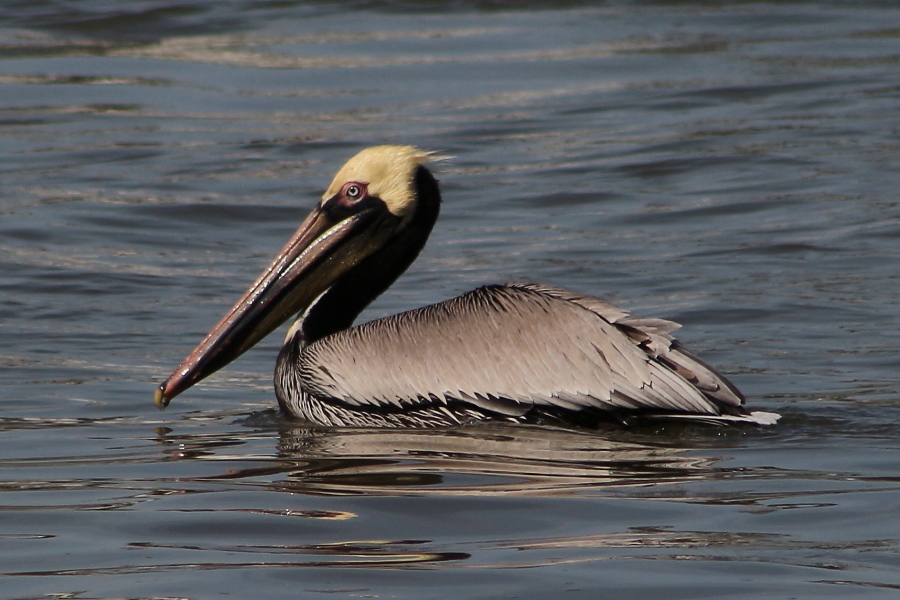
Enough of winter in April; now down south to South Carolina where we had another fabulous time in the low country with our great host, tour guide, and entertainment director. We took walks along creeks, through swamps and old plantations, and of course along the Atlantic Ocean. These gave us the opportunity to enjoy wildlife much different from that in New England including dolphins, alligators, and anoles. The most fascinating of these are the pelicans, truly bizarre birds with some amazing abilities. Just floating on the water their unique physical attributes are immediately apparent with exception of not being able to see just how large their gular pouch is because it's all folded up under their beak.
A pretty bird in its special way.
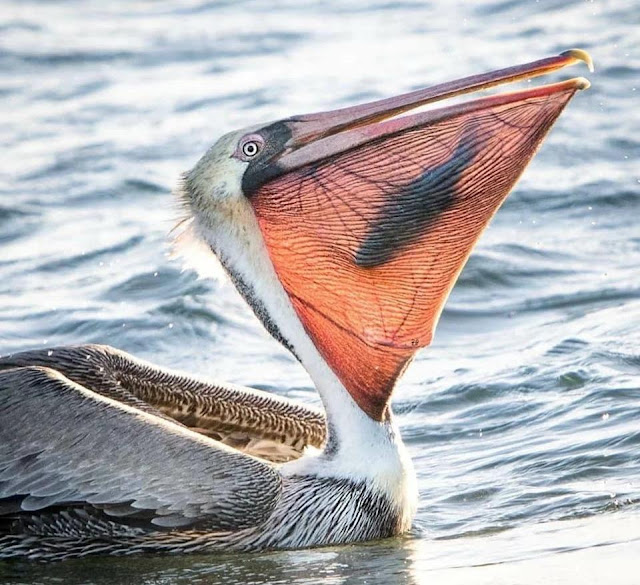
This photo, taken in Alabama and sent to me by a good friend (thank you PL!) shows the gular pouch in its full glory:
Soaring along in formation, often close to the water to take advantage of air pressure off the water, is when they are most elegant.
Flying in close formation over Shem Creek.
Other times they will use the currents and updrafts from the onshore breeze when it hits the dune line to facilitate their flight. Wherever they are, they are an oxymoron of awkward beauty.
At feeding time they use powerful wings to gain altitude where they are able to see fish under water even with waves and reflections on the surface. When they identify a school of fish they just fold their wings and let themselves plunge head first down into the sea.
Target in sight.
Contact
Splash down
If they're on target that pouch swells with water and a number of fish which they swallow whole after letting the salt water drain out. When the tide changes they know to congregate around the breach between Sullivan Island and the Isle of Palms (that's also where we saw dolphins) and when there's a big school of fish it's quite a spectacle to see.
The other bird I'll mention is the Anhiga, another ungainly bird with a long neck that it uses in a most unusual manner, stretching it out for no apparent reason.
I often see this behavior - is it a threatening position to scare me away? Twisting its neck into a pretzel is just as interesting, but that makes sense for grooming or situational awareness.
The Anhniga, like a cormorant, will spread its wings out to dry them after diving for fish.
Sunbathing by a lagoon in the early morning light.
Other birds we saw were ones we'll soon find here in New Hampshire including yellow-rumped warblers, palm warblers, and bluebirds already feeding their chicks.
Papa Bluebird.
And Mama Bluebird. That might be a tick!
Back in New Hampshire, April is always a time of change, and this year, everyone and everything will need to be resilient to make it through to May.
The crocuses didn't succumb to an April snowstorm, and neither will we!
Some other good news: The forecast is for clear skies for tomorrow's eclipse. Fingers crossed for this rare astrological experience!
Advance notice, this is another long entry. It was one of those weeks with so much going on - ducks, beavers, snow, timberdoodles - I don't know where to start. I guess a couple of follow-ups should be first. One or more Red Crossbills have been hanging around since my first sighting in early March, and one appears to have found itself a mate. The two stay near each other but the female is less bold so I haven't gotten a picture, but I did get a good look at the male.
A Red Crossbill in a Red Maple on Wednesday. (Note the buds!)
Another follow-up goes all the way back to January 21st when I heard Pine Siskins and noted that NH Audubon predicted the pine siskin would be the finch of the year. I can attest to the foresight of that prediction: All winter long I heard these these loud and boisterous birds just about everywhere I went, and I'm still hearing them. I was able to get a recording of both of their distinctive calls so when you're out and about you'll recognize it:
The highlight of my week was an evening visit to Page Pond to see if I could witness the strange mating practice of the American Woodcock, also known as the timberdoodle. I've seen woodcock during the day on the wet trail just in from the field at Barnard Ridge Road, using its long pointed bill to probe around in wet soil in search of worms and other edibles. But it's their nighttime courting behavior I was in search of this week, and I knew they might be in that area.
I arrived just after sunset and sat near the edge of the transitional forest between the field and the woods and waited. It was almost dark when I heard the first nasal "peent" of the woodcock. Soon I heard a couple more farther away in the field, and then a dark flying object sped right past me and landed in the field perhaps 30 yards away. I knew it was a woodcock when it started to call: peent... peent.... peent. After a couple of minutes of this the bird took flight and I was able to watch it circle around in a large pattern over the field and the small trees gaining altitude higher and higher, emitting a musical burbling song from its wings, until I lost sight of it in the darkening night. And that was a disappointment, because that's just when it was about to start its crazy decent back to earth. Supposedly the male woodcock will drop in a twisting, almost deadfall decent, slowing his fall just before he hits the ground, right back where he started. Apparently this wild behavior impresses the girls.
I didn't see it land, but knew it had because soon it started again: peent... peent... peent. I saw him take flight one more time, but after that it was too dark to see. But he continued this for another 15 or 20 minutes as indicated by the peenting and burbling that I heard. I never saw him fly off, but when the music ended I knew he was done. Did he get the girl?
Another male was still at it somewhere off in the field, but I was cold and headed home. I didn't get to witness the fall of the timberdoodle, but I got a pretty good taste of one of the more interesting mating rituals in the New Hampshire bird community. Next time I'll try in the morning when the day is brightening rather than getting dimmer. I don't have my own photo of the timberdoodle, but here's one from NH Audubon:
The American Woodcock. Photo: David Nelson/Alamy
Another exciting event occurred on Friday - that cold, windy day before the storm arrived. As the sun rose over the lake it revealed a huge flock of ducks all grouped up on the far side of Marion Cove, tucked in behind the lee of the land to get out of the brutal 20 mph wind. The air temperature was 18 degrees. It was too dark to see what kind of ducks they were but as the sun rose it became clear they were ring-necked ducks, and there was well over a hundred of them!
This is only a portion of the flock.
On one count I got 115 and on another 117, but there were even more hidden behind a point of land that I couldn't count. They must have flown in the day before and sought out the most protected part of the lake to spend the night, and they ended up staying all day.
Linda observed there were two groups. One consisted of apparent pairs, a hen and a drake staying close together and behaving calmly. The other group was a jumble of males and females (more males than females though) that were much more active, especially the drakes. Our hypothesis is that these birds had not yet paired up and the males were doing their best to convince a female to accept them as their mate. As the day progressed, warmed, and calmed somewhat, the flock spread out and some came closer and gave us a better look at them.
When a female or two took flight, many others in this sub-group would follow along after them.
These ducks will soon continue on their way up to northern Maine and Canada to breed.
While the ring-necked ducks were here the much smaller group of Common Mergansers kept their distance - we saw them far away down the lake. We also saw one pair of Hooded Mergansers in the cove before the ring-necked flock arrived.
Male hooded merganser
And the female.
They are a pretty bird; these poor photographs don't due them justice, but the goal of the journal is to document what nature is present.
We're having a lot of fun watching multiple beavers cruise by every night, sometimes giving us great shows with their tail slaps. One sight that has not been seen however, is a loon. None of our loon watchers has seen a single one, which is unusual as the loons usually arrive as soon as there are moderate-size areas of open water, often days before ice out. Perhaps it's because ice out was so early this year. We'll have to wait and see when they arrive. Has anyone from other lakes seen their loons yet?
My comment a couple of weeks ago that old man winter might not be done with us yet was on target and somehow those ring-necked ducks knew what was coming; we picked up almost two feet of snow yesterday which made for some of the best skiing of the year.
A good late winter snowstorm after a very long dry spell.
After having very few birds at the feeder recently, the Juncos - aka snowbirds - came out in force as soon as the snow started.
Dark-eyed Juncos line up for their attempt at the feeder.
It may look like a blue-sky day, but this was before sunrise using artificial light.
These are not polite birds like the chickadees are; a dominant bird often jousts with the others to keep them away from the food.
Here they are in action:
I heard a pine siskin calling during a lull in the storm in the afternoon and looked out the window to see one perched on the feeder. I was impressed to see this little finch take on the flock of juncos for jurisdiction over the feeder.
It confronted every junco that attempted to land including one persistent junco that wouldn't back down.
Eventually the two of them came to a truce, each taking ownership of an opposite side of the feeder.
It was a busy week at the lake. This morning, with almost two feet of new snow, the lake has filled up with frozen slush and the ring-necked ducks were nowhere to be seen. I wonder if the timberdoodles' bills are long enough to probe down through a foot of snow to find their worms!
Lake Wicwas saw the first accumulating snow of the season this week and though it had mostly melted by today, it gave us a few days of soft, gray-scale November scenery.
November Gray
Earlier in the week one might have thought a strange erratic snow had already accumulated on some alder trees.
Snow?
I haven't seen this in several years and it's been almost a decade since I last spoke of it in the Journal. These are insects, Woolly Alder Aphids, named because they use alder as their host tree, and because it looks like wool when they colonize a tree.
Woolly Alder Aphids on an alder tree.
Like other aphids, they live off the sap in plants, sucking the sweet, sugary juices of alder through the bark. They secrete a white, waxy substance which they use to cover themselves as a defense mechanism - predators don't recognize them as an insect, and even if they do discover them, they find the waxy coating unpleasant to eat and leave them alone. I brushed a bit of the coating off to expose them; I was surprised that it came right off with just a light brushing - it's not stuck to them much at all.
What's hiding under that waxy barricade.
Here are few in my hand. The really tiny ones are newly hatched aphids.
They have some interesting facets to their life cycle. During the summer the females reproduce asexually - no male required. That's when they build the large colonies on alder trees. Then later in the year the females search out males to mate with, resulting in just a single egg, which will then generate a new colony of aphids. This is thought to maintain diversity in the gene pool. [Ref: Michael J. Raupp, Ph.D, University of Maryland]
Before the snow fell this week we had some really nice weather to get out and savor the waning days of fall. I had perhaps my last kayak of the year.
Sure looks like November.
It was a nice paddle even though I didn't come across any wildlife other than a few ducks. We still might get a nice day later in November, or even December, so the paddle hasn't been put up for the winter just yet.
Amy Wilson was also out on the lake last week and she did see wildlife, including this loon which sent us looking to understand its status.
A loon with perplexing markings. (Photo by Amy Wilson.)
It has some aspects of a juvenile, but not the chevron pattern of one of this year's brood. It is sporting what looks like a few white dots on its back, reminiscent of an adult's breeding plumage. It also has an unusual black and white coloring on its beak, unlike either the black beak of an adult nor the white beak of a juvenile. Referring to photos and descriptions from both the Loon Preservation Committee and the Cornell Lab of Ornithology, I believe this to be either a non-breeding immature adult, or a molting adult transitioning to its winter plumage. It could be one of our breeding loons, but more likely it's a visitor on its way to the Atlantic Ocean.
Tramping on terra firma around Lake Wicwas, I twice came across a flock of turkeys, but they are so aware of their surroundings that they heard me coming and just melted away into the forest before I could get a picture. But Neil Crimins caught what is surely the same flock as it made its way right through his yard.
Our neighborhood flock of turkeys.
I also took advantage of the nice days to walk in the Page Pond Town Forest. I stopped by the new accessible trail and viewing platform overlooking the quarry pond on the Quarry Loop Trail - it's great!
The viewing platform and accessible trail on the Quarry Loop built by the Meredith Rotary Club.
I continued down the Yellow Trail, across the beaver dam, and returned via the Page Brook Trail. On the way I passed by this huge old pine tree that lies just a few yards off the Yellow Trail.
One big old pine tree.
My final walk of the week was up Whiteface Mountain in the Belknap Range (not the 4000' Whiteface up by Wonalancet) after the snow fell.
We've had an unusually high number of white-breasted nuthatches at our feeders this year so I thought I'd doing a little looking into the subject of nuthatches.
Yes, birds have tongues.
The White-breasted Nuthatch (Sitta carolinensis) is a small, acrobatic bird that is found throughout much of the eastern and central United States. This species is a year-round resident of deciduous and mixed woodlands, and is commonly found in residential areas and parks.
One of the most distinctive features of the White-breasted Nuthatch is its ability to walk down trees headfirst. This behavior is made possible by its sharp claws and strong toes, which allow it to cling to the rough bark of trees. The bird uses this ability to forage for food, probing crevices in the bark for insects and seeds.
White-breasted Nuthatches are also known for their vocalizations, which consist of a variety of calls and songs. The most common call is a nasal "yank" or "yank-yank" sound, which is often heard in the woods. The bird also has a loud, ringing "whinny" call that is used to defend its territory.
In terms of diet, White-breasted Nuthatches are opportunistic feeders, consuming a variety of insects and seeds. In the summer, they primarily feed on insects such as beetles, caterpillars, and ants, while in the winter, they shift to a diet of seeds and nuts. They also hoard food, caching it in crevices and other hidden places for later use.
White-breasted Nuthatches are also known to be cooperative breeders, with the breeding pair being helped by one or more helpers in raising their young. The breeding pair excavates a hole in a tree, usually in a dead tree or a dead branch of a live tree. The female lays an average of six eggs and both parents incubate them for about two weeks. The young are then cared for by both parents and helpers, if any, and fledge in about three weeks.
In conclusion, the White-breasted Nuthatch is a fascinating and familiar bird that is well adapted to its forested habitat. Its acrobatic ability to walk down trees and its vocalizations, along with its opportunistic feeding habits and cooperative breeding behavior, make it a unique and interesting species to study and observe.
Did that sound a little stilted? Have you heard of ChatGPT? ChatGPT is an artificial intelligence software program that's been in the news a lot lately and has been predicted by some to replace lots of people's jobs in the future, so I thought I'd give it a test. The above description of white-breasted nuthatches is word-for-word what ChatGPT gave me when I asked it to "write a scientific article about the white-breasted nuthatch". It isn't bad, but it is somewhat, shall I say, artificial, so I think my job is safe for a bit longer. But I can envision a day where a web-connected trail camera sends photos to an image-recognition system connected to an artificial intelligence engine that will document what's happening around Lake Wicwas with no human intervention. Then I can just stay home all day like the human blobs in the movie WALL-E.
This isn't going to happen as long as I have a say in it.
My own research revealed that the migratory behavior of white-breasted nuthatches is still being studied. It had been believed they were not migratory and stayed in their territory year round, but recent studies have found they may in fact have some migratory behavior, possible being an irruptive species like their red-breasted cousin, meaning they move in mass migrations in years of low food supply in their home range. Because white-breasted nuthatches are such common and widespread birds this is hard to determine without banding specific birds and tracking them, something that a group of ornithologists is starting to do. So maybe this is an irruptive year with low food supply in Canada bringing more white-breasted nuthatches to central New Hampshire, but regardless, I'll enjoy watching them on the feeder, even if they do shovel seeds onto the ground as they dig through the feeders looking for the largest, choicest seeds.
Nuthatches excavate in the feeder to find the perfect seed.
This is a female.
Another thing I learned is how to differentiate male and female nuthatches. The female has a slightly gray cap on its head as seen above, while the male's cap is black, matching the shade of its nape just behind the cap. The distinction is slight, but noticable.
Although the larger lakes are still ice-free, Wicwas has between seven and ten inches of good ice on it. There are people out fishing, and the first bob house has appeared.
That sky looks like snow is coming.
I saw this on Thursday after a cold night had frozen the surface up nicely, allowing a skating excursion around the entire lake, just before more snow fell. Then on Friday we received a nice snowstorm, one without any rain involved, and the world was freshened up with a beautiful blanket of white - easy to shovel and great to ski on.
Turtle Island on Friday morning.
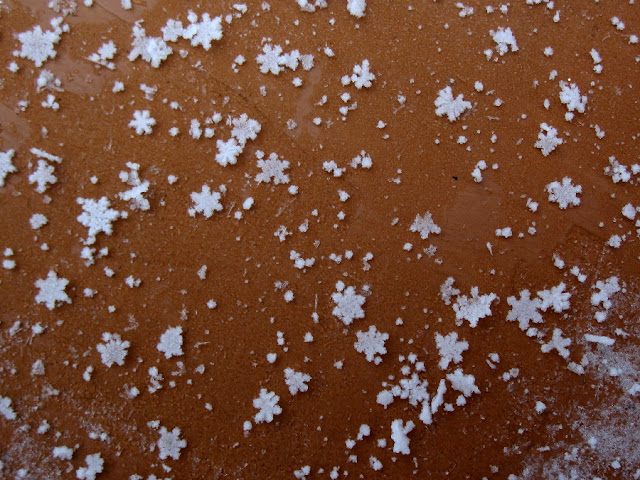
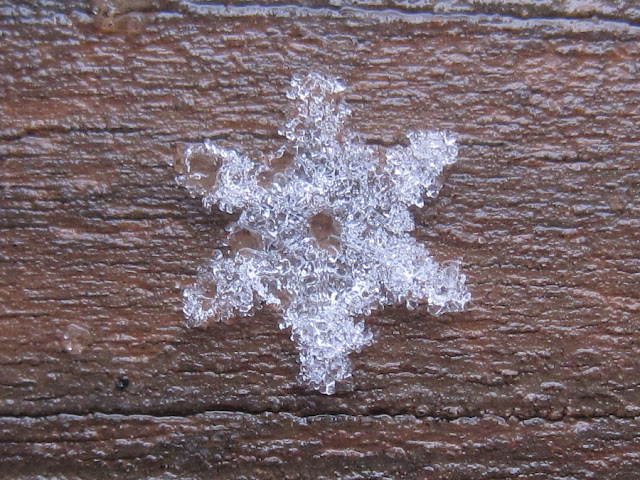
As the storm wound down the heavens started sending these perfect snowflakes down to earth.
It's the kind of snow you'd see in a Hollywood movie on Christmas Eve and call it fake.
But it was real.
Whether it was the snow, or the breast of a bird, white was the color of the week, and none of it was artificial.