Showing posts with label Chestnut-sided Warbler. Show all posts

Sunday, May 11, 2025

May 11, 2025: Happy Mother's Day!

Flowers for mom.

It's very kind of Mother Nature to provide a bright sunny day to help celebrate Mother's Day after a rather dreary week.  That's a Service Berry tree blooming on Sheep Island.  

Serviceberry (aka Shadbush) on Sheep Island.

I'd hoped we would have enough sun to get some of these trees blooming for Mother's Day.  The Black Cherry didn't make it, but the Hobblebush Viburnum did.
Hobblebush Viburnmum

This shrub has two distinct types of flowers.  The outer blossoms are sterile, and likely developed just to attract pollinators to the small fertile flowers in the center which produce the seeds.  It seems every plant evolved with some special trait that gives it enough of an edge to survive in a competitive world. 

There was enough sun to get a few more wildflowers to brighten up the world for mom, including these violets.

Common Blue Violets in a sunny moment.


Sunny moments were the exception for the week as it rained more days than not, giving us almost five inches of rain in the past week.  The lake rose to more to 12 inches above normal, even with the dam lowered.  We'll keep the dam open to get the lake down as quickly as possible so the loons will be able to access their nesting sites which are currently submerged.  This was the scene more often than not around the lakes this week:

A calm, misty evening.

I did fit in a couple of paddles between the showers, taking advantage of high water to explore areas of the lake that are typically inaccessible.  

Exploring a marsh near the Wicwas dam.

There were blackbirds singing loudly from tall stems in the marshes.
A Red-winged Blackbird sings its distinctive song.

I should also mention the new arrivals this week:  Chestnut-sided Warbler, Magnolia Warbler, Nashville Warbler, Yellow Warbler, and Blackburnian Warbler.  That's a lot of warblers!

I found leatherleaf that had bloomed in spite of the rain and high water.

Leatherleaf

These plants are wetland-specific species, not bothered by the high water levels.

I'll close with one more almost-flower:

A Pink Lady's Slipper preparing to bloom.

One more sunny day ought to do it - something to look forward to next week!


Happy Mother's Day!

A mid-day update:  I was way off on the lake level.  It's more like two feet above full level, lapping over the top of the dam!


Sunday, May 26, 2024

May 26, 2024: Nests on Land, Sea, and Air

 Nesting season is now in full swing; I'll start with land.

Hermit Thrush nest built into a depression in the ground.

I never would have seen this Hermit Thrush nest if the bird sitting on the nest hadn't flown out right in front of me as I walked past it.  The nest is right beside what must be a lightly used trail or it wouldn't have selected that spot.  But otherwise it's perfect, beautifully hidden under a hemlock branch and some small plants.

The undisturbed appearance of the nest.

I held the hemlock aside to take a picture and then went quickly on my way.  The Hermit Thrush is one of several birds that make their nest on the forest floor, from the Oven Bird - named after the dome-shaped nest it builds -  up to the much larger turkey.  In the case of Hermit Thrushes, it's the male that constructs the nest, though the female may help with the interior decorating, lining it with soft finishing touches.  Field guides say she usually lays three to six eggs, so maybe there's more to come.  

Mallards also make nests on the ground, usually hidden under a shrub or other small plant.  Our Mallard family has already hatched their eggs and mom has been out on the lake with her six little ducklings.

One of our Mallard families.

Next up is a nest in the air.  Visiting an area of young forests I heard the call of the Chestnut-sided Warbler and stopped to peer into the dense jungle of trees.  I never found the warbler, but I did find what has all the characteristics of a Chestnut-sided Warbler nest:  a tightly built nest of grasses and other plant material woven around multiple stems of a young sapling five to ten feet above the ground in a young successional forest.

I didn't climb in to see if there were eggs in this nest.

Finally, on the water, there is this exciting nest:

The northern loon pair has nested.

The northern loon pair has selected a site, built a nest, and is assumed to be sitting on an egg or two.  With a telephoto lens I was able to take a picture far enough away to not disturb the loon as shown by its head-up position.  When feeling threatened a loon on a nest will put its head low down against the ground to hide and to be in a position to quickly leave the nest for the safety of the lake.  Eagle-eye Amy W. spotted it on May 23rd, just a couple of days after there were territorial battles being waged between the pair and an intruding loon, possibly the Paugus Bay loon we saw two weeks ago.  

Our pair made it quite clear what the intruder would be dealing with if it sticks around.

Lots of chasing and wing-rowing.

I guess they decided it was time to send him packing before they nested.  


Trees are mating now also - in their own way - as shown by the quantity of pollen covering everything, including the lake on a calm morning.


The Black Cherries are doing their thing too.


They're always a beautiful sight, and will continue to be so right through the summer as their deep red fruit matures.

The state flower, the lilac, seems to be having a good year too with lots of blooms all around town.

These lilacs are along Chemung Rd.

Finally, everyone's favorite, the Pink Lady's Slipper:


I'm seeing a lot of them this year - hopefully you will too!


Friday, May 19, 2023

May 19, 2023: Woodland Wildflowers

I'm publishing early this week in case anyone wants to go out this weekend to look for woodland wildflowers.   Most of the deep-woods flowers are blooming now, and by next weekend they may be going by, depending on the weather.  One exception is the Lady's Slipper which usually doesn't bloom until late May, but you might get lucky and see an early bloomer this weekend.  Last week I noted I found a couple of trilliums blooming, but this week there were many to be found.

Painted Trillium

Several of the tiny white woodland flowers are also blooming, including the starflower and the goldthread.  

Starflower
Goldthread

There are still a few trailing arbutus around, but these, the earliest of the wildflowers, are mostly gone.  All of these deep-wood flowers take advantage of a narrow window of opportunity after the ground warms up, but before all the trees leaf out.  The bare branches of deciduous trees allow sufficient sun to reach the forest floor for these plants to collect enough energy to grow and flower before they are relegated to the dark shade of the forest.  They will continue to photosynthesize throughout the summer with what little light does reach them, but that short window is what really keeps them going.  

If your travels take you by more open sunny areas you're likely to see several other pretty blooms growing down at your feet.  Two violets, the sweet white and the common blue are in bloom now.
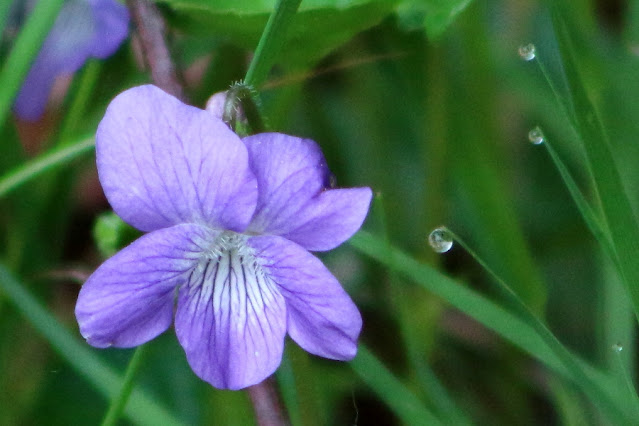
I love the perfect spheres of dew on the blades of grass,

Also down at ground level, wild strawberry are flowering, hoping to attract an early pollinator to let them set fruit for the birds later in the summer.

A future strawberry in the making.

Another fruit-bearer is blooming as well, and judging by the quantity of blossoms, it appears another good blueberry season might be in store for us.

Lots of blossoms have been set on the blueberry bushes.

Of course, this depends on sufficient rain coming during June and July, something we haven't seen in two weeks now.  

Bridging the borders between sun and shade is one of my favorite flowers, the fringed polygala, which can spread into large patches.

Fringed Polygala

I think it's the unusual color, somewhere between magenta and violet, that I find intriguing.  You might also see bluets and lily-of-the-valley blooming right now.

Lily-of-the-valley

The last flower I'll mention is a new one for me, and I had to work to determine what it is.  Though I found it on the forest floor, it's not one that blooms down low, but rather up high in the forest canopy.


I expected it was a flower from a tree, but which tree?  I found many of these flowers under hemlocks, but I knew that wasn't its host.  Eventually, by looking up flowers of the various trees that grow in our forests, I determined it's the flower of the American Beech; it perfectly fits the description of the male beech flower in the Audubon guide "Eastern Forests".  [Alfred A. Knopf, Inc, publisher, 1985]  The flowers are very light, and with the strong winds this week, they could have blown a long way.

The tiny flower of the mighty beech tree.

The variation in relative size between plant and flower that different species have developed is remarkable.  A trillium flower is about one third the height of a mature plant, while the flower of the American Beech is less than one one-thousandth of the height of a mature tree.

Moving on to the animals, I saw a couple of new bird arrivals this week, the American Redstart the Baltimore Oriole and the Chestnut-sided Warbler.
Chestnut-sided warbler.

These birds tell me that we're nearing the end of the migration, as these birds, based on my observations, are among the last to arrive.  I heard the oriole on the Wetland Loop Trail at Page Pond, high up in a tree with no chance to see it.  Chestnut-sided warblers flit around in the thickets of young successional forests, but its song is so loud you can easily track it, and if you watch long enough you can usually get a glimpse of him (it's always him that sings).  You're likely to see one along the Page Pond Field Trail at the Barnard Ridge Road trailhead.  Listen for its distinctive "Pleased, pleased, pleased to MEET you" song.

It can be hard to get past the bugs, but if you can, the sights and sounds of the forest are now reaching their spring climax.
Singing loudly to defend his territory.


Sunday, May 20, 2018

May 20, 2018 - An Arachnid Convention

The weathermen have really struggled the past two weeks - they keep forecasting rain, but it never happened.  The incredible stretch of warm sunny weather ended yesterday, but it was much appreciated by the trees which blasted out their leaves in just one week, and though good size, the leaves haven't turned dark green yet.

This provides a unique window into seeing what kind of trees make up the forests of New Hampshire as the dark green of the coniferous trees - pine, hemlock, spruce - stand out from the light green of new leaves on the deciduous trees.  A stark strip of light green leading up from the lake caught my eye again this week.

I asked why there is such a uniform stand of deciduous trees with white pines lining both sides.  The answer came quickly:  there is a ravine here with wetlands at the bottom.  White pine thrives in dry sandy soil, but not in the soggy soil of a wetland.  The natural community known as a Red Maple - Black Ash Swamp [Ref:  Sperduto & Kimball, "The Nature of New Hampshire", University of New Hampshire Press, 2011] is the domain of red maples which thrive in the rich, wet soil, and crowd out most other trees, save for a rare Black Gum.

A wide range of birds use this community for food and cover and on any morning a dozen different birds can be heard, though most are hidden away in the dense forest.  One pretty Chestnut-sided warbler did present itself to me.
Chestnut-sided warbler (Dendroica pensylvanica)

The squirrels and chipmunks which live on the edges of these wetlands are not so shy, especially when you're standing just beyond the entrance to a chipmunk's new home that it's still in the process of furnishing.

The squirrels just seem annoyed that you are in their territory.

We can optimistically hope that the dry weather will mean a shorter black fly, mosquito and tick season.  Have you ever wondered why you can come back from a walk with three or four ticks on you?  Maybe you happened upon lunch break at a parasite conference.
Female wood ticks (Dermacentor variabilis) hanging out at the food court, waiting for lunch to arrive

But we allergy lovers sure appreciated the little rain we did get on Saturday to knock down the pollen levels a bit.  Those trees, loving the hot dry weather after those April showers, can dump out a lot of pollen from all those branches.
Oak trees are producing a lot of pollen at the moment

I'm hoping the weathermen - which are forecasting another dry week - are wrong again, and we'll get a little much-needed rain.

Sunday, April 15, 2018

April 15, 2018 - Summer residents returning, ready or not

The world is inching its way along towards spring, always at its own pace.  The days (until today that is) have been nice enough to get out and enjoy some springtime walks, but it's clear we still have a ways to go before lake activities are at hand.
Lake Wicwas still firmly in the grasp of Old Man Winter


The latest report from the Lake Winnipesaukee Ice Out team (Emerson Aviation) is that there is still no appreciable open water on the big lake.  Here on Lake Wicwas we have the same story, just bits of open water around a few edges edges.
Open water is growing, enabling ducks and beavers to cruise the shorelines

I'm still able able to venture out a short ways from shore to measure the ice, and it stands 12" thick, though we are now down to only 3" of solid ice with the rest being soft, porous ice.  But it was still strong enough on Friday to support me without sinking in at all.
12 inches of ice yet to wilt away

Bird activity seems to be picking up - there was a bald eagle and a pair of red-tailed hawks soaring over the lake this week. 
Red-tailed Hawk riding the thermals

And mallards have joined the geese on the lake.
All my ducks geese in a row
Mom and dad mallard looking for the best nesting site
Time to warm up my feet

The mallards seem to spend most of their time in the water, though they occasionally climb up onto the ice for whatever ducky-reason they may have:  (Link to video)

I even flushed out a grouse on one walk, though I had to send a picture of the tracks to one of my colleagues at the Conservation Commission to identify the tracks (thank you JS)!
Grouse tracks are much closer together than the larger turkey and pheasant

Even in the absence of insects the flycatchers and warblers are starting to return;  I heard my first phoebe and chestnut-sided warbler with its pretty "sweet-sweet-sweet-to-MEET-you" song on Friday.  On morning walks it's reassuring to hear the summer songbirds singing again.  We enjoy the sounds of chick-a-dees, titmice, and other year-round residents through the winter, but the songs of warblers provides some subliminal message that even if one's walking on snow and ice, summer will arrive.  Sounds are hard to capture, but here are some of the sights from one spring walk this week after an April shower.
An April Sunrise
Morning dew on last years survivors
Wintergreen wanting to be springgreen
Pretty barren in the understory

Pearl necklaces
Winter.  Still.

Pussy willows are among the first trees to blossom

It is a time of contradictions, old man winter fighting to conserve the past, and spring, pushing us into the inevitability of the future.
Cracks showing in winter's defenses