A somewhat random record of observations of what's happening around Lake Wicwas and the Lakes Region. I hope to post about once a week - your comments are welcomed.
Spring is popping up everywhere now, and I saw my first true wildflower Wednesday on a hike in the Ossipee Mountains - not where or what I expected. But there on a southern exposure on the Mt. Shaw Trail, I saw my first flash of color, a bright Round-leaved Yellow Violet (one of those oxymoronic flower names).
Round-leaved Yellow Violet (Viola rotundifolia)
This was at 1800' elevation, and soon there were many of these violets, sometimes in large clumps.
A little higher up Mt. Shaw, on a ledge overlooking a deep-blue Lake Winnipesauke, I could see there's still snow on the trails at Gunstock.
It was a warm, sunny day, and approaching the trailhead on my way down in the afternoon I started seeing trillium leaves poking up through the leaf litter. Then right at the parking area there were dozens of them.
Dozens of trillium at the Mt. Shaw Trailhead.
A few had buds that were about to open.
So I searched to see if I could find one that had opened, and finally I found one - just one, and just barely open, but that was enough to verify they were Purple Trillium.
Purple Trillium
On the next sunny day there will be a fabulous display of color at the Mt. Shaw trailhead on Rt. 171 for all to see.
A deciduous forest floor only gets direct sunlight for a brief period between snow-melt and leaf-out. These early wildflowers have evolved the ability to emerge early enough to take advantage of this short window to collect enough energy to blossom and survive until next spring.
It wasn't until Friday, back at Lake Wicwas, that I saw my first Trailing Arbutus in bloom.
Trailing Arbutus aka Mayflower
At the same time as the flowers are exploding on the scene, so are the birds. This week I heard the first Hermit Thrush, Blue-headed Vireo, Phoebe, Palm Warbler, and Black-throated Green Warbler. All of these have loud songs, and the hermit thrush is my favorite of the woodland birds.
On a mid-day kayak I saw my first osprey of the season as it flew over the lake and landed in a lichen covered tree on Loon Point.
On the same paddle I came across a promising loon encounter. Two loons were interacting closely, actively enough that I first thought they were in conflict. But there wasn't any chasing or vocalizing, and their behavior didn't seem aggressive, so maybe they were just checking each other out.
When one of them swam right beside my kayak I was able to clearly see the white band with black dot that identified it as the northern male. And later in my trip there were two loons fishing together in the northern territory, so perhaps the behavior I saw earlier was the loon version of flirting. Maybe our male has accepted a new mate after last year's partner was killed.
I also saw a second pair of loons in the south territory which may be the banded south pair, but we'll need to see bands to know that. The busy loon-watching season has begun!
It's an exciting time of year on the lakes and in the forests as nature reawakens for the summer; there were many more new sightings, too many to note, so some will have to wait. But something else is exploding on the scene too. Be aware that biting insects will be out very soon, so the days of bug-free walks are almost over. Here's clear evidence that the insects are coming.
We've returned from our excursion in South Carolina, but not before experiencing a few more wonders of nature. Our fabulous host and tour guide had tracked down a rookery along a marsh in Mount Pleasant and when we visited we found a host of southern bird species sharing an obviously popular spot for nesting which included Anhingas, Wood Storks, Snowy Egrets, and Great Egrets. And in their breeding mode they were putting on quite a display - not for us, but for their mates.
A Snowy Egret struts its stuff.
The males of both the snowy and great egrets had their breeding plumage in place and were proud to display it.
A great egret attracting attention.
It's easy to see why these birds where hunted to near extinction for their feathers during the early 1900s. No longer at risk of being shot, they now have more time to discuss parenting methods.
"I think we should let them cry at night."
I couldn't tell which nests had chicks in them but it appeared that the great egrets were flying back and forth bringing food in to feed chicks in at least some of the nests.
Regurgitating food for the chicks.
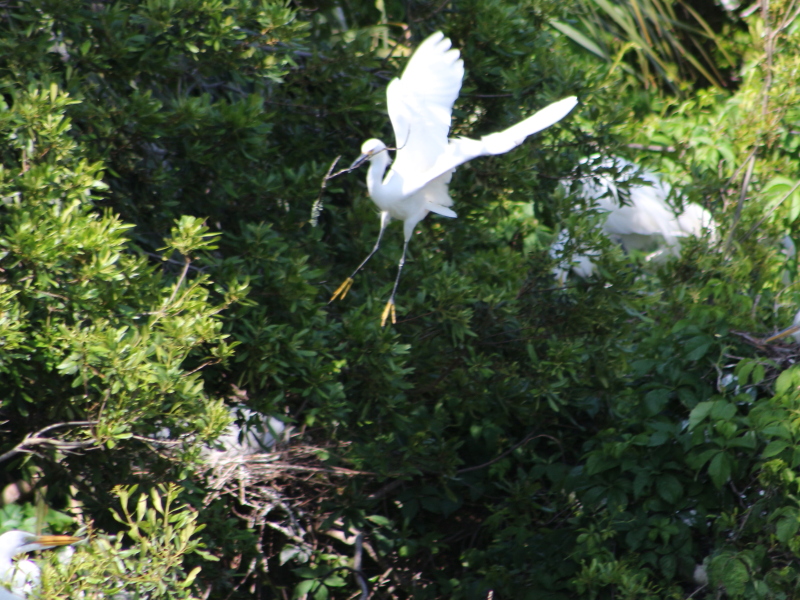
Meanwhile, one of the snowy egrets continued to make home improvements.
Bringing in some additional building materials.
The wood storks were well hidden deep within the trees so it's not clear what they were up to, but it appeared that the anhingas had already nested and were incubating their eggs.
The anhingas looked like loons panting on their nests in the hot sun.
We earlier had watched a snowy egret fishing in Shem Creek at low tide and I found it fascinating how it would shake its foot in the mud to scare out a crab or a shrimp and then with lightning speed stab it with its bill. You can see it in action in this video I took at the creek:
A couple of other interesting, non-New Hampshire creatures we came across during our travels in the low country included a reptile and a crustacean.
Brown anole (Anolis sagrei)
Some kind of land-and-sea crab.
I don't what kind of crab that was, running around by the brackish water with the alligators, but the lizard is a brown anole, a non-native species that was likely introduced to Florida in the 1970s and has exploded in population throughout the south, largely displacing the native Carolina (aka green) anole.
Upon returning home we found winter still hanging on strongly in New Hampshire, with barely any progress towards spring while we were away. The red maple blossoms, the first to come out, had barely budged.
Red maple blossoms still just emerging.
But at least the Trailing Arbutus (mayflower) are blooming in the forest.
Trailing Arbutus (Epigaea repens)
And, two more summer residents and a passing migrant arrived this week:
A palm warbler makes a rest stop on its way to Canada.
This pair of yellow-rumped warblers is behaving like they are going to nest right here.
On the lookout for the next insect.
Yellow-rumped warblers are an early arriver and we watched them dashing around the bare branches as well as on the ground, picking off insects, probably of the crawling variety. The palm warbler is just passing through New Hampshire on its way to breed in Canada or downeast Maine. I also heard a blue-headed vireo singing from somewhere high in the tree tops.
I'll end with one decidedly non-nature moment, but an interesting connection between north and south. I saw a large ship which looked like a ferry heading out to sea from Charleston Harbor in a direction that didn't seem like a ferry route. I took a picture and after expanding it I saw it was "The Cat" which I thought ran from Bar Harbor, Maine to Yarmouth, Nova Scotia. A little digging revealed that after a few seasons off, it was returning to New England from its summer berth in Charleston.
"The Cat" returning north for its service between Maine and Nova Scotia.
This ship started life as the U.S. Navy Military Sealift Command fast ferry Alakai (USNS Puerto Rico). There's a neat video of it being retrofitted at the Detyens Shipyard in North Charleston including how it was put into drydock and then refloated.
It's one of the larger migrating objects I've seen this spring.