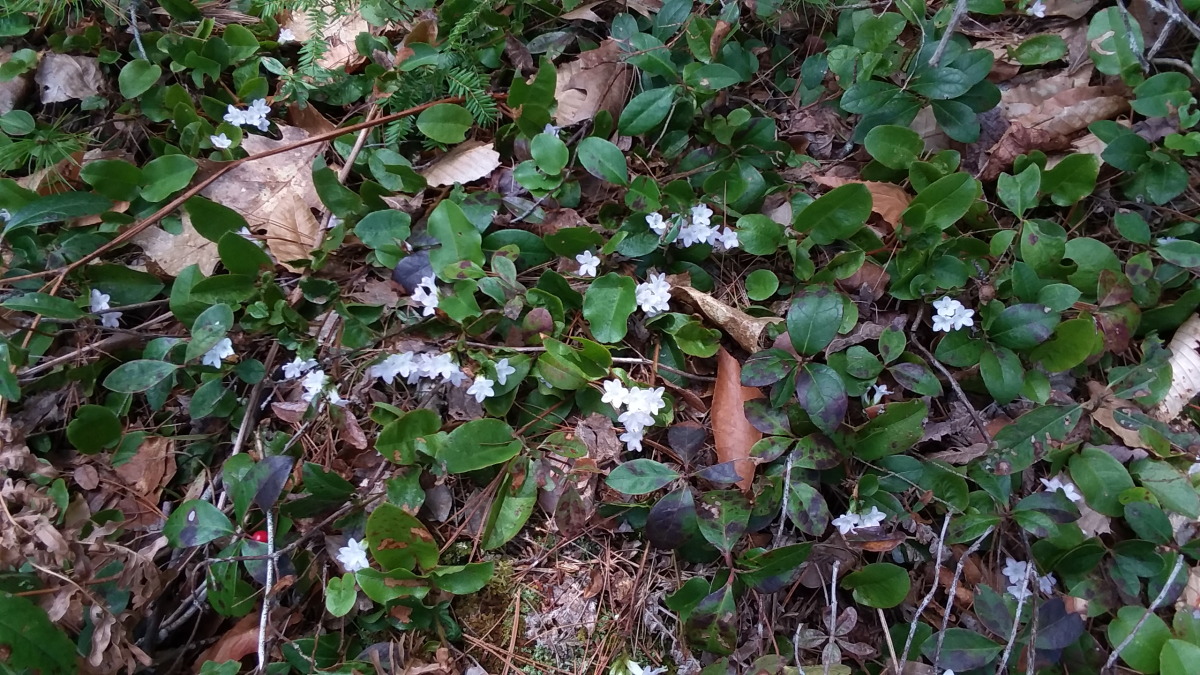
A late ice-out didn't slow down the native flowers one bit. The Trailing Arbutus, commonly known as Mayflowers, blossomed right on schedule, appearing on the first day of May.
 |
| Trailing Arbutus (Epigaea repens) |
These are always the first wildflowers to appear in the spring, and although tiny, they have the most beautiful, sweet fragrance, which is strong enough to note even as I run past a patch of them on the trail.
Pick one up and roll it between your fingers and you will be amazed at the scent.
I thought the late snow pack might slow things down a bit, but apparently not, as Marge Thorpe found a Purple Trillium blooming on the trail to Crockett's Ledge on Saturday morning, having survived the storm that blew through Friday night.
 |
| Purple Trillium (Trillium erectum) Photo by Marge Thorpe |
Another early bloomer is the Bloodroot, though this one has the advantage of being pampered in Linda's flower garden.
 |
| Bloodroot (Sanguinaria canadensis) |
Though lacking a blossom, another early, very fast grower in New England forests is the Skunk Cabbage. These seem to explode on the scene in wet, marshy areas, growing by leaps and bounds. This cabbage patch is beside Chemung Road approaching the Hamlin trailhead, being fed by the stream that drains the beaver ponds that give the Four Ponds Trail its name.
 |
| Skunk Cabbage (Symplocarpus foetidus) stands in stark contrast against the drab forest floor |
Unlike the Trailing Arbutus, Skunk Cabbage gives off a most unpleasant odor when disturbed; its name is quite appropriate. I have distinct memories of these from my earliest escapades in the woods around my home, wondering where that awful stench was coming from as I traipsed through swamps and marshes. (And mom never yelled at me when I came home with mud up to my knees.)
Odoriferous or not, the season of wildflowers is just beginning, and will brighten our world for the next five or six months - a great reason to get out and brave the bugs. Yes, the black flies have arrived too.
In the world of reptiles, one may find turtles on both land and water at the moment as they escape the cold water of their winter dungeon to seek out the warmth of spring air.
 |
| Painted Turtle (Chrysemys picta) sunning |
 |
| Snapping Turtle (Chelydra serpentina) |
That big snapper was right on the trail in the Page Pond Town Forest, and doing a good impersonation as a rock, wasn't noticed until she snapped at us as we walked by - more than a little startling! It's still a little early for momma snappers to be laying eggs, so perhaps she was also just out enjoying a walk on a warm spring day.
On the bird front, there has been an eagle scouting out Lake Wicwas almost everyday this week, causing much anxiety to the other birds on the lake. The loons tend to call out when it's soaring overhead, but the Canada geese really get squawking when its around. The eagle might only be catching fish and water snakes at this point, but I expect it's taking note of future dining opportunities when little loon and geese chicks hatch out later this summer. : (
 |
| Keeping close to shore, and an eye on the sky |
I would so love to someday see a bald eagle flying with a three foot long Northern Water snake dangling from its talons.
Finally, there is one more May flower that adds color to the otherwise gray forest this time of year - the Red Maple blossom. One of my friends says the spring foliage season, which is largely administered by the red maples, is her favorite season.
 |
| Red maples fronting the spring foliage season |
 |
| Red maple blossom adorned with spider webs and dew |
Imagine how many of these tiny blossoms there must be to wash an entire hillside with the red hue of a New Hampshire spring.