Showing posts with label Round-leaved Yellow Violet. Show all posts

Sunday, April 27, 2025

April 27, 2025: Talons and Trilliums

Spring is popping up everywhere now, and I saw my first true wildflower Wednesday on a hike in the Ossipee Mountains - not where or what I expected.  But there on a southern exposure on the Mt. Shaw Trail, I saw my first flash of color, a bright Round-leaved Yellow Violet (one of those oxymoronic flower names).

Round-leaved Yellow Violet (Viola rotundifolia)
This was at 1800' elevation, and soon there were many of these violets, sometimes in large clumps.

A little higher up Mt. Shaw, on a ledge overlooking a deep-blue Lake Winnipesauke, I could see there's still snow on the trails at Gunstock.

It was a warm, sunny day, and approaching the trailhead on my way down in the afternoon I started seeing trillium leaves poking up through the leaf litter.  Then right at the parking area there were dozens of them.
Dozens of trillium at the Mt. Shaw Trailhead.

A few had buds that were about to open.

So I searched to see if I could find one that had opened, and finally I found one - just one, and just barely open, but that was enough to verify they were Purple Trillium.
Purple Trillium

On the next sunny day there will be a fabulous display of color at the Mt. Shaw trailhead on Rt. 171 for all to see.

A deciduous forest floor only gets direct sunlight for a brief period between snow-melt and leaf-out.  These early wildflowers have evolved the ability to emerge early enough to take advantage of this short window to collect enough energy to blossom and survive until next spring.  

It wasn't until Friday, back at Lake Wicwas, that I saw my first Trailing Arbutus in bloom.
Trailing Arbutus aka Mayflower

At the same time as the flowers are exploding on the scene, so are the birds.  This week I heard the first Hermit Thrush, Blue-headed Vireo, Phoebe, Palm Warbler, and Black-throated Green Warbler.  All of these have loud songs, and the hermit thrush is my favorite of the woodland birds.

On a mid-day kayak I saw my first osprey of the season as it flew over the lake and landed in a lichen covered tree on Loon  Point.


On the same paddle I came across a promising loon encounter.  Two loons were interacting closely, actively enough that I first thought they were in conflict.  But there wasn't any chasing or vocalizing, and their behavior didn't seem aggressive, so maybe they were just checking each other out.

When one of them swam right beside my kayak I was able to clearly see the white band with black dot that identified it as the northern male.  And later in my trip there were two loons fishing together in the northern territory, so perhaps the behavior I saw earlier was the loon version of flirting.  Maybe our male has accepted a new mate after last year's partner was killed.  

I also saw a second pair of loons in the south territory which may be the banded south pair, but we'll need to see bands to know that.  The busy loon-watching season has begun!


It's an exciting time of year on the lakes and in the forests as nature reawakens for the summer; there were many more new sightings, too many to note, so some will have to wait.  But something else is exploding on the scene too.  Be aware that biting insects will be out very soon, so the days of bug-free walks are almost over.  Here's clear evidence that the insects are coming.


Happy spring!


Sunday, May 12, 2024

May 12, 2024: Iron Mines

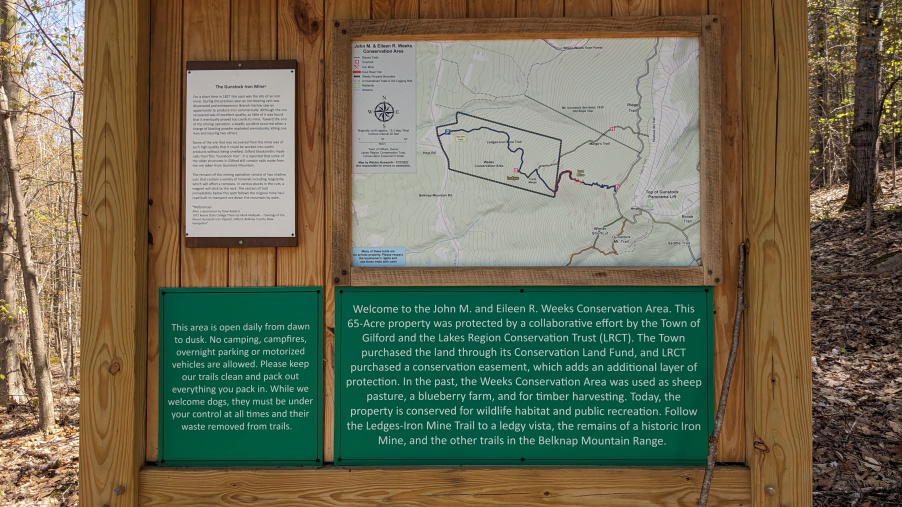
There's an old iron mine on the western flank of Gunstock Mountain which I'd never been to, but the Town of Gilford and the Lakes Region Conservation Trust recently improved the trail to the mines so I decided I would check it out.  It's a short, half-mile hike up the the site, and along the way there is a very nice viewpoint looking out over Gilford.

Viewpoint on the Iron Mines Trail

The mines themselves - there are two sites - are small and not very impressive to look at, but the story is interesting.  
One of two sites where iron ore was mined from the Belknap Mountains

The mines contained very-high quality iron ore, so high in fact that some was used directly without being smelted.  But the deposits were small, and the mine didn't last long.  There's a short history posted on the kiosk at the trailhead.


What I find most interesting is that someone discovered the iron deposit in the first place, just two small veins located on a large mountain range.  Were there specific topological or geological aspects that attracted their attention?   Did the magnetite in the rock make their compass act erratically? Something led them to discover the deposit, and if known, that would be a interesting part of the story.

The Iron Mines Trail connects to the large trail network in the Belknap Range that runs all the way to Mt. Major in Alton.  I continued on, completing a loop over Gunstock and Belknap, taking advantage of the nice late-spring day with no bugs and clear sightlines through empty branches.

There is still snow in the White Mountains.
Snow on Mt. Washington, seen from the summit of Gunstock.

And on the ski trails.

Flintlock Trail at Gunstock.  This is the trail one can see from Clough Park in Meredith Village

The waters of Winnipesaukee were shining blue from the ledges on Belknap. 

Of course, I had to climb the fire tower.


Back on Lake Wicwas, the wakening forest is entering the mellow-yellow, lemon-lime phase.

Blue water on Wicwas too.


Paddling on that blue water this week I had an exciting moment when I came across a single loon that was banded - with a color scheme I'd never seen before!
Orange with black dot over yellow with black stripe.

I sent the information off to the Loon Preservation Committee, but they were only able to narrow it down to three loons based just left leg bands.  The next day the same loon was here again and I waited patiently hoping to get a right foot wag, but the bird wasn't cooperating.  I did get one fuzzy photo of its right leg under water, but that was enough for the LPC biologists to determine its identity:  It's a loon that was rescued on January 18th of this year on Paugus Bay in Winnipesaukee.  The warm weather this winter had let it stay so long that it had molted its flight feathers and couldn't leave when the bay finally froze over.  The team at LPC are thrilled to know their rescue effort was successful.  Now we'll watch to see if this loon sticks around at Wicwas, and if so, what kind or turmoil develops during nesting season.  You can read the Loon Preservation Committee's report on the rescue here.

While the loons may not have even selected a nesting site yet, the geese have already hatched goslings as seen in this picture from Jim DeMott.

Six little goslings.  Photo by Jim DeMott.

If all the geese on the lake this year have this many chicks, it's going to be a big year for geese.

Paddling down near the outlet I saw this creature swimming across the lake straight towards a beaver lodge, so I thought is was a beaver - though strange to be out in the middle of the day.  But it turned out to be a muskrat.  

A muskrat - note the thin rat-like tail.

It's always fun to see something different on the lake.  

I'll end by noting that the Serviceberry (aka Shadbush) are blooming, and it's about time to look for native cherry trees in bloom.  Here's one more picture from my hike in the Belknaps - a pretty Roundleaf Yellow Violet.

Round-leaved  Yellow Violet (Viola rotundifolia)

Now there's a nice Oxymoron.