Showing posts with label Nodding Ladies' Tresses. Show all posts

Sunday, September 25, 2022

September 25, 2022: Fall Flowers Arrive

As we move deeper into fall the colors of the Lakes Region start to change.  Leaves are still predominantly green though more and more hints of yellow and red appear as the leaves slowly lose their chlorophyll-based green pigment.  Most of the summer flowers have faded - though a few stubborn black-eyed Susans soldier on - but the fall flowers now get their moment in the spotlight.  One of the most recognizable late-summer, early-fall flower is the turtlehead which grows in wet areas and is often found at the edge of the lake or other wetlands.  It gets its name because the bloom resembles the head of a turtle.

Turtleheads (Chelone glabra) growing along the shoreline.

The petals never really open up wide, forming an enclosed blossom with a small hole at the end.
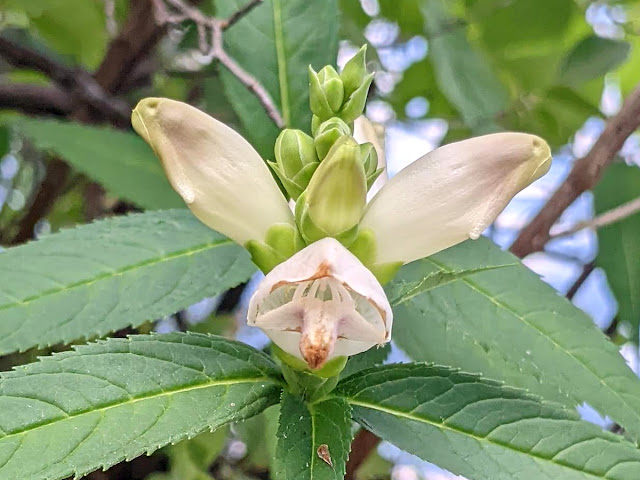
All the good parts of the flower are inside the blossom.

Turtlehead is an excellent filter for water runoff and holds soil well so it prevents erosion - it's an ideal species to plant along the water's edge, by retention pools, wet areas prone to erosion, and on borders of rain gardens.

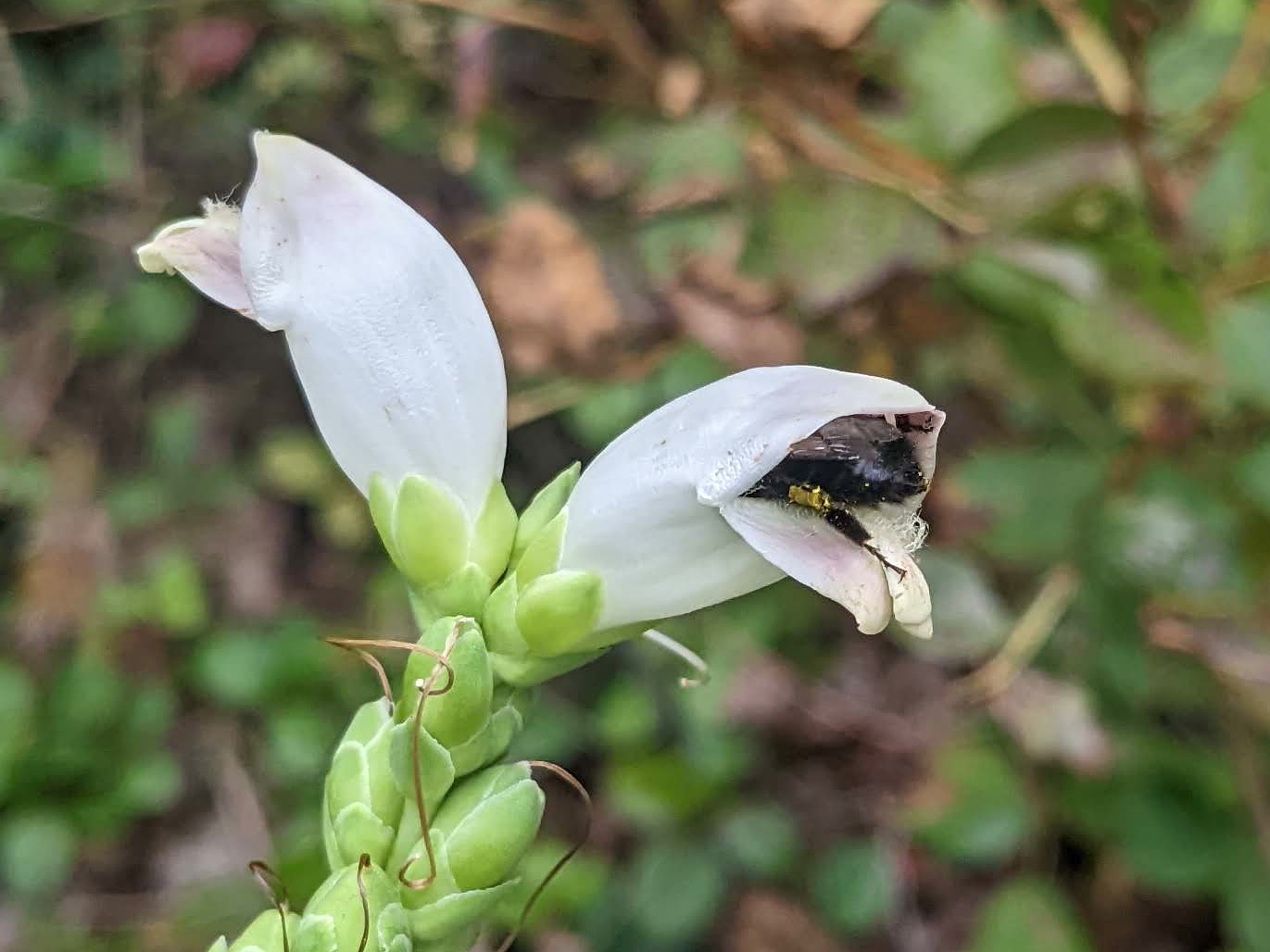
Each turtlehead flower contains both the male and female parts needed to reproduce, but it requires a pollinator to move the pollen between the parts inside the flower.  Similar to the Lady's slipper, the enclosed flower forces insects in search of nectar to climb inside the blossom where it rubs against the various sex parts of the plant, spreading pollen to the required areas to make seeds.  It's a brilliant adaptation, and while looking at some of these plants I witnessed the pollination process in action.  A bumblebee (the most most common pollinator of turtleheads because large, fuzzy bumblebees can survive colder fall temperatures) flew down to sample a flower.

Bumblebee on the approach path.

I watched it land and climb inside the blossom.

In we go.


It completely disappeared in side for perhaps a minute while it was collecting all the pollen it could find before climbing out and buzzing away.

Doing its thing in there.

There'll be more turtleheads next year!  It's a symbiotic relationship:  The bumblebee gets food and the turtlehead gets to propagate its genes.  Life on planet earth is dependent on pollinators in so many ways.

Autumn is also the time for asters, of many varieties and I don't know what they all are called.  Some are very tall, four or five feet in height.

This wild calico aster planted itself by the house and now towers over Linda's day lilies.

I think this one is a calico aster.  Colors range from white to yellow to lavender, sometimes with a reddish hue.  


The pearly everlasting doesn't look like the typical aster, but it's also in the aster family.

Pearly-everlasting (Anaphalis margaritacea)

This plant spreads well and the flowers last for several weeks.

This patch expands its footprint every year.

One of my favorite little flowers that pops up this time of year isn't an aster.  Like the lady's slipper, it's in the orchid family and like so many flowers this one is also pollinated by bees.

Nodding Ladies' Tresses


This is also a great time to enjoy the bright colors of goldenrod though I didn't come across much in my travels this week.  But if you're in a field and see brilliant waves of yellow, look closely at the flowers to see what's pollinating them.  And remember, goldenrod isn't actually a cause of allergies - it's usually the ragweed that often accompanies the goldenrod.  You can read why goldenrod gets an unwarranted reputation in this article from the UNH Extension Service.  

Small unknown beetles collecting pollen from goldenrod.

On a whim I went to see if I could identify these beetles and sure enough, they are well known beetles on goldenrod and are called, appropriately enough, Shiny Flower Beetles.  Something to look into on another day.


Sunday, September 21, 2014

September 21, 2014

Fair warning to those of you who are not enamored with insects - this week I had a double feature.  I saw two insects - a spider and a grub - interacting with each other, although one was doing a lot more interacting than the other.  If you follow this blog, you know that spiders (which are actually arachnids, not insects) are carnivorous predators, so you have probably guessed that the spider had the upper hand in the relationship.  In fact, the spider, a medium sized dock spider, was in the process of consuming the grub.


The grub was still alive, squirming in a futile effort to escape. 

Later the same day a large flock of warblers flew through the area;  they were picking similar larvae off the leaves of trees as they went.  The whole flock was present for only a minute or two, flying on after clearing out the immediate area.

I saw another tiny creature that must have hatched out just recently - a Brown Snake. 
Immature Brown Snake, or DeKay's Snake (storeria dekayi)

Although very small, it was rather quick, but it settled down in my hand to pose for a picture to show the size of it.

This species of snake bears its young live;  this one may have only been a few days old.  I found it creeping in the vicinity of the late-blooming Nodding Ladies' Tresses which I always enjoy finding this time of year.
Nodding Ladies' Tresses


The lake was very quite on Sunday when I went for a kayak;  I saw more ducks than humans, although there were people out on the islands enjoying the warm day before the showers came through.


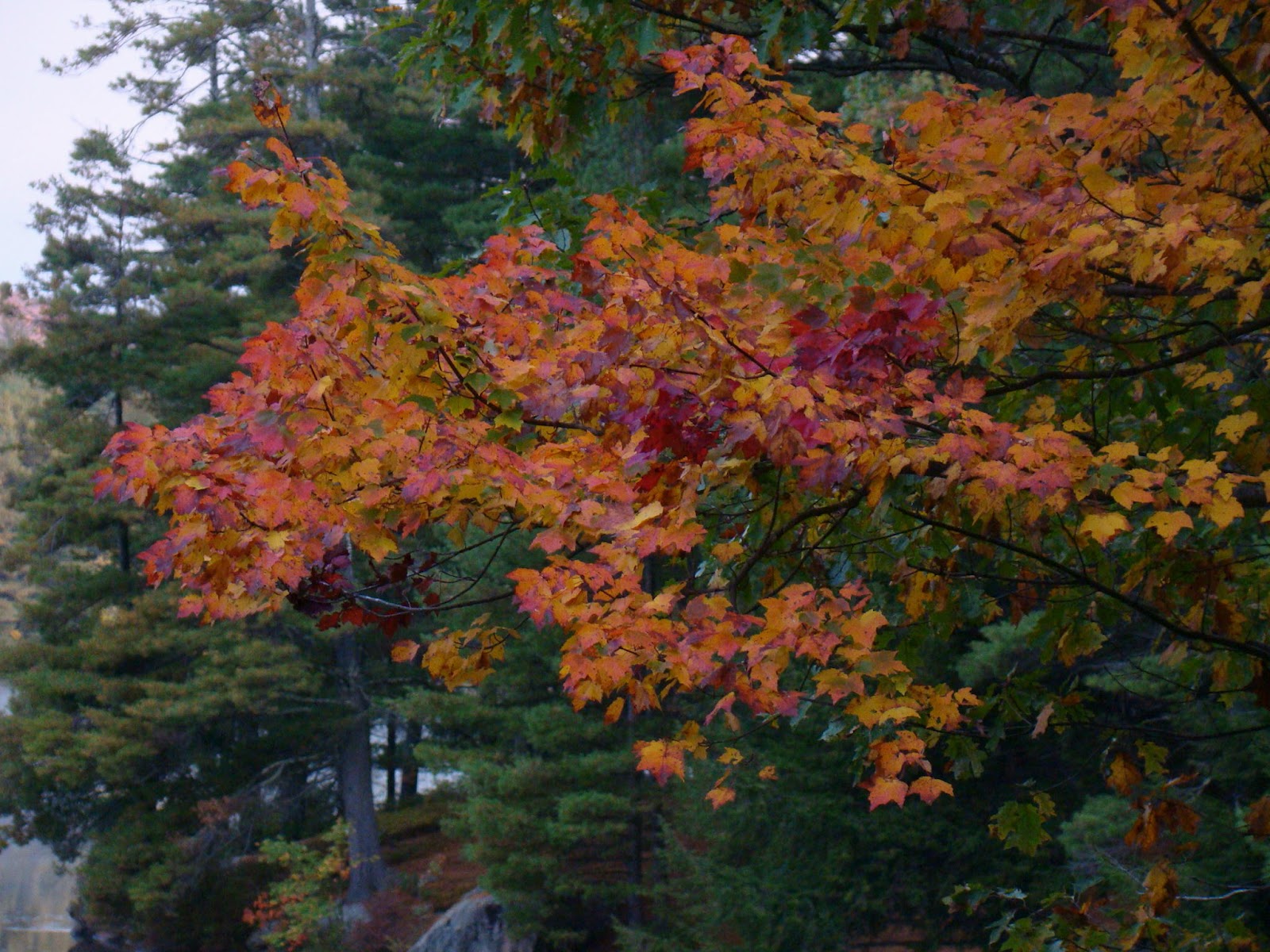
I also more signs of the leaves starting to turn.
Maple Trees in Wicwas Wetlands

And as the sun arcs lower in the sky and sets farther south, the evening light shines its orange colors on different shores around the lake, now painting houses on the north shore a beautiful color at sunset.

The equinox occurs tomorrow (Monday) at 10:29pm.  Welcome fall.

Sunday, August 4, 2013

August 4, 2013

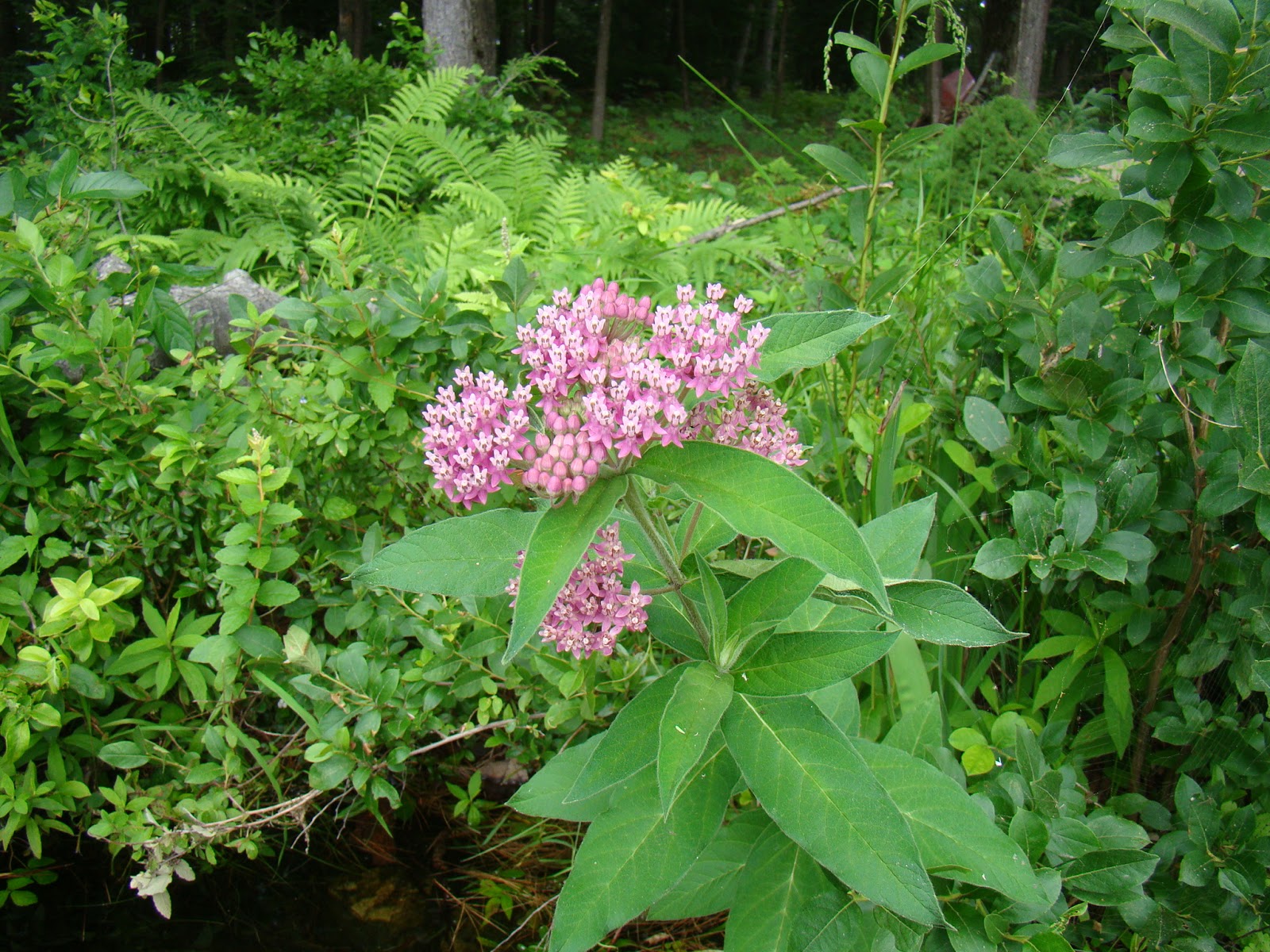
My favorite identifier of unknown (to me that is) plants and animals helped me out with two plant species this week.  The first, the tall pink flower growing on the shoreline, and posted on July 17th, is the Swamp Milkweed.  This flower is a favorite of butterflies, especially the Monarch.
Swamp Milkweed

The other plant she identified is the tiny yellow waterflower I found last week;  this is the flower of the Bladderwort.  There are several species (Common, Floating, Swollen, Horned), and with a little more work I may figure out which one it is.  (Thank you NV!)
Bladderwort

The Bladderwort is a really neat plant, in that it is a carnivore.  The bladders which are under the water are the traps.  They have small appendages located at the opening of the trap which detect tiny aquatic animals that touch the appendages.  The trap then opens and a vacuum sucks its prey into the bladder where it is digested.  Sounds to me like a great storyline for a sci-fi movie!

I did not see any interesting animal activity this week, so I guess this is the time for flowers - I saw the first Nodding Ladies' Tresses blooming today, one of tiniest pretty flowers with a great name.
Nodding Ladies' Tresses
 

But I did watch a Hummingbird drinking nectar from Linda's Flowers.  I clearly need a camera with a faster shutter to take a picture of a hummingbird.
 

Today we took a walk down to the dam to investigate a purple flower we noticed, and wanted to make sure it wasn't purple loosestrife - an invasive species, that although beautiful, can completely take over a wetland.  Fortunately it is not Loostrife, but rather Steeplebush.
Steeplebush

While at the dam (which by the way, shows the lake is still 3-4 inches above full level) I saw a bright red flower blooming along the edge of the stream flow flowing to Lake Winnisquam.  It is a Cardinal Flower - stop sometime on your way by and you'll see it easily, as the bright red color stands out against the green backdrop.
Cardinal Flower

I had the honor to present some of my observations around Lake Wicwas this weekend at the Lake Wicwas Association Annual meeting at the Wicwas Grange.  It was a lot of fun, and I learned a quite a lot from all the dynamic and enthusiastic people who enjoy the lake, including learning about Norm Harris' Flying Squirrel Circus.  That's a story for another day....
Flying Squirrel  (Taken 28 December 2011)


Sunday, October 7, 2012

October 7, 2012

After a beautiful late-summer day on Friday, the weather at Lake Wicwas turned back to fall.  I did not see a lot of activity around the lake, but I did see an Osprey, which surprized me, since I thought they had all started their migration by now.  Perhaps this one was coming down from a summer in Canada.  Dave T. told me about the Squam Science Center's project that is tracking osprey with RF transmitters, and it's fascinating to watch their journey.  They have tracked osprey that had their nest right here in Tilton and spent the summer in the neighboring lakes (but they weren't the birds that were at Lake Wicwas this summer according to their maps).  You can follow their migration here:  Project Osprey.  One of the new chicks (Jill) left Tilton on September 11 and arrived at the Amazon River three days ago - including a 24 hour flight from Cuba to South America - a trip of 3900 miles in 25 days!

Back closer to home, the fall colors are near peak in the Lakes Region, and the weather allowed some good leaf peeping.  We took a nice walk along the Winnipesaukee River Trail from Tilton to Franklin;  the water is flowing rapidly in the river, probably due to a combination of last week's rain fall and lowering the lake level in Winnipesaukee.

But the foliage is better right here - these are some of the sights you'll find right on the shores of Lake Wicwas: 


There are still a few brave fishermen out enjoying their trade in the beautiful surroundings.


The Partridge Berries and Wintergreen are ripening now, trying to attract some of the attention from the trees above, and providing some bright color right at our feet.
Partridge Berry
Wintergreen
Nodding Ladies' Tresses
There is also a lovely fall flower blooming now - a tiny orchid with the name Nodding Ladies' Tresses:


And on a morning walk, the moon was trying its best to draw my attention up above the trees.


It is amazing to think there is NASA equipment that has been up there for over 40 years now.

I did see a pheasant dart out of a thicket, but there's little chance to get a picture of that bird.  Here's one (sort-of) wild creature I did capture.

If you've ever wondered if evergreens lose their needles as the deciduous trees do, there's plenty of evidence in the lake  right now.  These are white pine needles that have been shed.

They are also forming a soft, quiet carpet in the forest at the moment.

Enjoy the autumn splendor while it lasts!