Showing posts with label Partridgeberry. Show all posts

Sunday, March 29, 2020

March 29, 2020: Turkey Trots

March came through for us with one more late winter snow, and as March snows tend to be, it was beautiful.

Morning breaks on the fifth day of spring.


We are now past the spring equinox so the sun is bright and high in the sky which baths the pristine world in a softness that January just can't deliver.

Mountain streams are flowing with snow-melt.

March skiing in the Ossipees

It also means the snow doesn't last long especially when it falls on bare, warmed earth.

Just a few hours of late March sun has already taken its toll on the snow.
Shannon Pond in Moultonborough.

On the still-frozen lakes however, late snow can set back ice-out quite a bit.  Before the snow fell the lakes were getting soft and dark and absorbing much of the sun's energy, but the fresh cover of bright white will reflect the sun's rays for several days and greatly slow the process.  At this point we are probably looking at an average or slightly early ice-out in the Lakes Region.

The nice soft snow also rejuvenated the world of tracking.  In one short wander around Lake Wicwas the day after the snow fell we found the tracks of at least eight different animals, all of which had traveled by in just the prior 36 hours:  deer, fox, turkey, otter, mink, squirrel, mouse, and mole.  The most entertaining of these was a set of tracks left by a flock of turkeys taking a long stroll to enjoy the pretty spring day.

A flock of turkeys passed this way.


A hen (female) and her brood (chicks) will join other families in large flocks in the fall and winter and cover a range of 4 to 5 square miles searching out the best food supplies as the seasons change.  [Ref:  NH Fish and Game]  I always get a reminder of turkey history when I refer to one of the more unique NH wildlife books, Hilbert Siegler's New Hampshire Nature Notes written in 1962;  it is completely silent on turkeys.  That's because there were no turkeys in 1962 after being hunted to extinction in the state (which is called "extirpation").  A first attempt at reintroducing turkeys in 1969 failed, but a second attempt in 1975 was successful, and today there are 40,000 turkeys in NH, the maximum carrying capacity of the state.   There is a nice historical article about the turkey reintroduction in the March/April 2020 issue of the New Hampshire Wildlife Journal.


Right about now the Toms (males) are attracting their harem with impressive gobbling and bold plumage displays - mating will take place in April and nesting in May.  By June we'll be looking for cute little turkey poults running around, eating up tics, ants, and other annoying insects.  Thank a turkey!


But they best keep a careful lookout - the foxes are making regular patrols of the local area, still using the lake for travel.

The fox is still making its daily excursion across the softening lake.


I was a bit surprised to see people out fishing on Lake Wicwas yesterday, even if they were staying close to shore.

The last hurrah of ice fishing.

They told me there's about 6 inches of ice (that's near the boat ramp).  That seems about right as there's still open water only close to shore.

Open water is expanding, but only at the edges.


But every day we make progress - first the snowdrops, and now crocuses.

Perfect New Hampshire juxtaposition:  flowers with a snow shovel.


There is even a little red appearing through the melting snow pack.

An over-wintered partridgeberry, just waiting for a partridge or turkey to gobble it up.

Time may be passing slowly, but each and every day, we move forward.
Snowdrops keeping the faith.

Sunday, June 23, 2013

June 23, 2013

With the summer solstice occurring this week, Lake Wicwas is now into the heat of summer, when the animal activity moves into the cooler times after dark.  One of the best parts of this time of year is getting to sleep with the windows open, letting the nighttime sounds of nature into the house.  Whether it's a coyote or an owl or a tree frog, it's fun to hear what's going on out there all night long.  And what's more satisfying than being awakened in the middle of the night by the call of a loon or the ga-lumping of a bull frog?  

Most of the birds are quiet during the heat of the day, singing only in the early morning or evening;  one exception being the Red Eyed Vireo which will sing all day long throughout the hottest weather.  
On a morning walk I heard a Downy Woodpecker chirping, but as I came nearer it turned its occasional chirping into a non-stop string of scoldings. 
Downy Woodpecker

It kept a close eye on me and never once stopped for even a second - for several minutes. 

Eventually I went on my way, leaving its racket behind me.


The beaver are also mostly nocturnal, not visible much this time of year, but signs of their presence and activity are found during the day.  These hemlock trees have had their bark removed all the way around which will eventually kill the tree. 

Hemlock Trees De-barked by Beaver Over Night

Their teeth marks are visible here

Beaver rarely cut down hemlock, but they remove the bark so it will die, leaving space and light for tree species more to their liking.  It does appear they consume the bark however, as there are no bark remnants around the base of the trees.

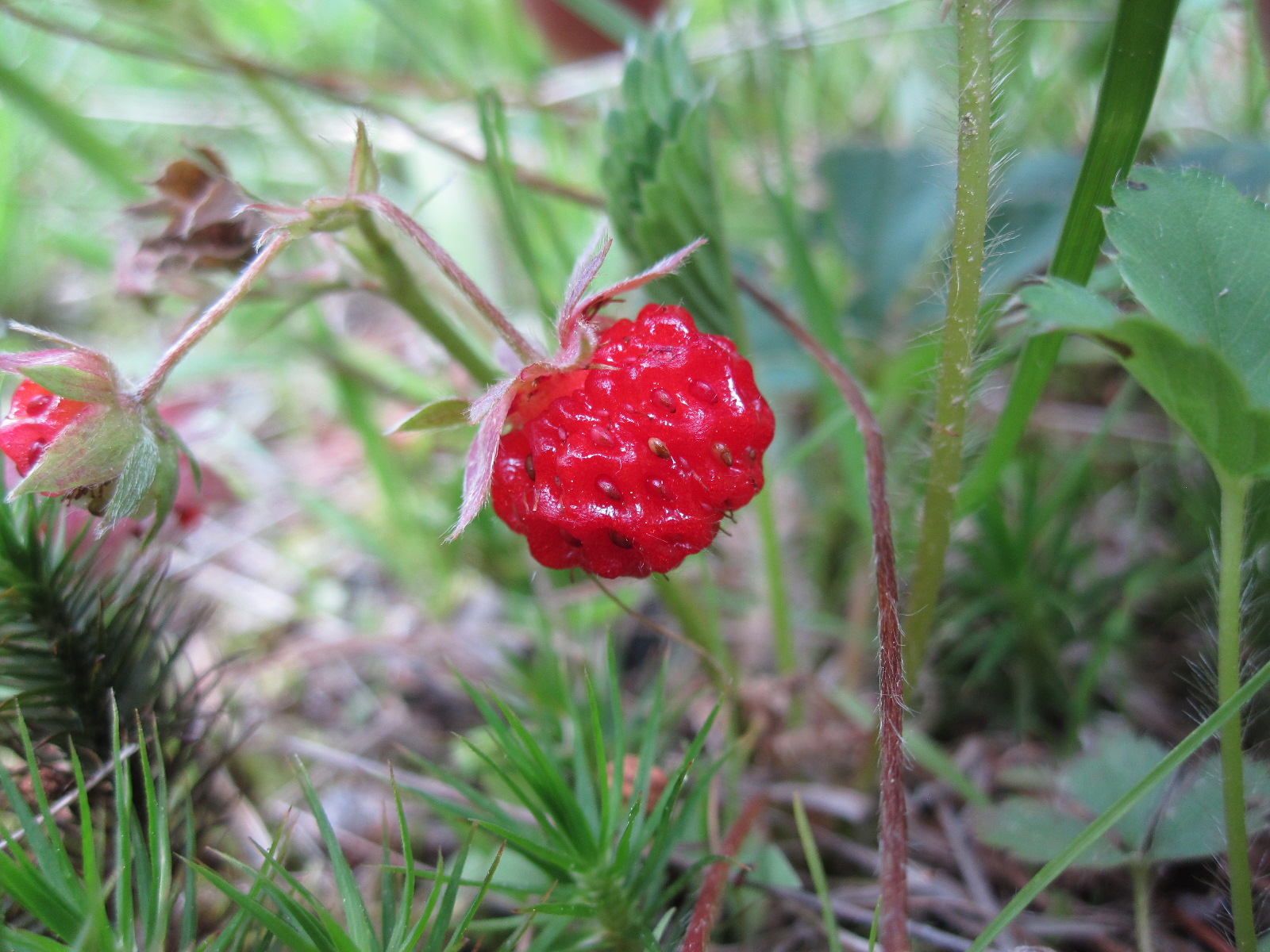
The spring flowers are mostly gone now, having relinquished their reign to summer plants that can handle the heat, such as Daisies and Hawkweek.  The Partridgeberry, which looks quite similar to Arbutus, is blooming, and the Strawberries are fruiting. 
Partridgeberry Blooming
 

Wild Strawberry
 

Sometimes you find visitors enjoying the flowers. 

Last week there were hundreds of tiny grasshoppers springing from the ground as you walked by - they have grown quite a bit in one week.

I did observe one intruiging animal activity this week - a Orb-weaver Spider.  Our dock, like probably every dock on Lake Wicwas, has a nice spider web or two on it.  Swimming one afternoon, I saw a medium-size dragon fly get caught in the web.  Instantly the spider came out from hiding to see what it had caught, and scurried quickly up to its prize. 
Orb-weaver Spider

It went straight to the dragonfly and sunk its jaws into its abdomen to inject a dose of venom. 

Within just a minute or two the dragonfly was dead, or at least paralyzed.  The spider then wasted no time in feasting on its catch, as it started to suck the life juices out of it.  (Which made me realize that a spider must be immune to its own poison.) 

Within a few minutes the dragonfly was noticeably collapsed and reduced in size. 

After its meal, the spider went out and made some quick repairs to its web, and I could see it spreading a new thread radially along its trap. 

It was a small scale version of prey and predator that takes place constantly in nature at every scale.

The heat and rising humidity of the week culminated in some rather strong thunderstorms today, but Wicwas avoiding the worst of the storms that other parts of New Hampshire experienced.  As the storm passed, the sky to the west cleared, leaving eerie colors to a pretty sunset, and announcing the start of summer.


Sunday, October 7, 2012

October 7, 2012

After a beautiful late-summer day on Friday, the weather at Lake Wicwas turned back to fall.  I did not see a lot of activity around the lake, but I did see an Osprey, which surprized me, since I thought they had all started their migration by now.  Perhaps this one was coming down from a summer in Canada.  Dave T. told me about the Squam Science Center's project that is tracking osprey with RF transmitters, and it's fascinating to watch their journey.  They have tracked osprey that had their nest right here in Tilton and spent the summer in the neighboring lakes (but they weren't the birds that were at Lake Wicwas this summer according to their maps).  You can follow their migration here:  Project Osprey.  One of the new chicks (Jill) left Tilton on September 11 and arrived at the Amazon River three days ago - including a 24 hour flight from Cuba to South America - a trip of 3900 miles in 25 days!

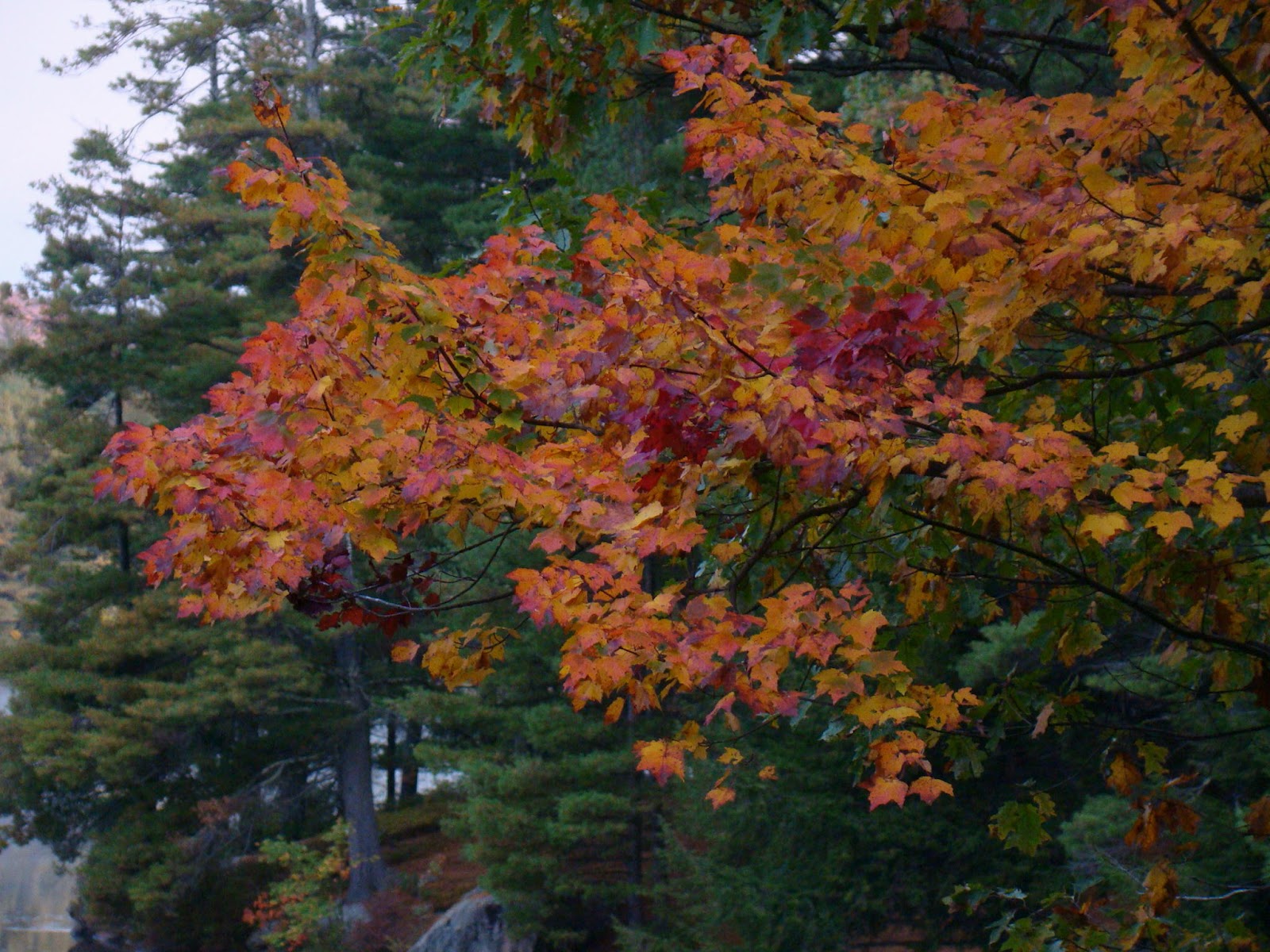
Back closer to home, the fall colors are near peak in the Lakes Region, and the weather allowed some good leaf peeping.  We took a nice walk along the Winnipesaukee River Trail from Tilton to Franklin;  the water is flowing rapidly in the river, probably due to a combination of last week's rain fall and lowering the lake level in Winnipesaukee.

But the foliage is better right here - these are some of the sights you'll find right on the shores of Lake Wicwas: 


There are still a few brave fishermen out enjoying their trade in the beautiful surroundings.


The Partridge Berries and Wintergreen are ripening now, trying to attract some of the attention from the trees above, and providing some bright color right at our feet.
Partridge Berry
Wintergreen
Nodding Ladies' Tresses
There is also a lovely fall flower blooming now - a tiny orchid with the name Nodding Ladies' Tresses:


And on a morning walk, the moon was trying its best to draw my attention up above the trees.


It is amazing to think there is NASA equipment that has been up there for over 40 years now.

I did see a pheasant dart out of a thicket, but there's little chance to get a picture of that bird.  Here's one (sort-of) wild creature I did capture.

If you've ever wondered if evergreens lose their needles as the deciduous trees do, there's plenty of evidence in the lake  right now.  These are white pine needles that have been shed.

They are also forming a soft, quiet carpet in the forest at the moment.

Enjoy the autumn splendor while it lasts!


Sunday, June 24, 2012

June 24, 2012

Lake Wicwas has certainly been treated to some great weekend weather lately.  Even this past Saturday, when thunder could be heard rumbling close by with storms all around us, we received only a few raindrops, not even enough to get the roads wet.  Taking a bike ride south along lake Winnisquam in the evening it was evident that just a couple of miles away they had much more precipitation. 

My simple curiosity this week was with the water bugs which have hatched out in massive quantity and form giant black swarms on the surface of the water.  From well over a hundred feet away I could see thousands insects no more than quarter of an inch across dancing in formation on the water.  Their behavior is much like schools of fish or flocks of birds that swim or fly in ever changing shapes, something known as swarm behavior.  They would group tightly together, then something would cause them to spread out getting so thin that the swarm almost dissapeared, only to reform again in tens of seconds.  It's also rather fun to swim into their swarm;  as you approach they start hopping up off the water about six inches like miniature pogo sticks.
Waterbugs Swarming


Another insect hatching now is the Mayfly, an insect that clearly hasn't learned how to read a calendar.

Mayflower

A late blooming wildflower is decorating the forest floor - the partridgeberry.  I don't have any good guesses as to why this flower blooms so much later than all the other small, forest ground plants.
Partridge Berry
Several more cormorants have made the lake their home, perching on dead branches of favorite pine trees on a couple of islands.  They are pretty cool looking birds, with webbed feet that can hold onto branches, even if they are rather messy.
Cormorant

The loons have been busy trying to nest, but with the changing water levels, it is not apparent they have been successful, and it's getting late for another attempt.
Common Loon

They are a beautiful bird. 

Another beautiful, and rarer bird visited Lake Wicwas this weekend:  a Bald Eagle!  We saw it Friday afternoon, circling rather high over the south part of the lake.  It flew in from the north, made quite a few large circles over the lake, moving slowly southward until it went over the hill towards Lake Winnisquam.  A fabulous sight to see.

The heavens also added some beauty this weekend, with a nice sunset followed by a bright crescent moon.


The fireflies have also emerged.  After watching the moon pass in out of the clouds, I walked to a field on that dark, warm, humid night, and was treated to a fabulous light show of hundreds of twinkling lights dancing all around me.