Showing posts with label Bladderwort. Show all posts

Sunday, July 7, 2024

July 7, 2024: Great Spangled Fritillary

In celebration of the Star Spangled Banner, a Great Spangled Fritillary came to visit us on July 4th.

Great Spangled Frittilary

This pretty butterfly is common across much of North America and I see them occasionally around the lakes and mountains.  

The inside of its wings have brighter coloring than the outside.

The adults feed on a wide range of flowers throughout the summer and this one enjoyed both the nectar in the Black-eyed Susans as well as the camouflage the orange blossoms provided for it.

It would hard to see if I didn't know it was there.

Probing with its proboscis into the center of the blossom.

After mating in July the female will lay her eggs in late August or September.  The eggs will hatch but the larvae will burrow into the leaf litter on the ground where they will spend the winter.  (The fritillary is one of many butterflies and other beneficial insects that depend upon lawns and gardens not being raked in the fall so there will be more Fritillaries next summer.)  Unlike the adults, the caterpillars are very picky eaters:  they eat only violets; the adult always places her eggs on one of the violet species.  


It was another sad week for our loons as now the south nest in Harris Cove has been predated.  It was noted on Wednesday when Debby saw both loons out in the lake and was able to see the abandoned nest from shore. I checked in with Jayden our LPC biologist who asked me to go take a close look to confirm. I found an unoccupied nest full of mussel shells.  

The southern nest after predation.

I searched for eggs and shell fragments on the island and in the water but found nothing.  Jayden guessed it was predated by a raccoon, otter, or mink.  It's late for another attempt at nesting but not impossible.  We'll see.  As of now the north nest is still hanging in there. 


There was enough curiosity about one of the weeds I saw last week that I went out to get more data on it, and it had matured and grown enough in one week that with the assistance of our local weed expert we were able to definitely identify it as bladderwort.  I've found three types of bladderwort in Lake Wicwas; the one in question from last week's weed survey is the Greater, or Common Bladderwort.  
Greater Bladderwort (Utricularia vulgaris)  The black objects are the bladders.


Those black bladders are its distinctive characteristics, though its size is significant too - it can grow up to three feet long over the summer and sometimes forms large mats that can be confused with invasive milfoil.  On new growth at the tips the bladders are almost clear, turning pink then red as they age, and finally the dark black color.  This is all a single plant:
Pink bladders on the tips are new growth, while the black bladders on the right are older.


The second bladderwort I found is the floating bladderwort, much smaller and more delicate than the common bladderwort - also prettier:
Floating Bladderwort  (Utricularia radiata)

Like the common, this one is free-floating - no roots to tie it to the lake bed.  I lifted one up to see the floatation parts.
These upper leaves are inflated to provide floatation.

Lifting it completely out of the water revealed the full size of the plant.
This Floating Bladderwort is about 18" long.

The third bladderwort I've seen in Wicwas is the Purple Bladderwort which flowers later in the summer.  All three of them are carnivorous, using their bladders to suck in and digest small insect larvae.  I wrote about bladderwort's carnivorous ways (no Cheeseburgers in Paradise for them) in July 2020.

An added bonus for my encore weed tour was that the Watershield was blooming.
A Watershield (Brasenia schreberi) blossom.

There were no butterflies on the aquatic flowers, but plenty of other pollinators were doing their thing.
Small flies pollinate a Yellow Pond Lily.

We'll see what the second weed-watch tour discovers in a couple of months, and meanwhile hope our remaining nest can survive the next two weeks.


Sunday, September 6, 2015

September 6, 2015

Last week I commented on the large mats of Bladderwort in the lake.  It's not just Lake Wicwas, but many lakes are experiencing this phenomenon this summer.  Marge Thrope sent me an article on the subject written by Amy Smagula, NHDES Exotic Species Program Coordinator, in the Volunteer Lake Assessment Program newsletter (click here to read it).  Amy says aquatic plants have boom and bust years just like terrestrial plants, and 2015 is the bladderwort's time for glory. 

The autumn harvest and gathering has commenced in the Lakes Region;  an audible indicator is the annual pine cone drop which is now taking place in the pine groves around Lake Wicwas.  It's not the trees themselves dropping their cones, but rather these little rascals cutting them off the branches so they fall to the ground where they gather them up to store away for a cold winter day.


The originator of the term "squirreling away"
You hear it far off on a quiet morning, the cones bouncing off all the dead branches on its way from tree-top to forest floor.
The White Pine - Nature's pinball machine

It sounds like an old-time pinball machine where each branch rings up another 1000 points on the scoreboard.

This will be the source of those piles of pine cone shells that will appear on the snow this winter.
Midden Pile under a favorite lunch branch

(Sorry to use the "W" word - and to show snow.)

On August 16th this year I noted some of the berries around the area, including the Hobblebush viburnmum with its bright red fruit.  Now, three weeks later, those berries are turning black.


I find it interesting there aren't any berries that are part black and part red - it seems each berry changes color almost at once - maybe overnight?


I also showed evidence of bears eating berries of some sort, and this week I found signs of fox doing the same.

The berries in this scat look suspiciously like those viburnum berries, but that's just a guess.  You may have also noticed that this fox left its calling card right next to an antlion dwelling - that little cone in the sand where the antlion excavated its trap to catch unsuspecting ants - just like Sarlaac, the giant antlion in the Star Wars movie "Return of the Jedi".)

One more fruit bearing plant that is ripening at this time:  the Indian Cucumber.  The root of this plant is edible, but the berry is not.
At least not to humans -  I don't about animals.  If squirrels eat them, you can be sure this guy will be watching to make sure you don't steal its food if you lean down to take a look at it.


Sunday, August 30, 2015

Weed Watching

I took my late summer weed-watch tour of my section of Lake Wicwas this week.  The mission is to look for non-native plants that might have invaded the lake, but scrutinizing the water and shoreline with a keen focus also rewards me with interesting sights I usually pass right by.  One item that immediately caught my eye was this large mat of weeds - there were actually several such growths, some of them over ten feet across.


It looked like a familiar native species, but being rather large I sent pictures to our local expert, Marge Thorpe, who took a trip out to inspect it and confirmed it as native bladderwort.  (Thank you Marge!)
Bladderwort

I didn't see any other plants of concern, always a relief.  Hopefully my fellow weedwatchers will have the same results on their sections of lake.  Of course, the credit for this goes to all the users of the lake who are careful to remove any plants from their boats as they travel from lake to lake - as well as to all the great volunteers who conduct the critical Lake Host program on Wicwas and many other bodies of water throughout New England.

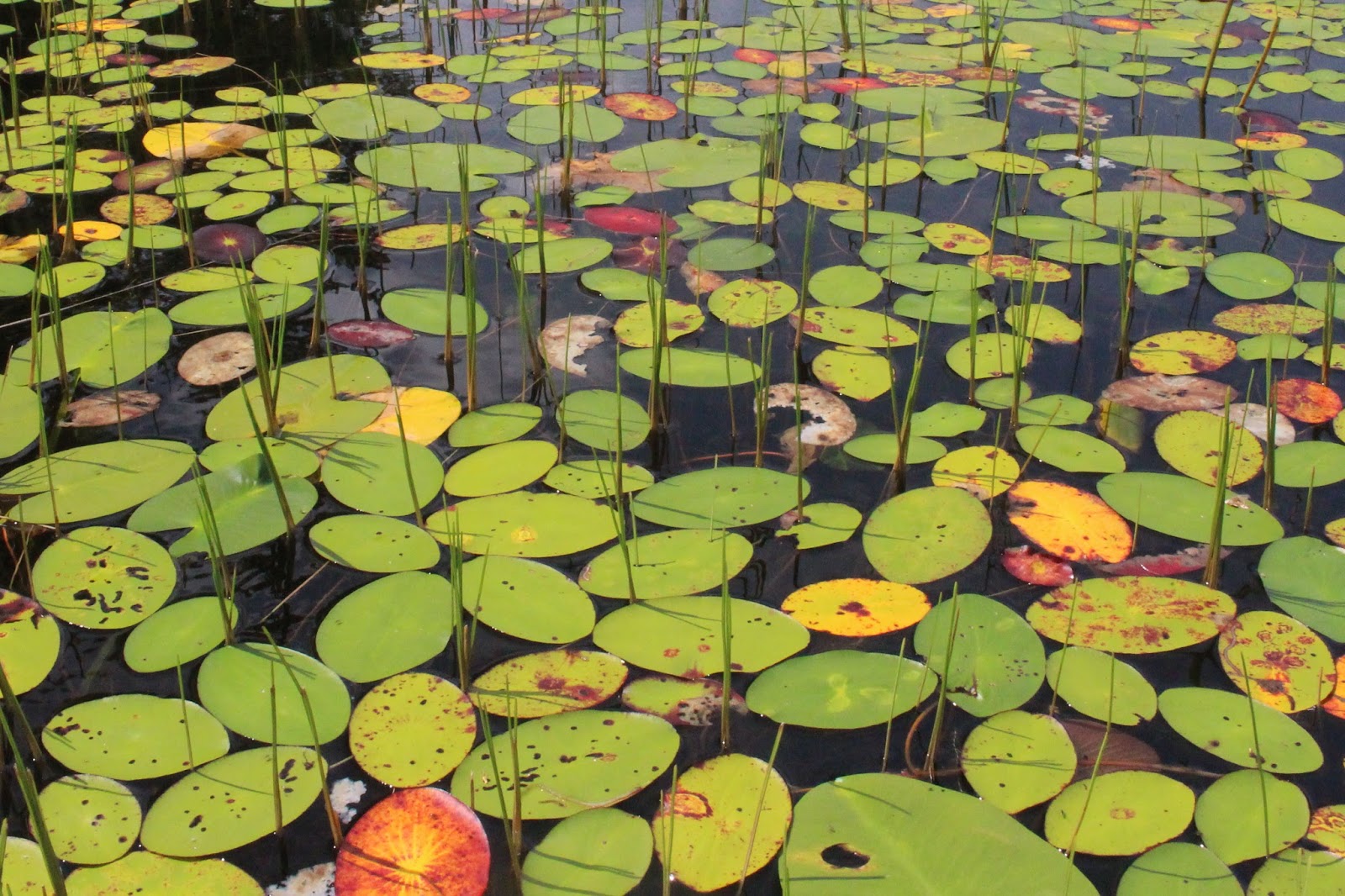
The variety of water plants within this one lake is really quite diverse.  There are many sizes and shapes of lily pads with wide, flat leaves that in some areas completely cover the surface of the lake, yet even when they blanket the water, other plants have evolved with the opposite form so they can protrude right up through them, tall and needle-like.

I saw only a few of a similar tall, skinny plant, this one with tiny white flowers on the top of each stalk.

Many of the arrowheads (pickerelweed) around the lake have had their leaves chewed off by the geese, leaving more narrow stalks sticking up out of the water.

Then there are the grasses, some of which grow tall and lie flat upon the surface.

Sorry I don't know the names of most of these - perhaps a project for a cold winter day....

In addition to providing a source of food, all these aquatic plants perform important functions in the life of the lake, including filtering water and providing cover for myriad small animals.  They can also help to crowd out invasive species that might otherwise try to take hold in a barren section of a lake.

The search also brought me to notice some terrestrial plants that grow right on the water's edge.  The Turtlehead for one:
Turtelhead (Chelone)

I liked the way one single plant found a place to settle down among the rocks on the shoreline.

Finally, peering into the water brought me to this pair of water bugs, identified by a fellow lake watcher and biologist (thanks Dave!) as "Whirligig Beatles" (Gyrinus natator).  They chased each other around madly in circles,

every now and then stopping for just a second to cozy up,

and then resuming the chase again.

Kind of reminds me of being a teenager.  Maybe he should search the lake and bring her a pretty flower.


Sunday, August 4, 2013

August 4, 2013

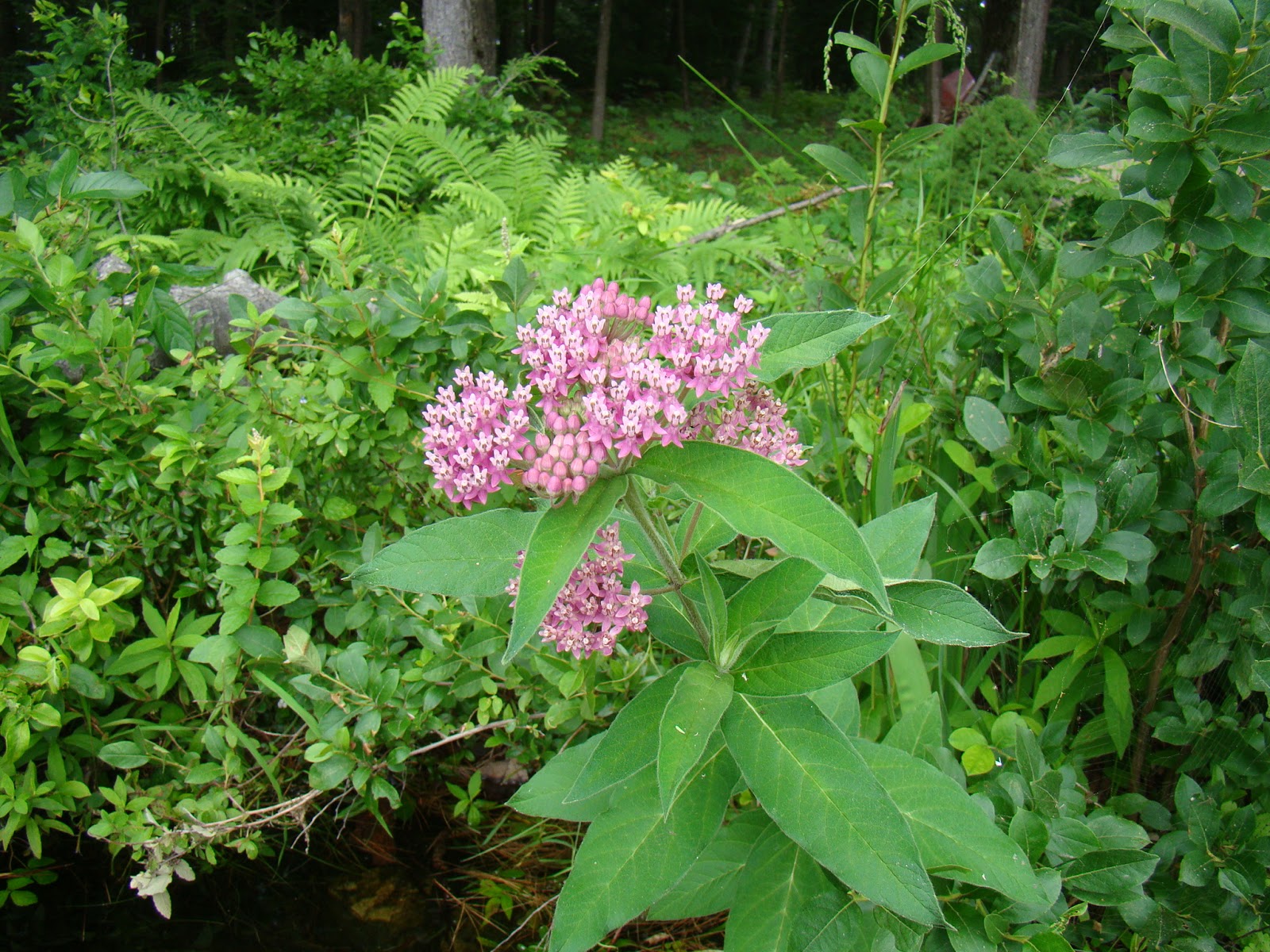
My favorite identifier of unknown (to me that is) plants and animals helped me out with two plant species this week.  The first, the tall pink flower growing on the shoreline, and posted on July 17th, is the Swamp Milkweed.  This flower is a favorite of butterflies, especially the Monarch.
Swamp Milkweed

The other plant she identified is the tiny yellow waterflower I found last week;  this is the flower of the Bladderwort.  There are several species (Common, Floating, Swollen, Horned), and with a little more work I may figure out which one it is.  (Thank you NV!)
Bladderwort

The Bladderwort is a really neat plant, in that it is a carnivore.  The bladders which are under the water are the traps.  They have small appendages located at the opening of the trap which detect tiny aquatic animals that touch the appendages.  The trap then opens and a vacuum sucks its prey into the bladder where it is digested.  Sounds to me like a great storyline for a sci-fi movie!

I did not see any interesting animal activity this week, so I guess this is the time for flowers - I saw the first Nodding Ladies' Tresses blooming today, one of tiniest pretty flowers with a great name.
Nodding Ladies' Tresses
 

But I did watch a Hummingbird drinking nectar from Linda's Flowers.  I clearly need a camera with a faster shutter to take a picture of a hummingbird.
 

Today we took a walk down to the dam to investigate a purple flower we noticed, and wanted to make sure it wasn't purple loosestrife - an invasive species, that although beautiful, can completely take over a wetland.  Fortunately it is not Loostrife, but rather Steeplebush.
Steeplebush

While at the dam (which by the way, shows the lake is still 3-4 inches above full level) I saw a bright red flower blooming along the edge of the stream flow flowing to Lake Winnisquam.  It is a Cardinal Flower - stop sometime on your way by and you'll see it easily, as the bright red color stands out against the green backdrop.
Cardinal Flower

I had the honor to present some of my observations around Lake Wicwas this weekend at the Lake Wicwas Association Annual meeting at the Wicwas Grange.  It was a lot of fun, and I learned a quite a lot from all the dynamic and enthusiastic people who enjoy the lake, including learning about Norm Harris' Flying Squirrel Circus.  That's a story for another day....
Flying Squirrel  (Taken 28 December 2011)