Showing posts with label Swamp Milkweed. Show all posts

Sunday, July 14, 2024

July 14, 2024: A Week of Extremes

It was a week of extremes on lake Wicwas, from great beauty to true tragedy.  We'll start with the beauty from a paddle in one morning as the lake was just waking up.  Dragonflies and damselflies start their days drying off the prior night's dew along the reeds and ferns near shore before starting their hunting excursions for the day. 

Pondhawk


There were quite a few young damselflies that apparently had just hatched out from their larval stage.  

This is a spreadwing damselfly, perhaps an Emerald Spreadwing.

I found their exoskeletons on reeds where they had metamorphized into their flying forms.  

Exoskeletons left on the reed where they climbed up out of the lake.


I also saw that blueberry season has begun. 
They're still mostly green but some have turned a powdery-blue.

The first fruit was just starting to ripen but later in the week I was able to find enough for our first batch of Lake Wicwas summer blueberry treats.  They'll probably hit their peak this coming week so if you're around now is the time to take advantage of this opportunity to taste summer in New Hampshire.


On the gloomy end of the enjoyment spectrum is more sad news for the loons.  Jayden from the Loon Preservation Committee came out on Wednesday for a routine check on our loon nests, and as we approached the north nest everything seemed fine with the male loon at his sentry post, but as we got near the nest we saw a terrible sight.  The female loon was dead on the ground about four feet from the nest. 
The female loon with the nest in the foreground.


Not expecting this event we had to return to shore to get proper protective gear to bag the loon to bring it to the Loon Center for study and hopefully determine the cause of death.  This gets a little grisly now, so you may want to skip over the next two pictures.  There were no visible injuries on the bird such as a spear hole through the sternum which would indicate attack from another loon.  

A scavenger or two had found the carcass but most of the bird was intact.


Possible causes of death include a fight with another loon, perhaps a female trying to evict this female from its mated pair so it could take its place.  (This is in fact what this female did in 2021 when she killed or drove off the prior banded female - she hasn't been seen since.)  Another possibility is of course lead poisoning.  Either of these could have weakened the loon causing it to return to its nesting site where it expired.  There's also a possibility of attack by a predator but it seems unlikely since the bird was not taken away or consumed.  We know it took place at most 48 hours earlier, because two days prior the female was sitting happily on her nest. 
July 8th, 2024


The Loon Center is very busy right now so a necropsy (an animal autopsy) will probably not happen until this fall but hopefully blood tests and examination of injuries and will give us some indication as to what happened.   If we get a report later in the year I'll be sure to pass on what was discerned.  Both of the destroyed eggs were outside of the nest and were collected for study as well.  Before and after this event there has been a lot of loon trauma on the lake, perhaps all caused by a rogue loon that's been here much of the summer.  It's been dubbed "Bad Loon" by someone who's seen it even harassing the ducks!
"Bad Loon"     Photo by Amy Wilson.


We also went to the site of the southern pair where Jaden was able to find some shell fragments from that nest which were also collected to be analyzed.  It's unlikely the southern pair will nest again, but the pair is still staying close together in their nesting territory so it could happen.  At any rate it's been a very difficult year for the Wicwas loons and it may be the first year since 2017 without at least one chick fledged.  It's a painful year to be a loon watcher on Wicwas.


The ducks have done much better.  I've seen a couple families of little ducklings zipping rapidly into the weeds when they hear my kayak approaching, and this week I must have caught them off guard when I rounded a corner because once we saw each other, Mrs. Wood Duck put on quite a show scooting and splashing dramatically along the surface to draw my attention in the opposite direction from where she had sent her little ducklings down around the corner. 

Once she was far enough away she went airborne and circled up and around to make sure she was seen.  But looking back at the ducklings I saw what I'm pretty sure was another adult hen herding the ducklings along.

Mrs. Woodie #2 herding four visible ducklings plus an unknown number around the bend.

I know some waterfowl as well as some land birds (turkeys for example) will merge their broods together and I wonder if that's what happened with these two merganser females. 


OK, we'll end the week back at the beautiful end of the spectrum with some summer flowers blooming right now.
Shinleaf

Swamp Milkweed

Steeplebush

Pickerel Weed
Page Pond
Swamp Rose.  (Those last two pictures were taken at the Page Pond Town Forest on Meredith Neck.)

Bring a pair of binoculars on your travels around the lake to enjoy these heart-warming summer sights.


Sunday, August 20, 2023

August 20, 2023: Little Red Eft

I sure have seen a lot of these little guys lately with all the rain we've had - it brings them onto the trails in droves.  One day mountain biking there were so many that they were the biggest obstacle to avoid on the trails.
Eastern Newt (Notophthalmus viridescens), Red Eft phase

The red eft is the intermediate stage of the Eastern Newt.  These amphibians start their life in the water as green-colored aquatic larvae with gills, then move onto land after a few months when they become this red eft form.  During this time they can travel "great distances" [Ref:  Smithsonian National Zoo] moving to a different water body in the process.  They live in this form for two or three years before a metamorphosis back to an aquatic animal, and their return to water as adults.  They mate in early spring with a single female depositing between 200 and 400 eggs onto various aquatic plants.  According to the above reference however, some populations remain in the red eft stage permanently and only return to water long enough to breed.  The life span of these small amphibians is 12 to 15 years, their long life perhaps helped by their production of a toxin that discourages predation by other animals.


Mid August is a good time to look for caterpillars.
Hickory Tussock Moth Caterpillar (Lophocampa caryae)

This Hickory Tussock Moth caterpillar was on the ground looking for a safe place to spin its cocoon, and nowhere near a hickory tree.  But oak is also a favorite food for these caterpillars and there are plenty of those around.  It's best not to touch any of the various types of tussock moth caterpillars, especially the hickory species as it can cause a severe allergic reaction if its sharp hairs pierce your skin.  

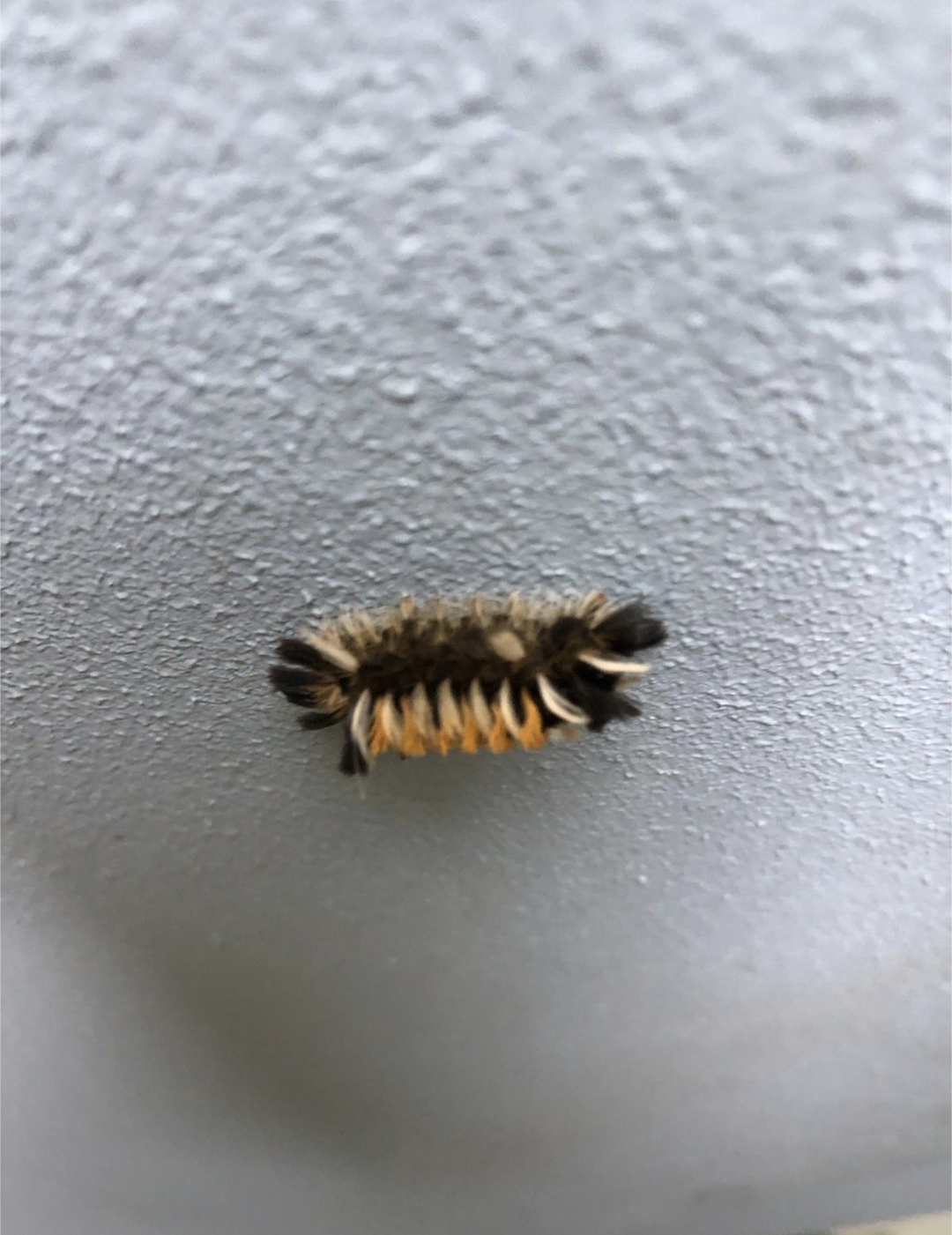
It's also a good time to look for caterpillars on milkweed plants, and not just for monarch butterfly caterpillars.  I found this small army of Milkweed Tussock Moth caterpillars on the underside of a milkweed leaf on the shoulder of Chemung Road.
Another tussock moth caterpillar, the Milkweed Tussock Moth (Euchaetes egle)

The whole tussock moth caterpillar started when a friend (thanks Tutu!) found this guy on a run down in New Jersey!


There are just a few milkweed plants around the lake as they grow mostly in fields that aren't mowed during the summer.  Around the lake we have mostly Swamp Milkweed.
Swamp Milkweed (Asclepias incarnata) on the shore of one of the Rawson Wood Islands.


I mentioned a couple of weeks ago the good pinecone crop this year.  They are really visible now in the tops of the trees, and the squirrels have begun to chew them off the trees to collect them before they release their seeds so they can store them away for winter.

I've also seen beech nuts underneath large beech trees, so the beech are starting to produce mast also.
Beechnuts on a trail in a hardwood forest.

The beechnuts are quite small this year, about half the size of what I expect to see.


There is a new development with the loons this week:  One of the chicks is starting show its independence.  Previously the two have always been close together, but now one of them is moving away from the family, starting to head out on its own.  
They sure have grown in two short months.
I can't tell them apart anymore.

There are still other loons visiting the lake, having daily interactions with the family.  One morning we watched two loons frantically wing-rowing back and forth and around the lake for long time, probably the chicks' father defending their territory.  When the chasing loon got close to the pursued, the later would thrust its head and one wing into the water making an abrupt stop and turn to throw off its pursuer - just like Starsky and Hutch's J-turn with the parking brake in their '76 Ford Gran Torino.  I wish I had some video of the chase for you.

I don't know how much stress eagles add to the loons' lives right now, but they are here, as this fabulous picture taken by Debby Crowley shows.
A bald eagle watches over all activity on Lake Wicwas.


I'll end today with a non-nature picture, but it's a really neat sight.  There are a lot of pretty boats on New Hampshire's lakes, but few as beautiful as this classic.
"N. H. Dreamin' " cruises the waters of Lake Wicwas.

Keep watching for those fuzzy caterpillars!

Sunday, July 12, 2020

July 12, 2020: Hot Summer Evenings

We are into the heat of summer now.  Even before tropical storm Fay arrived yesterday we were experiencing southern humidity levels with dew points into the low 70s.  But the heavy air gave us - in between thunderstorms - a lot of very still and quiet hours, perfect for a peaceful paddle around the lake.  One evening I did a weed-watch tour, and following the shoreline studying aquatic plants was also fruitful in finding plants that are blooming in or near the lake.  One delicate bloom that always pops up in the first week of July is the rose pagonia.  

Rose Pagonia (Pogonia ophioglossoides)

This tiny, delicate member of the orchid family grows in wet habitats and can be found in many protected marshes, fens, and bogs in the Lakes Region.  In Lake Wicwas, look for them in any of the shallow shorelines that are protected from wind and waves; they are often growing among the grasses so the flowers may not be visible until you are quite close.


Another, much larger flower but with almost the same coloring is the Swamp milkweed.
Swamp Milkweed (Asclepias incarnata)

This particular plant was growing quite far out from shore on its own tiny hummock island.  


Being a milkweed it's not surprising that it has a milky substance in its stalks and is frequented by butterflies.  The monarch in particular likes to lay its eggs on this and other milkweeds.  Here's something interesting about it:  according to the Ladybird Johnson Wildflower Center, "The genus [asclepius] was named in honor of Aesculapius, Greek god of medicine, undoubtedly because some species have long been used to treat a variety of ailments."  [Ref:  Ladybird Johnson Wildflower Center]

As a bonus, I discovered a new flower on this weed-watch tour, Swamp Candles:
Swamp Candles (Lysimachia terrestris)

I first thought this was whorled loosestrife because it has similar flowers, but they grow out of the stalk in a different way so I looked it up, and found that I was close, as it is in the loosestrife family.  Whereas whorled loosefstrife grows on dry ground, swamp candles grow in, well, swamps.

Almost everywhere along the shoreline you will find pickerel weed blooming.
Pickerel Weed (Pontederia cordata)

But don't be surprised if all the arrow-head shaped leaves have been plucked off - the geese love to eat them.

You might find some birds out on calm evenings too, such as this family of ducks, all in a row.


Or this family dabbling for dinner.

The ducklings are so big now you can hardly tell them from their mother.

And here's one more thing you don't see often in the Lakes Region:  A fresh water shark.

Just kidding - it's got to be a fish, but I don't know which one.  This guy spent a fair amount of time just cruising along the surface, probably finding insects to gulp down.  There's always something new to see on the lake, even in the hazy heat of summer.

And yes, Harold and Betty are doing fine; growing, apparently getting along with each other, and travelling much farther from their nesting site.  So far so good.
This morning at 6:40am.
That bulge on the parents head means it's concerned, so I moved on quickly.

Sunday, August 5, 2018

August 5, 2018: Not quite 1000 feet.

Have you ever come across one of these pre-historic looking creatures?
Millipede (Spirobolus species)
This a millipede, and no, it doesn't have 1000 feet even though that's what "milli" stands for.  There are thousands of species of millipede around the world and even the most-footed species only has 750 legs.  Our local variety is made up of 50 individual segments, each of which has two pairs of legs (200 legs in total), which is why it is in a scientific class called Diplopoda.
That's a lot of legs
According to Wikipedia Millipedes were among the very first animals to walk on the land, with fossils traced back 420 millions years to the Silurian period, and in those days they would be a little more intimidating:  they grew to be over 6 feet long.
How would you like to meet this at the business end of six-foot long arthropod?
This guy's only about 5" long
Millipedes are great recyclers, improving soil quality as they consume dead leaves and other decaying plant matter.  In some regions millipedes may consume nearly all the leaf litter in the area.  These guys must have played a big role in creating the soil that lies on top of all the granite in New Hampshire.  They prefer wet or damp areas, as they need moisture to survive - compost piles are a favorite residence.

I found three of these big arthropods within a few feet of each other, making me think they had just hatched, but then I read that they hatch from eggs with only six or seven segments.  As they grow, they molt, adding more segments with each molt, so these big guys with 50 segments are mature.  At any rate, they are harmless to humans and great for the environment, so thank them when you see them in your yard and garden.

Back a couple of weeks ago I mentioned some arachnids that hide on flowers, blending in with the plant as they wait for their prey.  Last week I found some cool insects that have no intention of hiding on their flowers.
Great Black Wasps (Sphex pensylvanicus)
These Great Black Wasps contrasted beautifully against the bright pink Swamp Milkweed.


Little Sam, who isn't quite so little anymore, continues to thrive on a diet of ever-larger fish provided by it parents.
Sam continues to grow rapidly.
Here comes dinner.

We are still seeing Sam with only one parent, but we don't know if it's always the same parent.  When they were taking their daily bath together I did get a good look at both of the parent's legs and neither had a band on it, so I do know the male is tending to Sam at least part of the time.
A good look at an un-banded leg.
Of course, Sam had to show off too.
If I ever get a glimpse of a band I'll know that's the female.  (If anyone has seen any bands, please let me know; the female's left leg has a green band and a red/white stripe band, her right leg has a white band  and a silver band).

Sam may be growing, but he still has a long way to go before he's flying anywhere with those stubby little wings!