Showing posts with label Steeplebush. Show all posts

Sunday, July 14, 2024

July 14, 2024: A Week of Extremes

It was a week of extremes on lake Wicwas, from great beauty to true tragedy.  We'll start with the beauty from a paddle in one morning as the lake was just waking up.  Dragonflies and damselflies start their days drying off the prior night's dew along the reeds and ferns near shore before starting their hunting excursions for the day. 

Pondhawk


There were quite a few young damselflies that apparently had just hatched out from their larval stage.  

This is a spreadwing damselfly, perhaps an Emerald Spreadwing.

I found their exoskeletons on reeds where they had metamorphized into their flying forms.  

Exoskeletons left on the reed where they climbed up out of the lake.


I also saw that blueberry season has begun. 
They're still mostly green but some have turned a powdery-blue.

The first fruit was just starting to ripen but later in the week I was able to find enough for our first batch of Lake Wicwas summer blueberry treats.  They'll probably hit their peak this coming week so if you're around now is the time to take advantage of this opportunity to taste summer in New Hampshire.


On the gloomy end of the enjoyment spectrum is more sad news for the loons.  Jayden from the Loon Preservation Committee came out on Wednesday for a routine check on our loon nests, and as we approached the north nest everything seemed fine with the male loon at his sentry post, but as we got near the nest we saw a terrible sight.  The female loon was dead on the ground about four feet from the nest. 
The female loon with the nest in the foreground.


Not expecting this event we had to return to shore to get proper protective gear to bag the loon to bring it to the Loon Center for study and hopefully determine the cause of death.  This gets a little grisly now, so you may want to skip over the next two pictures.  There were no visible injuries on the bird such as a spear hole through the sternum which would indicate attack from another loon.  

A scavenger or two had found the carcass but most of the bird was intact.


Possible causes of death include a fight with another loon, perhaps a female trying to evict this female from its mated pair so it could take its place.  (This is in fact what this female did in 2021 when she killed or drove off the prior banded female - she hasn't been seen since.)  Another possibility is of course lead poisoning.  Either of these could have weakened the loon causing it to return to its nesting site where it expired.  There's also a possibility of attack by a predator but it seems unlikely since the bird was not taken away or consumed.  We know it took place at most 48 hours earlier, because two days prior the female was sitting happily on her nest. 
July 8th, 2024


The Loon Center is very busy right now so a necropsy (an animal autopsy) will probably not happen until this fall but hopefully blood tests and examination of injuries and will give us some indication as to what happened.   If we get a report later in the year I'll be sure to pass on what was discerned.  Both of the destroyed eggs were outside of the nest and were collected for study as well.  Before and after this event there has been a lot of loon trauma on the lake, perhaps all caused by a rogue loon that's been here much of the summer.  It's been dubbed "Bad Loon" by someone who's seen it even harassing the ducks!
"Bad Loon"     Photo by Amy Wilson.


We also went to the site of the southern pair where Jaden was able to find some shell fragments from that nest which were also collected to be analyzed.  It's unlikely the southern pair will nest again, but the pair is still staying close together in their nesting territory so it could happen.  At any rate it's been a very difficult year for the Wicwas loons and it may be the first year since 2017 without at least one chick fledged.  It's a painful year to be a loon watcher on Wicwas.


The ducks have done much better.  I've seen a couple families of little ducklings zipping rapidly into the weeds when they hear my kayak approaching, and this week I must have caught them off guard when I rounded a corner because once we saw each other, Mrs. Wood Duck put on quite a show scooting and splashing dramatically along the surface to draw my attention in the opposite direction from where she had sent her little ducklings down around the corner. 

Once she was far enough away she went airborne and circled up and around to make sure she was seen.  But looking back at the ducklings I saw what I'm pretty sure was another adult hen herding the ducklings along.

Mrs. Woodie #2 herding four visible ducklings plus an unknown number around the bend.

I know some waterfowl as well as some land birds (turkeys for example) will merge their broods together and I wonder if that's what happened with these two merganser females. 


OK, we'll end the week back at the beautiful end of the spectrum with some summer flowers blooming right now.
Shinleaf

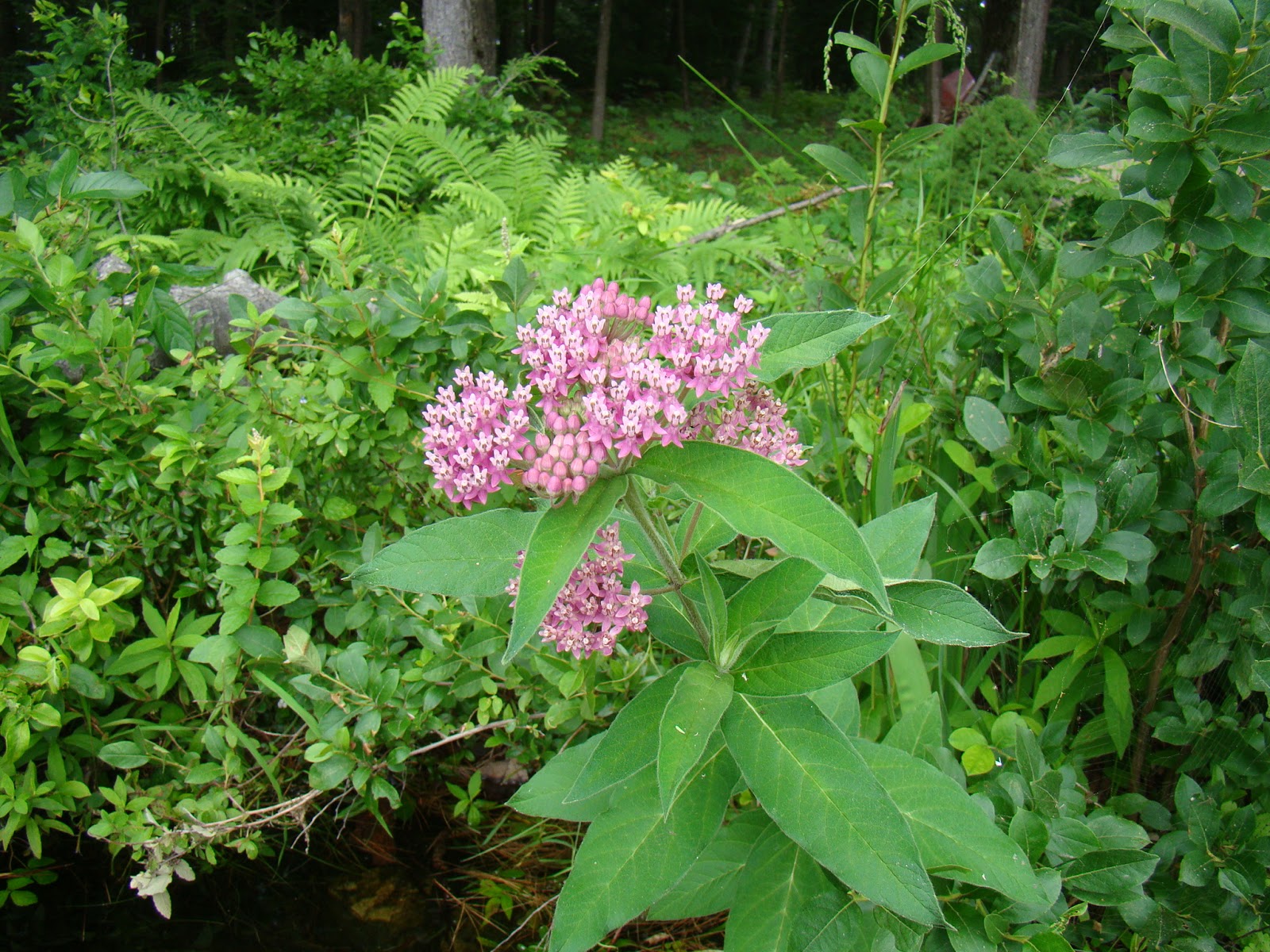
Swamp Milkweed

Steeplebush

Pickerel Weed
Page Pond
Swamp Rose.  (Those last two pictures were taken at the Page Pond Town Forest on Meredith Neck.)

Bring a pair of binoculars on your travels around the lake to enjoy these heart-warming summer sights.


Sunday, July 13, 2014

July 13, 2014

Lake Wicwas' newest loon continues to grow under the attentive care of its parents.  There have been numerous sightings of the parents feeding it small minnows, and it has even started to dive on its own, though it surely isn't catching anything yet.  It will be several more weeks before it can secure its own food, though its days of free-rides on its parent's back are probably over.  Brian Matteson took a beautiful picture of the little one with a parent on July 9th (thank you for sharing!).
About 15 days old (Brian Matteson photo)


One of our loon watchers discovered that the Loon Preservation Committee has a live camera focused on a nest where a pair of loons are still incubating their eggs.  It seems a little voyeuristic, but check it out here:  http://www.loon.org/looncam.php  These loons are well behind the Wicwas pair - perhaps they had a failed nesting and had to start again.

There continue to be several other loons on Lake Wicwas, at least three others this week.  I watched two loons acting up at one point.  They were floating very close together, frequently thrusting their heads quickly underwater and then back up again.  When one did this, the other immediately did the same.  They made occasional short, quick dives, making quite a commotion with loud splashes when they went down, returning to the surface close together again.  Maybe one was stalking the other to protect its claimed territory, or maybe it was a pair in some kind of courting behavior? 

On a morning paddle I saw three different single loons around the lake, each minding their own business, including this one stretching its wings as it woke up.
Good Morning!

It was a beautiful morning for a paddle.
Sunrise

The lake's summer colors are filling in nicely now.  Both the Yellow Water Lilies and the pretty white, Fragrant Water Lilies are in bloom everywhere.
Frangrant Water Lilies


The Steeplebush are also blooming along the shoreline.
Steeplebush (Spiraea tomentosa) on Sheep Island
 Did you notice the pile of beaver-debris on the rocks?


Their flowers are a favorite of butterflies, though I saw none this early in the morning.

At the other end of the day, there was a spectacular full-moonrise over Lake Wicwas.  People were calling it a "super moon" because it is larger and brighter than usual.  The proper name is a "perigee moon".  The moon doesn't have a circular orbit around the earth;  it has an elliptical orbit, and this month the closest approach (perigee) occurred on the same day as the full moon.  This will occur for the next two months as well, and in August the moon becomes full in the same hour as it reaches perigee, making it the most super!
Moonrise over Bryant Island

Full Buck Moon

The Native American name for the full July moon is the Buck Moon, because July is the month when the antlers of the male White Tail deer start to emerge.  If you're looking for the next two super moons In August and September, remember that moon rise occurs around sunset.
The end of another perfect summer day on Lake Wicwas

(No bugs this week, RP!)


Sunday, August 4, 2013

August 4, 2013

My favorite identifier of unknown (to me that is) plants and animals helped me out with two plant species this week.  The first, the tall pink flower growing on the shoreline, and posted on July 17th, is the Swamp Milkweed.  This flower is a favorite of butterflies, especially the Monarch.
Swamp Milkweed

The other plant she identified is the tiny yellow waterflower I found last week;  this is the flower of the Bladderwort.  There are several species (Common, Floating, Swollen, Horned), and with a little more work I may figure out which one it is.  (Thank you NV!)
Bladderwort

The Bladderwort is a really neat plant, in that it is a carnivore.  The bladders which are under the water are the traps.  They have small appendages located at the opening of the trap which detect tiny aquatic animals that touch the appendages.  The trap then opens and a vacuum sucks its prey into the bladder where it is digested.  Sounds to me like a great storyline for a sci-fi movie!

I did not see any interesting animal activity this week, so I guess this is the time for flowers - I saw the first Nodding Ladies' Tresses blooming today, one of tiniest pretty flowers with a great name.
Nodding Ladies' Tresses
 

But I did watch a Hummingbird drinking nectar from Linda's Flowers.  I clearly need a camera with a faster shutter to take a picture of a hummingbird.
 

Today we took a walk down to the dam to investigate a purple flower we noticed, and wanted to make sure it wasn't purple loosestrife - an invasive species, that although beautiful, can completely take over a wetland.  Fortunately it is not Loostrife, but rather Steeplebush.
Steeplebush

While at the dam (which by the way, shows the lake is still 3-4 inches above full level) I saw a bright red flower blooming along the edge of the stream flow flowing to Lake Winnisquam.  It is a Cardinal Flower - stop sometime on your way by and you'll see it easily, as the bright red color stands out against the green backdrop.
Cardinal Flower

I had the honor to present some of my observations around Lake Wicwas this weekend at the Lake Wicwas Association Annual meeting at the Wicwas Grange.  It was a lot of fun, and I learned a quite a lot from all the dynamic and enthusiastic people who enjoy the lake, including learning about Norm Harris' Flying Squirrel Circus.  That's a story for another day....
Flying Squirrel  (Taken 28 December 2011)