Showing posts with label Pearly Everlasting. Show all posts

Sunday, August 24, 2025

August 24, 2025: Pollinator Paradise

Sometimes one single plant can be a huge attraction to whole host of pollinating insects.

Thread-waisted Wasp on a Flat-topped Aster.

Like the Evening Primrose, when these asters started growing in the garden we thought they were weeds.  But curiosity inspired us to let them grow and see what developed.  The result is tall (up to six feet) wildflowers that have dozens of blossoms which attract everything from honeybees to tiny flies. 


I won't even try to identify them all, but here are some of the pollinators I found on a single plant at the same time.  


Aster seeds are also consumed by birds and they provide late-season nectar for migrating Monarch Butterflies.  Native to New England and growing well in hot and dry weather, it's an all-around excellent plant to let grow in your yard or garden - and you'll be helping pollinators which are under great stress these days.  Linda's woodland sunflower patch is another pollinator heaven.


Walking by it there's a loud buzz from the hundreds of insects visiting the blossoms, though they are predominantly bees - the sunflowers don't seem to attract the wide diversity of insects that the asters do.  


On the loon front I'm sorry to report that the survey crews have not been able to locate our younger chick Star, and we believe that he has been killed.  We don't know the cause, but another loon is a distinct possibility considering there has been a constant presence of non-resident loons on the lake.  We also know that the parents had been leaving chicks alone, tucked in against a shoreline while the parents go out to fend off other loons.  Earlier this week I watched our resident north territory male defend his territory from four other loons.

Letting intruders know this territory has been claimed before they get any ideas about next summer.

Escorting them out of the cove.

"And don't come back!"

But we can take solace that the larger chick, Spangle continues to thrive.

Starting to look like a juvenile loon now.

She is not safe yet though as she remains susceptible to attack by other loons, though with only one chick to defend, she will be better protected than ever.  We'll continue to hope for a positive outcome.  


Birds with larger broods than loons have better prospects for some of their chick to survive simply due to the numbers.  


I'll close with a bright greed katydid visiting our house. 


These are perhaps the prettiest of the insects in the bush cricket family, and the one makes the distinctive "katy-did, katy-didn't" sound by rubbing it wings together.  They can be distinguished from grasshoppers by their very long and thin antennae, often longer than their bodies. 

Grasshoppers have shorter and thicker antennae.  Katydids are mostly nocturnal, but this one was out in the morning sun for some reason.

Next week I'll be looking for late summer wildflowers.  Here's a preview of what's to come:

Perley Everlasting - another member of the aster family, but with a much different flower.

It should be a good week to walk through fields and along country roadsides.


Sunday, September 25, 2022

September 25, 2022: Fall Flowers Arrive

As we move deeper into fall the colors of the Lakes Region start to change.  Leaves are still predominantly green though more and more hints of yellow and red appear as the leaves slowly lose their chlorophyll-based green pigment.  Most of the summer flowers have faded - though a few stubborn black-eyed Susans soldier on - but the fall flowers now get their moment in the spotlight.  One of the most recognizable late-summer, early-fall flower is the turtlehead which grows in wet areas and is often found at the edge of the lake or other wetlands.  It gets its name because the bloom resembles the head of a turtle.

Turtleheads (Chelone glabra) growing along the shoreline.

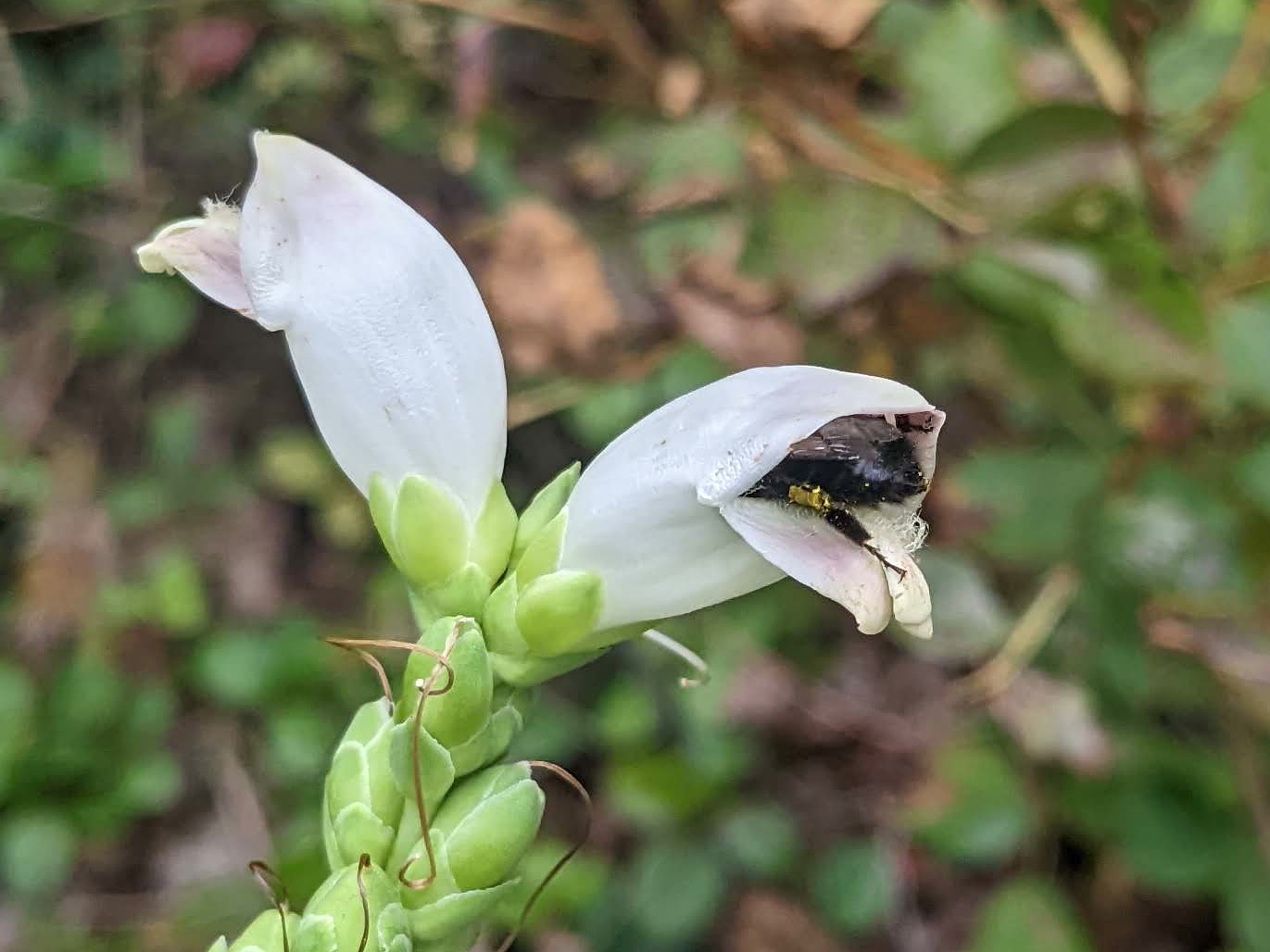
The petals never really open up wide, forming an enclosed blossom with a small hole at the end.

All the good parts of the flower are inside the blossom.

Turtlehead is an excellent filter for water runoff and holds soil well so it prevents erosion - it's an ideal species to plant along the water's edge, by retention pools, wet areas prone to erosion, and on borders of rain gardens.

Each turtlehead flower contains both the male and female parts needed to reproduce, but it requires a pollinator to move the pollen between the parts inside the flower.  Similar to the Lady's slipper, the enclosed flower forces insects in search of nectar to climb inside the blossom where it rubs against the various sex parts of the plant, spreading pollen to the required areas to make seeds.  It's a brilliant adaptation, and while looking at some of these plants I witnessed the pollination process in action.  A bumblebee (the most most common pollinator of turtleheads because large, fuzzy bumblebees can survive colder fall temperatures) flew down to sample a flower.

Bumblebee on the approach path.

I watched it land and climb inside the blossom.

In we go.


It completely disappeared in side for perhaps a minute while it was collecting all the pollen it could find before climbing out and buzzing away.

Doing its thing in there.

There'll be more turtleheads next year!  It's a symbiotic relationship:  The bumblebee gets food and the turtlehead gets to propagate its genes.  Life on planet earth is dependent on pollinators in so many ways.

Autumn is also the time for asters, of many varieties and I don't know what they all are called.  Some are very tall, four or five feet in height.

This wild calico aster planted itself by the house and now towers over Linda's day lilies.

I think this one is a calico aster.  Colors range from white to yellow to lavender, sometimes with a reddish hue.  


The pearly everlasting doesn't look like the typical aster, but it's also in the aster family.

Pearly-everlasting (Anaphalis margaritacea)

This plant spreads well and the flowers last for several weeks.

This patch expands its footprint every year.

One of my favorite little flowers that pops up this time of year isn't an aster.  Like the lady's slipper, it's in the orchid family and like so many flowers this one is also pollinated by bees.

Nodding Ladies' Tresses


This is also a great time to enjoy the bright colors of goldenrod though I didn't come across much in my travels this week.  But if you're in a field and see brilliant waves of yellow, look closely at the flowers to see what's pollinating them.  And remember, goldenrod isn't actually a cause of allergies - it's usually the ragweed that often accompanies the goldenrod.  You can read why goldenrod gets an unwarranted reputation in this article from the UNH Extension Service.  

Small unknown beetles collecting pollen from goldenrod.

On a whim I went to see if I could identify these beetles and sure enough, they are well known beetles on goldenrod and are called, appropriately enough, Shiny Flower Beetles.  Something to look into on another day.


Sunday, September 3, 2017

September 3, 2017 - Lightning Strike II


After an impressive electrical storm hit the Lakes Region back on July 17th I took a look around for signs of strikes but didn't find anything.  Then this week, while doing trail work in the Hamlin Conservation Area, someone with a good eye noticed two trees with the sure marks of lightning.

I can't tell if these date from the July storm, but given their prominent location, I would guess they are from a more recent storm.  When struck, current takes a path down a tree just under the bark where there is the most moisture, providing the best electrical circuit - current always takes the path of least resistance.  The rapid heating due to the high current expands the moisture in the sap, instantly vaporizing the water, which blows the bark right off the tree.
Bark blown off the trunk (this is looking south, towards the trailhead)

Bark fragment on the ground doesn't show any signs of charring
The resulting long strip of exposed wood may or may not kill the tree; these strips, though long, are narrow so the tree may survive.  Lightning is fickle - these two trees are about 50 yards apart, and neither are the tallest in the area - why these particular trees?

They are easy to find if you want to see them for yourself.  They are just 0.1 miles from the trailhead kiosk, one right beside the trail on the right and the other just down the slope on the same side of the trail.  While you're in the area, walk down to the first trail intersection and see the freshly trimmed field there.
The Tuesday Trail crew clearing the old log yard.
You might come across some wild blackberries which are ripening now - look along the edges of sunny trails and wood roads.

Also be sure to keep an eye out on your travels for the late fall flowers that are blooming now.
Pearly Everlasting (Anaphalis margaritacea)
Some of which have visitors.
Unidentified visitors

Black-eyed susan
With a Plume Moth (family Pterophoridae) 
Milkweed pod with Small Milkweed Bugs (Lygaeus kalmii)
You are also likely to see more signs of upcoming attractions;  lightning can't take them all out!

Female Common Yellowthroat  (Geothlypis trichasat the edge of the swamp in the Chemung State Forest


Sunday, September 13, 2015

September 13, 2015

This summer was the longest there can be, if one uses the dates of an early memorial day and a late labor day as the mileposts of summer.  But with labor day come and gone, the activity on the lake has subsided considerably.  This past weekend, even though the fabulous weather continued - at least for Saturday - there was less action on the lake, only a few kayaks and canoes along with the fishermen. 
A calm fall day on Lake Wicwas

We took a slow ride around the lake with a good friend to enjoy the beautiful calm day, and were treated to a few sights:  an osprey
a heron,

and a couple of loons.


Spring may provide the mother-load of wildflowers, often with stunning beauty and short blooming spans such as the Lady Slipper and Trillium, while summer treats us to longer lasting, often large fields of color provided by the likes of Daisies and Black-eyed Susans.  But fall has its own special flavor as late flowers fill in the color void before the trees start to turn.  These range from brilliant fields of goldenrod to tiny white flowers such as the Nodding Ladies' Tresses.
Nodding Ladies' Tresses
A classic fall bloom is the Pearly Everlasting, a dry white flower that lasts a long time.
Calico Aster (Aster lateriflorus)


Asters, closely related to daisies, are frequently found in fields this time of year;  these were growing near the lake.
Calico Aster (Aster lateriflorus)

Red clover is a summer flower that blooms into the early fall.

As with clover, the wild thistle is a favorite of bumble bees collecting their pollen,

but evidently Lady Bugs appreciate this food source as well.
Sharing a Thistle Blossom


The bumble bee, with its furry coat to keep it warm, will be active into fall well after the other bees have disappeared.

Yes, summer is waning and fall is on its way.  Early signs are evident with the animals, on the plants, in the trees - and on the water.