Showing posts with label Turtlehead. Show all posts

Sunday, August 31, 2025

August 31, 2025: Late Summer Flowers

Last week I mentioned late summer wildflowers; they may not be as showy as spring trilliums and lady's slippers, but they are more plentiful, easier to find, and tend to bloom for a longer period.  A favorite of mine, and one that often grows near water, is the Turtlehead.

Turtlehead, a relative of snapdragons

While looking at them this week I thought they resembled snapdragons, and sure enough, both plants are in the Plantaginaceae family.  Snapdragons are native to the Mediterranean and cultivated as annuals in New England, while turtleheads are hardy perennials native to New Hampshire.  Look for them near shorelines and other wetland areas.

Next up are a couple of blue/purple flowers.  From a distance this Purple False-foxglove looked like it might be Purple Loosestrife, but it's not.

Purple False-Foxglove

This native flower is not closely related to the cultivated foxglove which comes from Europe; they share a common name because their flowers are similar in shape.

I found the next flower growing right along a roadside:

Common Bellflower

The Common Bellflower is native to Europe, and though not classified as invasive in New Hampshire, it needs to be managed carefully as it spreads aggressively, often escaping from gardens as the ones I saw beside the road had done.

Queen Anne's Lace must be a drought-resistant plant as it really is having a good year.  

Fresh blooms continue to emerge even with the lack of rain.

Queen Anne's Lace putting out a new flower.

Flowers aren't the only thing catching my eye in late August.  Dragonflies are still buzzing around wildflower fields as well as shorelines.

Clubtail dragonfly
A pair of Slaty Skimmers mating.  

Note how the female (behind) is grasping the male's tail.


But there's no denying that summer is waning fast.  The lake temperature took a tumble this week with cool nights followed by shorter days which provide less energy to warm it back up.  
Fog wells up from the lake on a chilly August morning.

And this sight is hard to ignore:
The first maples start to turn.

But fear not, September will bring plenty of great weather for outdoor activities.  

Happy Labor Day!


Sunday, August 25, 2024

August 25, 2024: Double-Dammed Pond

We're getting towards the best time of the year to be outside:  The bugs are mostly gone, the air is cooler and drier, and once the smoke from wildfires moves out the sky will be blue.  With so many great hiking options right close by there's no need to travel far to get your nature fix.  Right here beside Lake Wicwas is the 700 acre Hamlin-Eames-Smyth Town Forest with almost 20 miles of trails.  One of my favorite loops is the Blue Trail that goes out to Double-dammed Pond.  

Double-dammed Pond

This pretty beaver pond got its name from the fact it has dams at both ends of its elongated pond.  On my way out there I stopped to peruse numerous fungi with a range of sizes, colors, and shapes.

Indian Pipe

Amanita

Yellow Slime Mold

I think this is a Yellow Slime Mold (with a second fungus growing with it) - something worth studying further - it's really interesting.

Those are just a few of many you'll see if you take a walk in the woods this week.  I'll include more of the mushrooms I've seen this summer when I do the annual fungus post.  

🍄

Most of the woodland flowers are done blooming now but if you look along the shores of any pond or stream where more sun reaches the ground you're likely so see aquatic or wetland flowers blooming.  A perennial late-summer favorite of mine is the turtlehead.

Turtlehead (Chelone glabra)

It was on a walk to a different beaver pond quite a bit farther north that I came upon a fabulous raptor perched proudly on a drowned tree in the pond.  


It was a small a raptor and I knew it was something special, though I wasn't prepared to declare it was a Merlin until I returned home and checked the field guides, and finally sent the picture to a friend who's a true avian expert (thanks RB!) and he confirmed it was a Merlin.  


That's a first for me.  I've seen small, fast raptors speeding through the yard on occasion and wondered if was a Merlin but never got a good enough look to know.  To see one perched, waiting for an unsuspecting bird to fly near was a real treat.  Merlins are small falcons and are very fast and powerful birds.  Other birds are their primary food source; they catch them on the wing, chasing them down, or forcing them to fly higher until they tire out and are overtaken.  Merlins breed in Canada so this one was probably on its way to the southern US or Central America for the winter.

Beaver Pond in Twin Mountain

Back on Wicwas I came upon what I thought was a new sculpture someone had placed in their yard.


It looked so real, but was so stationary that I didn't think it was real; it never moved as I paddled right by it.  But looking back over my shoulder I detected a slight twitch in its head, and decided it was in fact the real thing.  Last week someone shared with me that they watched a heron eat a turtle - whole.  He said it was quite a sight to see.  I'd never heard of that, and looking into it, I learned that herons have two stomachs, which together, allow them to digest turtles.  The first has a potent stomach acid that softens bones and shells.  The second stomach grinds everything up with the help of stones the heron eats for this purpose, much like loons do.  That begs the question of whether herons, like loons, suffer from lead poisoning from consuming lead fishing sinkers.  Maybe herons take different size stones, or maybe they collect them from areas where fishing tackle might not be lost.  


The forest has been quiet here in late summer, but I have seen this deer a couple of times recently. 


Yesterday morning we had a lengthy stare-off where the deer took a long time to decide if I was a threat.  It eventually concluded "yes" and was off.

Is that where the term "high-tail" it out of here comes from?


Sunday, September 10, 2023

September 10, 2023: Summer in September

The best week of summer 2023 came in September when New Hampshire had a quintessential summer week with hot, hazy, humid weather every day.  With nary a breeze to stir up the lake, the water temperature was more like July without the chilly, early September feel that makes one think twice before jumping in the lake this time of year.  It was the perfect way end to the summer season, ideal for all the Labor Weekend activities.  Well, maybe except for one activity.  Our visitor from Colorado took me on a hike in the northern Presidential Mountains, and even way up there, on the summit of 5774' Mt. Adams (second in elevation only to Mt. Washington) it was hot, hot, hot with barely a breeze blowing on the summit.  

Mt. Madison, seen from a hot Adams summit.

An updraft in the morning was bringing warm air from the valleys up the mountain slopes and we feared we'd be socked into the clouds by the time we reached the first summit, Mt. Madison.

Cloud building on the hike up.

And in fact, the clouds had reached up to Mt. Adams by the time we summited Madison.  

Clouds flowing up the north flank of Mt. Adams.

But when we got down to the saddle between the two peaks, Adams had cleared.  We hiked past Star Lake and had a steamy trip up to Adams, and though hot, there were no complaints about the weather - or the views.

Star Lake.

We picked a good section of the range to hike, as Mt. Washington and the peaks just to the south of us remained under clouds all day while we experienced a sunny hike on the entire trek across the talus fields above treeline.

We had a few glimpses of Washington when the clouds lifted.

It was a grueling day, but we were prepared for the conditions with plenty of water and salty snacks.  It was my best hike of the summer - thanks for the excursion VP!

Just as we arrived at the Madison AMC hut we heard a helicopter come out of nowhere and land right at the hut.


It dropped off a crew of workers in hard hats and left as quickly as it arrived.  But it was back in just a few minutes with a grapple hook hanging below.  The crew had gathered up four empty propane tanks while it was away, which they connected to grapple hook, and off it went.  

A resupply mission to the hut.

It came back twice more, once to remove more material, and again to bring in new supplies.  On the final trip it had dropped off the grapple and landed to pick up the crew.  Madison Hut is now stocked for the last two weeks of its season.  

It's worth noting that foliage season comes early in the northern White Mountains.  There was already a warm yellow glow in the mid-elevation forest with quite a few leaves on the ground.  

Salmicus Falls

The huts will be open for leaf-peeping season, but then close down for the year.  Foliage viewing in the North County will be here soon.


Back at Lake Wicwas I was relieved that the hot weather hadn't brought on a cyanobacteria bloom.  There was obvious cyanobacteria in the lake with many suspended green specks smaller than a grain of sand, but it had the look of what DES calls a "starry night" rather than a "galaxy", so it was at a safe level.  We were fortunate this year.  Even Lake Winnipesaukee has four cyanobacteria alerts right now.  The large amount of shoreline covered by vegetation is a big factor in Lake Wicwas remaining healthy - lots of blueberry and huckleberry, buttonbush, even dogwood line the shore.

Silky dogwood (Cornus amomum)

This silky dogwood is a great species to plant on a shoreline to help with water quality.  It thrives in damp soils, has pretty flowers and light blue berries that are favored by birds because of their high fat content.  It also turns a beautiful deep red or purple color in fall.  


And this shrub won't grow high to block your view of the lake.  

If you're lucky (or if you planted them) you might find pretty turtlehead flowers blooming on the shoreline right now.

Turtlehead (Chelone obliqua), a common shoreline flower.

There was also a dragon at the lake this week, actually a dragonhunter.

Dragonhunter (Hagenius brevistylus)

This is a member of the aptly-named clubtail family.  It's the largest clubtail dragonfly in the northeast, and one of the most handsome with its contrasting yellow, black, and green coloring.  

I think the dragonhunter, the bear, and all the other lake and forest animals are enjoying Summer in September as much as I am.


Sunday, September 25, 2022

September 25, 2022: Fall Flowers Arrive

As we move deeper into fall the colors of the Lakes Region start to change.  Leaves are still predominantly green though more and more hints of yellow and red appear as the leaves slowly lose their chlorophyll-based green pigment.  Most of the summer flowers have faded - though a few stubborn black-eyed Susans soldier on - but the fall flowers now get their moment in the spotlight.  One of the most recognizable late-summer, early-fall flower is the turtlehead which grows in wet areas and is often found at the edge of the lake or other wetlands.  It gets its name because the bloom resembles the head of a turtle.

Turtleheads (Chelone glabra) growing along the shoreline.

The petals never really open up wide, forming an enclosed blossom with a small hole at the end.

All the good parts of the flower are inside the blossom.

Turtlehead is an excellent filter for water runoff and holds soil well so it prevents erosion - it's an ideal species to plant along the water's edge, by retention pools, wet areas prone to erosion, and on borders of rain gardens.

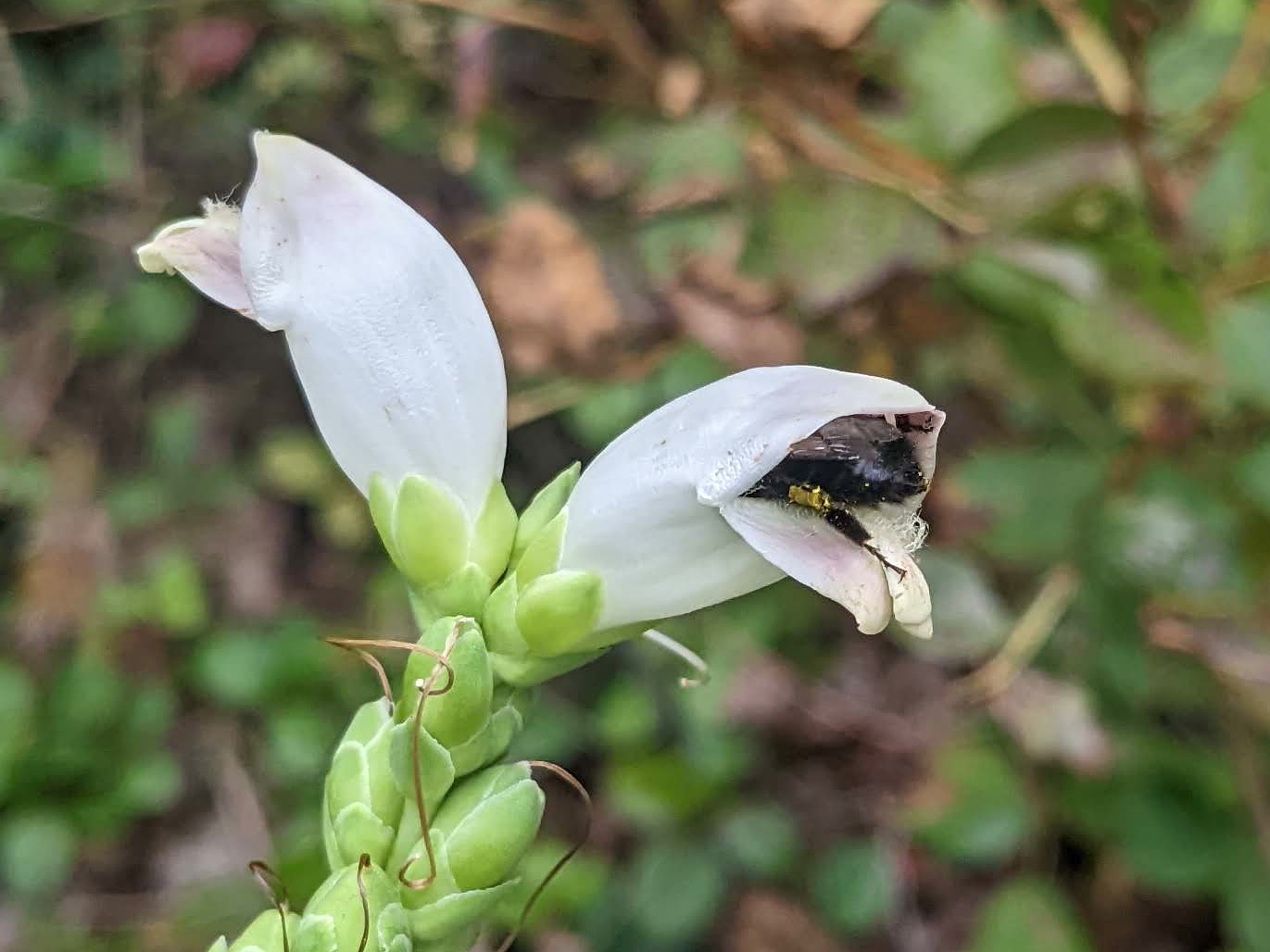
Each turtlehead flower contains both the male and female parts needed to reproduce, but it requires a pollinator to move the pollen between the parts inside the flower.  Similar to the Lady's slipper, the enclosed flower forces insects in search of nectar to climb inside the blossom where it rubs against the various sex parts of the plant, spreading pollen to the required areas to make seeds.  It's a brilliant adaptation, and while looking at some of these plants I witnessed the pollination process in action.  A bumblebee (the most most common pollinator of turtleheads because large, fuzzy bumblebees can survive colder fall temperatures) flew down to sample a flower.

Bumblebee on the approach path.

I watched it land and climb inside the blossom.

In we go.


It completely disappeared in side for perhaps a minute while it was collecting all the pollen it could find before climbing out and buzzing away.

Doing its thing in there.

There'll be more turtleheads next year!  It's a symbiotic relationship:  The bumblebee gets food and the turtlehead gets to propagate its genes.  Life on planet earth is dependent on pollinators in so many ways.

Autumn is also the time for asters, of many varieties and I don't know what they all are called.  Some are very tall, four or five feet in height.

This wild calico aster planted itself by the house and now towers over Linda's day lilies.

I think this one is a calico aster.  Colors range from white to yellow to lavender, sometimes with a reddish hue.  


The pearly everlasting doesn't look like the typical aster, but it's also in the aster family.

Pearly-everlasting (Anaphalis margaritacea)

This plant spreads well and the flowers last for several weeks.

This patch expands its footprint every year.

One of my favorite little flowers that pops up this time of year isn't an aster.  Like the lady's slipper, it's in the orchid family and like so many flowers this one is also pollinated by bees.

Nodding Ladies' Tresses


This is also a great time to enjoy the bright colors of goldenrod though I didn't come across much in my travels this week.  But if you're in a field and see brilliant waves of yellow, look closely at the flowers to see what's pollinating them.  And remember, goldenrod isn't actually a cause of allergies - it's usually the ragweed that often accompanies the goldenrod.  You can read why goldenrod gets an unwarranted reputation in this article from the UNH Extension Service.  

Small unknown beetles collecting pollen from goldenrod.

On a whim I went to see if I could identify these beetles and sure enough, they are well known beetles on goldenrod and are called, appropriately enough, Shiny Flower Beetles.  Something to look into on another day.