Showing posts with label Calico Aster. Show all posts

Sunday, September 3, 2023

September 3, 2023: A Glimpse of Fall

Friday gave us our first glimpse of fall, one day before the start of meteorological autumn arrived.  It was bright, breezy and cool, with a brisk NW wind blowing away the humidity from early in the week.  As temperatures drop, the forest starts to become more active, as do the lakes.  I saw this white-tailed deer swimming between two islands in the middle of the afternoon on Tuesday.

A deer out for an afternoon dip.

It would swim where the water was deep, and walk along the bottom of the lake where it was shallow.


It climbed up onto one small firm spot,


which it crossed before jumping back into the lake.


Eventually it made its way onto one of the larger islands where it disappeared into the trees in search of fresh browsing spots.


Earlier in the week I met a deer standing in the clearing just past the trailhead of the Hamlin Town Forest.  


This one wasn't fazed at all; it just watched me as I went by and on my way.


No bear encounters this week so I was able to study the beechnuts on the ground.  They are plentiful, and were falling all around me like rain.

A good crop of beechnuts.

Though I do believe they are smaller than usual this year.


These were under a big beech tree, but I could find no signs of bear claws on this trunk.

No claw marks on this big old beech.

No up-close bear encounters, but I did find this nice pile of fresh bear scat one morning:

Very fresh bear scat full of black cherry fruit and seeds.
It was still glistening so it wasn't more than a couple of hours old, though it wasn't still warm.  A few minutes later I walked through a storm of bees hovering around a ground nest that the bear had just recently ripped up to eat the bees and the eggs.  I wasn't far behind it!

The current star of the wildflowers right now are the asters, of several types and colors. 

Yellow and purple centers in Calico Asters.

These were being appreciated by multiple species of insects seeking their pollen and ensuring a good seed crop for next year as well as seeds for the birds that will feed on them in the coming days.


There's nothing new to report on the loon chicks; LuLu and Checkers spend a lot of time watching their parents dive, maybe observing how it's done, but certainly wanting to be first in line when someone brings up a tasty morsel for them.

On this bright blue day it was dad they were haunting for food.

You can see a bit of white on dad's band.


I started seeing signs of trees turning color a couple of weeks of weeks ago but haven't wanted to admit it.  Now that September is here, there's no more denying it.

And Mt. Washington had its first snow of the season.  Fall is coming.


Sunday, September 25, 2022

September 25, 2022: Fall Flowers Arrive

As we move deeper into fall the colors of the Lakes Region start to change.  Leaves are still predominantly green though more and more hints of yellow and red appear as the leaves slowly lose their chlorophyll-based green pigment.  Most of the summer flowers have faded - though a few stubborn black-eyed Susans soldier on - but the fall flowers now get their moment in the spotlight.  One of the most recognizable late-summer, early-fall flower is the turtlehead which grows in wet areas and is often found at the edge of the lake or other wetlands.  It gets its name because the bloom resembles the head of a turtle.

Turtleheads (Chelone glabra) growing along the shoreline.

The petals never really open up wide, forming an enclosed blossom with a small hole at the end.

All the good parts of the flower are inside the blossom.

Turtlehead is an excellent filter for water runoff and holds soil well so it prevents erosion - it's an ideal species to plant along the water's edge, by retention pools, wet areas prone to erosion, and on borders of rain gardens.

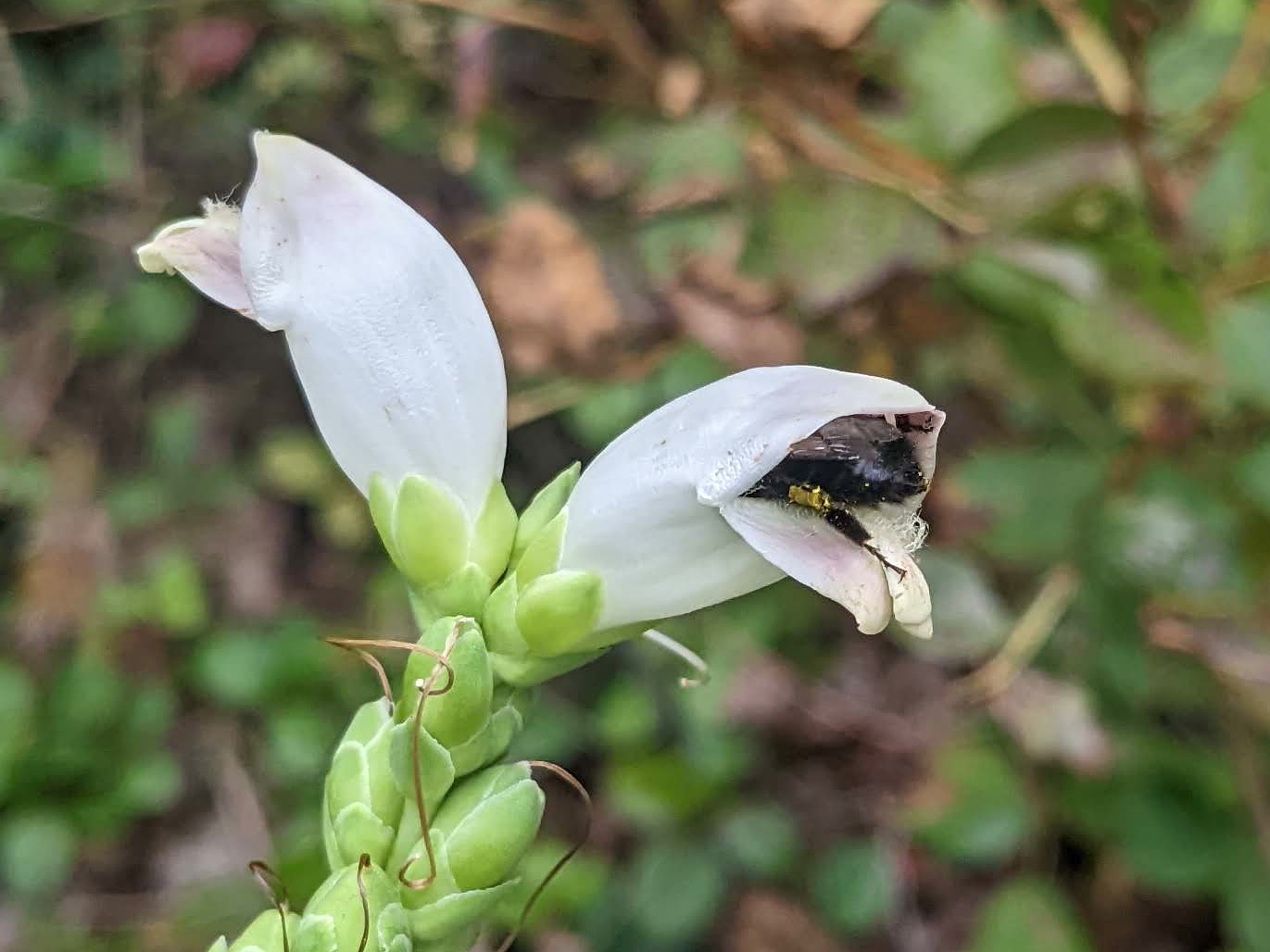
Each turtlehead flower contains both the male and female parts needed to reproduce, but it requires a pollinator to move the pollen between the parts inside the flower.  Similar to the Lady's slipper, the enclosed flower forces insects in search of nectar to climb inside the blossom where it rubs against the various sex parts of the plant, spreading pollen to the required areas to make seeds.  It's a brilliant adaptation, and while looking at some of these plants I witnessed the pollination process in action.  A bumblebee (the most most common pollinator of turtleheads because large, fuzzy bumblebees can survive colder fall temperatures) flew down to sample a flower.

Bumblebee on the approach path.

I watched it land and climb inside the blossom.

In we go.


It completely disappeared in side for perhaps a minute while it was collecting all the pollen it could find before climbing out and buzzing away.

Doing its thing in there.

There'll be more turtleheads next year!  It's a symbiotic relationship:  The bumblebee gets food and the turtlehead gets to propagate its genes.  Life on planet earth is dependent on pollinators in so many ways.

Autumn is also the time for asters, of many varieties and I don't know what they all are called.  Some are very tall, four or five feet in height.

This wild calico aster planted itself by the house and now towers over Linda's day lilies.

I think this one is a calico aster.  Colors range from white to yellow to lavender, sometimes with a reddish hue.  


The pearly everlasting doesn't look like the typical aster, but it's also in the aster family.

Pearly-everlasting (Anaphalis margaritacea)

This plant spreads well and the flowers last for several weeks.

This patch expands its footprint every year.

One of my favorite little flowers that pops up this time of year isn't an aster.  Like the lady's slipper, it's in the orchid family and like so many flowers this one is also pollinated by bees.

Nodding Ladies' Tresses


This is also a great time to enjoy the bright colors of goldenrod though I didn't come across much in my travels this week.  But if you're in a field and see brilliant waves of yellow, look closely at the flowers to see what's pollinating them.  And remember, goldenrod isn't actually a cause of allergies - it's usually the ragweed that often accompanies the goldenrod.  You can read why goldenrod gets an unwarranted reputation in this article from the UNH Extension Service.  

Small unknown beetles collecting pollen from goldenrod.

On a whim I went to see if I could identify these beetles and sure enough, they are well known beetles on goldenrod and are called, appropriately enough, Shiny Flower Beetles.  Something to look into on another day.


Sunday, September 5, 2021

September 5, 2021: Teenage Loons

Mother nature is letting us know that September is here even if we don't look at a calendar.  The days are still longer than the nights but she's giving us plenty of clues that the equinox is approaching, the most evident signs being served up by the flora around the region.  

Goldenrod blooming.

When the golden rod lights up the fields and the edges of the roads we know the days are becoming cooler.  Often intermixed with goldenrod are several varieties of wild asters.

Calico Asters.

These calico asters have tiny white blossoms that look like miniature daiseys and though the centers of these are yellow they can also develop a delicate lavender color.  

These yellow and lavender asters were seen last year in early October.

Another hint is coming from the trees.

Red maple (See the spider web?)

The red maples are always the first to betray the hopes of summer by exposing their true colors hidden from us for the past several months.  I often see them turning first near bodies of water and thought wet roots caused their early color, but I recently heard a repuatable source report that red maples at high and dry location start to turn color at the same time as those near water.  I do remain convinced that weak subjects turn earlier, supported by the fact that damaged or broken branches will start turning red in July as the nutrient flow to the leaves is restricted, slowing the process of photosynthesis.  

Animals are also telling us the season is progressing, including our two loon chicks which are certainly acting like teenagers at this point.  One of the chicks (Coco I think based on behavior - I can't tell them apart visually any more even when they are side-by-side) has been expressing her independence, spending time away from mom and her brother. (Remember, we don't really know the sex of either chick).  

One day this week she spent a long time on her own doing her morning preening.  She would slap her wings strongly against the water, sputtering along in the lake for several yards with water splashing all around her.  Then she'd preen her back feathers followed by rolling over with her belly up to work on her bright white belly feathers.  Part of what she was doing here is taking oil from her oil gland and spreading it over all her feathers to provide waterproofing for them.  Finally she would stretch up high in air and spread her wings, give them a shake to realign her feathers, then settle back into the lake.  For about 15 seconds.  Then it was lather, rinse, and repeat.  This went on for quite a while until she moved out of my sight.  This was all observed far away through binoculars so I have no pictures to share.  But another day when the family was together I did get a picture of one of the chicks spreading its wings, and wow, they have quite a wingspan now.


As big as they are, they are still happy to have mom prepare a meal for them.  

Mom cooks up breakfast.

This week I broke one of the rules of wildlife observation.  Usually when I come across an animal in its habitat I try my best to not disturb it.  This isn't possible with animals like deer which are so attentive to their surroundings that they almost always detect me long before I see them.  But when I come across a turtle sunning on a log, or a heron fishing in the marshes I try my best to sneak in a picture and then glide by quietly without interrupting its feeding or its warming of its body.  But I will make an occasional exception.


One knows what any bird will do when it perches for more than just a moment.


My sending this heron on its way gave me a chance to get a good look at its large body and strong legs which are usually hidden beneath those stupendous wings. 

There's a couple of nice drumsticks.


Heron don't really show many changes as summer advances since their young don't leave the nest until they look almost adult-like.  But there are plenty of other signs that summer is waning. 

Winterberry fruit is starting to ripen.

Winterberries will become a brilliant red and last throughout the winter as the animals slowly consume them, apparently preferring other food sources before turning to winterberry.

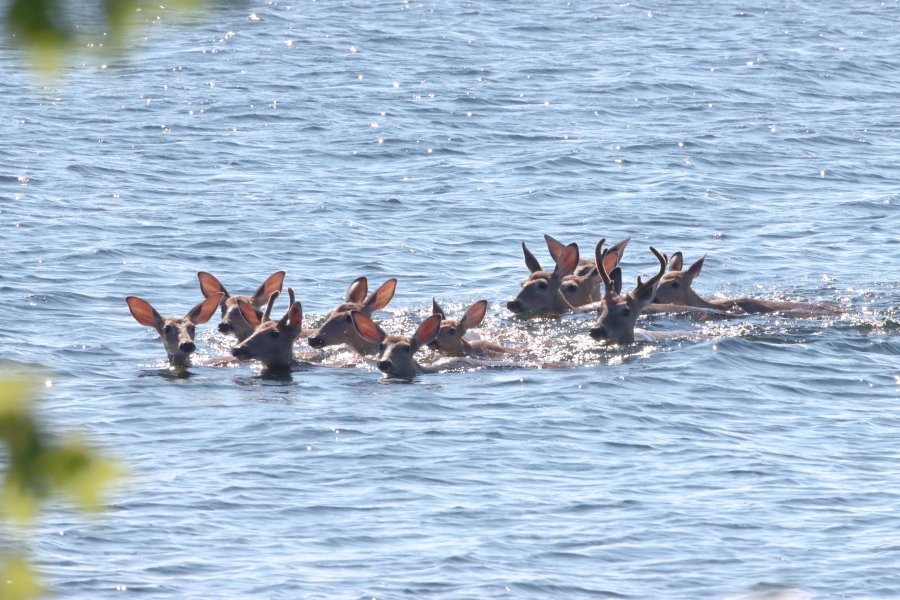
Finally, I want to share this great photo a friend took on Friday of  ten deer swimming in Lake Winnipesaukee from Mark Island to Bear Island.

Even the deer are on the move.  Photo by Rick Page.

Note there are a couple of young bucks in that herd.  Thanks for sharing Rick!  

It may be getting cooler, but that means some of the best outdoor activity weather of the year is just ahead!

Sunday, September 30, 2018

September 30, 2018: Rubin Whitten Saved the Town of Ashland

The best season for hiking has arrived - cool temperatures, clear blue skies, and no bugs!  It's the perfect stage to explore all the bounty autumn has to offer, whether it's in your back yard, on a lake, or in the mountains.
Squam Lake and the Ossipee Mountains from Whitten Woods' north view point
Linda and I took a walk at Whitten Woods, a new conservation area opened by the New England Forestry Foundation and the Squam Lakes Association.  Located in Ashland at the site of a historic farm owned by Rubin Whitten who saved the residents of Ashland by sharing his wheat crop from this hill, the only crop that survived the "Year Without a Summer".

In 1816 Mount Tambora in Indonesia erupted, affecting weather across the world.  In New Hampshire there was frost, snow, and ice throughout the summer, with killing frosts every month.  Most of the crops failed, leaving the settlers without a winter food source.  But up on this high, south facing hill, Whitten had planted wheat - an unusual crop in these parts, but more tolerant of cold weather.  His was one of the only crops which survived; the elevation may have helped, as cold airs sinks down into the valleys.  He offered his crop to the townspeople, becoming a local legend and hero.  [Ref:  Eric Werme, Old Farmer's Almanac, WMUR]

It's a pleasant hike on good trails with two nice view points.
Whiteface (left) and Chocorua (right) from Whitten Woods' south view point
Starting up from the trail head on Highland Street just outside of downtown Ashland we enjoyed some early color in the leaves and plenty of fall flowers.
Calico Aster (Aster lateriflorus)
There is a lot of blue in flowers right now, including this dark-blue bud I didn't recognize and can't identify - any ideas?   (Update:  Paula Wanzer identified this for me - it is a Closed Gentian, an interesting flower. I'll try to provide more information on it next week.)
Closed Gentian (Gentiana andrewsii)

As we walked along the old roads of Whitten's farm, signs of human activity were evident, including fruit trees such as this crab apple.

Humans may not be harvesting produce here anymore, but the animals continue to take advantage of what the settlers left behind.  Seeing motion in the branches led us to a red squirrel fattening up for winter on the small fruit.

Most of the property has long since been taken over by forest, which has clearly been logged in the recent past based on the size of the trees.  But as we walked we came across some large areas that have been kept open over the years, though we couldn't determine why.
A long, wide slope running up the south hill has been continually mowed, with only ferns growing in it
Why was this stretch of gentle terrain kept open all these years?  It looked like a ski slope.

Whitten Woods is a great, nearby place to visit, and a good skiing and snowshoeing option in the winter.


Earlier in the week on a hike at higher terrain, a small visitor came to say hello to me.
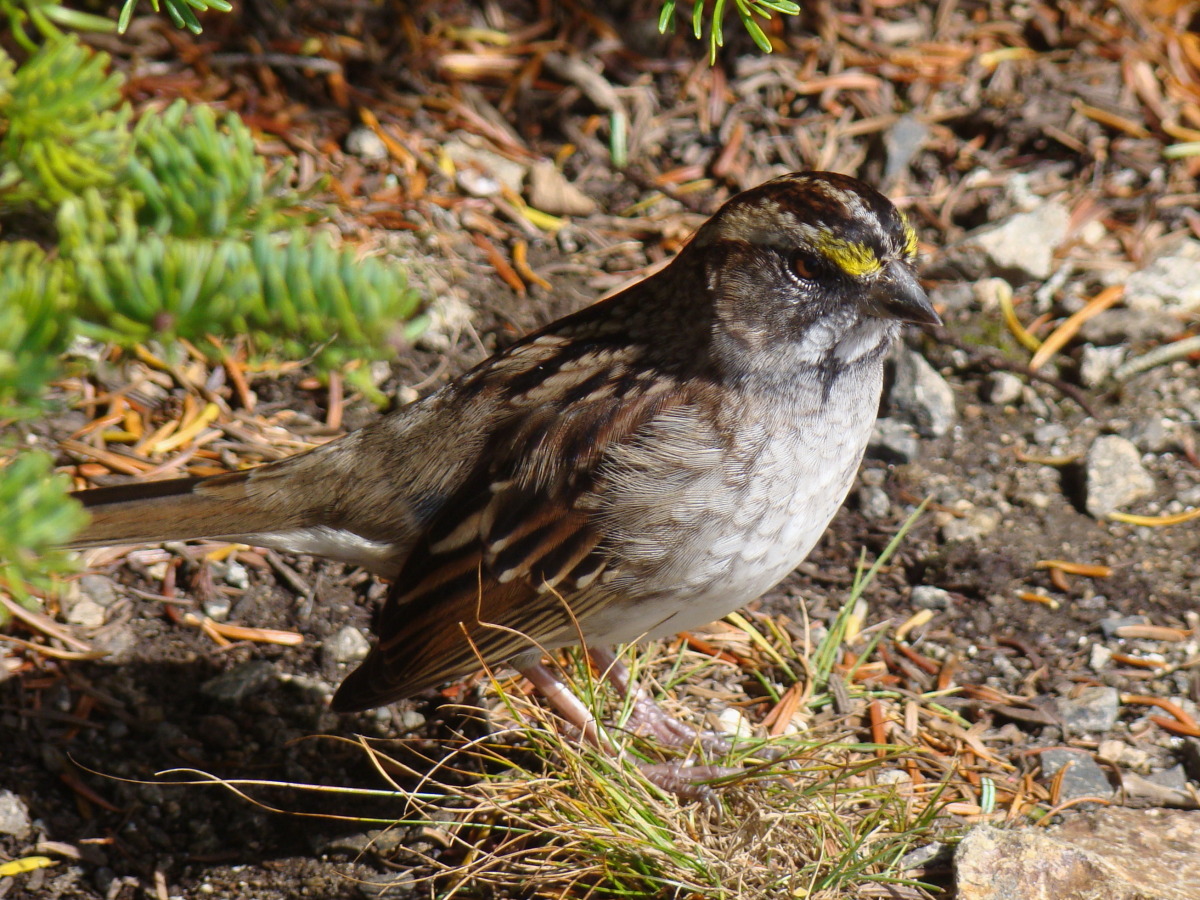
White-throated Sparrow (Zonotrichia albicollis)
This is the famous singer of "Old-Sam-Peabody-Peabody-Peabody" that frequents the boreal forests in the highest elevations of the White Mountains.

This pretty bird hopped out of the scrub, right up to my feet as soon as I sat myself down on the summit of 4327' high Mt. Flume at the southern end of the Franconia Range.  It was clearly looking for a handout (which it didn't get).
Mt. Flume, where this sparrow lives - probably knowing that's where hikers drop bits of food as they enjoy the view
It's a pretty harsh environment to survive;  they must put up with it in order to live in such a beautiful place.
A birds-eye view of Mt. Lincoln, Mt. Lafayette, and Mt. Garfield from the summit of Flume

Back down at lake level, the water has been cooling off, but it's still plenty warm to form morning mist on the lakes.

On Saturday the fisherman were out for perhaps the last bass tournament of the year.  As they roared down the lake in the morning a loon hid in the mist, watching them go by.

Our mating pair is still on the lake, though their brilliant contrasting black and white plumage is starting to fade into the drab gray clothing they will wear through the winter.

It may be the best season for hiking, but that doesn't mean there aren't plenty of days left on the water to watch for loons, sunsets, and coming shortly, brilliant fall leaves.  Whether at elevation or sea level, there's autumn beauty everywhere you look in New Hampshire.