Showing posts with label Dock Spider. Show all posts

Sunday, May 28, 2023

May 28, 2023: Pickerel Frogs

I think we're pretty close to having a full contingent of summer residents now.  This week I saw a veery, a Yellow Warbler, and a Red-eyed Vireo, some of the last arrivals.  The amphibians are also out and about; the tree frogs are singing, and I saw my first pickerel frog.
Pickerel Frog

It blended in so well with its surroundings that I never would have seen it if it didn't leap out of my way as I approached.


It was down near the lake where there are lots of good things to eat, but that's also where our resident garter snake hangs out, so it better be on high alert.  Pickerel frogs are considered poisonous as their skin excretes a toxin that is harmful to humans, cats and dogs, other amphibians and some snakes, but the garter snake has developed immunity to the pickerel frog's toxin [Amphibian Planet].  Dogs often learn about amphibian secretions from toads which have a more mild toxin, but the dog still ends up with a foaming mouth.  Pickerel frog secretions can be fatal to small animals, but to humans and pets it's usually just irritating to the skin and mucous membranes.  

Dragonflies are becoming numerous as they emerge from the depths of the lake as it warms.
Common Brown Baskettail (Epitheca cynosura)

I recently learned that dragonflies are actually considered aquatic insects because they spend most of their lives in the water. They live as nymphs in the lake for a few months or even a few years depending on species.  Then most only live for a few weeks as flying dragonflies to mate and lay their eggs back in the lake.  Their mating process is fascinating - a topic for another day.

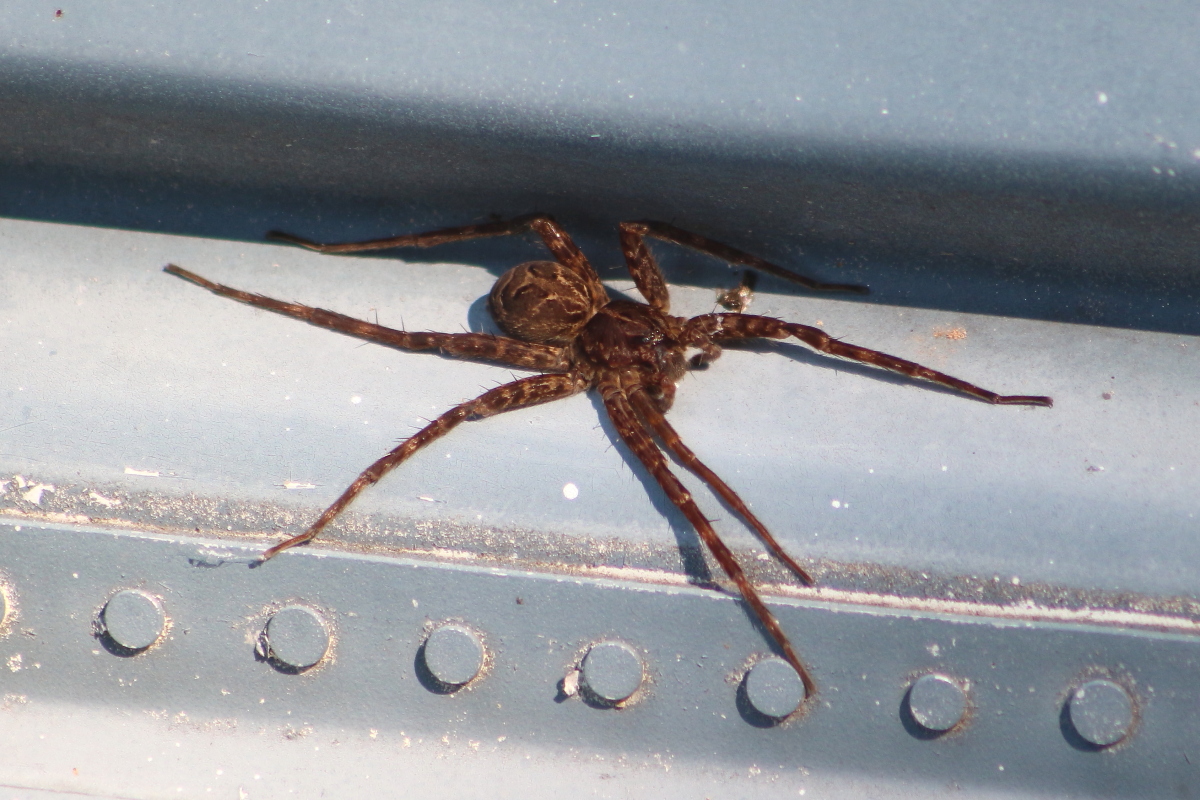
Another small animal I saw this week was a Dock Spider.
This little guy was hanging out on our screen.  I think it looks like a pirate.

I've never seen such a little one. Usually I find huge ones on the dock or the boat come mid summer.

On a much larger scale, I've seen deer a few times over the past couple of weeks so I set up the trail camera to see what I could catch. What I caught was a rather skinny young deer, nibbling its way through the trees, and then grooming itself in the opening where I placed the camera. 

It must be relieved to have green grass and new leaves to browse on after what looks like a hard winter for it.  It looks like it might have little antler stubs known at buttons - perhaps it's a young buck.
Here's a video as it browsed and groomed and picked off ticks.


Now on to the flowers - the Lady's-slippers are out.
Pink Lady's Slipper

While I was enjoying this one I noticed a dry, brown stalk coming out from its base.  It's last year's flower which is now a seed pod - an empty seed pod.  Inside it would have been many, maybe hundreds, of tiny seeds.
The now-empty seed pod.

The seeds have presumably been released on the ground so perhaps there will be a whole patch of lady's-slippers here in a few years.

Around the lake, the white blossoms of the serviceberry are gone, replaced with chokeberry growing all along the shoreline.
Black Chokeberry (Aronia melanocarpa)
The chokeberry flower is very similar to other fruit trees such as cherry, plum, and apple.


You've likely heard about the smoke in the upper atmosphere that was blown here from fires in Canada.  Between the smoke and the pollen there have been some pretty impressive sunsets.


It looks like we're going to have nice sunsets all weekend; let's enjoy this beautiful weather as we remember what this long weekend commemorates.  There will be a memorial service at Oakland Cemetery on Monday morning at 8:00 and all are welcome.
A prior Memorial Day Ceremony at Oakland Cemetery.

Sunday, September 18, 2022

September 18, 2022: Butterfly Questions

Last week I saw monarch butterflies in the fields, and this week I saw a different bright orange and black butterfly right at the house.  

Another bright orange butterfly.

In addition to the monarch I recognize a couple of other butterflies with primarily orange colors including the painted lady and the fritillary, but this one was none of those.  What really caught my eye was the way it folded its wings flat and straight up in the air, and the fact that when resting like this it looked completely different.

Looking like a dead leaf.  Note the partly unfurled proboscis.

I thought it looked so much like a dead leaf that if it were in the woods it would be perfectly camouflaged and invisible to predators.  It sat on a piece of clothing that was left on the railing and uncurled its proboscis to probe the cloth.

That curly white mark on its wing is significant.

I have no idea what it thought it might find there.  


The combination of bright coloring on one side of its wings and drab brown on the other side made it easy to narrow down its identity to just a couple of species of brushfoot family butterflies.  But there are two that are quite similar with one clear identifying feature:  The white curly line with a dot beside it on the outside of its wings that someone thought looked like a question mark.  Thus the common name for this butterfly:  "Question Mark"  The very similar "comma" butterfly lacks the dot, thus its common name is ",".

There were a few other insects to be enjoyed this week.  One, small and pretty, is this  Snowy Tree Cricket:

Snowy Tree Cricket

I don't know that I'd ever seen this insect before and I wouldn't have guessed it to be a cricket - I didn't even know there were any other crickets beyond the usual black Field Crickets that serenade us on warm summer evenings.  Now that I've listened to the call of the tree cricket (which is much more musical than the sharp chirp of the field cricket) I realize I heard them all the time but didn't know what they were.  You can listen to it here, and the video also shows the action of their wings which they rub together to make the sound.  And you can blame the summer racket on the guys - only the males can "sing", and naturally, they do this to attract the gals.

One last insect to share might be less exciting for some to see:

Dock Spider.

I'll bet this is the same spider I saw a few weeks (August 28, 2022), the one I saw jump off a rock onto the water and right back up again.  It looks like she's had no problem finding plenty to eat.  I'm assuming its a female because it's so big.

One big momma.

Males are about half the size of females.  But enough creepy crawlers.  Let's end with a peaceful moment brought to you by Maddie and her mom.

Nap time on Lake Wicwas
I think our northern loon pair has left the lake as Maddie and her parents are now fishing throughout their section of the northern end of the lake.  Maddie will be here for another month or two though her parents may leave weeks before she does.  Change is coming.


Sunday, August 28, 2022

August 28, 2022: Quiet Time at the Lake

It's the time of year when things are pretty quiet around the lakes.  Most of the animals are done with searching for and attracting mates and are now carefully raising their young, doing their best to keep them hidden from predators.  Food is plentiful so animals don't need to prowl widely in search of sustenance and so are able to keep to remote areas away from human activity.  Hot, humid days also  keep many animals deep in the forest with most of their activity taking place in early morning, late evening, or after dark when it's cooler, though I do see a doe and her fawn on occasion in the hour after sunrise.  And I know other animals are out there because I find evidence of their travels and successful hunting trips dotting the trails.

Fox scat strategically deposited upon a stone wall.

Yet there's still lots of activity to be found if one sets their sights on smaller, less visible life forms.  This large American toad was squatting at the edge of a trail where there must be a plentiful supply of food.

A fat American Toad waits patiently for a spider or slug to amble by.

Spiders are abundant now and some are large enough to be a hearty meal.

A good size dock spider.


While I was watching this spider I witnessed it catch a meal.  It suddenly sprang off the rock onto the surface of the water and just as quickly leaped right back up on the rock.  In one flash of continuous motion it had picked off some tiny insect.  Spiders are close to the bottom of the food chain, consuming very small life forms, and in turn are eaten by toads, frogs, and snakes, which then are gobbled up by herons and various other birds and mammals.

A great blue heron watching for the motion of a frog, toad, or fish.

I also saw this young painted turtle soaking in the warmth of the afternoon sun.

It's shell was only about 3 inches long.

I may not see much activity in the forest in late August but it is a time when I start to notice changes in the trees themselves.  It's very subtle, yet the differences are noticeable in the colors around the lake.  The green on the trees seems just a little darker as photosynthesis and chlorophyll move into the latter stages of the season.  Likewise the blue in the sky and and contrast of cumulus clouds in the mid day sun have a discernable change as the sun impinges at a slightly lower level.  The days are now two hours shorter than they were back on the solstice and the sun sets across the lake noticeably farther south on Sheep Island.  I do my best to ignore the stray branch on a red maple tree that has turned red and the poplar across the lake that show tinges of yellow - I tell myself those are weak or sick trees and not really a sign of a waning summer.  


There are other signs that are harder to ignore.  This week I heard the first pin ball game being played by the red squirrels as they gnawed cones off the top of the white pines which bounce off the branches as they fall to earth with a thunk that says "game over".  Most of these seeds won't get to become mighty pines as they'll be collected and squirreled away in the harvester's winter stores.  Someone passed on their observation that there aren't a lot of white pine cones in the trees this year, and I agree.  In contrast, the spruce trees do seem to be over achievers this year.

Laden with cones on the east shore of Mark Island, I think this is a Red Spruce.

Our little loon chick isn't quite so little any more, and in fact is now molting the last of her baby feathers and starting to reveal juvenile plumage, as captured by Debby Crowley this week.

At six weeks Maddie is starting to lose her downy baby feathers.  Photos by Debby Crowely.
And her appetite has grown as well.  She's now willing to tackle fish that a couple of weeks ago she would refuse.
Mom or dad brings in a big one.

And somehow she swallows it down.  (Thank you Debby for sharing these fabulouse pictures with us!)

If she keeps eating like that there's no doubt she'll be ready for autumn when it arrives.


Sunday, September 21, 2014

September 21, 2014

Fair warning to those of you who are not enamored with insects - this week I had a double feature.  I saw two insects - a spider and a grub - interacting with each other, although one was doing a lot more interacting than the other.  If you follow this blog, you know that spiders (which are actually arachnids, not insects) are carnivorous predators, so you have probably guessed that the spider had the upper hand in the relationship.  In fact, the spider, a medium sized dock spider, was in the process of consuming the grub.


The grub was still alive, squirming in a futile effort to escape. 

Later the same day a large flock of warblers flew through the area;  they were picking similar larvae off the leaves of trees as they went.  The whole flock was present for only a minute or two, flying on after clearing out the immediate area.

I saw another tiny creature that must have hatched out just recently - a Brown Snake. 
Immature Brown Snake, or DeKay's Snake (storeria dekayi)

Although very small, it was rather quick, but it settled down in my hand to pose for a picture to show the size of it.

This species of snake bears its young live;  this one may have only been a few days old.  I found it creeping in the vicinity of the late-blooming Nodding Ladies' Tresses which I always enjoy finding this time of year.
Nodding Ladies' Tresses


The lake was very quite on Sunday when I went for a kayak;  I saw more ducks than humans, although there were people out on the islands enjoying the warm day before the showers came through.


I also more signs of the leaves starting to turn.
Maple Trees in Wicwas Wetlands

And as the sun arcs lower in the sky and sets farther south, the evening light shines its orange colors on different shores around the lake, now painting houses on the north shore a beautiful color at sunset.

The equinox occurs tomorrow (Monday) at 10:29pm.  Welcome fall.

Sunday, July 27, 2014

July 27, 2014

Blueberry season is in full swing now, with ripe berries dripping off the high-bush blueberry bushes all around the edges of Lake Wicwas. 

If you want to enjoy this delectable fruit of New Hampshire you should hurry, as they will only last a couple of weeks.  Just beware you may have to fight over them with the bears - someone saw a black bear on Sheep Island gorging himself on blueberries!  I have been watching the Black Cherries for signs of bear activity, but haven't seen any there yet.  Only the birds and squirrels have been consuming them, as seen by the bare stems. 

Black Cherry

Bears are much less deft in their dining, leaving torn and broken branches in their wake.

While I was a-berrying near the water's edge I discovered some old scat that revealed the recent diet of this otter:  Crayfish.
River Otter Scat

There is always a lot of fish scales in otter scat, but this clearly shows crustacean shells as well;  they look like tiny lobster shells, even having turned red after baking in the sun.


My morning paddle around the lake revealed several interesting sights, including a Great Blue Heron enjoying the sunrise.
Great Blue Heron

Here's another picture of a heron, taken by Brian Matteson (thank you!) as it stood right on his dock at 8:30 in the morning of July 9th.

Farther along I came across two groups of loons out for a morning sail - probably the same five I saw last week, but split up into two teams.  First, a group of three,


and later a group of two that were far more interested in each other than they were in me.

They swam right past my kayak as I floated in the middle of the lake, even posing for a portrait.


These two played their usual head dunking game, with one dunking the instant the other put its head in the water.  I didn't see any foot wagging, so I don't know if any of these are the banded loon, but I'm guessing that one of this pair is just that, keeping an eye on the other loon to keep it away from the chick.  This guess is based on the information I received from Janelle Ostroski at the Loon Preservation Committeeon on what I observed last week.  She says the loon with the green and red-and-white striped bands - put on in early July - is the female of the nesting pair that had the chick this year.  Janelle says it's possible that she is hanging out with the other loons to make sure they stay away from her chick.  (With only one chick, a single parent will have no problem providing for it.)  I just read the article in the LPC Summer, 2014 Newsletter about how territorial loons can be when they are establishing a new presence on a lake, even killing other bird's chicks, so she is being a good mother. 

There is a single loon that appears to have taken up residence in a cove at the far end of the lake.  It just floats in the middle of the cove all day long, sometimes cruising the shore line for food and reconnaissance purposes.  When another loon comes into the cove, it meets it, confronts it, and I assume sends it away again (I can't tell them apart, so I can't be positive which one actually leaves).  Every now and then it puts on quite a dramatic show:  it almost takes off, flapping its wings harshly on the water as it skims along the surface at near flight-speed.  It will curve all along the cove, travelling well over 500 feet in this mode.  My theory is that this bird has staked its claim on the cove, and is protecting its territory, waiting for a mate to come along.  Maybe next year?

Back home, as I approached the deck, I startled a chipmunk that ran off the step and hid under a plant right beside my foot.  I also noticed a large black scarab beetle upside down on the step with its legs flailing uselessly.  So I flipped it over, but something didn't look right.  Closer inspection revealed its head was missing!  Mr. Chipmunk must have been munching on the beetle, starting with the head.  Much to Rosie's relief, by the time I grabbed my camera, the chipmunk had returned, and when I approached he ran away again, this time taking his breakfast with him!  There is one good side of chipmunks in your garden!

Those of you with insect issues weren't so fortunate with this next subject, so you may want to fast forward a bit.  With the abundant insect life around the lake, the spiders are growing by leaps and bounds.  This cute little guy (over 3 inches long, leg to leg) has taken up residence on our dock - thus the common name of "dock spider."
Dock Spider (Dolomedes )


Like most spiders, these Dolomedes have eight eyes, but unlike most spiders, they have quite an interesting feeding method that uses the hairs on their legs more than their eyes.  But that story will have to wait for another day or this post will get way too long.

At sunset we observed one enjoyable aspect of the wild fires taking place in Canada.  After the fine soot drifted the 2400 miles to New England, making its way into the upper levels of the atmosphere, it attenuates much of the shorter wavelengths of sunlight, providing stunning red colors, deepening in hue as the sun sets lower and lower.
Sunset colored by smoke from fires in Canada

The blueberries might only last a couple of weeks around the lake, but that's a lot longer than they last once they get in the house and Linda does her magic - then their life span is measured in seconds!