Showing posts with label Goslings. Show all posts

Sunday, May 25, 2025

May 25, 2025: Northern Water Snake

Swimmers in New Hampshire lakes might not be pleased to see this, but rest assured that these snakes will flee from anything larger than a big frog, especially humans, so there's nothing to worry about unless you decide to approach one of these guys.

A northern water snake on a midday search for food or a mate.

Northern Water Snakes are very common around all our waterbodies, rarely found any distance from a pond, lake, or stream.  They are excellent swimmers and especially active this time of year when they are searching for mates.  After mating the two snakes will go their separate ways, with the female gestating 10 to 30 young until late summer.  During this time, water snakes feed primarily on fish and amphibians, but also crayfish, leeches, and other snakes.  

Snakes use their tongue as a sensor.  They stick it out to collect airborne molecules on it, then pull it in into their head and place it into an organ that lets them smell what was captured on the tongue.  The forked tongue provides a stereoscopic capability which lets them determine the direction of the source. 

Sticking our its tongue to smell.

Northern water snakes are not poisonous, but do have sharp teeth they use catch and hold onto their prey, which they swallow whole.  With fast reflexes they are able to catch fish, sometimes hunting minnows at night, though they are most active during the day, and are often found sunning themselves on a warm rock or branch at the water's edge.
A good size water snake I found sunning itself on a rock a few summers ago.

Predators of water snakes include birds, racoons, and snapping turtles, as well as other snakes.  Some day maybe I'll see an eagle swoop down and grab a swimming snake off the surface of the lake.


The female water snake is ovoviviparous, meaning it gives birth to live young which are left completely on their own.  This is the time for larger fish to exact revenge, as the infant snakes are especially vulnerable to fish.  Many of the young won't survive, but with a couple dozen snakes born every year over perhaps a five year life span, the species is not in danger - where there is a good food source.  The biggest risk to this species is the loss of natural waterfront habitat which provides the food it needs.


I haven't seen a snake sunning itself on this tree trunk that fell into Lake Wicwas, but lots of other animals have been using it including turtles, geese, ducks, and this week, a Double-crested Cormorant.  

Double-crested Cormorant.
A pair of mallards does their preening on the log.


The water level in Wicwas is still about 10" above normal, but at least one pair of geese was able to incubate their eggs before the lake flooded.

Looks like five goslings.

The loons, however, are still cruising the lake, waiting for the level to go down before building a nest.  One day we saw both pairs of loons floating on their respective side of the line that divides the two territories, and both pairs were vocalizing loudly to let the other pair know they need to stay where they are.  The northern pair did have an intruder one day, which they appear to have quickly sent packing to another lake.

An intruder in the northern territory.


Cool weather has extended the period of the early wildflowers; all the ones noted last week are still in bloom.  This week the Lady's Slippers are in peak color, the Painted Trilliums have started to bloom, the Canada Mayflowers are about to, and the various cherries are in full bloom.

Painted Trillium.

Lady's slipper in a deep color.

Canada Mayflower about to bloom.

I also saw a small Jack-in-the-Pulpit just starting its spring sermon.  

Jack-in-the-Pulpit

There will be more of these soon, but you have to look for them as they hide under cover of their leaves!


Sunday, June 4, 2023

June 4, 2023: We have a Loon Nest

The pair of loons we identified several weeks ago, the "northern" pair, has nested! 

Photo by Marge and Dave Thorpe

It's in a rather remote part of the lake that will have minimal impact from motor boat traffic, and probably not a lot of kayak traffic either, so at this point it won't be marked with signs in an attempt to minimize disturbances.  The nest is so well hidden that it was only discovered when someone paddled so close that the loon not on the nest started to act up and gave away the location.  Many thanks to Shayne Duggan for being aware of the loon's behavior and knowing what it meant.  The Loon Preservation Committee has a description of loon behaviors on their website that will help you understand what different behavior means.  You can find it here:  Loon Watching the Responsible Way:  A Guide to Understanding Loon Behaviors.

And now a second pair of loons is starting to exhibit nest-building activities.  I was able to see bands on one of them - it's the male that was banded here last year, and raised the chick Maddie.


We haven't been able to see whether there are bands on his mate, so we're still waiting to confirm if last year's banded female is back.  

Something that is back are eagles.  There were multiple sightings of an immature bald eagle soaring over and divebombing the loons.  Adult loons should be fine, but loon chicks are quite vulnerable to eagles as well as to hawks.  I'd much rather have the eagles go after this critter I saw swimming in the lake on one of my paddles this week:

Northern Water Snake

Northern water snakes are harmless and don't bother me one bit, but they are much more plentiful than loon chicks!

As always, the geese are well ahead of loons in their breeding; I saw three geese families on another paddle, two swimming in the lake, and one up on an island foraging for food.

A family with four goslings on Sheep Island.

The little chicks are awful cute when they are so small and fluffy.


When the parents on the island saw me they encouraged the chicks to move along into the bushes for safety, which they did only reluctantly and with significant prodding - they clearly wanted to continue to find food in the warmth of the sun.

In need of a little prodding.
"Move along junior!"

What amazed me was that the parents were perfectly silent the whole time - you know how loud they usually are when they feel threatened, but not when there are chicks to hide.  A second family with four goslings, and a third family with six, were side-by-side, out for their morning swim.


That makes 14 new geese on the lake this summer!

The late frost we had a couple of weeks ago killed the leaves on quite a few of the beech and oak trees that were exposed to open sky.

One of many oak trees damaged by the late freeze.

I've been watching to see if they would put out a second set of leaves, and this week they started to do that.  

I'll keep an eye on them as the season progresses to see how they do.

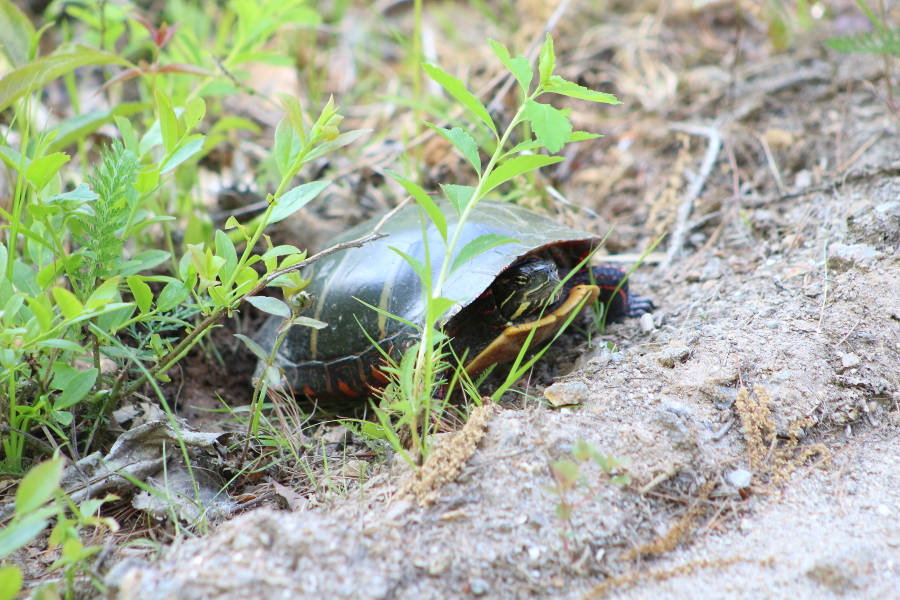
Finally, birds aren't the only animals working on nests right now.  Watch out for turtles crossing roads to get from water to the perfect site to lay their eggs!

Momma Painted Turtle laying her eggs on the shoulder of the road.

It's almost peak time for new life on the lakes!


Sunday, June 5, 2022

June 5, 2022: The Loons have Nested

Amy Wilson had the sharp eye and key knowledge to discover the loons have selected a nesting site and are incubating an egg - hopefully two.  She noted the key sign was a single loon floating in the lake just off a prime nesting island.  And these loons are good - the nest is extremely well hidden, impossible to see behind thick vegetation which also provides shade from the intense June sun.  Because it's in a popular boating lane but can't be seen, paddlers and fishermen are likely to flush the loon off the nest by passing close to it without ever knowing it's there, so markers have been placed to alert boaters to keep a safe distance from the site.


On Thursday Loon Preservation Committee intern Taylor Tewksbury came to the lake to document the nest.

LPC intern Taylor Tewksbury inspects a nesting site from a prior year.

We were able to observe the bands on both loons, confirming their identity:  the male banded on Lake Wicwas in 2019 and the female banded on Lake Pemigewasset in 2018.  We also were given a great show by the male doing his afternoon grooming.  It was so dramatic that we saw it from a far distance and thought there was an altercation taking place.  
From a distance this looked like trouble.

But no, it was just him grooming and spreading oil, and doing some acrobatics in the process.  

Just some very enthusiastic preening.

He was putting on quite a show for us.

I've never seen a loon do the backstroke before.

We also observed a shift change. so both parents are doing their part on the nest.  This is the same pair that successfully raised Coco and Jimmy last summer so we're hoping for another successful breeding season!


The Canada geese, as usual, are far ahead of the loons and at least one family is already out on the water with their goslings and I expect there will be more soon.

Two is an unusably small brood for Canada geese.

We're right in the heart of breeding season for many of our local fauna, and the forest, especially in the morning, is just brimming with the sounds of nature, displaying a plethora of songs stating their presence, whether it's to attract a mate or deter a competitor.  One morning there was a nice chorus of bullfrogs singing so I thought I'd capture a bit of the performance.  I was so focused on the frogs that I didn't realize there were so many birds accompanying the amphibians.  In this recording there are at least five different birds vocalizing, including  a veery, common yellowthroat, eastern wood peewee, great crested flycatcher, and at the very end a loud, piercing, broad-winged hawk:


I think I hear a mourning dove in there too.

The animals aren't alone in making every effort to propagate their species - many plants, terrestrial and aquatic, are in full bloom to attract pollinators to help them along.
Yellow Pond-lilies (Nuphar lutea)

There are often flies inside these flowers pollinating them, but not this one.

Lupine

This is the week to head up to Sugar Hill to see the lupines!   (With maybe a stop at Polly's....)


Sunday, June 9, 2019

June 9, 2019: A Second Nest Appears

For the second year in a row there are two loon nests on Lake Wicwas.  I expect we'll see a band on the first pair to know it's our long-resident female, but without bands to identify the second pair we we can only postulate these are the same birds which have returned for another year.

The second nest is in a secluded spot on the lake where there isn't much boat traffic so it will not be marked with signs and its location won't be advertised.  If you do happen to come across it or observe a loon behaving strangely just move away from the area.

I noticed the nest because two loons were close together near shore but clearly not fishing.  Thinking something was going on, I took some pictures from a distance but only after blowing them up did I see they were building a nest on a tiny mound of earth.  One bird was at the nest pulling up weeds while the other loon was farther out searching for more substantial building materials and bringing them back.
A dive down to find some nesting material

What did we find?
A pretty little lily pad for the nursery


According to the Loon Preservation Committee, both the male and female participate in home building.
The second loon gathering sticks for the foundation


As of today a loon is sitting happily on the nest, though it has no shade at all so when the weather gets hot it might not be so happy.  It will be important for one parent or the other to stay on the nest as an egg can cook quickly if exposed to the hot sun.  They'll switch positions frequently to allow their partner to go for a swim and cool off.

Last year both of our loon pairs laid two eggs and each hatched a single chick, but both of them succumbed to the many threats a loon chick faces. Let's hope things go better this year.

The other large birds that nest on local lakes seem to fare much better, and the parents have already hatched their eggs and are out on the water tending to their brood.
Seven little goslings in a row

Geese and loons will sometimes interact but mostly they keep their distance from one another.

When I was out attending to some conservation areas on the lake this week I was visited by a few other birds including one I don't see very often.
A curious song sparrow wondered what I was up to

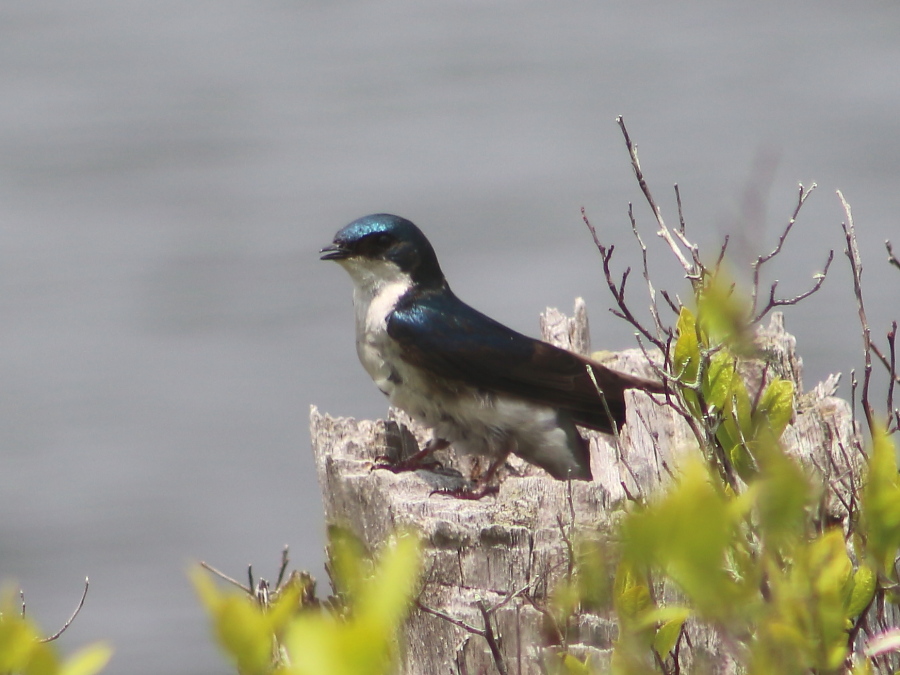
And a tree swallow sat for a long time and watched
 Both of these were on Turtle Island.  This next one was poking along the rocks over at Bryant Island looking for insects to eat.
I don't see a spotted sandpiper on the lake very often.

It's always nice to have some company to share the beautiful sights of early summer on the lake.

Sunday, May 13, 2012

May 13, 2012

Lake Wicwas is really starting to come alive now.  All the trees save the oaks have leafed out and are turning darker green, and more and more of the other plants are joining them, including a flower I haven't noticed before - a tiny member of the lily family, the Sessile Bellwort.

Sessile Bellwort (Uvularia sessilifolia)


Here a fern that was just a sprout last week is about to unfurl.

And a few other pretty flowers:

Star Flower

Bluets

The blueberries have set their blossoms, and the vestiges of this summer's fruit can be seen as minute green specks where the blossoms have been relinquished.
Blueberry

Another fruit, the black cherry is in bloom;  each blossom will form a single cherry, and tiny insects are helping with the pollination.
Black Cherry
 

An advantage of the cool, wet weather this past week (in addtion to filling the lake back up) is that the flowers have a much longer season.  Also, the black flies aren't too bad yet, but there are plenty of tics around.

I found this Orange Jelly Fungus on the ground, but it must have fallen off the tree where it grew.  Jelly fungus are reportedly edible, but I didn't sample it!
Orange Jelly Fungus  (Dacrymyces palmatus)
I saw a deer enjoying the fresh, tender foliage of the spring plants, consuming lots of nutrients in the last month of her gestation period .  Whitetail deer have a gestation period of 200 days, with mating taking place in late November.  Both male and female mating clocks are triggered by the amount of light in the day, so they have a quite precise mating date that is not influenced by weather.  Thus fawns are usually born in early June, though it can be delayed if there is insufficient food for the doe so the fetuses (there are most often two) need more time to gain sufficient weight.  And if a doe doesn't conceive at her first mating, she will have a second heat in about 30 days, delaying birth until July. 
July 2010

The geese don't wait so long - their young have already hatched out and the goslings are being introduced to the lake by their parents.  Talk about having your ducks in a row!