Showing posts with label Swamp Rose. Show all posts

Sunday, October 5, 2025

October 5, 2025: Summer Continues

It's hard to remember it's October with seemingly endless summer weather coming day after day.   The forecast for Meredith is for three more days with the temperature hitting 80 degrees before rain arrives on Wednesday.  On one of those gorgeous days this week I took a long, peaceful paddle around the lake and was treated to several large bird sightings.  First was this mature eagle perched in a prime spot to watch over the world.

Farther along I saw an eagle fly high over the lake, and later a third one, immature, swoop down low, right at the loons.
An eagle on the hunt for fish - or loons.

The loons were aware of both of these. They sent out a general alert about the high-flier, but when the immature eagle came on its strafing run, they let out some pretty impressive shrieks that resounded across the lake.  Fortunately, all the loons evaded the attack.  There were three that I saw on this paddle, two together which swam amicably towards a third.   All were adults in various stages of losing their sharp summer plumage.  I didn't come across Spangle.


The northern territory male loon is still on the lake as well.  Perhaps he's sticking around to keep other loons out of his territory, or perhaps he's making sure he's visible to any eligible females that might fly over Wicwas on their way to the ocean.  (I don't know about this, I just like to consider various hypotheses - which sounds better than just making stuff up.)

The rest of my trip was spent just savoring a quiet, late summer day - and I wasn't the only one doing so.
A couple of painted turtles soak up some warm summer rays.

Swamp Rose (Rosa palustris)
Groundnut (Apios americana)

Groundnut, also know as wild potato, has edible tubers and legumes.  The tubers were an important food source for the native Americans, and were boiled like potatoes.  Europeans also relied on them during their early years in Massachusetts.  [Ref: Lady Bird Johnson Wildflower Center]  I've seen groundnut growing in multiple locations around Lake Wicwas.


As leaves turn and start to drop from their branches, the sightlines through the forest are returning.  I had walked this section of trail a few times this summer but never saw this huge hornets nest until now.

It's a beauty - and so big it's bent the branch it's attached to almost 180 degrees - they must manufacture some pretty strong glue.  Bald-faced hornets are aggressive and pack a powerful sting, so I was careful in walking behind the nest to take a video of the residents coming and going as they performed their duties.  Click below to see the video:
They know to create the opening facing away from the prevailing winds.  I wonder how many hornets call that nest home.
 

Soon all the leaves will be gone, and the hornets too.  But as long as they last, let's relish in these last glorious days of summer.


Sunday, July 14, 2024

July 14, 2024: A Week of Extremes

It was a week of extremes on lake Wicwas, from great beauty to true tragedy.  We'll start with the beauty from a paddle in one morning as the lake was just waking up.  Dragonflies and damselflies start their days drying off the prior night's dew along the reeds and ferns near shore before starting their hunting excursions for the day. 

Pondhawk


There were quite a few young damselflies that apparently had just hatched out from their larval stage.  

This is a spreadwing damselfly, perhaps an Emerald Spreadwing.

I found their exoskeletons on reeds where they had metamorphized into their flying forms.  

Exoskeletons left on the reed where they climbed up out of the lake.


I also saw that blueberry season has begun. 
They're still mostly green but some have turned a powdery-blue.

The first fruit was just starting to ripen but later in the week I was able to find enough for our first batch of Lake Wicwas summer blueberry treats.  They'll probably hit their peak this coming week so if you're around now is the time to take advantage of this opportunity to taste summer in New Hampshire.


On the gloomy end of the enjoyment spectrum is more sad news for the loons.  Jayden from the Loon Preservation Committee came out on Wednesday for a routine check on our loon nests, and as we approached the north nest everything seemed fine with the male loon at his sentry post, but as we got near the nest we saw a terrible sight.  The female loon was dead on the ground about four feet from the nest. 
The female loon with the nest in the foreground.


Not expecting this event we had to return to shore to get proper protective gear to bag the loon to bring it to the Loon Center for study and hopefully determine the cause of death.  This gets a little grisly now, so you may want to skip over the next two pictures.  There were no visible injuries on the bird such as a spear hole through the sternum which would indicate attack from another loon.  

A scavenger or two had found the carcass but most of the bird was intact.


Possible causes of death include a fight with another loon, perhaps a female trying to evict this female from its mated pair so it could take its place.  (This is in fact what this female did in 2021 when she killed or drove off the prior banded female - she hasn't been seen since.)  Another possibility is of course lead poisoning.  Either of these could have weakened the loon causing it to return to its nesting site where it expired.  There's also a possibility of attack by a predator but it seems unlikely since the bird was not taken away or consumed.  We know it took place at most 48 hours earlier, because two days prior the female was sitting happily on her nest. 
July 8th, 2024


The Loon Center is very busy right now so a necropsy (an animal autopsy) will probably not happen until this fall but hopefully blood tests and examination of injuries and will give us some indication as to what happened.   If we get a report later in the year I'll be sure to pass on what was discerned.  Both of the destroyed eggs were outside of the nest and were collected for study as well.  Before and after this event there has been a lot of loon trauma on the lake, perhaps all caused by a rogue loon that's been here much of the summer.  It's been dubbed "Bad Loon" by someone who's seen it even harassing the ducks!
"Bad Loon"     Photo by Amy Wilson.


We also went to the site of the southern pair where Jaden was able to find some shell fragments from that nest which were also collected to be analyzed.  It's unlikely the southern pair will nest again, but the pair is still staying close together in their nesting territory so it could happen.  At any rate it's been a very difficult year for the Wicwas loons and it may be the first year since 2017 without at least one chick fledged.  It's a painful year to be a loon watcher on Wicwas.


The ducks have done much better.  I've seen a couple families of little ducklings zipping rapidly into the weeds when they hear my kayak approaching, and this week I must have caught them off guard when I rounded a corner because once we saw each other, Mrs. Wood Duck put on quite a show scooting and splashing dramatically along the surface to draw my attention in the opposite direction from where she had sent her little ducklings down around the corner. 

Once she was far enough away she went airborne and circled up and around to make sure she was seen.  But looking back at the ducklings I saw what I'm pretty sure was another adult hen herding the ducklings along.

Mrs. Woodie #2 herding four visible ducklings plus an unknown number around the bend.

I know some waterfowl as well as some land birds (turkeys for example) will merge their broods together and I wonder if that's what happened with these two merganser females. 


OK, we'll end the week back at the beautiful end of the spectrum with some summer flowers blooming right now.
Shinleaf

Swamp Milkweed

Steeplebush

Pickerel Weed
Page Pond
Swamp Rose.  (Those last two pictures were taken at the Page Pond Town Forest on Meredith Neck.)

Bring a pair of binoculars on your travels around the lake to enjoy these heart-warming summer sights.


Sunday, July 16, 2017

July 16, 2017 - Annual Loon Census

Yesterday the Loon Preservation Committee held the annual loon census where volunteers all over the state observe and record the loons they see between 8:00 and 9:00 am.  The data is analyzed and compiled to create a picture of the loon population in New Hampshire.  Since the Wicwas loons are nesting late this year, we knew where to find at least one of them.
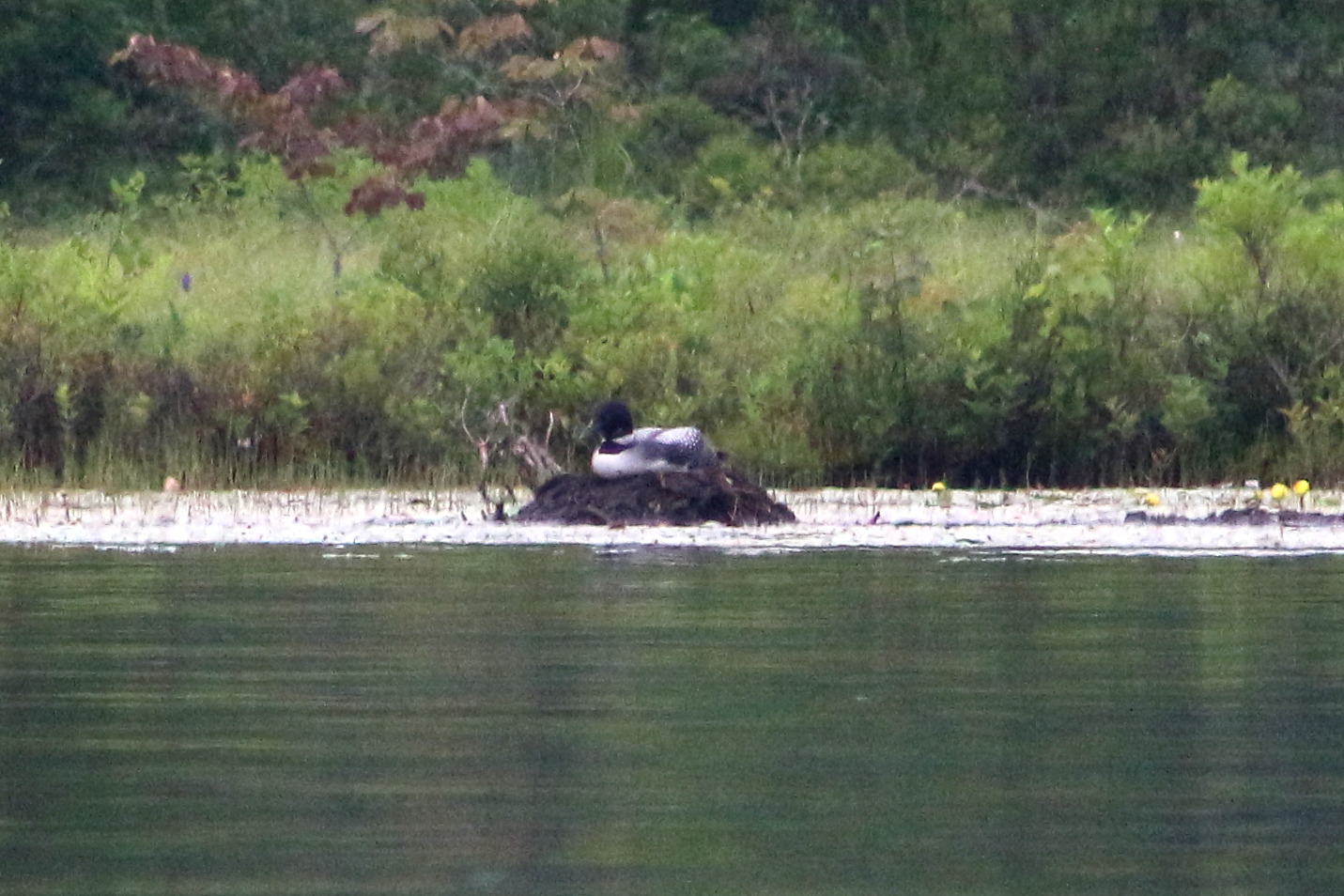
King (or queen) of his own island

The loon on the nest was somewhat concerned due to several boats in the area, so I kept a safe distance away.
Head lowered means move away before the loon leaves the nest for the safety of the water

What I presume is the mate of the bird on the nest was several hundred yards away and appeared to be keeping an eye a rogue loon, driving it away from the nesting site out towards the center of the lake.  I also saw a loon fly over the lake, circle overhead, and then fly back in the direction from which it came.  Almost an hour later another loon flew in and landed - I don't know if it was the same loon or not.  So over all, my Lake Wicwas Loon count was three on the water, and two flying.  If you are a member of the LPC you will receive the results of the survey;  if not you can join here.

Of course, paddling around on the lake in the morning provides perks beyond loon watching.  I saw two heron fishing beside the Rawson Wood Islands, as a red-winged blackbird serenaded them from its perch high in a shrub over the marsh.
Red-winged blackbirds like to sing from highly visible locations

Right below the blackbird was a pretty Swamp Rose.
Swamp Rose (Rosa palustris)

These are blooming all around the lake; you will find them along much of the shoreline, sometimes with visiting pollinators if you look closely.
Bumble bees pollinate the Swamp Rose

And the heron and loons weren't the only ones fishing - there were several humans out doing the same.
The strike!

The catch


The release
Thanks DC for being a willing subject!

As we watch the loons nesting in this year's selected location off what are known as the "Rawson Wood Islands" it's worth remembering that Mr. Wood conserved these very islands because he was aware they were prime loon nesting territory.  Rawson Wood was dedicated to conservation - did you know he founded the Loon Preservation Committee which is such an important force in protecting loons in New Hampshire?  He also founded the North American Loon Fund and was a director of the National Audubon Society.  It is quite an honor to have an island in Lake Wicwas named for him, and to have his name on the list of generous people who have likewise granted conservation land to ensure Lake Wicwas will be a sanctuary for loons and many other species long into the future.
A Great Egret fishes on the Rawson Wood Islands (photo from June, 2016) 

Sunday, July 15, 2012

July 15, 2012

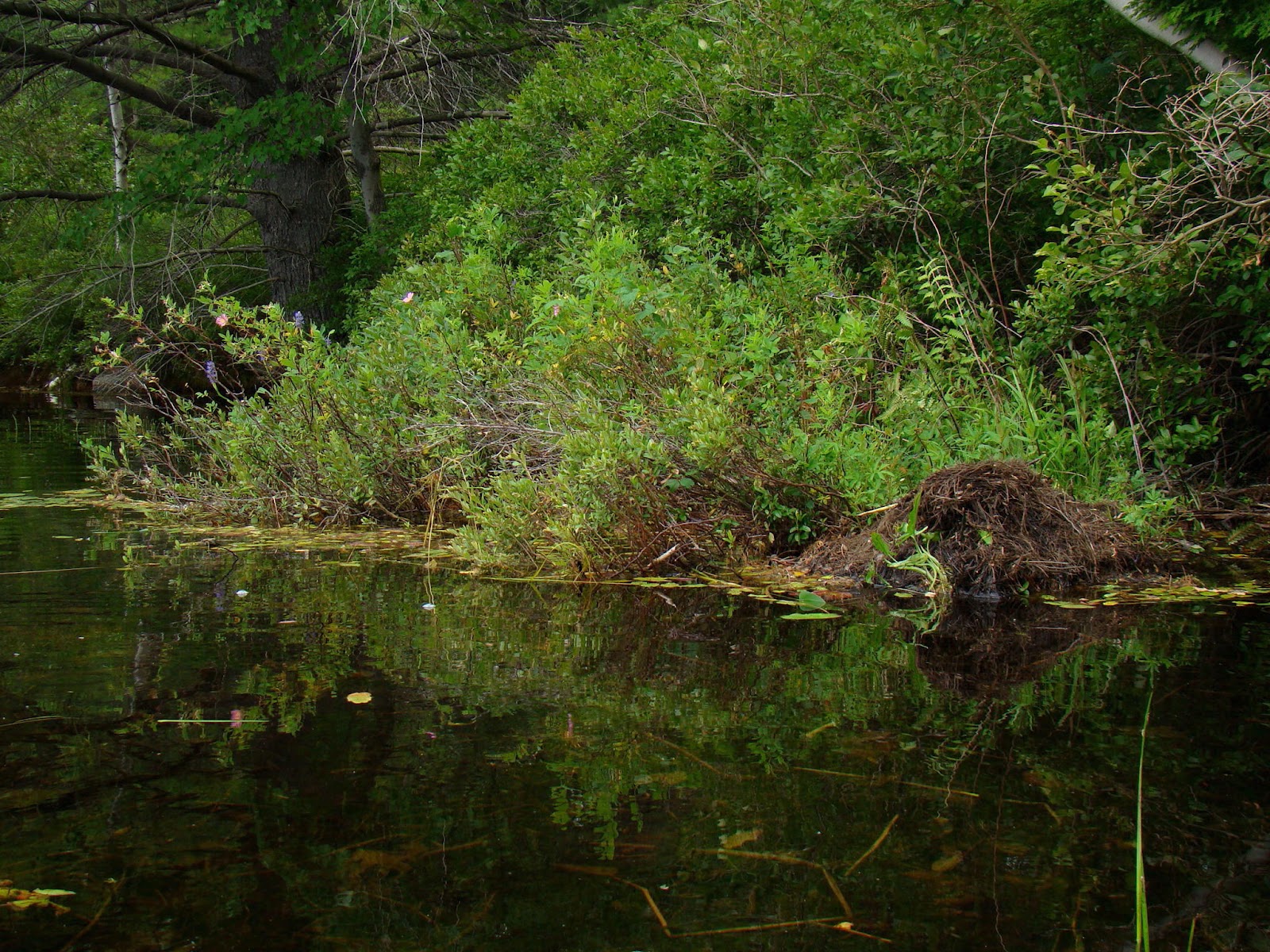
Last week when I was looking at the blown down trees on the shore I noticed this pile of vegetation which I thought was a muskrat lodge.

Muskrat Lodge

Reading up on muskrats, I determined that's what it is.  Muskrats are much like beavers in that they build lodges, though their construction material is mostly soft aquatic vegetative matter rather than tree materials.  The muskrat will use a base of mud, and add weeds, cattails, sedges and sticks, though I have seen them use small, leftover beaver branches as well.  When the mound is large enough, it hollows it from the inside to form its home.

Muskrats consume large amounts of aquatic plants, enough in fact, that they can have a significant impact on recovering open water that has become clogged with weeds.  I wonder if they like milfoil - maybe the DES can hire them?

I have seen muskrats on and around Lake Wicwas a couple of times, but never had an opportunity to get a picture.  Once, in the early spring, as the ice was coming out, a muskrat was sitting on the ice at the edge of a melting hole where there was open water.  It seemed to be dipping its front paws in the water; for what reason I don't know.  The other time was when I was riding by bike along Chemung road just south of the boat launch.  I spooked a muskrat by the side of the road and it raced along ahead of me until it found a hole to duck into.  Here's an interesting fact about muskrats:  they have teeth outside of their lips that let them chew on plants underwater without drowning!  (from Rezendes, Paul, "Tracking and the Art of Seeing".)

Did you notice the muskrat has Pickerel Weed and Swamp Rose decorating its back yard?
Pickerel Weed and Swamp Rose

A quasi-quatic animal I did capture on film recently is the raccoon - this one came along at 10:00 pm and had obviously just emerged from the lake.
Raccoon


Out on the lake, it appears the loons are still nesting - hopefully we'll be seeing a new chick soon.  Decorating the lake are the Fragrant Water Lilies.

On land, the flowers from spring are now producing berries in abundance.  Blueberries of course, but also Bunchberries and even the Painted Trillium, which has large green berries that will eventually turn red.
Blueberry

Bunchberry

Painted Trillium

Continuing the bear and blueberry story from last week, the blueberries are at their peak right now.  We enjoyed blueberry scones this morning with some good friends before a beautiful paddle on the calm, placid water.  And the bears continue to enjoy the blueberries as well, leaving more evidence of their presence.

Finally, I found a boat that tore off its mooring and washed ashore.  If you know someone who lost a small yellow boat, let me know - I have it.


Sunday, September 19, 2010

September 19, 2010

Red continues to be the color of the season.  Walking to Arbutus Hill Pond, I saw many Red Efts still on the trail, and bright red Swamp Rose hips are along the shore of Lake Wicwas. 
Swamp Rose

I watched a Ruby-Throated Hummingbird collecting nectar from several stands of red (cultivated) flowers, spending a long time going from blossom to blossom.  And then of course, there is this harbinger of things to come:


In Arbutus Hill Pond there was a large group of ducks, over a dozen.  There are several heron nests there; I didn't see any herons in Arbutus Hill Pond, but I did see one later in Lake Wicwas.  There were also quite a few ducks in Lake Wicwas - where I have seen flocks of ducks preening, there have been dozens of feathers floating on the surface.  This feather, with distinctive markings, and the autumn sky reflecting off the water was special.


Near shore I saw this young Northern Water Snake - they are much more colorful when young, as they become darker, almost black, as they age.

Northern Water Snake
The water in Lake Wicwas is extremely clear right now.  This is probably due to the lack of rain this year, including thunderstorms, which wash silt into the lake.  But I believe the lake has also become much clearer in general over the years.  When I was a kid I remember noting how brown the water was in the turbulence behind a motor boat.  Today the water appears more blue-green.  It is still a far cry from the clear blue of lake like Winnepesaukee, but it's a significant change over 40 years.  I expect much of it is due to the settling of the washout from the logging that was done in the first half of the 20th century.

There are still signs of logging evident in the lake today, including remnants of the sawdust pile at the southern tip of the lake, and the logs that float up to the surface every year.  These remnants from logging have been waterlogged for years, slowly decomposing at the bottom of the lake.  As they build up gas in the wood, they eventually become less dense, and when they equal the density of water they float up to the surface.  They are never perfectly balanced though, so one end floats up first, presenting quite a hazard to boats as they float with one end right at the surface.  Or sometimes the heavy end gets stuck on the bottom, and the lighter end lurks just below the surface.  There is evidence of one of these taking its toll on a boat, as a single propeller blade is deeply embedded in the top of of these vertical logs about 30 feet from the western shore of the lake.

Several of these logs floated to the surface in 2010, and good Samaritans dragged them over to the boat landing to remove them from being a hazard.
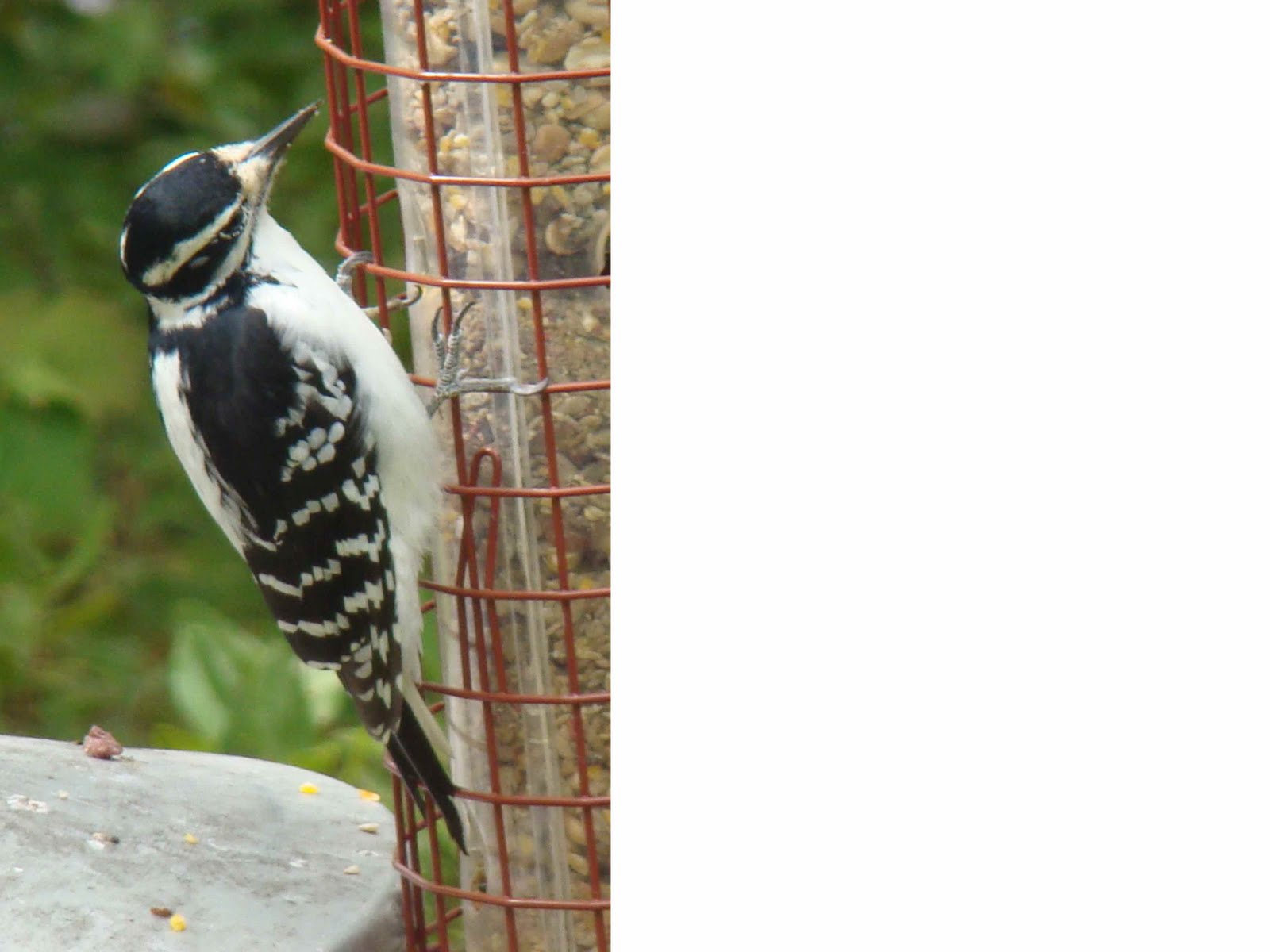
Linda was brave enough to put the bird feeder back up, at least during the day while we can watch it, and within two hours we had the usual mixed flock, including several good size Hairy Woodpeckers.
Hairy Woodpecker
This Black-and-Yellow Garden Spider was hanging upside down in its web, waiting for unsuspecting insects to fly in.  I expect the dots on its abdomen serve as a self-defense feature, appearing as eyes to keep birds away.  It won't be long before they are gone for the season.
Black-and-Yellow Garden Spider (Argriope aurantia)

The lake is still warm enough for hardy souls to swim, or even windsurf, as I saw on Saturday afternoon.  There are still plenty of boats on the lake, and lots of opportunity for more great fall weather.