Showing posts with label Red-winged Blackbird. Show all posts

Sunday, May 11, 2025

May 11, 2025: Happy Mother's Day!

Flowers for mom.

It's very kind of Mother Nature to provide a bright sunny day to help celebrate Mother's Day after a rather dreary week.  That's a Service Berry tree blooming on Sheep Island.  

Serviceberry (aka Shadbush) on Sheep Island.

I'd hoped we would have enough sun to get some of these trees blooming for Mother's Day.  The Black Cherry didn't make it, but the Hobblebush Viburnum did.
Hobblebush Viburnmum

This shrub has two distinct types of flowers.  The outer blossoms are sterile, and likely developed just to attract pollinators to the small fertile flowers in the center which produce the seeds.  It seems every plant evolved with some special trait that gives it enough of an edge to survive in a competitive world. 

There was enough sun to get a few more wildflowers to brighten up the world for mom, including these violets.

Common Blue Violets in a sunny moment.


Sunny moments were the exception for the week as it rained more days than not, giving us almost five inches of rain in the past week.  The lake rose to more to 12 inches above normal, even with the dam lowered.  We'll keep the dam open to get the lake down as quickly as possible so the loons will be able to access their nesting sites which are currently submerged.  This was the scene more often than not around the lakes this week:

A calm, misty evening.

I did fit in a couple of paddles between the showers, taking advantage of high water to explore areas of the lake that are typically inaccessible.  

Exploring a marsh near the Wicwas dam.

There were blackbirds singing loudly from tall stems in the marshes.
A Red-winged Blackbird sings its distinctive song.

I should also mention the new arrivals this week:  Chestnut-sided Warbler, Magnolia Warbler, Nashville Warbler, Yellow Warbler, and Blackburnian Warbler.  That's a lot of warblers!

I found leatherleaf that had bloomed in spite of the rain and high water.

Leatherleaf

These plants are wetland-specific species, not bothered by the high water levels.

I'll close with one more almost-flower:

A Pink Lady's Slipper preparing to bloom.

One more sunny day ought to do it - something to look forward to next week!


Happy Mother's Day!

A mid-day update:  I was way off on the lake level.  It's more like two feet above full level, lapping over the top of the dam!

Sunday, July 16, 2017

July 16, 2017 - Annual Loon Census

Yesterday the Loon Preservation Committee held the annual loon census where volunteers all over the state observe and record the loons they see between 8:00 and 9:00 am.  The data is analyzed and compiled to create a picture of the loon population in New Hampshire.  Since the Wicwas loons are nesting late this year, we knew where to find at least one of them.
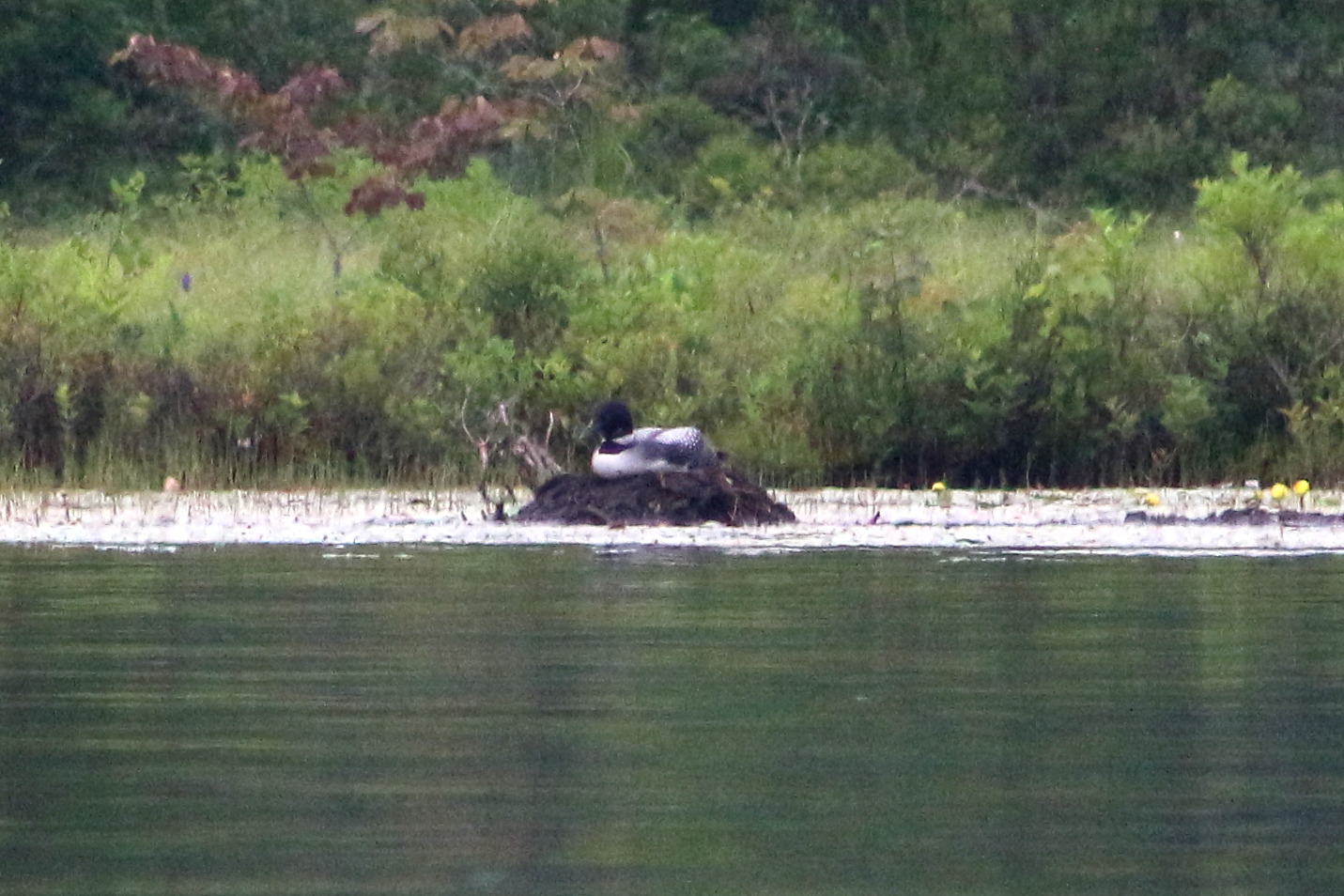
King (or queen) of his own island

The loon on the nest was somewhat concerned due to several boats in the area, so I kept a safe distance away.
Head lowered means move away before the loon leaves the nest for the safety of the water

What I presume is the mate of the bird on the nest was several hundred yards away and appeared to be keeping an eye a rogue loon, driving it away from the nesting site out towards the center of the lake.  I also saw a loon fly over the lake, circle overhead, and then fly back in the direction from which it came.  Almost an hour later another loon flew in and landed - I don't know if it was the same loon or not.  So over all, my Lake Wicwas Loon count was three on the water, and two flying.  If you are a member of the LPC you will receive the results of the survey;  if not you can join here.

Of course, paddling around on the lake in the morning provides perks beyond loon watching.  I saw two heron fishing beside the Rawson Wood Islands, as a red-winged blackbird serenaded them from its perch high in a shrub over the marsh.
Red-winged blackbirds like to sing from highly visible locations

Right below the blackbird was a pretty Swamp Rose.
Swamp Rose (Rosa palustris)

These are blooming all around the lake; you will find them along much of the shoreline, sometimes with visiting pollinators if you look closely.
Bumble bees pollinate the Swamp Rose

And the heron and loons weren't the only ones fishing - there were several humans out doing the same.
The strike!

The catch


The release
Thanks DC for being a willing subject!

As we watch the loons nesting in this year's selected location off what are known as the "Rawson Wood Islands" it's worth remembering that Mr. Wood conserved these very islands because he was aware they were prime loon nesting territory.  Rawson Wood was dedicated to conservation - did you know he founded the Loon Preservation Committee which is such an important force in protecting loons in New Hampshire?  He also founded the North American Loon Fund and was a director of the National Audubon Society.  It is quite an honor to have an island in Lake Wicwas named for him, and to have his name on the list of generous people who have likewise granted conservation land to ensure Lake Wicwas will be a sanctuary for loons and many other species long into the future.
A Great Egret fishes on the Rawson Wood Islands (photo from June, 2016) 

Sunday, July 17, 2016

July 17, 2016

Back on May first we had a late frost which coated the black cherry buds with a layer of ice.
May 1, 2016


At the time I wondered if it would have a detrimental affect on the Lake Wicwas cherry crop as it did on the New England peach crop.  But no, these hardy cherries came through it just fine.
Black Cherry survived the late frost

They are starting to change color from green to red to black, and soon the fox and bear will be here taking advantage of the bountiful crop.  Birds will eat their share too, but even before the fruit is ripe the insects start to dig in. 
Green Stink Bug (Acrosternum hilare)

This green stink bug has some amazing camouflage to help it hide from predators while it sucks juices out of the still-green fruit.

I did my mid-summer weed watch tour on a segment of Lake Wicwas this week, and I was happy to find nothing out of the ordinary.  Our Lake Host program continues to be successful in keeping milfoil and other invasive weeds out of the lake through education and boat inspections.  Far from being a chore, the process of weed watching is always an interesting event, as poking along the shores of a lake with a careful eye always reveals interesting sights.   Some of the more visible sights are signs of the beaver.  At one point I saw where a beaver had cut off some saplings to bring the tender wood back to their lodge.

I also saw their attempts to increase the size of their kingdom by stuffing all kinds of debris in the top of the dam to raise the lake level.
Beavers are genetically programmed to stop any flowing water

An unexpected sight was to see a beaver swimming along through the weeds in the middle of the day.
A beaver swims among the weeds

I also caught a glimpse of a muskrat along the shore, but it eluded the camera.

On an exposed point were the left over shells from some aquatic carnivore - probably muskrat, racoon, or mink - that enjoyed a meal of fresh water mussels at a table with a view.
Someone enjoyed a fresh seafood dinner

A weed watch tour is almost certain to reveal a red-winged blackbird chirping from the top of a reed or a branch hanging over the lake. 
Red-winged blackbird on an alder tree

Of course there are always pretty flowers growing along the shore as well as in the lake.
Yellow Pond Lilly

Unidentified wetland flower
Swamp Milkweed

I didn't see any osprey on this tour but I did see a large turkey vulture circling above me.
Turkey Vulture

If you're wondering why the weed watcher program is important to the health of our lakes and our economy, take a look at this news story that WMUR aired on Chronicle which shows the sad story of what happens when milfoil gets into a lake:  The Milfoil Battle

If you want to get in on the action and do some weed watching of your own, just let me know and we'll get you started.  Who knows, maybe you'll find your own secret blueberry bush loaded with berries along some hidden shoreline.  And even if you don't, you're sure to see something interesting and beautiful along the shores of a New Hampshire lake.
Goldfinch in its summer colors

Sunday, March 17, 2013

March 17, 2013

After our short spring interlude, winter returned to Lake Wicwas with cold temperatures - back down to 13 degress last night under clear skies and a crescent moon.  And another light snow came through and made it look like winter too!

Fresh Spring Snow Friday Night
And Bright March Sunshine on Saturday


The new snow wasn't enough to penetrate the trees and allow skiing in the woods after last week's rain devastated the base, but it left another perfect surface for both skiing and tracking on the lake.  There were numerous mink, weasel, mouse and fox tracks to be seen.  Here a pair of coyotes traveled right across the middle of the lake and along the shore line, heading into a low swampy area.
Coyotes On the Prowl
The larger foot print and stride - about 24" - distinguishes it from a fox.


The fox stride by comparison is about 16 inches long.  This near perfect rendering of a fox's side trotting pattern very was left in the very thin layer of soft snow early Saturday morning. 
Fox  Side Trotting

 A mouse also left some clear tracks in the light snow.  The tiny size of these tracks, only about two inches apart, can be appreciated by the small line in the snow left by its tail.
Mouse Tracks on the Lake
 

In some deeper snow where the sun had softened it just the right amount, we came across some deer tracks that left the imprint of the hoofed animal's dewclaws, which I don't see very often.  
White Tailed Deer Track with Visible Dewclaw Imprints

All in all, it's been a pretty uneventful winter around the lake without any dramatic events - the most interesting sights being a Cooper's Hawk and a Bald Eagle in late February.  But all the snow has made it a great winter for animal tracking, and lots of other outdoor activity.
Signs of a Good Day on Lake Wicwas

Saturday, May 14, 2011

May 14, 2011

Lake Wicwas enjoyed one fantastic summer-like day this week before the weather turned back to cool and damp.  I expect I have enjoyed my last tranquil walk in the woods, being able to walk slowly without the constant buzz of mosquitoes all around.  The black flies are out, and the mosquitoes will follow shortly.  It is one aspect of summer I could do without!
Clouds Lift over the Hills behind Lake Wicwas


One warm day was enough to encourage the trees to push out their leaves – even the oaks now have tiny leaves on their branches, and the hills are painted a pale-green as photosynthesis begins.
Pale Green Leaves Emerging

Birch Tree Flower


The tree pollen is very high right now, and is reported to be at record levels this year.  All trees have some sort of flower which produces pollen; this is the flower of a birch tree, getting ready to release its crop to us allergy sufferers.


I think the Trillium is the most fabulous flower in New Hampshire, and there is a wonderful display of Painted Trillium right now on the Blue Trail in the Hamlin Conservation area.  My feelings for trillium are likely based on my first experience with this flower.  I came across it the first time on a group hiking trip in western NH.  I saw a single Purple Trillium; I didn’t know what it was, but I knew it was something special.  You can imagine my distress when the leader of the trip leaned over and plucked it off its stem, saying, “we’ll look it up later”.  Ever since then I think I’ve felt a need to protect them (and felt a lot less respect for one particular trip leader).  I have never seen a purple trillium again.
Painted Trillium
The Hobblebush Viburnum is also blooming, joining the brightness of the Shadbush.  This plant has an intriguing blossom, with a circle of large white flowers surrounding dozens of tiny blooms.  Hobblebush can be seen along the Blue Trail as well as many other places around Lake Wicwas.
Hobblebush Viburnum


Pin Cherry


Another white, blossoming tree is the Pin Cherry, which can be found along Chemung Rd at the edges of the swamps.  In a few months this will be an important source of food for many birds.


Speaking of birds, one can tell the insects are back by the Phoebes flitting out of the trees to catch an insect, and returning to its perch to wait for its next victim.  The Swallows are also back, dive-bombing the insects just above the surface of the lake.  Red-winged Blackbirds have been frequenting the bird feeders rather than spending time out in the marshes.
Red-winged Blackbird

(Note that I added some additional information from my sightings on the May 8th entry.)