Showing posts with label Black and Yellow Garden Spider. Show all posts

Sunday, September 4, 2016

September 4, 2016

Sometimes you don't have to go anywhere to witness nature's wonder.  Sometimes it comes and knocks on your door.

This week a brilliant Black and Yellow Garden Spider paid a visit, choosing to set up home on the deck, using Linda's Begonia for a foundation.
Black and Yellow Garden Spider (Argiope aurantia)

This is one of the largest and most recognizable of all the orb weaver spiders and is always stunning to see, especially in this haunt, high up with green trees and the blue lake in the background.
A nice spot for a summer day

She picked a nice spot to spend the summer.  I say "she" because females make these webs - males only occasionally make a web, when they are young and use it for protection.  There are several theories for the purpose of the wide vertical band in the web - called a stabilimentum - including strengthening and stabilizing the web, and providing defense and camouflage.

Perhaps you heard the NHPR "Something Wild" report on yellow jackets recently - they are particularly aggressive this time of year, as their ground nests, fully stocked with larvae, are prime targets of bears and skunks in search of protein.   And they sure can be annoying on a late summer picnic as they land on your potato salad or try to sip your iced tea.  But thanks to this pretty spider, there is one fewer to bother us now.  One afternoon I noticed Mrs. Arachnid was in her usual position, hanging upside down in the center of her web, but there was something else with her, and she had her fangs embedded inside it, sucking out all the juices.
Enjoying a healthy liquid diet

From this angle it was clear it was one of those pesky yellow jackets.
One less yellow jacket to deal with

When she was done with it she carefully unwound it from the tomb she had used to secure it.

She rolled it around, unwrapping and recycling the silk to be used again.

Her dexterity and deftness with her legs in handling her prey was amazing. 
The bee unwrapped
Fully desiccated and unwrapped, she released it from her web.
Most orb weavers consume their entire web every night, recovering their thread for a new web to built for the next day's trapping.

I thought I'd give her a little help with her food supply to ensure good egg production, so I caught a fly that had been buzzing around the house that afternoon and tossed it into her web.  I was amazed at how quickly she acted:  before I even realized what had happened, she had run over and secured that fly by wrapping it up in a new cocoon.  I could see six or more threads coming from her spinnerets that were still attached to the cocoon.  And those multiple spinnerets are used to produce at least seven different types of thread!  Some are formulated for strength, some for their sticky property, others designed for wrapping prey or forming an egg sac, and the spider somehow knows how to make the right mixture to use for each purpose. [Ref:  Encyclopaedia Britannica]
Electron microscope image of a spider's silk spigots.  Photo courtesy of MicroAngela

Another evolutionary wonder!

So next time a spider comes knocking on your door, feel free to show it the exit, but treat it kindly and it will repay the favor by catching its share of mosquitoes, flies, and maybe even a yellow jacket that will no longer be after your burger.

Sunday, September 9, 2012

September 9, 2012

I didn't get out much this week, as it is a busy time with fall chores kicking in, but I did see the loon chick on one trip around the lake.  No pictures, but it is starting to lose its baby fuzz and develop more mature markings, particularly on its head and beak.  It was also quite distant from its parents, the first time I've seen them apart. 

I took a run up to Crocket's Ledge on Saturday.  Though I didn't see any wildlife, I did find a plethora of mushrooms springing up everywhere.  Large clumps of them, and some of pretty good size.  Maybe next week I'll take some pictures.  For now, there was one new variety I found that was interesting enough that I had to look it up.  It is called a Crown-tipped Coral.

Crown-tipped Coral  (Artomyces pyxidatus)


This fungus is reportedly edible (though I'll pass) and the name is appropriately descriptive;  up close you can see where they got the crow-tipped part.

On the way back from Crocket's Ledge I saw a baby-blue car driving down Chemung Road, and I knew right away what it was up to.  So I stopped at the boat landing and sure enough, it turned onto the ramp.  It stopped for minute to prepare its metamorphosis,

 and then, it drove right into Lake Wicwas!

It took a moment to get it's mode of propulsion rearranged,

and it was off!


I've seen this amphibious vehicle before, but never got this close a look at it.  It has twin props, a high exhaust pipe, and another probe on the right side that I don't recognize - perhaps it's the bilge pump. 

This is an "Amphicar", built in Germany from 1961 through 1965.  It's a pretty cool machine, but I don't think I'd like to encounter much of a rough sea in it.  Plus, it has a British power-plant - an engine made by Triumph.  British cars were notorious for their electrical systems - I can't imagine how reliable it is when surrounded by water!

Quite a sight cruising the waters of Lake Wicwas!

Closer to the house, doing the end-of-summer errands, I found a couple of nice spider webs collecting their fall harvest.  The spider who made this web was an overachiever, as it had captured two dragon-flies.


It must make a pretty darn strong web to keep these large insects captive, and it certainly will eat well for the next few days.  I didn't see the homeowner though.

A second web didn't have any big customers, but it did have a beautiful web.

And this one was definitely at home, right in the middle of its web waiting for its meal.


There are plenty of other signs that autumn is coming, beyond the fabulous blue sky and water that graced the lake today.  Acorns are falling now, and it's looking like a good year for them, which will be appreciated by many animals, including the deer and turkey. 

I think these two objects are also the product of oak trees. 


I haven't found a reliable source of information yet, but the best I can discern is that they are called "galls", and are caused by insects laying eggs on an oak bud.  The oak grows a barrier around it, and the larvae develops inside.  That would explain why they always have a hole in them.

Of course, the most visible sign of the coming season is also becoming evident.


Wednesday, September 7, 2011

September 7, 2011

No activity observed around Lake Wicwas that can compare with the recent moose sighting, but there is plenty going on this week.  First, all the rain has brought the lake level back up to flood levels; as of today, the lake level at the dam is 12 inches above normal, with a mad rush of water going over the dam and on to Lake Winnesquam.  All of the streams are flowing rapidly, pouring more water into the lake, but it should hold steady if we don't get more rain tomorrow.  I ran up to the beaver dam on the blue trail in the Hamlin area, and the water is right at the top of their dam with a bit of water flowing over, but it is holding so far.

All the rain has created an absolute boom in the mushroom crop.  There are large fields of them everywhere, including some of the largest mushrooms I've seen here, in addition to some with brilliant colors.  I'm glad I don't like to eat mushrooms; otherwise I'd be tempted to pick some, which is dangerous because many edible mushrooms have very similar looking poisonous counterparts!


When it stops raining, the spiders come out to hunt - I just happened to be looking at the web of a black and yellow garden spider when a insect flew into it, and I got to see the home owner come down and eat the large bug alive.  It detects the arrival of its prey by sensing the motion of something struggling in its web, and it comes down to see what it caught. 
Black and Yellow Garden Spider
Lunch Time
It's not the variety of spider that wraps up its prey and saves it for later, but rather it just eats it when it's fresh and tasty! You can just make out the body and wings of the fly in the spider's mouth in the picture above.

An unusual sighting was finding an adult eastern newt on the forest floor - these are commonly seen in the water, with the less mature red variety usually seen in the woods.
Mature Eastern Newt
Immature Eastern Newt
I have heard the plieated wood pecker calling a lot recently, and found this evidence of its work, with the telltale large wood chips scattered about.

Also, our loon chick continues to grow and gain its independence.  We have seen it spending time by itself, with its parents nowhere to be seen.  But after a while, an adult comes by to check on it, and the chick swims quickly to join its parent.  It kind of looks like it is getting its first opportunity to take the car keys and go out for a cruise on the town by itself!


I recently heard from a fellow nature watcher who lives near the top of Arbutus Hill.  She reports that there is a two-year old bear cub in her vicinity!  She also has seen a fisher cat, and lots of coyote - something I have seen only once near the lake - perhaps they like the habitat farther up on the hill.  She has also observed lots of deer, particularly near the apple orchards.  Thank you so much for reporting on what's happening in your neck of the woods!  (No pun intended.)

Sunday, September 19, 2010

September 19, 2010

Red continues to be the color of the season.  Walking to Arbutus Hill Pond, I saw many Red Efts still on the trail, and bright red Swamp Rose hips are along the shore of Lake Wicwas. 
Swamp Rose

I watched a Ruby-Throated Hummingbird collecting nectar from several stands of red (cultivated) flowers, spending a long time going from blossom to blossom.  And then of course, there is this harbinger of things to come:


In Arbutus Hill Pond there was a large group of ducks, over a dozen.  There are several heron nests there; I didn't see any herons in Arbutus Hill Pond, but I did see one later in Lake Wicwas.  There were also quite a few ducks in Lake Wicwas - where I have seen flocks of ducks preening, there have been dozens of feathers floating on the surface.  This feather, with distinctive markings, and the autumn sky reflecting off the water was special.


Near shore I saw this young Northern Water Snake - they are much more colorful when young, as they become darker, almost black, as they age.

Northern Water Snake
The water in Lake Wicwas is extremely clear right now.  This is probably due to the lack of rain this year, including thunderstorms, which wash silt into the lake.  But I believe the lake has also become much clearer in general over the years.  When I was a kid I remember noting how brown the water was in the turbulence behind a motor boat.  Today the water appears more blue-green.  It is still a far cry from the clear blue of lake like Winnepesaukee, but it's a significant change over 40 years.  I expect much of it is due to the settling of the washout from the logging that was done in the first half of the 20th century.

There are still signs of logging evident in the lake today, including remnants of the sawdust pile at the southern tip of the lake, and the logs that float up to the surface every year.  These remnants from logging have been waterlogged for years, slowly decomposing at the bottom of the lake.  As they build up gas in the wood, they eventually become less dense, and when they equal the density of water they float up to the surface.  They are never perfectly balanced though, so one end floats up first, presenting quite a hazard to boats as they float with one end right at the surface.  Or sometimes the heavy end gets stuck on the bottom, and the lighter end lurks just below the surface.  There is evidence of one of these taking its toll on a boat, as a single propeller blade is deeply embedded in the top of of these vertical logs about 30 feet from the western shore of the lake.

Several of these logs floated to the surface in 2010, and good Samaritans dragged them over to the boat landing to remove them from being a hazard.
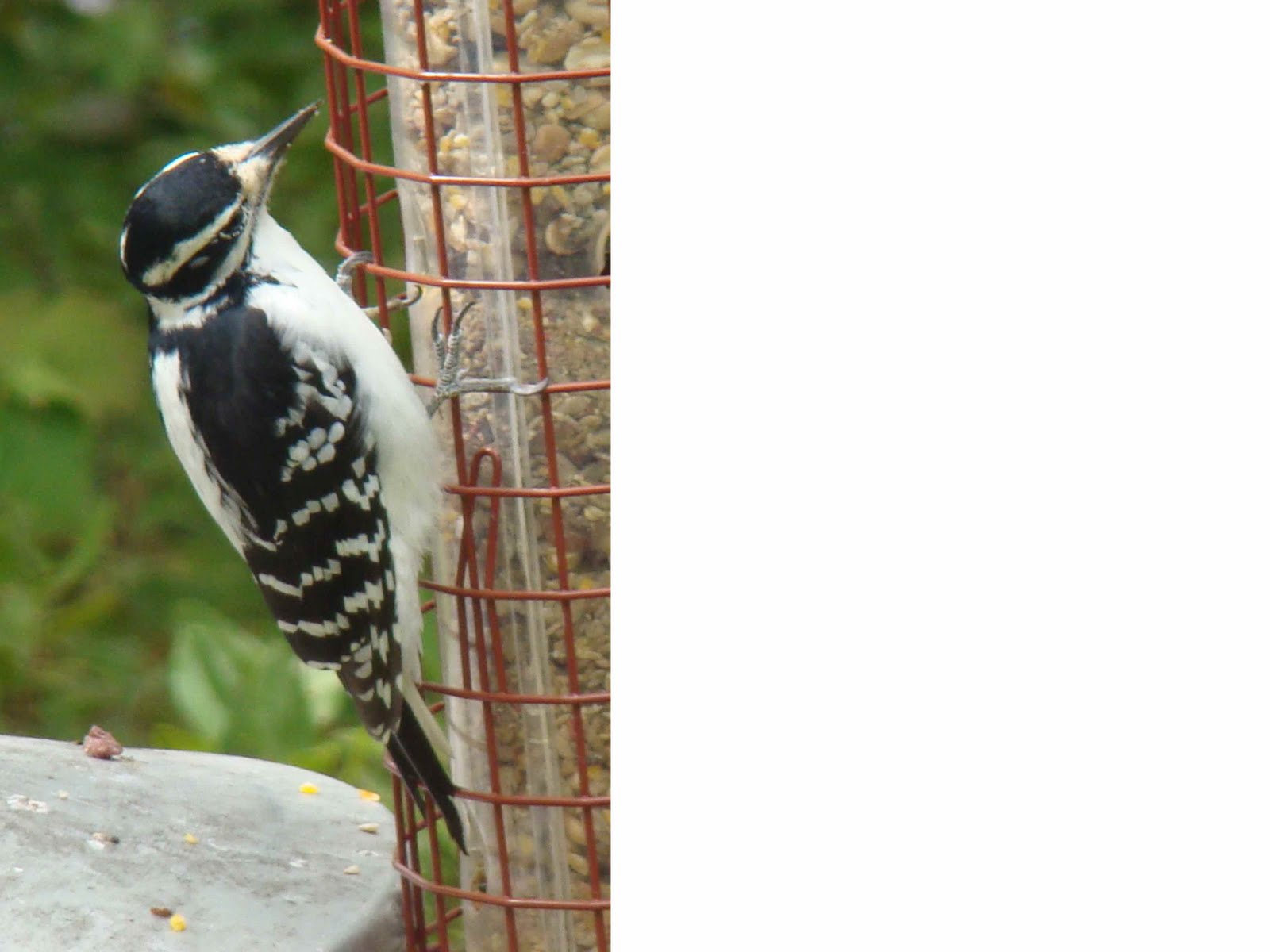
Linda was brave enough to put the bird feeder back up, at least during the day while we can watch it, and within two hours we had the usual mixed flock, including several good size Hairy Woodpeckers.
Hairy Woodpecker
This Black-and-Yellow Garden Spider was hanging upside down in its web, waiting for unsuspecting insects to fly in.  I expect the dots on its abdomen serve as a self-defense feature, appearing as eyes to keep birds away.  It won't be long before they are gone for the season.
Black-and-Yellow Garden Spider (Argriope aurantia)

The lake is still warm enough for hardy souls to swim, or even windsurf, as I saw on Saturday afternoon.  There are still plenty of boats on the lake, and lots of opportunity for more great fall weather.