Showing posts with label Muskrat. Show all posts

Sunday, May 12, 2024

May 12, 2024: Iron Mines

There's an old iron mine on the western flank of Gunstock Mountain which I'd never been to, but the Town of Gilford and the Lakes Region Conservation Trust recently improved the trail to the mines so I decided I would check it out.  It's a short, half-mile hike up the the site, and along the way there is a very nice viewpoint looking out over Gilford.

Viewpoint on the Iron Mines Trail

The mines themselves - there are two sites - are small and not very impressive to look at, but the story is interesting.  
One of two sites where iron ore was mined from the Belknap Mountains

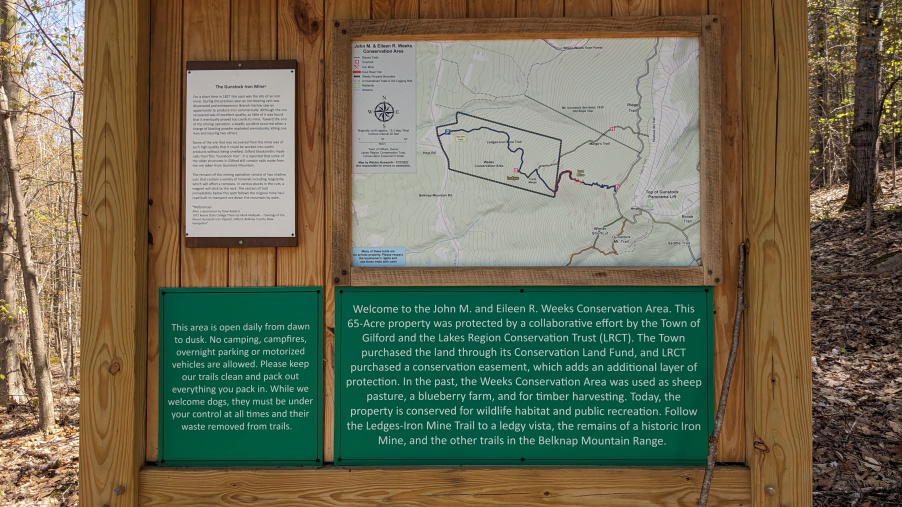
The mines contained very-high quality iron ore, so high in fact that some was used directly without being smelted.  But the deposits were small, and the mine didn't last long.  There's a short history posted on the kiosk at the trailhead.


What I find most interesting is that someone discovered the iron deposit in the first place, just two small veins located on a large mountain range.  Were there specific topological or geological aspects that attracted their attention?   Did the magnetite in the rock make their compass act erratically? Something led them to discover the deposit, and if known, that would be a interesting part of the story.

The Iron Mines Trail connects to the large trail network in the Belknap Range that runs all the way to Mt. Major in Alton.  I continued on, completing a loop over Gunstock and Belknap, taking advantage of the nice late-spring day with no bugs and clear sightlines through empty branches.

There is still snow in the White Mountains.
Snow on Mt. Washington, seen from the summit of Gunstock.

And on the ski trails.

Flintlock Trail at Gunstock.  This is the trail one can see from Clough Park in Meredith Village

The waters of Winnipesaukee were shining blue from the ledges on Belknap. 

Of course, I had to climb the fire tower.


Back on Lake Wicwas, the wakening forest is entering the mellow-yellow, lemon-lime phase.

Blue water on Wicwas too.


Paddling on that blue water this week I had an exciting moment when I came across a single loon that was banded - with a color scheme I'd never seen before!
Orange with black dot over yellow with black stripe.

I sent the information off to the Loon Preservation Committee, but they were only able to narrow it down to three loons based just left leg bands.  The next day the same loon was here again and I waited patiently hoping to get a right foot wag, but the bird wasn't cooperating.  I did get one fuzzy photo of its right leg under water, but that was enough for the LPC biologists to determine its identity:  It's a loon that was rescued on January 18th of this year on Paugus Bay in Winnipesaukee.  The warm weather this winter had let it stay so long that it had molted its flight feathers and couldn't leave when the bay finally froze over.  The team at LPC are thrilled to know their rescue effort was successful.  Now we'll watch to see if this loon sticks around at Wicwas, and if so, what kind or turmoil develops during nesting season.  You can read the Loon Preservation Committee's report on the rescue here.

While the loons may not have even selected a nesting site yet, the geese have already hatched goslings as seen in this picture from Jim DeMott.

Six little goslings.  Photo by Jim DeMott.

If all the geese on the lake this year have this many chicks, it's going to be a big year for geese.

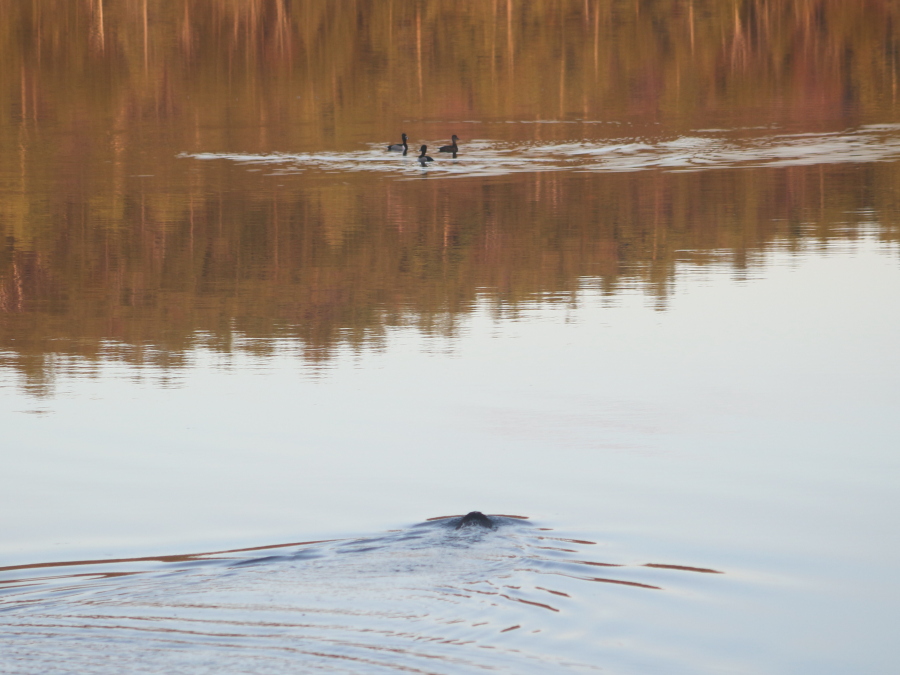
Paddling down near the outlet I saw this creature swimming across the lake straight towards a beaver lodge, so I thought is was a beaver - though strange to be out in the middle of the day.  But it turned out to be a muskrat.  

A muskrat - note the thin rat-like tail.

It's always fun to see something different on the lake.  

I'll end by noting that the Serviceberry (aka Shadbush) are blooming, and it's about time to look for native cherry trees in bloom.  Here's one more picture from my hike in the Belknaps - a pretty Roundleaf Yellow Violet.

Round-leaved  Yellow Violet (Viola rotundifolia)

Now there's a nice Oxymoron.


Sunday, March 13, 2022

March 13, 2022: Muskrat Lodge Revealed

Well, it was revealed - for a couple of days anyway before yesterday's snow came along and buried it again, but still, it's another sign of spring coming.


I found this medium-size muskrat lodge in a marsh near Chemung Road after a few warm days melted away a lot of snow cover in areas exposed to the strong March sun - we're only a week away from the vernal equinox now.  A muskrat family built this lodge over time in much the way beavers build a lodge, but they differ in their construction materials.  Beaver lodges are built primarily of sticks and branches held together with mud from the bottom of the lake, while muskrats use mostly vegetation in their lodge.  Both start as small mounds which are enlarged until they're well above the water level at which point they excavate their home from the inside.  (Both beavers and muskrats are rodents.)

Muskrat lodge in greener days.  Lodges are built close to a plentiful supply of food sources.

A muskrat lodge may start with only one or two rooms, but as the family grows the lodge is expanded and additional rooms added.  The rooms are above the water level so they have dry living quarters, but the entrance is always under water to foil some predators, though mink are excellent swimmers and are the most tenacious predator of muskrats.  Muskrats are active all year; their winter diet consists mostly of the roots of aquatic plants such at cattails, reeds, and arrowheads but they will also eat clams, mussels, snails, and other small animals.  Maybe they'll find an appetite for Chinese mystery snails!

I don't often see muskrats but on occasion I'll find one swimming in the lake in the early morning.  On one occasion, while riding my bike along the road, a startled muskrat ran in ditch beside me for a dozen yards before darting into the safety of a culvert.  Unless there's a point of refence to judge its size - which is considerably smaller than a beaver - or I can clearly see its tail, I have a hard time discerning a muskrat from a beaver.  But, as the name suggests, a muskrat has a thin, rat-like tail rather than the large paddle of a beaver's tail.

The rat-like tail shows this is a muskrat.

Poking around the muskrat lodge this week made it clear that the days of walking on the lake are coming to an end.  There's open water at the shore line wherever the March sun warms a south-facing bank or where a stream runs into the lake.

Anyone trekking onto the lakes now must know where the weak spots are.

There's still 18" of ice in the center of the lake but that consists of only 8" of solid ice with 10" of soft, porous ice that's cut through with just 10 or 12 revolutions of the ice auger.  The recent snowfall will make it even more treacherous to be on the ice - we already had one snowmobile go through the ice on Wicwas, requiring a rescue of the rider.  (Thank you GP for the notification!)  With a forecast of multiple days in the 40s and 50s for the coming week, my lake activities may be done until kayak season arrives.

These gaps will soon enlarge enough to launch a kayak.

And as of this afternoon, those holes are concealed by fresh snow, as was the muskrat lodge.  And look - there were turkeys strutting past the lodge just a short time before I was there.
Turkey tracks at the freshly decorated muskrat lodge.


We had been out in Steamboat Springs last week enjoying a week of Colorado snow, sun, and skiing.  (Thanks for a great visit VP!)

Plenty of snow at 10,000' in northwest Colorado.

I usually try to find wildlife on trips out of New Hampshire but this time I only came across a few birds - no moose, elk, coyote, not even a fox.  But there were plenty of signs they were out, searching along the Yampa River over night for a meal.

A popular place along the Yampa River for Steamboat's predators.

There's a wonderful boardwalk and Peace Pavilion built by the Steamboat Springs Rotary Club along the Yampa River.  I'll close this week with an optimistic yet hopeful sign for today's world which stands at the pavilion.


Sunday, April 18, 2021

April 18, 2021: Warblers, Another Sign of Spring

As the weather warms more and more summer birds are arriving.  This week I heard my first pine warbler, one of the earliest warblers to appear each year, and checking my notes, this was three weeks earlier than last year.  Pine warblers spend their time high up in the tree branches so I wasn't able to see any, but there are many.  As I walked along I would hear one loud and close, and then far away in the distance, another would respond, sending its report right back after the first one finished its message.  As I got close to the second one, I could hear a third off in the distance responding to the second.  I believe what's going on is that each bird has staked out its nesting territory and is proclaiming its domain with its song.  If it hears another pine warbler far away, all is well.  But if another gets too close, there will be an altercation.  I imagine a checkerboard pattern of pine warbler nesting sites throughout the forest.  

What's interesting is that within this range there may be a dozen other bird species doing the same thing, and they are perfectly comfortable with sharing their territory with different species of birds, just not with those of the same species.  

Here's a picture I took of a pine warbler back in 2013 when a male perched on a dead branch with no leaves to hide behind.


Pine warblers are unique among warblers in that seeds make up a large part of their diet, especially, perhaps as expected, pine seeds.  If you keep bird feeders out at this time of year and want to try to attract a pine warbler, try hanging your bird feeder high up, maybe 30 or 40 feet above the ground (that will also discourage the bears).  Having a diet of seeds lets pine warblers arrive earlier in the spring than birds that rely on insects, and pine warblers will starting breeding soon - thus the claiming of territory at this point in the year.

I mentioned seeing ring-necked ducks last week; on one kayak trip I came upon an interesting combination of three ring-necked ducks and a lone female merganser.


Earlier the same day I watched what was likely the same three ring-necked ducks, two males apparently courting a single female early in the morning.


A curious beaver on patrol seemed to be heading in that direction to see if there was going to be a show to watch as they fought over her attention.


I often struggle to differentiate between beaver and muskrat, but I'm pretty sure I saw a couple of muskrats this week.  At morning or night it's a pretty good bet a swimming rodent is a beaver, especially if it's on a high speed mission; muskrats are more likely to be active during the day and often are a little more erratic in their swimming patterns.  Muskrats are also smaller, but the sure way to tell is by the tail, as the muskrat has a thin rat-like tail versus the wide, flat paddle of the beaver tail.  I think this medium size rodent, swimming along the shore at 2:00 in the afternoon, was a muskrat:

A muskrat enjoys a warm spring afternoon.

In addition to the ring-necked ducks, we were visited by several groups of buffleheads this week.  

Mrs. Bufflehead.
And Mr. Bufflehead.


I always enjoy seeing these pretty birds and watching their dives - they are so quick as they upend themselves and plunk straight down into the water.  

One other neat observation was made by Tom Crane back on March 29th, before ice-out:  a pair of common goldeneyes visiting Wicwas, diving within a small channel that had opened up along the northern edge of the lake.

A pair of common goldeneyes fish between the ice sheets.


Tom noted "The male's head really gleamed a beautiful green when the sun hit it. We have also had a pair of Wood Ducks hanging around the cove longer than usual. We have also had a few of what look like Buffleheads around lately, as well as passing Mergansers. An interesting time of year."

Hopefully we'll get an improvement from the recent chilly, wet weather so we can get out and see more of the migrating birds.  It won't be long before the birds heading for Canada will have departed the Lakes Region.

A bufflehead takes off for places unknown.

But they'll be back again next year.

Sunday, January 12, 2020

January 12, 2020: The Muskrat Attraction

A couple of light snowfalls this week made for some good skiing as well as providing a good surface for animal tracks.  One ski trip took me up to the Ridgefield Open Space just north of Route 104 in Meredith, where the main animal attraction - based on the tracks in the snow - was a muskrat lodge.
A muskrat lodge in the Ridgefield Open Space.

There were plenty of animals checking out the lodge, which appears occupied based on the open air hole and melted snow where heat from the animals escapes up the chimney.


And those tracks are not from the homeowner, as the muskrat has a plunge hole out the bottom where it can access its den under the protection of water.  Nonetheless, muskrats are significant food sources for many predators including hawks, owls, foxes, and minks.  It's a good thing they have lots of offspring, with two or three litters per year.  In return, muskrats create open water for ducks and other waterfowl:  muskrats are such prolific feeders of aquatic vegetation that they can open up large areas of a swamp, perfect for bird habitat.  [Ref:  New Hampshire Nature Notes, Hilbert E. Siegler, Equity Publishing, 1962]

I recently had a discussion with someone about what muskrats eat in the winter and whether they store food under the ice like beavers do.  I went to find out, and according to wikipedia, they do not.  Their primary food source is stalks and roots of cattails, but also arrowheads, rushes, and other wetland vegetation [Sielger], and a healthy wetland complex has plenty of those available under the ice all winter long.
Lots of vegetation in the Ridgefield wetlands complex.

In addition to lodges, muskrats build feeding stations called "push-ups" made of vegetation that rise up above the water level.  In winter muskrats keep these holes open by replacing the vegetation in the hole every day, consuming some in the process.  [Ref:  Tracking and the Art of Seeing, Paul Rezendes, Harper Collins, 1999]  This gives them places to catch a breath while they're out finding food without having to stay close to their lodge.  I'll look for these this winter when I'm out on the ice.  Below is a muskrat structure in summer which I believe is a lodge due to its size and location on the shore line.
It's hard to remember the lake looking like this at this point in the winter.
You can differentiate this from a beaver lodge which is made of sticks and branches rather than vegetation.

Back on Lake Wicwas I saw many other tracks on land and lake:  fox, otter, mink, fisher, mice....  But the most interesting was this set of mink tracks which came from the exact point I saw a mink pop out on the shoreline last November.

I'll bet there's a mink den in this bank.
The middle of those three tracks led to this:

The obvious question here is why this mink pulled such a crazy stunt.  My guess is a raptor was about to swoop down and grab it for lunch, and at the last moment the mink saw it and made a frantic defensive maneuver.  If that's the case, it was successful, as the tracks continued on, though the spacing of the tracks became significantly longer!

I also followed some otter tracks which told another story, but that's a tale for another day....

And of course, all this was before the January thaw hit on Saturday and made the lake, well, a lake.
Maybe back to skating?
It looked like this just four days earlier.

You know what they say about New England weather.  I must say, it was rather surreal skiing in shirtsleeves at 57 degrees in January.


Sunday, October 27, 2019

October 27, 2019: Who Left these little Gems?


The past week provided us both beautiful late summer days and cool, damp October days - I was able to get on the lake on one of the former for a perfectly calm autumn paddle.

Paddling alongside a marshy shoreline I noticed those little brown specimens left carefully on a log, knowing they were from a mammal, and certainly an aquatic one.

A quick check of the nature guide confirmed my first thought:  Muskrat.  These animals are closely related to beavers in both appearance and behavior, as muskrats also make lodges out of mud and vegetation, but they will also carve dens in the bank of a lake or river.  They will even dig a den into the walls of a beaver lodge!  They can be distinguished from beavers by their smaller size and the fact that they have a skinny, rat-like tail rather than the broad tail of a beaver.  Muskrats eat mostly aquatic vegetation, but will also eat clams, fish, and other small animals.  I once saw a muskrat swimming along carrying a freshwater mussel in its mouth.
Taken in April at 5:30pm, is this a parent bringing dinner home for the kids?


Muskrats leave their scat on logs and rocks just above the water line, and that larger brown mass is from an older visit to that log.

There were other, prettier sights to see on my trip around Lake Wicwas, including geese, loons, and an eagle.

I'm guessing this is Harley.
A couple of geese keep an eye on me.


I didn't see the bald eagle until it flew out of tree as I passed under it, but I was able to catch a picture as it flew down the lake.

As soon as it was airborne the loons started hollering.  The loon I had passed by earlier, perhaps a quarter mile away, was the first to see it - they are clearly paying attention to the sky.  It gave out a loud alarm, and then from far down the other end of the lake a second loon responded as if to say "thanks for the warning, yes I see it coming right towards me."  They continued to call back and forth to each for several minutes.

Unlike an event Dave Thorpe witnessed a few days earlier, the eagle flew off over the lake, not bothering either loon.  But Dave saw a much more dramatic event, where the eagle dive-bombed one loon, flew back up, and then repeated the attack on a second.  In both attacks Dave reported a large splash of water, but he wasn't able to determine if it was the eagle hitting the water or the loon creating a diversion as a means of defense.  Either way, it gives me further confidence that our loon chicks are able to defend themselves.


On an earlier hike up to Arbutus Hill I noticed an interesting hole in the ground.
Not a great picture, but you can see the papery outer layer of a yellow jacket  nest.

It wasn't until I had my face down there that I realized it was a yellow jacket nest that a bear had ripped into to access the eggs, larvae, and any other protein that was present.  I'm always amazed at a bear's moxie to go after a large bee's nest - how many angry stinging insects would swarm it, especially its exposed face and eyes?  I was happy there was only a stray bee crawling around in the nest, surveying the damage.  I didn't stick my hand down there to pull out the leaves that had blown in.


Both of our chicks and one adult continue to linger on the lake, enjoying the end of the fall season as much as I am, while it lasts.