Showing posts with label Logging. Show all posts

Sunday, September 29, 2024

September 29, 2024: Logging for Moose

It's been a couple of years since I've seen a moose around Lake Wicwas, but I know they're still here.  

Moose scat - much larger than deer scat.

This week the Meredith Conservation Commission took a survey of a forestry project performed on the Leighton Town Forest far up in the Chemung area.  The work was done in 2017-2018 and included thinning overcrowded and weak trees as well as a several-acre patch cut for habitat diversity.  Much of the forest in New Hampshire is of a common age having regenerated after the state was largely cleared of forest in the nineteenth century.  With few fires to clear areas of forest, there is now minimal habitat of the young trees that many species need to survive.  One animal that takes advantage of early-growth trees is moose.  In the summer moose feed on aquatic vegetation in ponds and wetlands, but in winter they need other food sources which includes twigs and bark of small trees.  You can still see signs of bark scraped off red maple trees along the White Trail in the Hamlin Forest but they date from the early 2000s; there are few small trees left for them to feed on.

Look for old moose scrapes (this is from 2004) near the highest point on the Arbutus Hill Pond Trail.

The photo of moose scat was one of half a dozen piles of scat we saw on our trip around the patch cut at Leighton, which indicates the cut was successful.  The forestry plan for that property includes creating additional patch cuts every five to ten years so there will be a constant range of forest ages for animals to find their preferred habitat.

Here's what the cleared area looked like in 2018 shortly after in was cut.  


And here's what it looks like from the same spot today.

That thick young forest is what many species need for food and shelter.

It shows how quickly a forest can regenerate, though it will take 50 to 100 years to fully mature, and over 200 to become "old growth" forest.  Forestry requires a long term outlook.

The forest can look pretty ugly right after logging, but in a few years they recover.  Here's what the main logging path looked like right after the work was done.  


And six years later, the same spot has filled in with thick growth of pioneer species such raspberry, birch, red maple, and white pine.  

Here's another example of before and after:
2017
And the same area today:
2024

Another ​important aspect of forestry today is having a diverse forest to make it resilient to introduced animals, pathogens, and climate change. Imagine what would happen if many acres of forest consisted of a single species and that species was attacked by an invasive insect or disease like the ash trees and the elm trees before that. Or perhaps that species can't handle the droughts or very wet years climate change is causing. Careful forestry can open up areas around under-represented trees to allow them to thrive and maintain Forest diversity in case of species collapse.  For example, around the Lakes Region we find monocultures of Eastern Hemlock which is now under attack by the hemlock woolly adelgid, an invasive insect that's a serious threat to the health of hemlock trees.  American Beech is facing a similar threat from the Beech Leaf Disease.

A hemlock monoculture with a closed canopy blocking light from other plants.

A knowledgeable forester also assesses soil conditions and sun exposure and will manage for species best suited to the immediate microclimate.  

There's a lot to consider in the long-term management of our forests.  If you're interested in learning more, keep an eye on the Commission's Facebook page as they will be having more public forestry tours in the future.  There's also a good article in the Summer 2024 issue of the Forest Society's Forest Notes publication [Managing for Resilient Landscapes, Aldrich and Weisiger, Pg 14]

And yes, I used to see a lot of moose, and I know I will see them again.

I froze when this big bull walked right in front of me some ten years ago.  I don't think it even noticed me, which is just the way you want it around a moose.


Back around the lake, ducks that spent the summer north of the Lakes Region have started to make their appearance on Wicwas as they return south for the winter.

Two pairs of Wood Ducks enjoy a rainy morning on the lake.

All the migrating birds - and we - will soon be treated to the great New Hampshire foliage season.


Foggy mornings and changing leaves - Fall is in the air.


Sunday, January 29, 2023

January 29, 2023: Eagles Soar over Wicwas

This week there were four large birds soaring high over the Lake Wicwas.  Our first thought was eagles because they were so large, but we don't usually see eagles soaring in groups, so then I thought maybe turkey vultures, but they aren't this far north in winter.  As they circled closer we could see they were in fact bald eagles - four of them, all mature.

And they didn't seem pleased; they were acting aggressively and as they got even closer we could hear them calling.
Beaks open, squawking at each other.

I don't know much about eagle behavior but perhaps this was two pairs arguing over territory.  Eagles are territorial and will defend their home turf.  Eagles mate for life, and breeding season starts in late winter so newly formed pairs need to find a nesting territory.  Whether it was an eviction or not, after one pair left, the remaining pair settled down into the same tree they used to watch over the deer carcass on the ice a few weeks ago.  
Two perched eagles.  They seem to like this particular white pine tree.

White pine is the preferred nesting tree for bald eagles - it would be exciting to have a pair of bald eagles nest on Wicwas!  Well, maybe not for the loons....  This was another new experience for me, a result of the rebounding eagle population, enabled by work to protect endangered species and proof that such efforts can be successful.


The bald eagle isn't the only species that appreciates the attributes of white pine.  This week I toured a logging project with the forester and got to witness the latest method of responsible logging in action.
Freshly cut and trimmed logs beside a logging trail.

This project is using a technique known as "cut-to-length" which greatly reduces the impact of the logging process on the soils as well as the trees that are not harvested.  The other common method of logging large areas is “whole-tree” logging where the entire tree is dragged out of the forest along a skidder road with the branches removed and chipped at the log yard.  In this method trees, standing trees beside the skidder roads often incur basal damage that weakens the tree, and makes it sick and rot, if not die.   I toured the Chemung State Forest after its cut in 2021 and was dismayed to see dozens of trees with such damage.
Basal scarring from whole-tree logging in the Chemung State Forest in 2021.
This tree will surely die.


This damage is caused by trees being dragged out of the forest, especially on the inside of corners as the skidder drags the whole tree, branches and all, out to the log yard.  Another negative of whole tree logging is that the entire tree is removed from the forest. In cut-to-length, much of the bio-mass is left in the forest to be recycled back into the soil.

In the cut-to-length logging process I observed, three specialized machines are used to do the harvesting. The first machine, called a feller-buncher, cuts trees marked for harvesting and places them near the trail. 

Here is the machine in action:


Next, a powerful yet adept machine called a processor picks up each felled tree with a massive tool that quickly cuts off the branches, then measures and cuts the trunk into the desire lengths in a single step.  The operator then lays the processed trunks along the edge of the trail for the final piece of equipment, the forwarder.  It was fascinating to watch. 
The processor stripping branches from a tree.
The business end of the processor.
Here are a couple of videos of the processor stripping, measuring, and cutting a tree.


Finally, the forwarder is another tracked vehicle which has a crane to pick up the processed trunks and place them on a flat bed to bring them out of the forest where they can be loaded onto a logging truck to be brought to the sawmill. The forwarder hadn’t started taking out the trees yet so I hope to go back next week to see the final step.

All of these machines are on tracks rather than wheels to better distribute their weight. They don’t form ruts in the soil, and have enough traction to not spin like wheels which can dig holes in the ground. Furthermore, the branches, after being removing from the trunk, are placed on the logging roads and the tracked vehicles drive right on top of the branches, further protecting the underlying soil. Wheeled vehicles can’t manage that kind of rough, uneven terrain.
Tracks limit damage to the soils and allow traveling over brush than directly on the ground.

I'm not pretending that logging on this scale doesn't damage the forest - it does.  Cut-to-length still removes literally tons of biomass from the forest, impacts habitats, increases erosion, and damages soils along the logging roads.   It also can impact small streams and wet areas that are crossed.  But if planned and executed carefully the impact of cut-to-length is significantly less than whole-tree logging with skidders.  It’s always hard for me to see logging on this scale, but trees are a renewable resource and will likely be harvested as long as humans (and beavers) are on the planet, and if it has to be done, this is the best process I’ve seen yet.   Even horses and hand saws did their damage to the forest, let along the logging railroads of the 19th century.
Horses drag trees from the White Mountains.  Photos from the Museum of the White Mountains.
Mad River Log Drive, Campton, NH.

Things have improved.  The logging I saw this week was removing only a fraction of the trees, but opened up the canopy enough to provide smaller trees sunlight to grow strong and healthy, and left many large trees to reseed the areas newly opened to sunlight.  And next year will be a good seed year for white pine.  I learned from the forester that it takes two years for a white pine cone to mature and release seeds.  Last year the pines flowered and formed tiny cones:
This tiny cone was formed last year and will mature and release seeds this fall.

These will stay on the tree though the winter and create the large cones we are familiar with which will drop their seeds this summer.  And there will be plenty of large pines on this property, tall and strong, ready to host a nest for eagles looking for territory to claim as their own.


Sunday, September 8, 2019

September 8, 2019: Bumble Bee Season

Bumble bees are certainly around all summer, but this time of year they seem to be particularly noticeable.
A bumble bee searches for pollen on lantana flowers.

These large members of the bee family are important pollinators and are presently found swarming over the tiny blossoms of plants like goldenrod and Linda's Coleuses.
Golden rod is a favorite provider this time of year.

These non-aggressive bees are covered with thick hair which keeps them warm and explains why they are the first bee to become active in the spring as well as why they can hang around into fall even after the other bees have disappeared.
A nice warm fur coat.

Similar to other pollen collecting bees, the worker bee's mission is to collect enough food for the queen to lay eggs and fatten up to survive the winter.  In late summer only worker bees and queen bees are born, and all of them will leave the nest.  The worker bees feed the queen, and every bee in the colony will die when winter finally arrives except for the queen; only the queen will hibernate and live through the winter.  In the spring the queen will find a nest location, lay her eggs, and sit on them for two weeks to keep them warm, just like a bird does.  When they hatch, the new season begins.  [Ref:  Alina Bradford, LiveScience, 2017]
Large pollen sacs to bring home for the queen.


Several species of bumble bee have seen dramatic reductions in population in New Hampshire, and NH Fish & Game has listed four species as species of Greatest Conservation Need.  (Who knew Fish & Game studies bees?)  [Ref:  Sandra Rehan, NH Wildlife Journal, May/June 2016]  Rehan and other researchers at the University of New Hampshire are studying the cause of population decline which appears to be due to multiple factors including habitat loss, insecticides, climate change, and pesticides.  [Ref:  NH Wildlife Action Plan, Appendix A]

It's good to know Linda is doing her part to help these important insects survive.
Coming in for a landing on Linda's lupines.


The town of Meredith recently completed a habit logging project on the Eames property up behind the Hamlin easement.  The goal was to improve the quality of the forest and create greater habitat diversity for a range of birds and mammals.  I went for a short walk through the logged area (there are no trails in the area logged) and I saw that the project already appears to be bearing fruit.
This moose print in the soft soil is larger than my boot.

That's the track of a good size moose that was using the logging trail for ease of movement, and was probably enjoying the new browse area.  If you are hiking along the magenta trail - which is in the process of being re-blazed with white trail markers - and you see a large clear cut along the trail, know that this is NOT on town land.  That clear cut was done by a private land owner adjacent to the Eames property.
Clear cut along the border of the Eames Conservation Easement

If allowed to grow back to forest, this cut will provide excellent browse for moose and deer for many years, as well as a young successional forest habitat for ground birds and small animals.

I don't have any new pictures of the loon chicks this week, but I did see another very promising event.  One of the chicks came through the cove by itself and spent a long time fishing all along the cove.  And I saw it come with a fish on two of its dives.  So at least one of the chicks is providing for itself - good news especially as fall arrives and the parents will be going on their way in the coming weeks.  And fall is coming, as seen by misting mornings becoming more common.
A misty morning on the day I walked the logged area in Eames.

Sunday, March 6, 2016

March 6, 2016: Hurricane Logs from 1938

I was away this past week, off to Steamboat Springs for some family time and a taste of real winter.  New England may be short on snow, but Steamboat has received over 300" so far this year.  We enjoyed some great skiing and great weather!
Mid-mountain at Steamboat Springs, Colorado

Being away, I thought I would share something I learned recently regarding the regular appearance of floating logs in Lake Wicwas.  I've seen these appear from from the depths of Lake Wicwas since I was a kid, and have noted previously the process:  They have been waterlogged for many years, sitting on the bottom of the lake with tiny organisms feeding on the wood.  As part of their metabolic process these organisms produce gases which collect in the log, displacing the absorbed water, making the log lighter ever so slowly.  Eventually it becomes less dense than water and it starts to float up to the surface, typically dragging the heavier end along the bottom of the lake, meaning it may be invisible at the surface, but a real danger to boaters.  When they reach the surface, people will pull them ashore, usually over to the boat landing where the town will pick them up and take them away.  Over the past couple of years several have been brought to the ramp;  as of this fall there were six waiting for disposal.


I had always assumed these logs were just escapees from logging that was done in the past around Lake Wicwas.  Now here's what I learned in Daniel Hayduk's new book "Meredith Chronicles" (The History Press, 2015):  The hurricane of 1938, which came up right through the Connecticut River Valley, destroyed one third of New Hampshire's forest, and half of its white pine trees.  The Civilian Conservation Corps and the Work Progress Administration, two agencies established during the depression, came in to help salvage the massive glut of timber.  Since there was much more timber than was needed, the government set up price controls to protect woodlot owners from financial ruin.  But still, there was much more timber than could be used before it would be ruined by insect damage.  So the surplus timber was submerged in lakes to protect it from insects, and Lake Wicwas was one of the main storage sites!  So these logs that continue to appear, 80 years later, are souvenirs of the great Hurricane of '38.

There are a few other signs of that day in 1938 that can still be seen in the forests around the Lakes Region - in the form of rotted tree trunks buried under years of leaves, with mounds of earth at their base where their roots brought up soil and rocks when they fell.  This tree is not that old,
Fallen Hemlock or White Pine
but it shows the concept as it has all the right characteristics:  exposure to southwest wind off the lake, and laying in a northwest direction.
Soil mound at base

According to Tom Wessels "Reading the Forested Landscape" (The Countryman Press, 1997) it takes "a couple of decades" to create a moss bed on a log, and this tree has had its moss bed for at least 15 years, but that dates it only as pre-1980.  Plus the soil around the base doesn't show the wear of 80 years of weathering.  This summer I'll have to look for signs of 1938-felled trees on dry land to accompany the floaters in the lake.

Until then, I'll enjoy the last few weeks of this rather feeble winter, missing all that snow from Colorado.
And this is the snow in the valley!


Sunday, September 19, 2010

September 19, 2010

Red continues to be the color of the season.  Walking to Arbutus Hill Pond, I saw many Red Efts still on the trail, and bright red Swamp Rose hips are along the shore of Lake Wicwas. 
Swamp Rose

I watched a Ruby-Throated Hummingbird collecting nectar from several stands of red (cultivated) flowers, spending a long time going from blossom to blossom.  And then of course, there is this harbinger of things to come:


In Arbutus Hill Pond there was a large group of ducks, over a dozen.  There are several heron nests there; I didn't see any herons in Arbutus Hill Pond, but I did see one later in Lake Wicwas.  There were also quite a few ducks in Lake Wicwas - where I have seen flocks of ducks preening, there have been dozens of feathers floating on the surface.  This feather, with distinctive markings, and the autumn sky reflecting off the water was special.


Near shore I saw this young Northern Water Snake - they are much more colorful when young, as they become darker, almost black, as they age.

Northern Water Snake
The water in Lake Wicwas is extremely clear right now.  This is probably due to the lack of rain this year, including thunderstorms, which wash silt into the lake.  But I believe the lake has also become much clearer in general over the years.  When I was a kid I remember noting how brown the water was in the turbulence behind a motor boat.  Today the water appears more blue-green.  It is still a far cry from the clear blue of lake like Winnepesaukee, but it's a significant change over 40 years.  I expect much of it is due to the settling of the washout from the logging that was done in the first half of the 20th century.

There are still signs of logging evident in the lake today, including remnants of the sawdust pile at the southern tip of the lake, and the logs that float up to the surface every year.  These remnants from logging have been waterlogged for years, slowly decomposing at the bottom of the lake.  As they build up gas in the wood, they eventually become less dense, and when they equal the density of water they float up to the surface.  They are never perfectly balanced though, so one end floats up first, presenting quite a hazard to boats as they float with one end right at the surface.  Or sometimes the heavy end gets stuck on the bottom, and the lighter end lurks just below the surface.  There is evidence of one of these taking its toll on a boat, as a single propeller blade is deeply embedded in the top of of these vertical logs about 30 feet from the western shore of the lake.

Several of these logs floated to the surface in 2010, and good Samaritans dragged them over to the boat landing to remove them from being a hazard.
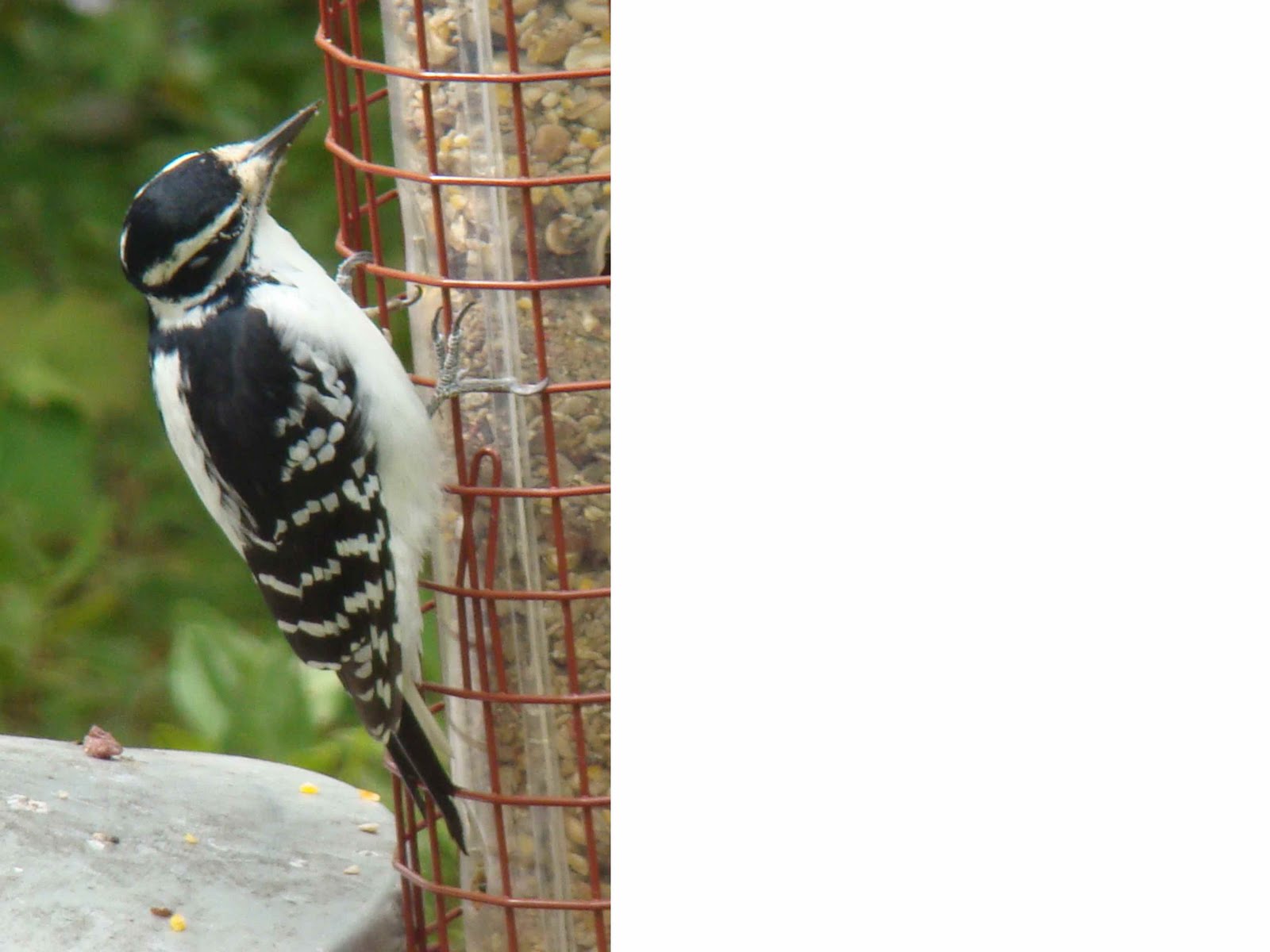
Linda was brave enough to put the bird feeder back up, at least during the day while we can watch it, and within two hours we had the usual mixed flock, including several good size Hairy Woodpeckers.
Hairy Woodpecker
This Black-and-Yellow Garden Spider was hanging upside down in its web, waiting for unsuspecting insects to fly in.  I expect the dots on its abdomen serve as a self-defense feature, appearing as eyes to keep birds away.  It won't be long before they are gone for the season.
Black-and-Yellow Garden Spider (Argriope aurantia)

The lake is still warm enough for hardy souls to swim, or even windsurf, as I saw on Saturday afternoon.  There are still plenty of boats on the lake, and lots of opportunity for more great fall weather.