Sunday, June 8, 2025

June 8, 2025: Great Crested Flycatcher

The dragon flies came out in full force with the warm temperatures this week which means it's feast time for the birds - no more need to go after tiny mosquitoes and black flies when there's much larger game available.  I mentioned recently the distinctive call of the Great Crested Flycatcher and on a paddle this week there was one calling loudly near me which I was able to locate perched on its branch waiting to attack whatever flew by its outpost.
Great Crested Flycatcher


In addition to the Phoebes which have been here for weeks, the Eastern Kingbirds now have a large presence around water as well.
Eastern Kingbird

All three of these flycatchers are quite noisy birds.  I also saw a couple of Belted Kingfishers this week.  

On the loon front, it appears the southern pair has decided to build a nest on a tiny hummock deep in Harris Cove.  It's well protected from boat traffic but won't have any protection from the sun which could be a problem for them.  At last check they weren't on the nest, so there probably wasn't an egg yet, but by today there might be.  If all goes well, mark your calendar for a chick just after the fourth of July.

One morning this week a pair of float planes landed on Wicwas.  

The two are the same model of pusher-plane with different paints schemes.
Note they have wheels as well as floats for water.
The loons were not pleased with these large noisy birds flying over them.

There are so many birds in the trees now feeding happily on flying insects as well as the crawling ones:  caterpillars.  One native caterpillar that has developed an excellent defense mechanism is the Tent Caterpillar.  
Tent caterpillars create a defense shield against predators.
Tent caterpillar are not a species at risk and since they can defoliate small trees there's generally no harm in removing them if you wish.

The bunchberry is booming now; I saw these up by Arbutus Hill Pond in the Hamlin-Eames property behind Lake Wicwas.
Bunchberry

More white flowers are adorning the False Soloman's Seal plants.
False Soloman's Seal

Later in the summer these will have large bunches of red and white speckled berries which are consumer by birds and rodents.  The Canada Mayflowers didn't quite live up their name this year, but they only missed it by a few days as they are blooming now in early June.
Canada Mayflower

And thank you Canada for giving us some gorgeous red sunsets this week.
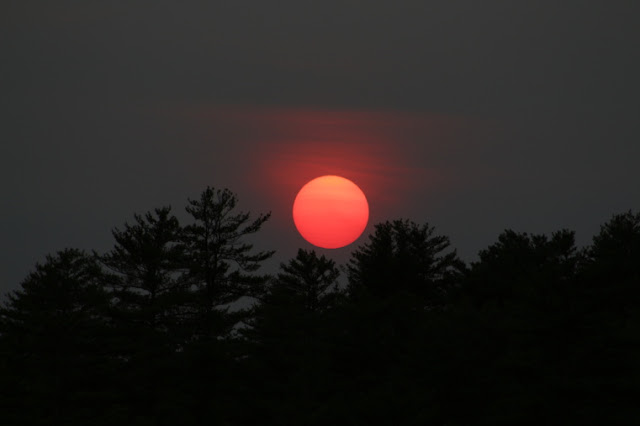
That's about the only good that comes from those wildfires, but we might as well appreciate whatever we can!

Sunday, June 1, 2025

June 1, 2025: Spiny Water Flea

Hello June!  We're now enjoying the longest daylight hours of the year, and this week we had some beautiful days to soak in all that sunshine.


On one paddle around the lake I noticed how the water lilies had adapted to the high water levels.  

Yellow Pond Lilies with long stems.

They had to grow long stems to keep their leaves above water and gather the sunlight that gives them life, and now with the water dropping they're dangling on long tethers that funnel the food they create down to their roots.  A few days later they had blossomed.


With the water level just about back to normal we can expect the loons to be seeking nesting sites; the territorial battles seem to have settled down, though not stopped.  On Friday I had a pretty good hint that they are in search of nesting sites when a loon popped up right next to my kayak, between me and the shore.

A close encounter with a loon in protective mode.

It then dove and swam right underneath me, surfacing on the other side, luring me away from shore.  

I'll bet its mate was at the shoreline evaluating a potential nest site; I didn't go looking, but rather continued quickly on my way.  It may be a little later than the ideal nesting period but there's still plenty of time to nest and raise chicks.  The biggest concern would be a heat wave in June or early July when they are sitting on their eggs.  


I love the different shades of green in the forest as the leaves on the deciduous trees fully develop the chlorophyll that the gives them their deep green color.  

It makes it easy to differentiate between evergreen and deciduous trees.
The view from above at Crockett's Ledge.

Soon their leaves will match the hue of evergreens that keep their through the winter.


I received a report from people fishing in Winnipesaukee and Squam that the Spiny Water Flea, a small, invasive crustacean, has grown to high population levels in both lakes.  

Spiny Water Flea shown on a pencil eraser.  Photo from NH Fish and Game.

This animal poses no health concerns to humans, but it is a problem for native animals as it alters the food web, and its sharp body parts can damage the internal organs of fish.  By feeding on native zooplankton, it can reduce the amount of plankton that consumes algae, leading to larger algal blooms.  The flea also causes problems with fishing lines.

Clogging up a fishing line.  Photo by Jeff Gunderson.

The spiny water flea is native to Asia and Europe and was brought to America by cargo ships, first found in the Great Lakes in the 1980s and making their way to Vermont by 2013.  It was found in both Winnipesaukee and Winnisquam in 2023.  Although NH laws requiring draining and drying boats between different water bodies will help slow its spread, it will undoubtedly find its way to all the lakes over time.  

One advantage Lake Wicwas has is its smaller size and high nutritive value.  According to NH DES the flea "seems to prefer the open water areas of large, low-nutrient lakes".  [Ref:  NH DES Environmental Fact Sheet NN-68]  Of course, the high nutrient content of Wicwas supports other problems such as increased vegetation growth of both native and invasive aquatic plants.  It also provides a good foundation for cyanobacteria blooms.

In other water quality news, we've already had a minor outbreak of cyanobacteria in Wicwas; I found it in many locations around the lake this week. 

Cyanobacteria along the west shore of Lake Wicwas.

NH DES tested a water sample and found a concentration of 25,900 cells/liter which is below the threshold level of 70,000, but it's still wise to be vigilant when you swim and to not let pets drink the water.  Keep an eye out for bright green flecks suspended in the water column, sometimes described as looking like a snow globe. 
Cyanobacteria suspended in the water.  Pollen doesn't typically do that.

As a cyanobacteria bloom expands it may rise to surface as a green scum, and then sink to the bottom of the lake.


New wildflowers sprouted this week.  Watch for the common four-petaled white Bunchberry and Pointed Blue-eyed Grass.  

Pointed Blue-eyed Grass.


I'll end with the end - the end of a beautiful day on Lake Wicwas.


Sunday, May 25, 2025

May 25, 2025: Northern Water Snake

Swimmers in New Hampshire lakes might not be pleased to see this, but rest assured that these snakes will flee from anything larger than a big frog, especially humans, so there's nothing to worry about unless you decide to approach one of these guys.

A northern water snake on a midday search for food or a mate.

Northern Water Snakes are very common around all our waterbodies, rarely found any distance from a pond, lake, or stream.  They are excellent swimmers and especially active this time of year when they are searching for mates.  After mating the two snakes will go their separate ways, with the female gestating 10 to 30 young until late summer.  During this time, water snakes feed primarily on fish and amphibians, but also crayfish, leeches, and other snakes.  

Snakes use their tongue as a sensor.  They stick it out to collect airborne molecules on it, then pull it in into their head and place it into an organ that lets them smell what was captured on the tongue.  The forked tongue provides a stereoscopic capability which lets them determine the direction of the source. 

Sticking our its tongue to smell.

Northern water snakes are not poisonous, but do have sharp teeth they use catch and hold onto their prey, which they swallow whole.  With fast reflexes they are able to catch fish, sometimes hunting minnows at night, though they are most active during the day, and are often found sunning themselves on a warm rock or branch at the water's edge.
A good size water snake I found sunning itself on a rock a few summers ago.

Predators of water snakes include birds, racoons, and snapping turtles, as well as other snakes.  Some day maybe I'll see an eagle swoop down and grab a swimming snake off the surface of the lake.


The female water snake is ovoviviparous, meaning it gives birth to live young which are left completely on their own.  This is the time for larger fish to exact revenge, as the infant snakes are especially vulnerable to fish.  Many of the young won't survive, but with a couple dozen snakes born every year over perhaps a five year life span, the species is not in danger - where there is a good food source.  The biggest risk to this species is the loss of natural waterfront habitat which provides the food it needs.


I haven't seen a snake sunning itself on this tree trunk that fell into Lake Wicwas, but lots of other animals have been using it including turtles, geese, ducks, and this week, a Double-crested Cormorant.  

Double-crested Cormorant.
A pair of mallards does their preening on the log.


The water level in Wicwas is still about 10" above normal, but at least one pair of geese was able to incubate their eggs before the lake flooded.

Looks like five goslings.

The loons, however, are still cruising the lake, waiting for the level to go down before building a nest.  One day we saw both pairs of loons floating on their respective side of the line that divides the two territories, and both pairs were vocalizing loudly to let the other pair know they need to stay where they are.  The northern pair did have an intruder one day, which they appear to have quickly sent packing to another lake.

An intruder in the northern territory.


Cool weather has extended the period of the early wildflowers; all the ones noted last week are still in bloom.  This week the Lady's Slippers are in peak color, the Painted Trilliums have started to bloom, the Canada Mayflowers are about to, and the various cherries are in full bloom.

Painted Trillium.

Lady's slipper in a deep color.

Canada Mayflower about to bloom.

I also saw a small Jack-in-the-Pulpit just starting its spring sermon.  

Jack-in-the-Pulpit

There will be more of these soon, but you have to look for them as they hide under cover of their leaves!


Sunday, May 18, 2025

May 18, 2025: One Big Loon

This week the banded male in the northern territory gave us a lesson on how it manages to stay strong enough to defend what is clearly a highly desirable breeding territory.  

Yup, he's going to swallow that whole.

We watched him catch and devour not one, but two huge fish.  Someone may be able to estimate the weight of these fish, but I expect each one accounted for a significant portion of his daily two-pound diet.  Here's the process he went through to get it down its throat after taking a good five minutes playing with it to weaken it enough to swallow.


At this point something wasn't going right and he coughed the fish back and started over again.

Getting farther down this time.

Swimming hard seemed to be part of the final swallowing process.

A big lump in that throat.

Almost down.

Always a big shake to get that neck bulge sent all the way down.

So that was a pretty good meal.  Two days later it was back in the same spot like any fisherman that returns to a spot where he once caught a big one.


This fish is also sliver with dark spots.  Are they Black Crappies?

I'll short cut the process this time, but it took just as long as before to accomplish the whole thing.


With plenty of fish in his belly he's got the energy he needs to keep up his weight and fight off the endless challenges on his territory.


In case you didn't catch the update to last week's journal, Lake Wicwas eventually crested over two feet above normal level, lapping over the edge of the dam.  Not the highest it's ever been, but close, and it's still about a foot higher than normal.  With three boards removed from the dam it's dropping at a rate of about 2" per day so without any more rain it will take another week before it's back to normal level.
Aren't fish supposed to swim under the dock?


We must be pretty close to a full complement of summer birds now.  Arriving this week were the Eastern Kingbird, Scarlet Tanager, and Great Crested Flycatcher.  The latter has a sharp call that's easy to recognize once you've learned it.  Wildflowers came on strong this week with the warm sunny days, and that green Lady's Slipper I found last week did in fact bloom.  
Pink Lady's Slipper

A few other flowers popped out as well including the Eastern Starflower and the Fringed Polygala.
Eastern Starflower

Fringed Polygala


We know "poly" means many, and this week I learned that "gala" means milk.  I also learned that's where the word "galaxy" comes from, originating as the "Milkyway Galaxy".  Though it looks like an orchid, this fringed polygala is a member of the Milkwork Family.  [Ref:  US Forest Service]  

Keep an eye for more flowers appearing on the forest floor in the next couple of weeks.