Showing posts with label South Carolina. Show all posts

Sunday, April 13, 2025

April 13, 2025: Spanish Moss and Soggy Snow

We spent the past week in South Carolina where it was nice to see something other than snow in the tree branches.  When we returned to the lake on Thursday night we found quite a change had taken place in the days we were gone.  Not only was all the snow gone, but the lake was almost completely open.  We were greeted the first night home with the call of a loon drifting over the lake.  The next morning was dull and gray - a perfect day if you're a duck - and we were immediately treated to a smorgasbord of ducks on the lake including mergansers, wood ducks, mallards, black ducks, and these ring-necked ducks which are always a treat to see.

Ring-necked Duck.

Later in the day a pair was having an afternoon siesta near the shoreline.  

Sleeping with one eye open at 1:00pm.

I was careful not to disturb them, but eventually they woke up and perked up a bit.


When they suddenly leapt out of the water, I thought I had startled them.


But in fact, their flock, which was hidden around a point of land, had taken flight, and they were just heading off to catch up with their friends.

Can you see the mallard on the rock near shore?

Another early migrant was an Eastern Phoebe.

Eastern Phoebe perched over the lake, hoping the insects are out soon.

And no surprise, with the ice out, the beavers are back on their evening cruises across the lake in search of food and timber for building supplies.

There were branches nibbled clean of their bark showing they had been on shore, and sure enough, come night fall, one arrived to feast.

That's one big beaver that seems to have stored up plenty of winter food, but nonetheless is looking for something fresh to eat.


Now, South Carolina.  Our hostess arranged for perfect weather in the mid 80's all week and not a drop of rain.  A fun part of visiting new areas is finding unfamiliar things to investigate, such as these blossom-type items scattered all over the ground in a Low Country forest.  I figured they were pollen-producing blossoms of a tree and it didn't take long to identify them as Sweetgum.  

The dried up, brown spikey-thing (a "gumball") tucked into the leaf litter on the left was a helpful clue.

Imagine how much pollen can be expelled from all those blossoms.  
Male flowers of the Sweetgum tree.


Not far away at food-serving facility beside a lagoon I saw a large bird we don't have in New England but is easy to identify.

A Black Vulture looks for easy pickings.

Black Vultures don't venture north of Massachusetts, but maybe soon they'll make their way up here like the Red-bellied woodpeckers and winter Bluebirds have.

On the Isle of Palms we saw the usual culprits such as Laughing Gulls, Egrets, and Boat-tailed Grackles, but also a new bird for me, Willets.

Willets foraging in the surf on Isle of Palms.

It took a bit for me to recognize them as they were wearing winter or immature plumage.  (Thanks RB for the confirmation!)


Along Shem Creek in Mount Pleasant, a pair of Barn Swallows was dashing around over the marsh collecting insects, but then perched on a railing just for our enjoyment.

Barn Swallows at Shem Creek.

There were also pelicans gliding low over the creek watching the fishing and shrimp boats for cast-off fish.


Over at Folley Island we saw Pelicans performing their freefall crash into the Atlantic Ocean.

Searching for targets.

On the attack.
Contact!


No trip to the Low Country would be complete without a visit to a stand of Live Oaks with their Spanish Moss.


This is "Oak Alley" at Boone Hall Plantation which also provides much history of the slave trade and life in South Carolina.  It's worth a visit, for the history lesson as well as the flowers.
Some of the gardens in front of the plantation Mansion.

And then, after a beautiful trip through the Shenandoah Valley where we drove along miles of Red Buds and flowering trees, watching summer return to late winter, we were back in New Hampshire.  And yesterday, mother nature made sure we knew that as we woke up to this on Saturday morning.

Back to snow in the trees - we should have stayed down south another week!  Thanks for a great visit!


Sunday, April 7, 2024

April 7, 2024: Temperature Shock

From 80 degrees to snow - this week's journal was supposed to be all about wildlife in South Carolina, but upon returning home Thursday night the local picture became the story.

Marion Lane on our arrival home from South Carolina.

Once we got north of Concord NH the scene looked like an Alaskan tundra with everything white and trees down beside the road for miles.  


We arrived to find over a foot of heavy snow plastered to everything, branches and trees down everywhere, and about half the people in Meredith without power including most homes around Lake Wicwas.  But that's better than some towns in the Lakes Regions which had 100% of their customers without electricity.  And many of us around the lake are still without power as of 9:00 this morning.

The heavy snow and wind brought trees down into the lake in multiple locations - I expect there will be more to be found as we get on the lake to explore.  This huge white pine and several hardwood trees were some of the casualties. 


There will be a lot of trail maintenance to do over the next few weeks.
Trail crews in Meredith will be busy this spring.

On the bright side, there were some signs of spring including my first loon sighting on Friday.  I also received a report of a pair of loons on the lake, so we're heading in the right direction. 

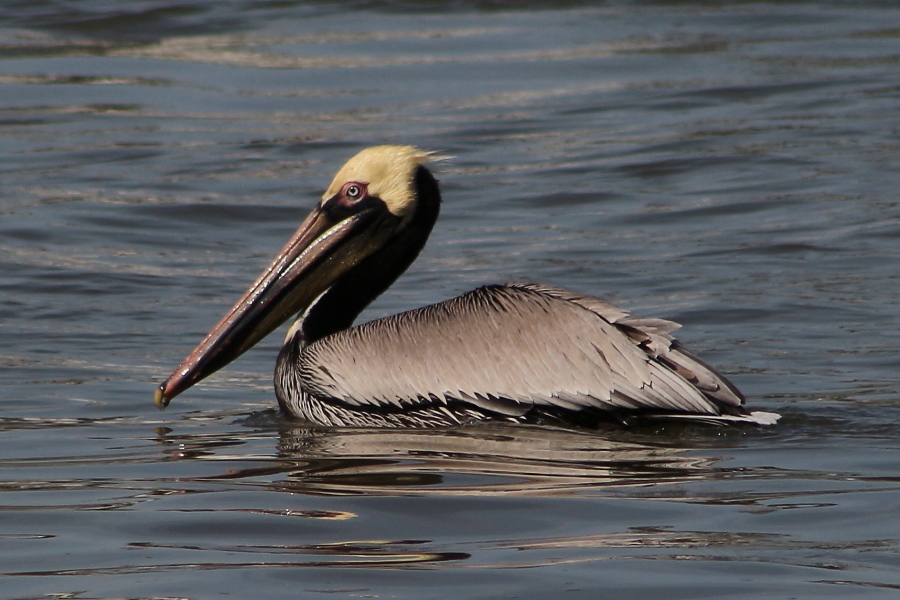
Enough of winter in April; now down south to South Carolina where we had another fabulous time in the low country with our great host, tour guide, and entertainment director.  We took walks along creeks, through swamps and old plantations, and of course along the Atlantic Ocean. These gave us the opportunity to enjoy wildlife much different from that in New England including dolphins, alligators, and anoles.  The most fascinating of these are the pelicans, truly bizarre birds with some amazing abilities.  Just floating on the water their unique physical attributes are immediately apparent with exception of not being able to see just how large their gular pouch is because it's all folded up under their beak.  
A pretty bird in its special way.

This photo, taken in Alabama and sent to me by a good friend (thank you PL!) shows the gular pouch in its full glory:

Soaring along in formation, often close to the water to take advantage of air pressure off the water, is when they are most elegant.
Flying in close formation over Shem Creek.


Other times they will use the currents and updrafts from the onshore breeze when it hits the dune line to facilitate their flight.  Wherever they are, they are an oxymoron of awkward beauty.


At feeding time they use powerful wings to gain altitude where they are able to see fish under water even with waves and reflections on the surface.  When they identify a school of fish they just fold their wings and let themselves plunge head first down into the sea.  

Target in sight.
Contact
Splash down

If they're on target that pouch swells with water and a number of fish which they swallow whole after letting the salt water drain out.  When the tide changes they know to congregate around the breach between Sullivan Island and the Isle of Palms (that's also where we saw dolphins) and when there's a big school of fish it's quite a spectacle to see.


The other bird I'll mention is the Anhiga, another ungainly bird with a long neck that it uses in a most unusual manner, stretching it out for no apparent reason.


I often see this behavior - is it a threatening position to scare me away?  Twisting its neck into a pretzel is just as interesting, but that makes sense for grooming or situational awareness.


The Anhniga, like a cormorant, will spread its wings out to dry them after diving for fish.
Sunbathing by a lagoon in the early morning light.


Other birds we saw were ones we'll soon find here in New Hampshire including yellow-rumped warblers, palm warblers, and bluebirds already feeding their chicks.
Papa Bluebird.

And Mama Bluebird.  That might be a tick!

Back in New Hampshire, April is always a time of change, and this year, everyone and everything will need to be resilient to make it through to May.
The crocuses didn't succumb to an April snowstorm, and neither will we!

Some other good news:  The forecast is for clear skies for tomorrow's eclipse.  Fingers crossed for this rare astrological experience!  

🌒


Sunday, April 30, 2023

April 30, 2023: Dolphins Don't Fish in Wicwas

We spent the past week a thousand miles south of the Lakes Region, getting an early peek at summer, and it sure was nice.  We saw spring unfold before our eyes as we drove the scenic route to South Carolina through the Shenandoah Valley, watching bare branches turn to flowering trees, then budding leaves, and finally to blooming magnolias as we arrived in Charleston and Mount Pleasant.  Our favorite Low-County tour guide had plenty of activities lined up for our entertainment, and one of the first was a visit to "Breach Inlet", a break in the barrier islands that separates Sullivan's Island from the Isle of Palms.  We walked the Atlantic shore along Isle of Palms and when we reached The Breach we found a dolphin fishing right in the breach as the tide rushed out.

A bottlenosed dolphin.

The breach is narrow so the current is swift as the water drains from the inland waterway when the tide goes out.  There are docks and boats close by on either side, but the dolphin didn't seem to mind.

Looking for fish in the riptide.

It swam against the strong current yet it remained stationary, diving down and coming up in the same spot, probably catching fish after fish coming out with the tide.  

Swimming against the tide.

It was one of the highlights of the trip.  

Another wildlife spectacle was found at the edge of a small lake which contained an egret rookery.


These beautiful birds don't seem to mind sharing nesting territory as there are over a dozen nests in the same small area.  And these birds are stunning when they show off all their plumage.

They have such an interesting shade of green on their face.

They also seem to be magnanimous, allowing interlopers to share the neighborhood.

A male anhinga preens while his mate feeds the young in the nest.

Mom with the hungry chicks.
Like many herons and storks, anhingas partially digest food and then regurgitate it for their young to eat right out of their throats.
Feeding time at the anhinga home.
They must really trust their parents

The anhinga pair was ahead of the egrets in the nesting cycle as they already had four good-size chicks in the nest while there was no evidence of egret chicks.

Did I mention the large, smiling alligator hiding in the foliage on the edge of the pond, just waiting for one of those plump birds to make a mistake?

"Never smile at a crocodile"  (I know, it's a 'gator - sorry Peter Pan)

At another site, a marshy bay beside the Pitt Street Bridge in Charleston Harbor, we saw a wide range of birds, including sandpipers, brown thrashers, marsh wrens, grackles, and more egrets.  I was able to watch one egret picking out its lunch from the marsh - probably small fish or shrimp.


Of course there were pelicans all around the South Carolina shore.


It's good to see pelicans making a comeback after their population was decimated by poisoning from pesticides.

We saw many animals that also live in New England, including ospreys.

Osprey over Isle of Palms

Other northern birds we saw included cardinals, mockingbirds, bluebirds, sandpipers, wood ducks (already with chicks hatched) and of course, Carolina wrens.  Yes, the Carolina wren has worked its way north even to New Hampshire as things have warmed up over the years.  

All along the drive both down and back there was a nearly constant circling of vultures taking advantage of thermals over the highway to search for road kill.  From a distance I can't tell the difference between turkey vultures, which migrate to New England in summer, and black vultures, which don't come as far north as New England.  But up close the black face (versus red on the turkey vulture) is evident.  The South Carolina vultures are more much more tame than they are here in New Hampshire.  

A Black Vulture perches on a roof top and watches the world pass by.  
I even saw a vulture driving a bunch of crows away from a dumpster that the vulture had claimed for itself - this is one bird that's learned how to adapt to modern civilization.

Alas, we did eventually have to return home.  As we drove back to New England we watched the season retreat, eventually regressing all the way back to brown leaves and bare branches here in New Hampshire.  But I was happy to see the see that the Trailing Arbutus are still blooming.


So we didn't miss much, and now we get to experience spring twice in the same year.  Thanks for a great visit LG!